
What is Shadow Orders in Crypto?
Key Takeaways
-
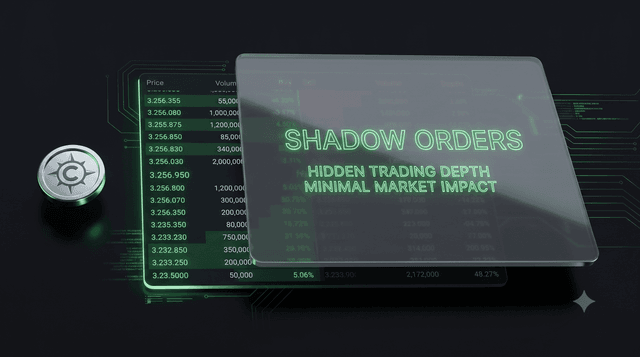
Shadow Orders Defined: These are hidden or "dark" orders that do not appear on the public order book, preventing market slippage and front-running.
-
Market Impact: They allow for the execution of large volumes without causing immediate price panic or "fakeouts" in the order book.
-
Shadow vs. Iceberg: While similar, shadow orders are often entirely invisible, whereas iceberg orders show a small fraction of the total size.
-
Strategic Advantage: Used primarily by institutional traders to maintain "neutral" market sentiment while accumulating or distributing assets.
In the fast-paced world of cryptocurrency trading, institutional players and "whales" often use sophisticated tools to execute large trades without tipping off the rest of the market. One of the most effective, yet misunderstood, tools in this arsenal is the Shadow Order.
Whether you are a retail trader trying to understand market movements or a high-volume trader looking for better execution, understanding how shadow orders function on a crypto exchange is essential.
Understanding the Mechanics of Shadow Orders in Crypto
To grasp the concept of shadow orders, we first need to look at how a standard crypto exchange operates. Normally, when you place a limit order, it sits on the Order Book. Everyone can see it. If you try to sell 1,000 BTC at once, the market will see that massive sell wall and likely drop the price before your order is even filled.
How Shadow Orders Work on a Crypto Exchange
A Shadow Order (sometimes referred to as a hidden order) is an order type that allows a trader to place a buy or sell request that remains invisible to other market participants.
When the market price reaches the specified limit price of the shadow order, the trade is executed automatically. To the rest of the traders watching the "tape" or the live trade feed, the transaction appears suddenly without any prior warning in the order book.
The Purpose of Shadow Orders in Crypto Trading
The primary reason for using shadow orders is to minimize market impact. In crypto, liquidity can be thin. If a whale places a visible $10 million buy order, other traders might quickly buy up the supply ahead of them (front-running), forcing the whale to pay a higher price. Shadow orders prevent this by keeping the trader's intentions private until the moment of execution.
Shadow Orders vs. Regular Limit Orders: The Key Differences
Understanding the distinction between these two is vital for any trader looking to master the crypto markets.
| Feature | Regular Limit Order | Shadow Order (Hidden) |
| Visibility | Visible to all on the Order Book | Completely hidden from the public |
| Market Impact | High (can cause FOMO or panic) | Low (maintains price stability) |
| Execution | Follows "Price-Time" priority | Usually has lower priority than visible orders |
| Fees | Standard Taker/Maker fees | Often carries higher fees (due to "dark" liquidity) |
Why Every Professional Platform Offers Shadow Orders in Crypto
For a crypto exchange platform, offering shadow orders is a matter of attracting institutional liquidity. Hedge funds and large-scale miners require these features to move their capital efficiently. Without shadow orders, the volatility caused by large trades would make the platform unattractive for professional use.
Strategic Advantages of Using Shadow Orders in Crypto
If you are handling significant volume, shadow orders offer several strategic "moats" that protect your capital.
-
Preventing Front-Running and Scalping
In the transparent world of blockchain and open order books, "bots" are constantly scanning for large orders to exploit. By using a shadow order, you effectively hide your hand from these automated predators.
-
Reducing Slippage in Low Liquidity Pairs
For altcoins with lower trading volumes, a visible large order can be disastrous. Shadow orders allow you to fill your position at a specific price point over time without the market moving away from you as soon as you "show your cards."
-
Avoiding "Fakeout" Resistance Levels
Often, traders look at the order book to find resistance (sell walls) and support (buy walls). A large visible order can create "artificial" resistance. Using shadow orders ensures that the resistance levels on the chart are based on actual historical volume rather than a single trader's pending order.
The Downside: What to Consider Before Placing Shadow Orders
While they sound like a "cheat code," shadow orders come with trade-offs.
-
Higher Priority Risk: Most exchanges prioritize visible orders over hidden ones. If a visible order and a shadow order are at the same price, the visible one usually fills first.
-
Increased Fees: To discourage the abuse of hidden liquidity and to compensate for the lack of "market making" transparency, some exchanges charge a premium fee for shadow orders.
-
Execution Uncertainty: Because you aren't "leading" the market, you rely entirely on other traders hitting your hidden price. You don't attract buyers/sellers to your price because they don't know you're there.
How to Identify Shadow Orders in Crypto Market Data
Even though they are hidden from the order book, shadow orders leave footprints. Experienced traders use Volume Spread Analysis (VSA) and Order Flow Trading to spot them.
Monitoring "The Tape" (Time and Sales)
If you see the price hovering at $50,000 and massive "Buy" prints are appearing in the trade history, but the sell wall at $50,000 isn't shrinking, there is likely a Shadow Order or a "Hidden Refreshing Order" on the sell side soaking up all the buying pressure.
Analyzing Depth Charts
Sometimes, sudden "gaps" in the depth chart that fill instantly without price movement indicate that a large shadow order was just triggered and filled.
Summary of Shadow Orders in Crypto
In summary, shadow orders are a sophisticated tool designed for privacy and efficiency. They allow large-scale participants to operate within the crypto ecosystem without causing unnecessary volatility or falling victim to front-running bots. For the average trader, the existence of shadow orders serves as a reminder that the public order book only tells half the story. To truly understand market direction, one must look beyond the visible walls and analyze the actual executed volume.
FAQs Regarding Shadow Orders in Crypto
Are shadow orders in crypto legal?
Yes, shadow orders (hidden orders) are a standard feature on almost all major global crypto exchanges. They are a legitimate trading tool used to manage liquidity and market impact, similar to "Dark Pools" in traditional stock markets.
Do shadow orders in crypto affect the coin's price?
Yes, but they affect it differently than visible orders. While a visible order might move the price due to sentiment (people seeing the order and reacting), a shadow order moves the price through actual supply and demand once the trade is executed.
Can retail traders use shadow orders in crypto?
It depends on the exchange. Many professional-grade crypto exchanges allow any user to select "Hidden" or "Shadow" in the advanced settings of a limit order, though there is often a minimum size requirement to use this feature.
Why are fees higher for shadow orders in crypto?
Exchanges prefer transparency because visible orders encourage other people to trade. Since shadow orders "hide" liquidity, exchanges often charge a slightly higher fee to compensate for the lack of contribution to public market depth.
Is an Iceberg order the same as shadow orders in crypto?
Not exactly. An Iceberg order breaks a large order into small visible pieces (e.g., you want to buy 100 BTC, but only show 1 BTC at a time). A Shadow order is typically 100% hidden from the order book.
Create a free KuCoin account to discover the next crypto gems and trade over 1,000 global digital assets today. Create Now!


