
What are digital-burnout metrics in crypto
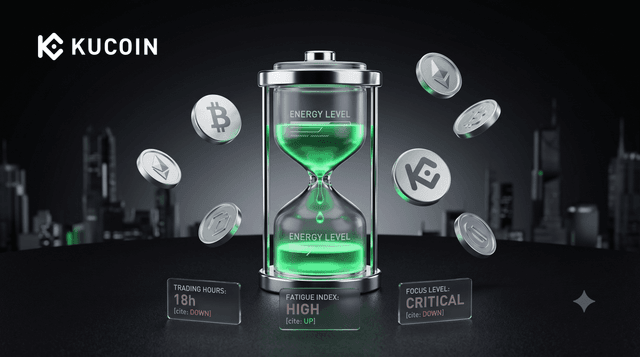
In the hyper-connected trading environment of March 2026, the "always-on" nature of global crypto markets has created a new challenge for even the most disciplined investors: the "Execution Paradox." While institutional algorithms and AI agents trade 24/7 without fatigue, human traders are subject to cognitive decline, decision fatigue, and emotional volatility. As we navigate a market defined by rapid-fire news cycles and high-frequency fluctuations, the most successful participants on platforms like KuCoin are no longer just tracking their Portfolio PnL—they are tracking their Digital-Burnout Metrics.
Digital-burnout metrics are quantitative data points used to measure a trader’s cognitive and emotional "fuel tank." In an era where "doom-scrolling" through Crypto Twitter (X) and over-analyzing 5-minute candles can lead to "tilt" or impulsive revenge trading, these metrics act as a high-tech early warning system. By auditing objective indicators like Screen-Time-to-Trade ratios, Sleep Latency, and Rule-Adherence Rates, traders can identify the precise moment their logical brain begins to lose ground to emotional impulsivity. Mastering these metrics isn't just about wellness; it is a fundamental risk management strategy designed to ensure that when you pull the trigger on a high-leverage trade, you are operating at peak mental performance rather than trading through a fog of exhaustion.
This guide explores the top five metrics for auditing your mental state, the mathematical impact of burnout on your portfolio, and how to use "circuit breakers" to protect your capital from your own fatigue.
Key Takeaways
-
Digital-burnout metrics are quantitative data points (biometric, behavioral, and psychological) that track the onset of mental fatigue in traders.
-
Burnout leads to "tilt," impulsive revenge trading, and a breakdown in risk management.
-
Key indicators include Screen-Time-to-Trade ratio, sleep latency, and decision-fatigue markers.
-
Automating trades and setting "circuit breakers" based on your burnout data.
What are Digital-Burnout Metrics?
In the context of crypto, digital-burnout metrics are objective measurements used to track the decline of a trader's cognitive and emotional health due to prolonged exposure to digital markets.
Unlike traditional finance, where the closing bell provides a natural reset, crypto traders often suffer from "Always-On Syndrome." Digital-burnout metrics allow you to put a number on your fatigue levels so you can step away before your PnL reflects your exhaustion.
Top 5 Digital-Burnout Metrics to Track
To manage burnout, you must measure it. Here are the primary metrics successful crypto traders use to audit their mental state:
-
Screen-Time-to-Trade Ratio
This metric tracks how many hours you spend staring at charts versus how many high-quality trades you actually execute.
-
The Red Flag: A rising ratio (e.g., 10 hours of screen time for 0 trades) indicates "doom-scrolling" or indecision, a primary symptom of digital burnout.
-
Decision Latency
How long does it take you to pull the trigger on a setup that meets your criteria?
-
The Red Flag: If you find yourself hesitating on "A-grade" setups or over-analyzing minor 5-minute candles, you are likely suffering from decision fatigue.
-
Sleep Latency and Quality
Using wearable tech (like an Oura ring or Apple Watch), traders track how long it takes to fall asleep after closing their exchange app.
-
The Red Flag: High cortisol levels from late-night trading lead to poor sleep quality. A sub-60 "Sleep Score" is a leading indicator of an impending "fat-finger" error or a missed stop-loss.
-
Rule-Adherence Rate (RAR)
This is a behavioral metric. It calculates the percentage of trades where you strictly followed your pre-set trading plan.
-
The Red Flag: A dropping RAR suggests that your "pre-frontal cortex" (the logical brain) is losing out to the "amygdala" (the emotional brain)—a classic sign of burnout-induced impulsivity.
-
Social Media Consumption Density
Tracks the time spent on Crypto Twitter (X), Discord, and Telegram.
-
The Red Flag: High density often leads to Information Overload, where the "noise" of the crowd drowns out your own technical analysis.
How Digital Burnout Impacts Your Portfolio
Burnout isn't just about feeling tired; it has a direct mathematical impact on your trading performance.
| Stage of Burnout | Metric Change | Impact on Portfolio |
| Early Warning | Increased Screen Time | Missed opportunities due to "analysis paralysis." |
| Active Stress | Decreased Sleep Quality | Higher frequency of impulsive "revenge trades." |
| Chronic Burnout | Low Rule-Adherence | Major drawdowns; ignoring stop-losses; "tilting." |
Summary
So, what are digital-burnout metrics? They are your early warning system. In 2026, the most successful traders aren't the ones who work the hardest; they are the ones who optimize their "human uptime." By tracking your screen time, sleep, and decision speed, you can ensure that when you do enter the market, you are operating at peak cognitive performance.
Start your crypto journey in minutes by creating a secure KuCoin account with no initial deposit required. Sign Up Now!
FAQs
Can I track burnout without expensive gadgets?
Yes. A simple "Trading Journal" where you rate your energy levels (1–10) and track your "Hours Slept" vs. "Daily PnL" can reveal powerful correlations between fatigue and losses.
How often should I audit my burnout metrics?
We recommend a Weekly Performance Review. Compare your total screen time against your net profit. If your screen time is up but your profit is down, it’s time for a "Digital Detox."
What is the 20-20-20 rule for crypto traders?
To reduce immediate digital strain, every 20 minutes, look at something 20 feet away for 20 seconds. This is a baseline "micro-metric" to maintain ocular and mental health.


