

Zcash Price Hits 8-Year High: How the NU7 Upgrade Vote Could Shape ZEC’s Future
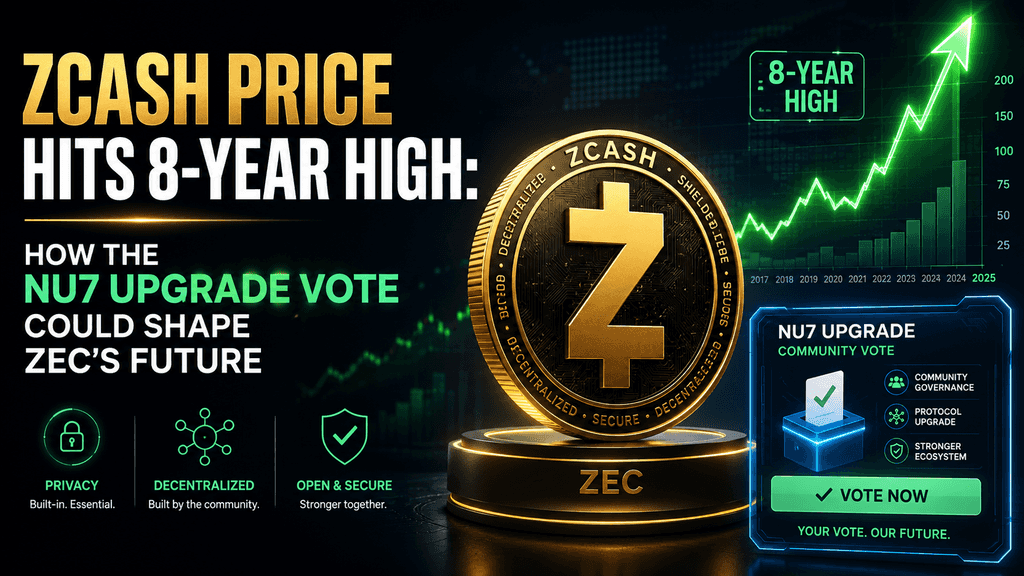
Zcash’s native token ZEC climbed sharply in late August 2026, briefly touching levels not seen since early 2018 and establishing a fresh multi-year high near $888. The move coincided with the conversion of Grayscale’s long-standing Zcash Trust into a spot exchange-traded product that began trading on NYSE Arca under the ticker ZCSH, alongside the opening of a coinholder vote on the scope of Network Upgrade 7. Market data from multiple sources placed the week’s gains above 60 percent at points, with 24-hour volumes swelling into the hundreds of millions and futures activity reaching elevated levels.
Circulating supply stood near 16.9 million ZEC against a fixed maximum of 21 million, pushing market capitalization above $13 billion during the peak. The rally unfolded against a backdrop of renewed attention to privacy-focused assets and recent protocol improvements, including the Ironwood pool introduced earlier in the summer. The concurrent NU7 vote and institutional product launch create a pivotal moment for ZEC. Decisions on issuance smoothing, block-time reduction, and legacy-pool cleanup will influence long-term supply dynamics, transaction throughput, and network sustainability, potentially reinforcing or tempering the price momentum that has already lifted ZEC to its highest mark in eight years.
ZEC Breaks Through the 2018 Ceiling After Multi-Year Consolidation
Trading data recorded ZEC advancing from the mid-$500 range in mid-August 2026 to highs exceeding $850 and briefly approaching $888 within days. Closing prices on successive sessions showed strong buying, with one-day swings of 40 percent or more appearing in several market summaries. The previous January 2018 peak near $800 had remained a technical reference for nearly eight years; surpassing it marked a clear shift in market structure. Volume expanded dramatically, with some exchanges reporting single-day turnover above $1 billion in notional terms during the most active sessions. Market-capitalization figures moved in tandem, lifting ZEC into the top tier of cryptocurrencies by size for brief periods. The advance occurred after a multi-month consolidation that followed earlier 2025 highs near $750, suggesting the breakout resolved accumulated positioning rather than an isolated spike.
Price discovery remained orderly relative to the magnitude of the move. Intraday ranges stayed wide yet continuous, and order-book depth on major platforms absorbed the flow without prolonged gaps. Technical observers noted that the breach of the long-standing 2018 high opened measured-move projections toward the next psychological thresholds, though historical drawdowns from prior peaks remain substantial relative to the all-time high near $3,192 set in 2016. The combination of spot demand and leveraged futures interest amplified the short-term trajectory while leaving the longer-term trajectory dependent on subsequent fundamental catalysts.
Grayscale Spot Product Conversion Supplies Immediate Institutional Channel
On August 25, 2026, Grayscale’s converted Zcash vehicle began trading on NYSE Arca as ZCSH, the first U.S. exchange-traded product offering direct spot exposure to ZEC. The fund originated as a private-placement trust launched in 2017 and had traded on the OTCQX marketplace, often at discounts to net asset value. The uplisting introduced continuous creation and redemption mechanisms intended to keep share prices aligned with the underlying holdings. Assets under management were reported in the $260–$310 million range depending on the measurement date, corresponding to several hundred thousand ZEC held in custody. Authorized participants included established market-making firms, and the annual sponsor fee was set at 2.5 percent.
The structural change removed a friction that had limited institutional access. Investors can now obtain ZEC exposure through conventional brokerage accounts without managing private keys or navigating on-chain privacy features. Early trading sessions for the new product occurred against the backdrop of elevated spot prices, creating a feedback loop in which ETF inflows and secondary-market demand reinforced each other. Grayscale indicated that a portion of fee revenue would support ecosystem development for a limited period, adding a modest secondary benefit. The listing therefore functions both as a liquidity event and as a signaling mechanism that privacy assets have reached a threshold of regulatory and operational maturity sufficient for mainstream product wrappers.
Coinholder Vote Opens on August 25 with Strict Eligibility Rules
The NU7 coinholder vote opened on August 25, 2026, and remains scheduled to close on September 14 at 19:00 UTC. Eligibility required: spendable, shielded ZEC held in the Ironwood pool at the snapshot block height of approximately 3,459,350, estimated for August 24 at 19:00 UTC. Funds could be moved after the snapshot without loss of voting power. Supported wallets include Vizor, Zodl, Zkool, and Keystone hardware devices. Organizers set a participation threshold of 1 million ZEC for the results to be considered representative. Voting occurs through a privacy-preserving system that publishes only aggregate outcomes.
The process itself represents an evolution in Zcash governance. Earlier sentiment polls had revealed divergences between developer and coinholder preferences on certain features. By restricting the ballot to holders of shielded Ironwood balances, the current vote aligns decision rights more closely with active, privacy-preserving participants. The privacy-preserving tallying method further reinforces the network’s core design principles. Results are expected shortly after the closing deadline and will inform the final scope of the upgrade before implementation deadlines in late September.
Issuance-Smoothing Question Tests Commitment to Halving Schedule
The first ballot item addresses the Network Sustainability Mechanism’s issuance component. Holders choose among a smooth issuance curve that replaces discrete halvings, preservation of the existing halving schedule with eventual reissuance of removed funds, or exclusion of smoothing from NU7. In all cases, the 21-million-coin supply cap remains intact. The smooth-curve option would distribute both new issuance and recycled fees more evenly over time, reducing the periodic supply shocks associated with halvings. Preservation of halvings maintains the discrete reduction events that have historically shaped miner economics and market narratives.
Market participants have debated the trade-offs extensively. A gradual curve could stabilize miner revenue after successive halvings and reduce the volatility that accompanies large supply drops. Retention of halvings preserves a familiar schedule that many holders view as a defining characteristic inherited from Bitcoin’s design. Because the total supply is unaffected, the decision centers on timing and predictability rather than absolute scarcity. The outcome will influence how secondary-market participants model future circulating supply and therefore affect longer-term valuation frameworks.
Fee-Recycling Timeline Determines Near-Term Miner Incentives
A related question asks when recycled transaction fees and donated funds should re-enter circulation through block rewards. Options include the earliest feasible date after mechanism activation, February 2027, February 2031, or abstention. The Network Sustainability Mechanism already incorporates a fee-burning or collection component; the reissuance schedule determines when those collected units become available to miners. An early start would supplement block rewards sooner, potentially supporting hash-rate continuity. A later start would keep the collected units out of circulation longer, exerting a mild deflationary pressure in the interim.
The choice carries implications for security budgets. As block rewards decline through successive halvings, transaction fees must eventually shoulder a larger share of miner compensation. Recycling collected fees on a predictable schedule can smooth that transition. Holders weighing the options balance the desire for immediate network security against the preference for prolonged scarcity. Because the vote is signaling rather than automatically binding code, the result will guide subsequent ZIP development and activation parameters.
Sprout-Pool Cleanup Decision Closes a Long-Standing Legacy Chapter
The Sprout pool, introduced at launch in 2016 and later deprecated for new deposits, still holds a small residual balance of roughly 23,000 ZEC and accounts for negligible transaction volume. The ballot asks whether v4 transactions should be disabled immediately upon NU7 activation, one year after the vote, or left without a set date. Disabling the format removes the remaining technical debt associated with the oldest shielded construction. Immediate action would complete the migration path that has been available for years; a delayed schedule would grant additional notice to any remaining holders.
From an operational standpoint, the residual balance is small relative to total supply, yet the existence of multiple shielded pools increases complexity for node software, wallet implementations, and auditors. Clearing the legacy format simplifies the protocol surface and reduces the attack surface associated with older circuit implementations. The vote therefore functions as both a housekeeping measure and a governance test of the community’s willingness to enforce migration timelines.
Block-Time Reduction Proposal Aims to Triple Confirmation Speed
ZIP 218 proposes reducing the target block interval from 75 seconds to 25 seconds while introducing per-pool action limits. Daily issuance remains unchanged because rewards are adjusted proportionally. The change would cut average inclusion latency by a factor of three and approximately double Orchard throughput for standard transactions. Testnet data indicated that uncle rates stayed manageable under the faster cadence. Supporting wallets and nodes would need to handle denser block production, yet the protocol already incorporates difficulty adjustment mechanisms designed for the new spacing.
Faster blocks improve user experience for everyday transfers and may encourage higher on-chain activity. The accompanying action limits mitigate certain denial-of-service vectors that become more relevant at higher throughput. Because the issuance schedule is preserved in aggregate, the change is largely performance-oriented rather than monetary. Approval would mark one of the more visible user-facing improvements in recent upgrades and could differentiate Zcash’s practical usability relative to slower privacy-oriented designs.
Readiness Clause Lets Holders Choose Between Scope and Schedule
The final question concerns whether NU7 should activate with only those features ready by a September 30 implementation deadline or be postponed until the full approved set is complete. A readiness certification process involving Zodl, the Zcash Foundation, and ZIP editors would determine which components meet the bar. Shipping a narrower upgrade keeps the network on a predictable cadence; delaying preserves feature completeness at the cost of calendar slippage.
The clause shows lessons from prior upgrade cycles in which incomplete features delayed activation or required follow-on patches. By placing the trade-off before coinholders, the process distributes accountability. The outcome will set expectations for how future upgrades balance ambition against delivery discipline and will influence developer resource allocation in the intervening weeks.
Market Reactions of Combined ETF Access and Protocol Signaling
The simultaneous appearance of a liquid spot product and a high-stakes governance vote concentrates attention on ZEC at a moment when price already reflects elevated expectations. ETF flows can absorb or release inventory independently of on-chain activity, while the vote outcome will shape expectations about future circulating supply and network capacity. Positive resolution of the performance-related items could support continued institutional interest; outcomes that preserve discrete halvings or delay certain features may be interpreted as continuity of the existing monetary policy.
Volatility is likely to remain elevated through the voting window and the subsequent implementation period. Historical patterns show that protocol milestones often produce short-term price discovery followed by consolidation once uncertainty resolves. The presence of a regulated product now provides an additional channel through which that discovery can occur, potentially reducing the amplitude of purely speculative swings relative to earlier cycles.
Privacy Narrative Gains Institutional Validation Through Product Launch
Zcash’s optional privacy model has long distinguished it from transparent ledgers. The successful conversion of a multi-year trust into an exchange-traded product demonstrates that selective disclosure and shielded transfers can coexist with regulated investment vehicles. Custody arrangements rely on established institutional providers, and the fund’s structure does not require investors to interact directly with shielded pools. This separation of concerns expands the addressable investor base without compromising the protocol’s core capabilities.
The timing coincides with broader market interest in assets that offer credible privacy guarantees. Recent protocol work, including the Ironwood pool’s public turnstile for supply auditing, addresses earlier concerns about verifiability. Together, the technical improvements and the product wrapper strengthen the case that privacy coins can operate within mainstream financial infrastructure rather than remaining confined to specialized user segments.
Historical Pattern Frames the Current Price Level Relative to Prior Peaks
ZEC’s 2016 all-time high near $3,192 remains distant; the recent multi-year high near $888 recovers only a fraction of that peak. The 2018 high of approximately $800 had stood as the cycle reference for nearly a decade. The intervening years included prolonged periods below $50 and a 2024 low near $16. Recovery from those levels to the current range represents substantial absolute gains yet still leaves the asset well below its historical maximum.
This distance supplies both caution and opportunity. Long-term holders who accumulated at earlier peaks continue to sit on unrealized losses, while newer entrants view the current levels as a reclaimed intermediate high. The fixed supply schedule and the upcoming governance decisions will determine whether the recent recovery marks a durable floor or a temporary peak within a longer consolidation.
Technical and Governance Interplay Will Determine Medium-Term Journey
The NU7 vote does not automatically rewrite consensus rules; it supplies a signal that developers and foundation teams will translate into activation parameters. Implementation still requires code audits, node upgrades, and coordination among mining pools and wallet providers. Parallel progress on the Zebra full-node implementation, which is expected to become the primary consensus client, reduces reliance on the legacy zcashd codebase. Successful coordination around both the vote outcomes and the node transition will be necessary for a smooth activation.
Price action in the coming weeks will therefore respond to two distinct information streams: the tabulated results of the coinholder ballot and the subsequent engineering updates that convert those results into deployable code. Clear majorities on performance items could accelerate development timelines, while close or ambiguous outcomes may prompt further deliberation. Either path will shape the narrative that investors apply to ZEC through the remainder of 2026.
Practical Considerations for Holders During the Voting Window
Eligible participants must confirm that their balances resided in the Ironwood pool at the snapshot height and that their chosen wallet supports the voting interface. After casting a ballot, holders remain free to move or spend the underlying ZEC. The privacy-preserving design means individual choices are not published; only aggregate tallies appear. Market participants monitoring the process can track participation volume against the 1-million-ZEC threshold as an early indicator of legitimacy.
Independent of voting, the existence of a liquid spot ETF provides a new hedging and exposure tool. Traders who previously relied solely on perpetual futures or OTC desks now have an exchange-listed instrument whose creation and redemption process can influence underlying demand. The combination of on-chain governance activity and off-chain product flows creates a richer information environment than existed in prior cycles.
FAQs
What price levels did ZEC reach during its recent advance, and how do they compare with earlier highs?
ZEC traded above $800 for the first time since January 2018 and briefly approached $888 according to multiple exchange records in late August 2026. The 2018 peak near $800 had served as the reference high for eight years, while the 2016 all-time high near $3,192 remains substantially higher. The recent move therefore reclaimed an intermediate multi-year high rather than establishing a new record.
How does the Grayscale Zcash ETF differ from the previous trust structure?
The prior vehicle traded on the OTCQX marketplace and frequently exhibited discounts to net asset value. Conversion to a spot ETF listed on NYSE Arca under ticker ZCSH introduces continuous share creation and redemption, which is designed to keep market prices aligned with the value of the underlying ZEC holdings. The change expands accessibility for investors who prefer exchange-listed products over direct token custody.
Who is eligible to participate in the NU7 coinholder vote?
Eligibility is limited to holders of spendable, shielded ZEC that resided in the Ironwood pool at the snapshot block height of approximately 3,459,350. After the snapshot, the coins may be moved freely without forfeiting voting rights. Supported wallets include Vizor, Zodl, Zkool, and Keystone hardware devices.
What are the main options regarding ZEC issuance under consideration?
Holders may support replacing the existing halving schedule with a gradual issuance curve, preserving the discrete halvings while allowing recycled funds to re-enter later, or excluding issuance smoothing from the NU7 scope entirely. In every case, the overall 21-million-coin supply limit is unchanged; the decision concerns only the timing and smoothness of new supply.
Why is a reduction in block time considered significant?
Lowering the target interval from 75 seconds to 25 seconds would reduce average confirmation latency by a factor of three and approximately double throughput for standard Orchard transactions. Daily issuance remains constant because rewards are scaled proportionally. The change is therefore primarily a performance improvement rather than a monetary-policy alteration.
What happens if participation falls below the stated threshold?
Organizers have indicated that results will be considered representative only if at least 1 million ZEC participate in at least one question. Below that level, the signal would carry less weight, potentially prompting further community discussion before finalizing upgrade parameters.
🔥 KuCoin Offers A More Stable Option in A Volatile Market
If you worry about the frequent ups and downs in the market, and pursue a more stable option to earn money passively, KuCoin is the right place to come:

Simple Earn: Deposit and withdraw tokens anytime, earning stable returns.
Kucoin Earn: Earn stable profits with professional asset management.
Hold to Earn: Earn rewards by holding assets in Funding, Trading, Margin, Futures, Mining, and Unified Accounts.
Staking: Unlock the earning potential of on-chain assets.
Advanced Investments: Advanced Investments offer a variety of structured products to help your money grow in any market.
Shark Fin: Principal Protection and Guaranteed Gains
Dual Investment: Buy low and sell high with transparent return calculations.
Snowball: High yields, with price protection.
Discount Buy: Buy crypto at discount prices.
KCS Loyalty: Level up to enjoy exclusive perks by staking ≥ 1 KCS.
KuCoin Wealth: Discover future value and begin your smart investing journey.
KCS Benefits: Hold and stake KCS to access benefits across the platform.
KCS Staking 2.0: Participate in KCS on-chain governance to earn yield.
Disclaimer: This content is for informational purposes only and does not constitute investment advice. Cryptocurrency investments carry risk. Please do your own research (DYOR).