

Zcash Votes for 25-Second Blocks in NU7, Delays NSM Reissuance to 2031
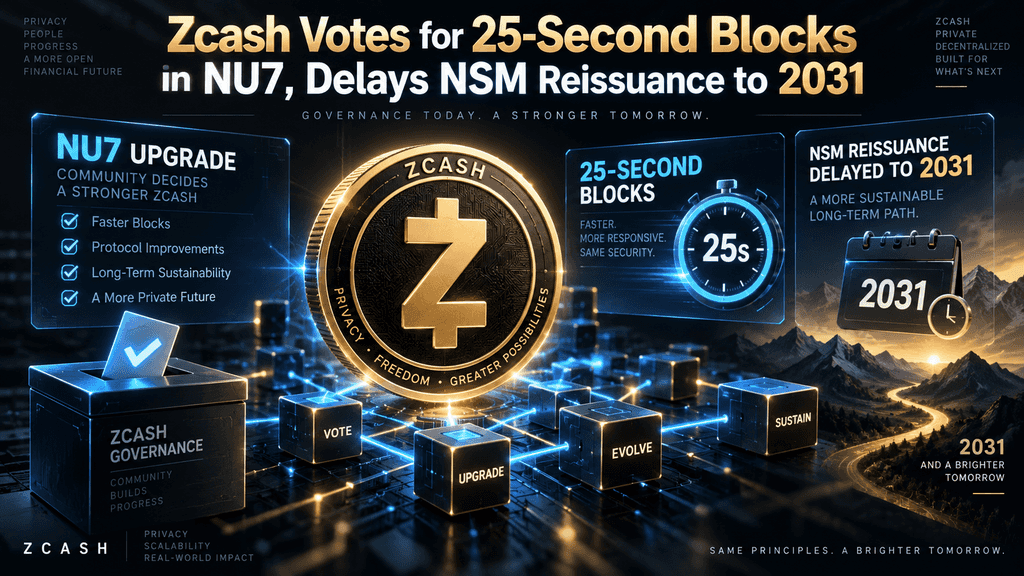
Zcash’s NU7 Vote Accelerates Confirmations While Preserving Its Long-Term Monetary Framework
Zcash token holders delivered a decisive signal on the scope of Network Upgrade 7 through a privacy-preserving coinholder poll that closed in mid-September 2026. Nearly 2.4 million ZEC, representing roughly two-thirds of the approximately 3.6 million eligible tokens held in the Ironwood shielded pool at the snapshot, participated. The results showed 99.9 percent support for reducing the target block interval from 75 seconds to 25 seconds under ZIP 218, 98.9 percent backing for retention of the existing Bitcoin-style halving schedule, and approximately 96.6 percent approval for postponing Network Sustainability Mechanism reissuance of removed funds until February 2031.
Voting power derived solely from spendable shielded balances, with ballots structured to protect privacy. Developers and ecosystem organizations have aligned on interpreting the outcomes conservatively, prioritizing features ready by the September 30 readiness cutoff while deferring incomplete items. These decisions clarify Zcash’s short-term performance path and longer-term monetary posture without altering the 21 million ZEC supply cap. The concept of this analysis is that the NU7 vote strengthens Zcash’s competitiveness as a privacy-focused payment network by accelerating confirmations and locking in predictable issuance, while the delayed NSM start preserves the current security budget trajectory for several more years.
Near-Unanimous Backing Emerges for Cutting Zcash Block Target to 25 Seconds
Token holders allocated roughly 2.397 million ZEC in favor of the proposal to shorten the target block spacing from 75 seconds to 25 seconds, with only 141.6 ZEC opposing and a small number abstaining. This produced a 99.9 percent weighted approval that includes abstentions in some tallies. The change, detailed in ZIP 218, pairs the faster interval with per-pool action limits designed to manage shielded transaction load on Sapling and Orchard. Shorter blocks reduce the average time users wait for a first confirmation, improving the practicality of private payments.
Daily ZEC issuance remains essentially unchanged because the subsidy per block declines proportionally, preserving the overall emission schedule measured in calendar time. The 21 million maximum supply stays intact. High turnout exceeded the one-million-ZEC threshold organizers set for treating the result as representative, lending weight to the mandate for developers. Implementation still requires code finalization, testing on testnet, and eventual mainnet activation, none of which the vote itself triggers. Market observers noted the clarity contributed to positive price action in ZEC following publication of the results.
Proportional Subsidy Adjustment Keeps Daily Issuance Steady Under Faster Blocks
ZIP 218 specifies that post-activation, the target spacing becomes 25 seconds while the block subsidy is scaled so that the quantity of new ZEC released over any given period of wall-clock time matches the pre-NU7 rate. Rounding effects produce a negligible under-issuance of less than 0.017 ZEC across a full halving interval, an amount that can be addressed later if related mechanisms activate. Action limits cap the number of shielded operations per block: GlobalShieldedBudget and OrchardBlockActionLimit at 330, SaplingBlockIOLimit at 300, and a residual Sprout limit to prevent resource spikes.
These technical constraints ensure the network can absorb higher block frequency without degrading validation performance. Users benefit from more frequent opportunities for transaction inclusion, which is particularly relevant for time-sensitive private transfers. Miners continue to receive rewards calibrated to the adjusted per-block amount, so expected revenue measured over hours or days does not triple. The design maintains compatibility with existing wallet and infrastructure assumptions while delivering measurable latency improvements. Developers must still integrate the consensus changes cleanly before any activation height is chosen.
Holders Firmly Retain Bitcoin-Style Halvings Instead of a Smooth Issuance Curve
On the monetary-policy question, approximately 2.376 million ZEC supported preserving the scheduled halvings that cut new coin issuance by half at fixed intervals, equating to 98.9 percent of participating weight. Support for replacing halvings with a gradual logarithmic curve remained minimal at roughly 22,385 ZEC. The outcome keeps Zcash aligned with the step-function emission profile inherited from Bitcoin, providing predictability for long-term holders and miners. A separate advisory-panel poll showed a much narrower split, illustrating the value of the coinholder process that weights by economic stake held in the shielded pool.
Retaining halvings means future block rewards continue their discrete reductions rather than smoothing into a continuous decline. ZEC, previously removed from circulation under the Network Sustainability Mechanism, can still re-enter later through block rewards once reissuance begins, without expanding the hard cap. This clarity reduces uncertainty around the issuance path for the remaining supply. Ecosystem groups subsequently confirmed they will follow the coinholder preference when preparing NU7.
Wide Support Delays Network Sustainability Mechanism Reissuance Until February 2031
Roughly 2.32 million ZEC, or about 96.6 percent of the weight on that question, preferred February 2031 as the start date for reissuing funds previously removed from circulation. Only about 70,240 ZEC favored beginning as soon as possible. The Network Sustainability Mechanism, introduced earlier in 2026, removes at least 60 percent of transaction fees from immediate circulation and places them into a reserve that can later fund block rewards. The total supply ceiling of 21 million ZEC remains unchanged.
Delaying reissuance allows those fees to accumulate for several years while current block subsidies continue under the existing schedule. Shielded Labs, Project Tachyon, ZODL, the Zcash Foundation, and Valar Group aligned on the February 2031 date as the most conservative reading of the results. The component that removes funds is already approved; only the timing and method of recycling remained open. This outcome prioritizes stability in the near-term security budget.
Strong Turnout in Privacy-Preserving Poll Signals Effective Governance Participation
Participation reached nearly 2.4 million ZEC out of an eligible pool of approximately 3.6 million tokens held as spendable balances in the Ironwood shielded pool at the designated snapshot height. That equates to roughly two-thirds of eligible economic weight and substantially exceeds the one-million-ZEC threshold set for regarding the outcome as representative. The voting system encrypted ballots and split them into unlinkable pieces so that totals could be tallied without revealing individual holdings or choices.
Only shielded balances counted, reinforcing Zcash’s privacy ethos in the governance process itself. The high engagement contrasts with earlier lower-turnout exercises and demonstrates that the revised mechanism successfully mobilizes stake. Results were published promptly after the September 14 close, enabling rapid ecosystem coordination. The process ran independently of the concurrent Community Advisory Panel survey, whose preferences differed on some issues. Overall, the poll establishes a clear, stake-weighted mandate for the features that will define NU7.
ZIP 218 Supplies the Precise Consensus Rules for Shorter Blocks and Limits
The specification in ZIP 218 defines the post-NU7 target spacing as 25 seconds and introduces the necessary constant updates in the protocol. It also sets the per-pool action limits that constrain the volume of shielded operations within each block. These limits protect node resource usage while still allowing meaningful throughput gains from the higher block rate. Subsidy calculations adjust so that issuance over calendar time stays consistent with the prior regime. Rounding produces only a tiny shortfall that later mechanisms can correct if desired.
The ZIP is intended to activate together with the rest of NU7 once the code is ready, and an activation height is selected. No mainnet or testnet activation date has been fixed yet. Implementation teams must ensure that wallets, explorers, and mining software correctly interpret the new constants. The technical package therefore delivers both latency reduction and safeguards against overload.
Developers Commit to Shipping Only Features Ready by September 30 Deadline
Coinholders voted 99.3 percent in favor of advancing NU7 as soon as possible and excluding any component not implemented by the September 30 readiness deadline. This preference prevents the entire upgrade from being delayed by unfinished work. Teams can therefore focus resources on the highest-priority items that already enjoy strong support, most notably the block-time reduction and related limits.
Features that miss the cutoff can be revisited in subsequent upgrades. The approach reduces coordination risk and gives users a clearer expectation of when performance improvements may arrive. Ecosystem organizations have publicly stated their alignment with this readiness-driven scope. Final integration, testing, and activation scheduling remain ahead. The vote itself changes no consensus rules; only the subsequent software release will.
Sprout Pool Deprecation Advances as Legacy System Sees Minimal Remaining Use
Holders also backed disabling transactions associated with the obsolete Sprout privacy pool. Sprout has been deprecated for years, holds a small residual balance under 23,000 ZEC, and accounts for under 0.1 percent of recent transaction volume. Setting a firm deprecation path in NU7 cleans up the protocol surface and reduces long-term maintenance burden.
The decision aligns with the broader preference for shipping a focused, ready set of changes. Users still holding Sprout funds retain time to migrate before any hard cutoff. The move simplifies future development without affecting the dominant Sapling and Orchard pools. Combined with the other results, it contributes to a cleaner upgrade package.
ZEC Price Strengthens as Governance Clarity Reaches the Market
Following publication of the results, ZEC recorded gains that extended a multi-week advance, with some sessions showing double-digit percentage moves and the token approaching or exceeding the $1,400 level on certain venues. Trading activity increased as participants digested the reduced uncertainty around issuance and performance. Live market data for ZEC price movements reflected the positive reaction. The combination of faster prospective confirmations and retention of the familiar halving schedule appeared to reassure longer-term holders. Volume in related pairs, including perpetual contracts, also expanded. Price discovery remains driven by broader market conditions in addition to protocol news, yet the vote supplied a clear positive catalyst. Ongoing monitoring of ZEC futures activity provides additional insight into positioning around the upgrade timeline.
NSM Design Addresses Future Security-Budget Concerns While Cap Stays Fixed
The Network Sustainability Mechanism was created to mitigate the risk that declining block rewards could eventually fall below the level needed to sustain adequate mining security. By redirecting at least 60 percent of fees into a reserve that can later supplement subsidies, the mechanism aims to smooth the long-term security budget. The hard 21 million supply ceiling is never breached.
Coinholders chose to postpone the reissuance phase until February 2031, allowing the reserve to build while current rewards remain intact. This timing preference reflects a conservative stance that prioritizes near-term predictability. Related ZIP documents describe both the removal and potential recycling components. The delayed start means the recycling effect will not appear in the immediate post-NU7 environment.
Miners and Users Stand to Experience Higher Confirmation Frequency After Activation
Once activated, the 25-second target will triple the number of blocks produced per unit of time relative to the prior 75-second interval. Users should observe shorter average waits for initial confirmations, improving the usability of shielded payments. Miners will process more frequent but smaller-subsidy blocks, with expected revenue over calendar time remaining comparable. Network throughput capacity rises in principle, subject to the new action limits that prevent any single block from becoming excessively large.
Infrastructure operators will need to adjust monitoring and capacity planning for the higher block rate. The changes do not alter the fundamental privacy guarantees of the shielded pools. Practical benefits will materialize only after the upgrade reaches mainnet and wallets fully support the new parameters. Monitoring current Zcash market data alongside network metrics will help track adoption of the faster cadence.
Implementation and Testing Must Precede Any Mainnet Activation of NU7
The coinholder vote supplies a clear preference ordering but does not itself modify consensus rules. Development teams must complete coding, peer review, testnet deployment, and security assessment before an activation height can be proposed. Features missing the September 30 readiness mark will be deferred. Ecosystem organizations have already coordinated on the conservative interpretation of the results, reducing the chance of divergent client implementations.
Users and service providers should prepare for the eventual arrival of shorter blocks and the associated parameter changes. No firm activation window has been announced. The process underscores Zcash’s reliance on stake-weighted signaling followed by engineering execution. Continued transparency from the development groups will be essential as the upgrade moves from preference to production code.
🔥 Beyond the Headlines: What KuCoin 5.0 Means for You
Market news moves fast — but where you act on it matters just as much. This October, KuCoin launches KuCoin 5.0, transforming KuCoin into a rebuilt platform. Here's what actually changes for you:
-
One account for everything. Older platforms split your money across separate "spot," "margin," and "futures" accounts and expected you to understand why. KuCoin 5.0's unified account removes that entirely — deposit once, and everything is simply there.
-
Stocks, indices, and commodities. KuCoin 5.0 expands beyond crypto into global markets. When crypto chops sideways and equities rally (or the reverse), you rotate in minutes instead of opening a brokerage account and waiting days for fiat rails.
-
Real-world assets (RWA). Tokenized exposure to traditional assets like commodities, right inside your crypto account. One of the fastest-growing segments in global finance is no longer reserved for institutions — you access it from the same balance you trade with.
-
Earn while you learn. Not ready to trade? KCUSD lets your stablecoins earn daily, auto-compounding interest. The lowest-stress way to put your idle deposit to work for 4% yield.
-
An AI assistant in plain language. Ask questions, get market context, understand what you're looking at — built into the platform, no jargon required.
-
An app that doesn't overwhelm. Faster, cleaner, and consistent — intuitive from the first tap, not after a tutorial.
-
Safety you can check, not just trust. A MiCAR-licensed EU entity, Proof of Reserves you can verify yourself, and internationally certified security (SOC 2 Type II, ISO 27001:2022).
Create your account in minutes — and start on the platform built for where crypto is going, not where it's been.
FAQs
How does the reduction from 75-second to 25-second blocks affect the daily issuance of new ZEC?
The per-block subsidy is scaled downward by the same factor so that the quantity of new coins released over any given calendar period remains essentially the same as under the previous schedule. Rounding produces only a negligible shortfall across an entire halving interval. The 21 million maximum supply is unaffected. Users therefore receive the benefit of faster confirmations without any change in the overall emission rate measured by wall-clock time. Miners experience more frequent but smaller individual rewards whose aggregate value over hours or days stays comparable.
What is the Network Sustainability Mechanism and why was its reissuance delayed?
The mechanism removes at least 60 percent of transaction fees from immediate circulation and places them in a reserve that can later be recycled through block rewards to support long-term security. Coinholders voted approximately 96.6 percent in favor of waiting until February 2031 before beginning that recycling phase. The delay allows the reserve to accumulate while current block subsidies continue under the existing path. The total supply cap remains fixed at 21 million ZEC in all cases.
Why was turnout considered strong for the NU7 coinholder poll?
Nearly 2.4 million ZEC participated out of roughly 3.6 million eligible tokens held in the Ironwood shielded pool, equating to about two-thirds of the eligible economic weight. This level substantially exceeded the one-million-ZEC threshold organizers established for treating the results as representative. The privacy-preserving ballot design encouraged participation without revealing individual balances or votes.
Will the vote itself activate the 25-second block time on mainnet?
No. The poll establishes the preferred scope for NU7. Developers must still implement the changes, complete testing, and select an activation height. Features not ready by the September 30 deadline can be excluded so that ready components are not delayed. Activation remains a separate engineering and coordination step.
How does retaining the halving schedule differ from the alternative smooth-issuance proposal?
Halvings continue to cut the block subsidy by half at predetermined intervals, producing a step-function emission curve. The alternative would have replaced those discrete reductions with a gradual logarithmic decline that approximates the same four-year totals under certain assumptions. Coinholders preferred the familiar step function by a 98.9 percent margin, preserving the Bitcoin-style monetary profile.
Disclaimer: This content is for informational purposes only and does not constitute investment advice. Cryptocurrency investments carry risk. Please do your own research (DYOR).