

World Liberty Financial CEO: USD1 Stablecoin Surpasses $4 Billion in Circulation with Over $1 Billion Daily Trading Volume
2026/08/28 17:54:00
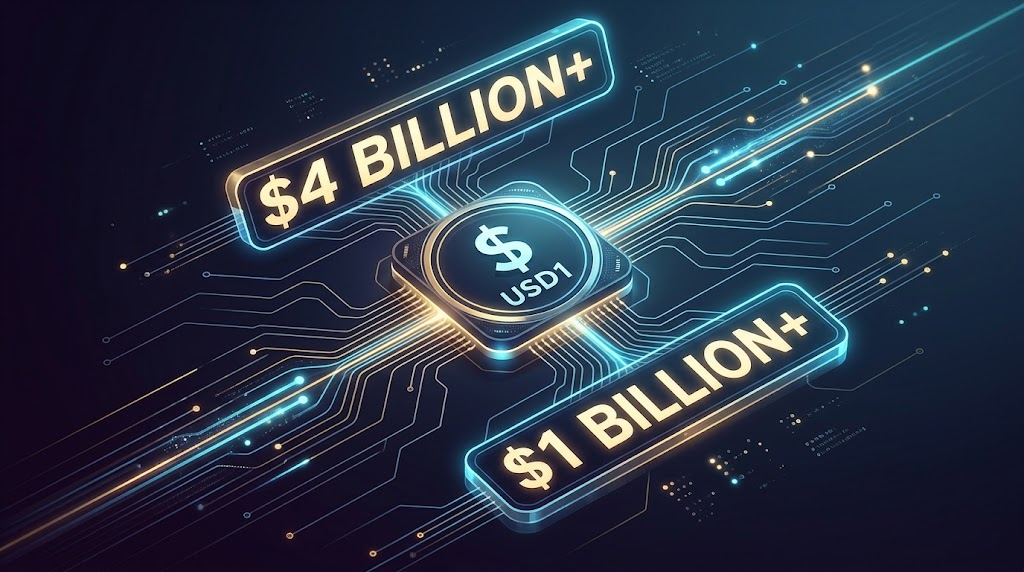
World Liberty Financial’s dollar-pegged stablecoin USD1 has crossed an important threshold in the digital asset market. On August 25, 2026, CEO Zach Witkoff appeared on CNBC’s Squawk Box and said the token now has more than $4 billion in circulation and generates over $1 billion in daily trading volume. He specifically noted that the trailing 24-hour volume stood at $1.7 billion just before the interview. These figures place USD1 among the larger dollar-backed stablecoins by market capitalization, according to trackers such as CoinMarketCap and DefiLlama.
The development arrives as the project receives preliminary conditional approval from the Office of the Comptroller of the Currency for a national trust bank charter and expands native issuance onto institutional blockchains. Witkoff framed the growth as evidence of genuine customer usage rather than reliance on political connections. This article examines verified market data, institutional drivers, multi-chain distribution, reserve structure, and USD1's competitive positioning as of late August 2026, drawing exclusively from recent reporting and on-chain metrics.
USD1 Circulating Supply Crosses the $4 Billion Mark in Late August 2026
As of August 26, 2026, multiple independent data providers list USD1’s circulating supply and market capitalization near or slightly above $4.04 billion. CoinMarketCap reports a live market cap of approximately $4.04 billion with a circulating supply of roughly 4.05 billion tokens, each intended to maintain a 1:1 peg with the U.S. dollar. DefiLlama and related stablecoin dashboards show comparable figures in the $4.05–$4.08 billion range, confirming that the token has remained above the $4 billion level for several consecutive days. Witkoff’s public comments on CNBC aligned closely with these external measurements.
The supply direction shows steady institutional accumulation rather than purely retail inflows. Earlier peaks in February 2026 approached $5.3–$5.4 billion, according to historical Arkham Intelligence data cited by Forbes, before settling into the current range. The recent stability above $4 billion coincides with expanded listing availability on major platforms and the native deployment on additional networks. Monthly attestation reports and live proof-of-reserves dashboards maintained by the issuer and its custodian continue to support the claim of full collateralization. These verified numbers establish USD1 as a meaningful participant in the broader dollar-stablecoin sector, where total market capitalization exceeds hundreds of billions of dollars.
Daily Trading Volume Exceeds $1 Billion, Reaching $1.7 Billion in Recent 24-Hour Periods
Trading activity provides a clearer signal of actual usage. Witkoff stated on CNBC that USD1 routinely clears more than $1 billion in daily volume and that the figure stood at $1.7 billion in the trailing 24 hours preceding his interview. Independent trackers corroborate elevated activity: CoinGecko historical data for late August shows 24-hour volumes fluctuating between roughly $900 million and $1.4 billion, while CoinMarketCap and DefiLlama report similar ranges with occasional spikes above $1.2 billion. Volume-to-market-cap ratios near 20–25 percent indicate relatively high turnover compared with many mid-tier stablecoins.
This liquidity supports rapid minting, redemption, and secondary-market transfers across centralized and decentralized venues. Elevated volume also reduces slippage for large institutional orders and facilitates the token’s role in settlement of larger transactions. The consistency of billion-dollar daily flows over successive periods suggests that the activity is not driven by isolated promotional events but by recurring demand from trading desks, payment processors, and on-chain protocols. Market participants monitoring stablecoin flows treat sustained high volume as a practical indicator of product-market fit.
Zach Witkoff Attributes Growth to Institutional Demand Rather Than Political Connections
In the same CNBC appearance, Witkoff directly addressed concerns that companies or foreign entities might use USD1 as a vehicle to transfer value to the Trump family. He rejected the premise, stating that the scale of circulation and daily trading volume demonstrates genuine customer adoption. Witkoff emphasized that he has never discussed business matters with President Trump and does not intend to do so, describing his focus as delivering utility for employees and customers. He positioned USD1 as part of the emerging “native cash layer of the internet,” arguing that the dollar itself should move continuously.
The comments followed weeks of public scrutiny surrounding the project’s ownership structure and foreign investment links. Witkoff’s response centered on observable market metrics rather than denials of ownership ties. By showing real-time volume data and multi-billion-dollar circulation, the CEO sought to shift the conversation toward operational performance. Independent reporting from Blockonomi and crypto.news reproduced the same statements and linked them to contemporaneous supply figures, reinforcing that the figures themselves are independently verifiable.
Early Institutional Boost from the $2 Billion MGX-Binance Settlement in 2025
A pivotal early catalyst occurred in May 2025 when Abu Dhabi-backed investment firm MGX selected USD1 as the settlement asset for its $2 billion investment in Binance. Witkoff publicly announced the arrangement at the TOKEN2049 conference in Dubai, describing the token as the official settlement medium for the transaction. That single deal rapidly expanded circulating supply and established an institutional reference point. Subsequent reporting indicated that Binance-linked wallets held a substantial concentration of the total supply for an extended period.
Although concentration has moderated since the peak, the MGX transaction remains the most visible large-scale use case. It demonstrated that a major sovereign-linked investor was willing to move significant capital through the token. The episode also accelerated listings and liquidity provision on major trading venues. Current supply distribution shows greater geographic and chain diversity than the early post-deal period, yet the original institutional endorsement continues to inform perceptions of the asset’s credibility among professional market participants.
Multi-Chain Deployment Spans Ethereum, BNB Chain, Solana, and Additional Networks
USD1 operates across multiple blockchains, with the largest concentrations historically observed on Ethereum and BNB Chain. DefiLlama data from earlier periods showed Ethereum holding roughly 41 percent and BNB Chain approximately 37 percent of supply, with Solana accounting for around 21 percent and smaller allocations on Aptos, Tron, and other networks. Native issuance on the Canton Network, announced on August 25, 2026, adds a permissioned institutional layer designed for tokenized securities and real-world assets.
Cross-chain availability enables users to select the environment that best matches their settlement, compliance, or cost requirements. The Canton deployment specifically targets atomic settlement of tokenized assets under privacy and permissioning controls favored by regulated institutions. Expanding chain coverage reduces single-network risk and broadens the potential user base without requiring bridges for every transfer. On-chain analytics confirm that supply continues to migrate as new venues and use cases emerge.
Reserve Composition Centers on U.S. Treasuries, Cash, and Cash Equivalents
World Liberty Financial describes USD1 as fully backed by U.S. dollars, short-term U.S. Treasury securities, and government money-market funds held with regulated custodians. BitGo Trust Company currently serves as the primary custodian under a South Dakota trust charter. Monthly AICPA-standard attestation reports and a live Chainlink-powered proof-of-reserves dashboard are cited as transparency mechanisms. Interest earned on the reserve portfolio accrues to the issuer rather than token holders, a common structure among fiat-backed stablecoins.
This conservative asset mix aims to minimize credit and duration risk while supporting 1:1 redeemability for authorized institutional partners. The planned transition of issuance and custody into a national trust bank would bring the reserves under direct federal supervision. Market observers treat the quality and transparency of reserves as the primary determinant of long-term peg stability. Recent public statements continue to affirm that the collateral remains cash and cash-equivalent instruments.
Preliminary OCC Approval Positions World Liberty Trust Company for In-House Issuance
On August 14, 2026, the Office of the Comptroller of the Currency granted preliminary conditional approval for World Liberty Trust Company, N.A. The charter would allow the entity to issue and redeem USD1, manage reserves, and provide custody services under federal oversight. Final authorization remains contingent on meeting capital, operational, and compliance requirements, including a reported Tier 1 capital threshold. The trust is not intended to accept retail deposits or offer traditional lending products.
If completed, the structure would reduce reliance on third-party custodians such as BitGo and place issuance under a single federally supervised entity. CEO Witkoff has described the move as aligning the stablecoin with institutional standards of accountability. The timing of the approval, occurring days before the circulation milestone and the Canton Network launch, underscores the project’s simultaneous pursuit of regulatory and technological expansion.
Competitive Standing Among Major Dollar-Pegged Stablecoins
DefiLlama and CoinMarketCap rankings place USD1 among the top six to ten dollar-pegged stablecoins by market capitalization, trailing Tether, USDC, and Sky’s USDS in most recent snapshots. Its growth rate since the March 2025 launch has been among the fastest for new entrants of comparable scale. Sustained daily volume above $1 billion further distinguishes it from lower-liquidity peers. Concentration metrics have improved relative to the early Binance-dominated period, although exchange holdings remain material.
The competitive landscape rewards liquidity, regulatory clarity, and multi-chain accessibility. USD1’s combination of institutional settlement history, expanding chain presence, and pending federal trust-bank status positions it to capture additional share in payment, collateral, and tokenized-asset workflows. Market-share shifts among stablecoins typically occur gradually; continued volume consistency will determine whether the current ranking solidifies.
Canton Network Native Issuance Targets Tokenized Real-World Assets
The August 25, 2026, announcement of a native USD1 issuance on the Canton Network introduces a privacy-enabled settlement option tailored for institutions. Canton already supports large daily flows among major financial market participants. Native issuance eliminates bridge risk and allows atomic settlement of tokenized securities, bonds, and other real-world assets against the stablecoin under the same compliance controls. Intended applications include intraday repo, digital-bond settlement, collateral, and cross-border payments.
This deployment expands USD1 beyond pure trading and payments into the emerging tokenized-asset infrastructure. Institutions already active on Canton gain a fully reserved dollar instrument that settles within the same permissioned environment. Early adoption metrics will indicate how quickly the new chain attracts meaningful supply and transaction volume relative to the existing public-chain deployments.
Transparency Mechanisms and Ongoing Attestation Practices
Issuers of fiat-backed stablecoins face continuous demand for verifiable collateral. World Liberty Financial relies on monthly third-party attestations and a real-time proof-of-reserves feed. These tools allow market participants to monitor the relationship between circulating supply and reported reserves without waiting for quarterly disclosures. The planned trust-bank structure would subject the same reserves to ongoing federal examination.
High-frequency transparency reduces the information asymmetry that has historically contributed to stablecoin de-pegs. Independent analytics platforms cross-reference on-chain supply with attestation data, providing an additional layer of verification. Continued publication of these reports remains essential for maintaining institutional confidence as the circulating supply stays above $4 billion.
Liquidity Distribution Across Centralized and Decentralized Venues
USD1 trades on multiple centralized exchanges and decentralized protocols. Earlier concentration on a single exchange has diversified over time, although large exchange wallets still account for a material share of supply. Decentralized venues contribute an increasing portion of total turnover according to DefiLlama metrics.
Broad venue coverage lowers the cost of entry and exit for different user types. Institutional desks can access deep order books on regulated exchanges, while DeFi participants utilize on-chain liquidity for automated strategies. The combination of centralized depth and decentralized accessibility underpins the token’s ability to sustain billion-dollar daily flows.
Conclusion
Crossing and holding the $4 billion circulation level establishes USD1 as a mid-tier infrastructural asset rather than a niche experiment. Sustained trading volume above $1 billion daily demonstrates that the token functions as a working medium of exchange and settlement instrument. The parallel regulatory progress and institutional chain deployment suggest a strategy oriented toward regulated financial workflows.
Observers will monitor whether the current metrics persist through market cycles and whether the trust-bank charter reaches final approval. The combination of verified supply, liquidity, and expanding use cases provides the factual foundation for assessing the stablecoin’s longer-term role in digital dollar markets.
FAQs
How does USD1 maintain its peg to the U.S. dollar?
USD1 is structured as a fully reserved fiat-backed stablecoin. Each token is intended to be matched by an equivalent amount of U.S. dollars, short-term Treasury securities, or cash-equivalent instruments held with a regulated custodian. Authorized institutional partners can mint and redeem tokens against these reserves, creating an arbitrage mechanism that helps keep the secondary-market price near $1.00. Monthly attestations and a live proof-of-reserves dashboard provide external verification of the collateral position.
What role did the MGX-Binance transaction play in USD1’s growth?
In May 2025, Abu Dhabi-backed MGX used USD1 to settle a $2 billion investment in Binance. The transaction was publicly highlighted by World Liberty Financial leadership and rapidly increased circulating supply while establishing an early institutional reference case. Although subsequent distribution has diversified, the deal remains one of the largest single settlements conducted with the token and contributed to its initial liquidity base.
Is USD1 available on multiple blockchains?
Yes. USD1 exists as native or bridged tokens on Ethereum, BNB Chain, Solana, and several additional networks. In August 2026, the issuer added native issuance on the Canton Network, a permissioned ledger designed for institutional real-world-asset settlement. Multi-chain presence allows users to choose environments based on cost, speed, or compliance requirements.
What does the OCC preliminary approval mean for USD1?
The August 14, 2026, preliminary conditional approval allows World Liberty Trust Company to pursue a national trust-bank charter. If finalized, the entity would assume issuance, redemption, and custody of USD1 under federal supervision. The approval remains subject to capital, operational, and compliance conditions before the bank can open.
How does daily trading volume compare with other stablecoins?
Recent 24-hour volumes for USD1 have ranged from approximately $900 million to more than $1.7 billion. These figures place the token among the more actively traded dollar-pegged assets outside the two largest incumbents. High volume relative to market capitalization indicates efficient secondary-market liquidity.
KuCoin Offers A More Stable Option in A Volatile Market
If you worry about the frequent ups and downs in the market, and pursue a more stable option to earn money passively, KuCoin is the right place to come:
Simple Earn: Deposit and withdraw tokens anytime, earning stable returns.
Kucoin Earn: Earn stable profits with professional asset management.
Hold to Earn: Earn rewards by holding assets in Funding, Trading, Margin, Futures, Mining, and Unified Accounts.
Staking: Unlock the earning potential of on-chain assets.
Advanced Investments: Advanced Investments offer a variety of structured products to help your money grow in any market.
Shark Fin: Principal Protection and Guaranteed Gains
Dual Investment: Buy low and sell high with transparent return calculations.
Snowball: High yields, with price protection.
Discount Buy: Buy crypto at discount prices.
KCS Loyalty: Level up to enjoy exclusive perks by staking ≥ 1 KCS.
KuCoin Wealth: Discover future value and begin your smart investing journey.
KCS Benefits: Hold and stake KCS to access benefits across the platform.
KCS Staking 2.0: Participate in KCS on-chain governance to earn yield.
Disclaimer
The information provided on this page may originate from third-party sources and does not necessarily represent the views or opinions of KuCoin. This content is intended solely for general informational purposes and should not be considered financial, investment, or professional advice. KuCoin does not guarantee the accuracy, completeness, or reliability of the information, and is not responsible for any errors, omissions, or outcomes resulting from its use. Investing in digital assets carries inherent risks. Please carefully evaluate your risk tolerance and financial situation before making any investment decisions. For further details, please consult KuCoin’s Terms of Use and Risk Disclosure.