

World Bank Commodity Price Forecast 2026: Prices to Surge 23% Amid Global Shocks
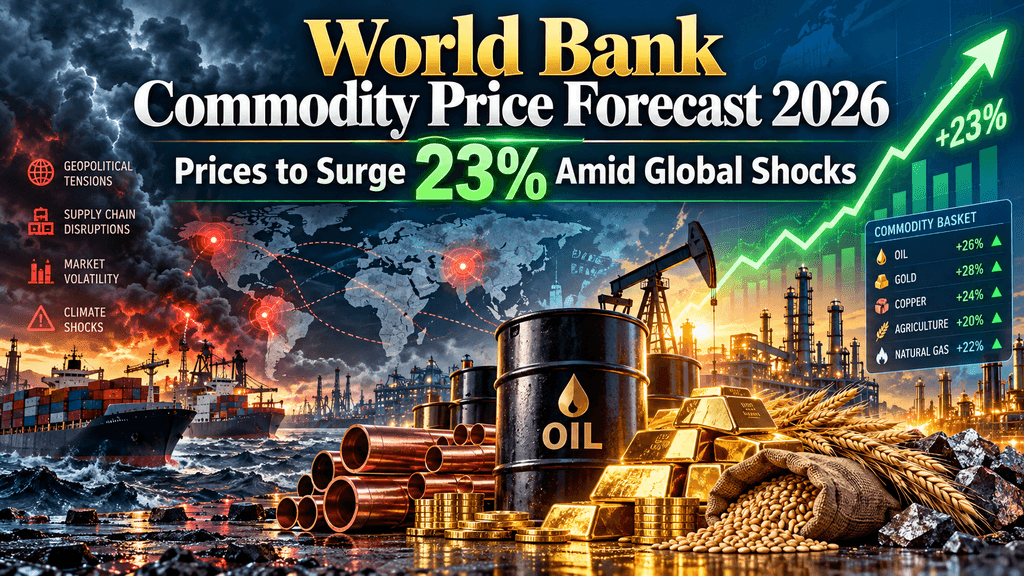
The World Bank forecasts a 23% increase in global commodity prices in 2026, driven by energy supply disruptions, geopolitical conflicts, and rising agricultural costs. Its latest Commodity Markets Outlook, published on October 28, 2026, projects energy prices to rise 32%, food prices to increase approximately 10%, and industrial metals to reach record levels. The revised outlook also warns that depleted oil inventories and continued trade disruptions could intensify inflation and weaken global economic growth. Although the World Bank expects overall commodity prices to decline by 7% in 2027, ongoing supply risks and uneven price movements across major commodity groups could complicate the recovery.
Why the World Bank Raised Its 2026 Commodity Price Forecast to 23% Amid Global Supply Shocks
The World Bank revised its 2026 global commodity price forecast to a 23% annual increase, up from the 16% projected in April, as prolonged energy supply shortages, geopolitical conflicts, and agricultural disruptions intensified pressure on international markets. Its October 28, 2026, Commodity Markets Outlook reflects a seven-percentage-point upward revision to expected annual price growth. The change is primarily linked to declining oil production, depleted inventories, disrupted shipping routes, and additional supply risks affecting food and industrial commodities. The 23% figure represents a forecast for the World Bank's weighted commodity price index, rather than an identical increase across individual markets.
Middle East Energy Disruptions and Oil Supply Shortages Drive the Forecast Revision
The Middle East conflict has become the central factor behind the World Bank's revised commodity price outlook. Disruptions to energy infrastructure and shipping through the Strait of Hormuz have constrained global oil availability, while continued inventory withdrawals have reduced the market's capacity to absorb further supply interruptions. The World Bank now projects energy prices to increase 32% in 2026, compared with its April forecast of 24%. Global oil production is expected to contract 5.2%, equivalent to approximately 5.5 million barrels per day, while consumption is forecast to decline by a smaller 2.5%. This imbalance is significant because weaker demand alone may not restore price stability when production losses remain substantial. Brent crude is forecast to average $91 per barrel in 2026, compared with the $86 estimate published in April. These figures represent annual forecasts, not confirmed full-year outcomes.
The latest available monthly data also illustrates how supply disruptions have affected commodity markets. The World Bank's October 2, 2026, update reported a 25.7% increase in its energy price index during September, driven by a 21.2% rise in crude oil prices and a 15.3% increase in natural gas prices. Unlike the annual forecasts, these figures describe observed monthly market movements. The distinction matters because short-term price increases do not necessarily continue at the same pace throughout the year. However, the combination of lower production, limited inventories, and persistent transportation risks helps explain why the October outlook is more severe than April's. For energy-importing economies, sustained price pressures could raise transportation, manufacturing, and electricity costs, although the impact on domestic inflation will depend on exchange rates, government policies, and the duration of supply shortages.
Agricultural Supply Risks, Industrial Demand and Upcoming Commodity Market Catalysts
Beyond energy markets, disruptions to grain shipments through the Black Sea and unfavorable agricultural conditions have increased uncertainty surrounding global commodity supplies. The World Bank identifies a strong El Niño weather pattern as a potential threat to harvests, while elevated fuel and fertilizer costs are increasing pressure on agricultural production. Food commodity prices are forecast to rise approximately 10% in 2026, and fertilizer prices are projected to increase about 14%. Industrial metals face a different combination of pressures, with demand supported by investment in renewable energy, electric vehicles, electricity infrastructure, and data centers alongside production constraints. These developments show that the revised commodity outlook reflects several distinct market forces rather than a single supply shock. Nevertheless, potential weather-related crop losses and further trade interruptions remain risks, not guaranteed outcomes.
Looking ahead, the World Bank's next scheduled monthly commodity price update on November 3, 2026, will provide an early opportunity to assess whether recent energy and agricultural price pressures are continuing. Important indicators include oil inventory changes, shipping activity through major energy corridors, grain export flows, weather developments, and signs of supply recovery. The next full Commodity Markets Outlook is scheduled for April 2027, although changing geopolitical conditions could affect market expectations before then. The October baseline projects an overall commodity price decline of 7% in 2027, assuming no major escalation in conflicts affecting global supplies. That forecast remains uncertain: prolonged production disruptions or more severe agricultural losses could keep prices elevated, while faster supply recovery and weaker global demand could ease inflationary pressure. For businesses, policymakers, and financial markets, the key issue is whether supply conditions improve sufficiently to support a sustained moderation in commodity prices.
World Bank Commodity Price Forecast 2026: Oil, Energy, Food, Gold and Industrial Metals
The World Bank's October 28, 2026, Commodity Markets Outlook projects significant differences across global energy, agricultural, and metals markets, with its overall commodity price index forecast to increase 23.1% in 2026. Energy prices are expected to rise 32%, food commodities 10.3%, metals and minerals 24.5%, and precious metals 39.9%. These projections reflect different supply conditions, production costs, and demand trends across individual markets. The variation is important for understanding how commodity price changes could affect inflation, industrial activity, international trade, and investment decisions. The figures represent forecast annual averages and price-index changes, not confirmed full-year results or current market quotations.
Oil and Natural Gas Price Forecasts for 2026
The World Bank forecasts Brent crude oil to average $91 per barrel in 2026, compared with $69 in 2025, as constrained production and reduced inventories keep global energy markets under pressure. Natural gas markets face even larger projected increases in certain regions. European natural gas prices are expected to average $19 per million British thermal units (MMBtu), representing a 58.3% annual increase, while liquefied natural gas delivered to Japan is forecast at $20 per MMBtu, up 66.7%. In contrast, US natural gas prices are projected to remain unchanged at approximately $3.50 per MMBtu, demonstrating how regional infrastructure, supply availability, and transportation constraints influence energy costs differently. Higher international oil and gas prices can increase electricity generation expenses, manufacturing costs, and transportation charges, particularly in energy-importing economies. However, domestic fuel prices do not necessarily move at the same rate because taxes, subsidies, currency movements, and long-term supply contracts influence what consumers and businesses ultimately pay.
Food, Grain and Fertilizer Prices Face Uneven Increases
The World Bank expects global food commodity prices to increase 10.3% in 2026, with grain prices rising 14.1% and fertilizer prices climbing 14.3%. Individual agricultural markets show substantial differences. US hard red winter wheat is forecast to average $311 per metric ton, compared with $243 in 2025, representing a 28% increase. Maize prices are projected to rise 9.9% to $223 per metric ton, while the benchmark Thai rice price is expected to increase 9.8% to $448 per metric ton. Fertilizer costs remain another important factor, with urea forecast at $510 per metric ton, up 20.6% from 2025. These increases can affect farmers' production decisions, food processors' operating costs, and import bills for countries dependent on international agricultural supplies. Nevertheless, not all food-related commodities are expected to become more expensive. Cocoa prices are forecast to decline 37.2%, illustrating how improving supply conditions in individual markets can produce lower prices despite broader agricultural inflation. Retail food costs will also depend on local harvests, distribution expenses, and exchange rates rather than international commodity benchmarks alone.
Gold, Silver, Copper and Industrial Metals Price Forecasts
Industrial and precious metals are projected to record some of the largest commodity price increases in 2026, although their underlying demand drivers differ. The World Bank forecasts copper prices to average $13,200 per metric ton, up 32.7% from 2025, while tin is expected to reach $51,000 per metric ton, representing a 49.7% increase. Aluminum prices are projected to rise 23.5% to $3,250 per metric ton. Demand from electricity networks, renewable energy infrastructure, electric vehicles, and data centers supports these industrial metals, making their prices particularly relevant for manufacturing and infrastructure investment. Precious metals are influenced more directly by safe-haven demand and financial uncertainty. Gold is forecast to average $4,600 per troy ounce in 2026, up 33.6%, while silver could average $70 per ounce, an increase of 75.9%. However, rising prices may increase procurement costs and project budgets for industrial consumers, while the outlook for metals producers depends on operating expenses and production volumes. Importantly, the World Bank tracks precious metals separately and excludes them from its headline commodity price index. Their projected gains should therefore not be interpreted as directly contributing to the overall 23.1% forecast.
How Rising Commodity Prices Could Affect Global Inflation, Economic Growth and Financial Markets
Rising global commodity prices could create broader economic challenges by increasing production costs, reducing household purchasing power, and influencing financial-market expectations. The World Bank's October 28, 2026, Commodity Markets Outlook highlights the risk that persistent supply pressures could worsen inflation and weaken economic growth. However, the effects will differ across countries and industries, depending on their reliance on imported commodities, domestic production capacity, and monetary policies. Understanding these differences is essential for assessing the economic implications of the latest commodity price forecasts.
Inflation Pressures and Central Bank Interest Rate Decisions
Higher commodity prices can contribute to global inflation when businesses pass increased energy, transportation, and raw-material costs to consumers. This process can affect food, manufactured goods, and services, although retail prices typically respond at different speeds. Persistent cost pressures may complicate monetary policy decisions by making it harder for central banks to bring inflation toward their targets without weakening economic activity. The International Monetary Fund's April 14, 2026, economic analysis identified commodity-related supply shocks as a source of higher inflation and reduced purchasing power. Nevertheless, the impact on interest rates remains uncertain. Policymakers must distinguish temporary supply-driven price increases from persistent inflation, particularly when higher borrowing costs cannot directly restore disrupted commodity supplies.
Global Economic Growth, Trade and Emerging Market Vulnerabilities
Elevated commodity costs can weaken global economic growth by reducing consumer spending, increasing business expenses, and delaying investment projects. The effects are particularly challenging for energy- and food-importing economies, where larger import bills can pressure trade balances, government budgets, and foreign exchange reserves. Commodity-exporting countries may benefit from stronger export revenues, although higher prices can also increase domestic costs and expose public finances to future market reversals. Lower-income households face additional challenges because essential goods account for a larger share of their spending. Recognizing these risks, the World Bank announced on October 28 that it was making $50 billion to $60 billion available through existing financial instruments to help affected countries support vulnerable households, businesses, and agricultural producers. The economic benefits will depend on how effectively those resources are deployed and whether international supply conditions improve.
Stock Markets, Bond Yields and Investor Risk Appetite
Commodity price volatility can influence global financial markets through corporate earnings expectations, inflation forecasts, and changes in investor risk appetite. Higher operating expenses may pressure profit margins in transportation, manufacturing, and consumer-facing industries, while some commodity producers could benefit from stronger selling prices. Bond markets may respond to expectations that persistent inflation will delay interest rate reductions, potentially increasing borrowing costs and affecting equity valuations. Currency movements can also create contrasting outcomes, particularly between major commodity exporters and import-dependent economies. Prolonged commodity-related shocks may contribute to tighter financial conditions and changing risk premiums, although the size of these effects is uncertain. For cryptocurrency and other risk-sensitive markets, the effects would be indirect, depending on liquidity, interest rate expectations, and broader investor sentiment. No single market reaction is guaranteed, making the duration of commodity inflation and the response of central banks more important than short-term price fluctuations alone.
World Bank Commodity Outlook for 2027–2028: Price Declines, Supply Risks and Future Market Expectations
The World Bank expects global commodity markets to gradually stabilize after the sharp price increases forecast for 2026, although the recovery may be uneven across major commodity groups. Its October 28, 2026, Commodity Markets Outlook projects that the overall commodity price index will decline by 7% in 2027 and a further 8.8% in 2028, supported by improving supply conditions and adjustments in global demand. These projections suggest that some inflationary pressures could ease over the next two years. However, declining annual prices would not necessarily mean a return to earlier cost levels, particularly for essential agricultural commodities.
Global Commodity Prices Could Moderate Through 2028 as Supply Conditions Improve
The World Bank's baseline forecast anticipates a gradual correction in energy and industrial commodity markets as production capacity recovers, inventories rebuild, and consumption adjusts to higher costs. Energy prices are projected to decline 11.5% in 2027 and another 11.8% in 2028, while Brent crude oil is expected to average $79 per barrel in 2027 before falling to $70 in 2028. Metals and minerals prices are also forecast to decrease by 3.3% in 2027 and 3.8% in 2028, reflecting expectations of more balanced supply and demand. Nevertheless, the projected overall commodity price index for 2028 would remain approximately 4% above its 2025 level, based on the World Bank's published forecast changes. This indicates that the anticipated correction may reduce cost pressures without fully reversing the earlier increase. For businesses planning procurement and capital investment, the distinction between slower price growth and genuinely lower input costs remains important.
Agricultural Price Trends Could Diverge From the Broader Commodity Market
The agricultural outlook presents a different challenge because food-related prices are not expected to follow the same downward trajectory as energy. The World Bank forecasts food commodity prices to increase another 7.2% in 2027 before declining 5.2% in 2028. Based on its annual forecasts, food prices would still be approximately 12% higher in 2028 than in 2025, even after the anticipated correction. This divergence suggests that consumers and food-importing economies may continue facing elevated agricultural costs despite a broader decline in global commodity prices.
Fertilizer markets offer a potentially more favorable outlook, with prices projected to fall 12.4% in 2027 and 8.2% in 2028. Lower fertilizer expenses could gradually improve agricultural production economics, particularly for farmers managing high input costs. However, the benefits may take time to appear in consumer prices because agricultural production cycles, local harvest conditions, transportation networks, and exchange-rate movements influence food costs. The timing of future harvests and the availability of international grain supplies will therefore remain important factors in determining whether the projected easing in agricultural input prices translates into more affordable food.
Supply Recovery, Geopolitical Risks and Market Signals to Watch
The World Bank's 2027–2028 projections depend on an orderly improvement in global commodity supplies, making the pace of recovery a central uncertainty. Its October 2026 report outlines an adverse scenario in which renewed energy disruptions and agricultural supply pressures could push Brent crude to an average of $105 per barrel in 2027, compared with the $79 baseline forecast. Food commodity prices could also exceed baseline expectations by 12% under this scenario. These estimates illustrate the potential consequences of additional supply shocks rather than the World Bank's central expectations. Prolonged transportation difficulties, limited energy inventories, and unfavorable agricultural conditions could delay the anticipated market stabilization.
Future commodity market expectations will increasingly depend on measurable changes in production, inventories, trade flows, and consumption. Rebuilding oil reserves, improving agricultural output, and more reliable international shipping could support the projected price correction, while weaker industrial demand might create additional downward pressure. Conversely, unexpected supply interruptions could produce renewed volatility across interconnected commodity markets. Investors, businesses, and policymakers will need to assess these developments alongside inflation data and economic growth indicators rather than treating the World Bank's forecasts as fixed outcomes. The next scheduled full Commodity Markets Outlook in April 2027 will provide an important opportunity to reassess the longer-term projections using updated market conditions.
Conclusion
The World Bank's October 2026 commodity price forecast reflects the growing economic consequences of simultaneous energy, agricultural, and industrial supply pressures. Its projected 23% increase in global commodity prices highlights the importance of supply disruptions in shaping inflation expectations, production costs, and international trade. While the institution anticipates lower overall prices in 2027 and 2028, the recovery is unlikely to be uniform across commodity categories. Food costs may remain elevated even as energy markets stabilize, and additional supply shocks could delay the expected correction. The outlook ultimately depends on whether production, transportation networks, and global trade conditions improve sufficiently to restore more balanced commodity markets.
FAQs
What does the World Bank's 23% commodity price forecast actually measure?
The World Bank's 23% forecast represents the expected annual increase in its weighted global commodity price index for 2026. The index combines energy and non-energy commodities using historical export-based weights, with energy accounting for approximately 67%. Precious metals are excluded from the headline index. The forecast does not mean every individual commodity will become 23% more expensive.
Is the World Bank commodity price index the same as consumer inflation?
No. The World Bank commodity price index measures changes in international raw-material prices, while consumer inflation tracks the prices households pay for goods and services. Commodity costs can influence inflation, but the effects depend on transportation expenses, wages, taxes, retail margins, and government policies. A 23% increase in the commodity index does not imply a 23% increase in consumer prices.
Does the 2026 commodity price forecast predict prices at the end of December?
No. The World Bank's annual commodity forecasts generally describe average price levels or average index changes across the calendar year, rather than prices on December 31. An annual increase can occur even when prices decline during the final months of the year. Readers should distinguish annual averages from monthly price movements and individual commodity spot prices.
How do currency exchange rates affect commodity prices in different countries?
Most internationally traded commodities are priced in US dollars, so exchange-rate movements can influence their cost in local currencies. A weaker domestic currency can make imported oil, grain, and metals more expensive even when dollar-denominated prices remain unchanged. Conversely, currency appreciation may reduce import costs. The final impact also depends on local taxes, supply contracts, and domestic pricing arrangements.
Which countries are most vulnerable to sustained high commodity prices?
Countries heavily dependent on imported fuel, food, and agricultural inputs are particularly exposed to rising international commodity costs. Low-income economies with limited fiscal resources and substantial foreign-currency debt may face additional difficulties. Commodity-exporting countries could benefit from stronger export earnings, although those gains depend on production volumes, domestic costs, and the commodities they trade.
What financial support is the World Bank providing to countries affected by commodity shocks?
On October 28, 2026, the World Bank Group announced that $50 billion to $60 billion was available through existing financial instruments, including $25 billion in pre-arranged financing. The resources can support vulnerable households, strengthen government finances, and provide liquidity for businesses and agricultural producers. This is available financial capacity rather than confirmation that the entire amount has already been disbursed.
Disclaimer: This general market information, possibly from third-party, commercial, or sponsored sources, is provided for reference and educational purposes only and does not constitute financial or investment advice, an offer, solicitation, or guarantee. We disclaim liability for its accuracy, completeness, reliability, and any resulting losses. Investments/trading are risky; past performance doesn’t guarantee future results. Users should research, judge prudently, and take full responsibility. For further details, please consult KuCoin’s Terms of Use and Risk Disclosure.