

Will the CLARITY Act Pass in 2026? Its Passage Odds Fall to 13% Ahead of September 15 Senate Vote
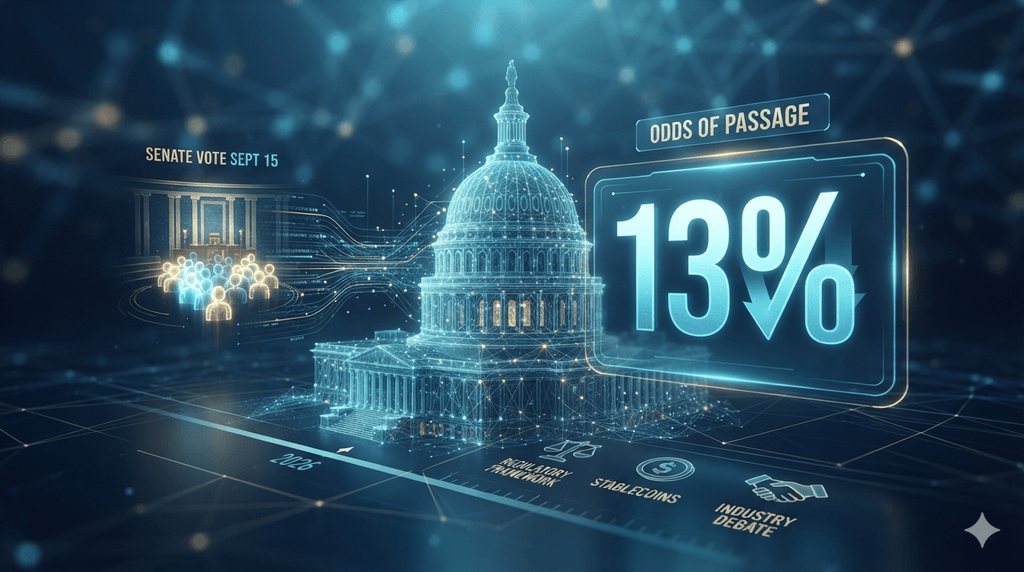
The Digital Asset Market Clarity Act, known as the CLARITY Act or H.R. 3633, represents the most advanced effort in years to create a comprehensive federal framework for cryptocurrency markets in the United States. After clearing the House of Representatives in July 2025 by a 294-134 bipartisan margin and advancing from the Senate Banking Committee in May 2026 by a 15-9 vote, the legislation now faces a critical procedural test. Senate Majority Leader John Thune filed cloture on the motion to proceed, setting a September 15, 2026, vote that requires 60 senators to agree to limit debate and begin formal consideration. Prediction markets have responded with sharp skepticism.
Polymarket currently implies only about a 13% chance the bill becomes law before the end of 2026, a steep decline from peaks near 82% earlier in the year, while Galaxy Research has lowered its own estimate as low as 10% in recent assessments. Despite a scheduled Senate procedural vote and broad industry support, unresolved disputes over ethics provisions, stablecoin yields, and DeFi protections, combined with a compressed legislative calendar ahead of the midterm elections, make full enactment of the CLARITY Act in 2026 improbable, shifting the practical outlook toward continued agency-level rulemaking and delayed statutory clarity for digital asset markets.
Prediction Markets Signal Deep Skepticism on Full Enactment Despite High Likelihood of a Senate Vote
Polymarket traders have driven the implied probability of the CLARITY Act becoming law in 2026 down to roughly 13%, with related contracts attracting more than $11.5 million in volume. This figure stands in contrast to Kalshi markets that assign about a 91% chance of some form of Senate vote occurring before October 1. The distinction matters because the September 15 action is not a final passage vote. It is a cloture vote on the motion to proceed, the procedural gate that allows debate to begin. Clearing that hurdle still leaves floor amendments, potential filibuster threats on subsequent stages, reconciliation with any differing House text, and a presidential signature. Analysts note that each remaining step multiplies risk on a calendar that offers limited working days after mid-September before campaigning intensifies. The sharp drop from earlier highs reflects accumulated delays rather than a sudden loss of conceptual support for clearer SEC and CFTC jurisdiction. Market participants appear to price the bill as likely to receive a hearing yet unlikely to complete the full legislative gauntlet before year-end, consistent with patterns observed in other complex, bipartisan measures that stall near the end of a Congress.
Galaxy Research’s successive reductions, from 75% after the May committee markup to 50% by late June and later to the 10% range, reinforce the same calendar-driven assessment. Head of research Alex Thorn has repeatedly emphasized that the substance of the bill retains support while the number of available session days shrinks. Republicans control 53 Senate seats and therefore need at least seven Democratic or independent votes to reach the 60-vote threshold for cloture. Only two Democrats, Senators Ruben Gallego and Angela Alsobrooks, supported the Banking Committee advance. Securing additional cross-aisle support has proven difficult amid ongoing negotiations. The prediction-market divergence between a high probability of a vote and a low probability of enactment captures the practical reality facing the industry: visibility on September 15 will clarify the near-term process but is unlikely by itself to resolve the deeper disagreements that have delayed final text.
Senate Calendar Pressure Intensifies as Midterm Election Season Approaches
The legislative calendar itself has become the dominant constraint. After the Senate returned from its August state work period, only a limited number of working weeks remained before members focused more heavily on November midterms. Majority Leader Thune’s decision to file cloture before the recess preserved the bill’s place in the queue and scheduled the first formal test for September 15. Yet even a successful cloture vote would open a multi-day process of debate and amendments that must compete with other priorities, including appropriations, defense authorization, and any must-pass measures that typically dominate the final months of a session. Historical patterns show that controversial or highly technical bills often lose floor time once campaigning accelerates. Observers tracking the process note that a failure to move quickly after September 15 would push any remaining action into a compressed November-December window crowded by year-end spending bills, further reducing realistic odds of completion in 2026.
Industry groups have publicly urged leadership to prioritize the measure, citing more than 200 firms that called for a vote earlier in the summer. Those appeals have not yet produced the unified Banking-Agriculture committee text or the locked Democratic support needed to make floor time productive. The bill’s placement on the Senate Legislative Calendar since early June made it eligible for consideration, but eligibility and actual scheduling remain distinct. As the calendar tightens, the cost of continued negotiation rises because each unresolved issue consumes scarce days. This dynamic explains why even optimistic assessments now treat 2026 enactment as a low-probability outcome while still viewing the September 15 vote as a necessary, if insufficient, next step.
Ethics Provisions Remain a Core Obstacle to Broader Democratic Support
One of the most persistent sticking points involves ethics language addressing potential conflicts of interest for public officials who hold or have held digital assets. Democrats have pressed for robust restrictions and enforcement mechanisms, while Republican drafts have at times limited enforcement pathways or included sunsets that some view as insufficient. Reports indicate that earlier attempts to craft DOJ-only enforcement language met resistance, and subsequent merged texts exceeding 600 pages still left the issue unresolved. Without a durable bipartisan ethics framework, the two Democratic committee supporters have signaled reluctance to provide floor votes, and additional Democratic support remains elusive. The dispute is not abstract; it touches directly on public confidence in the regulatory system the bill seeks to create.
Resolution would require compromise that satisfies both sides’ political constraints while preserving the bill’s market-structure goals. Failure to close this gap before or immediately after the September 15 vote would leave the measure vulnerable to further delay. Ethics concerns have already contributed to the steady erosion of prediction-market odds throughout the summer. Market participants treat the issue as more than a side disagreement because it affects the willingness of the necessary seventh and subsequent Democratic votes. Until negotiators produce language that can lock in a reliable bipartisan bloc, the path to 60 votes stays narrow regardless of how the procedural vote itself turns out.
Stablecoin Yield and Rewards Language Continues to Divide Stakeholders
Stablecoin provisions, particularly those governing interest or yield on payment stablecoins, constitute another major unresolved area. Draft language has sought to prohibit payments that function economically like interest on bank deposits while allowing certain bona fide activity-based rewards. Banking interests have expressed concern that unrestricted yield could draw deposits away from traditional institutions, while crypto firms argue that limited rewards are necessary for product competitiveness and user adoption. The interaction with the already-enacted GENIUS Act, which established a federal framework for payment stablecoins, adds complexity because CLARITY must avoid creating inconsistent or overlapping rules.
Negotiators have circulated multiple iterations, yet no final compromise has secured broad agreement. The issue carries practical weight for market participants who have built products around rewards programs. Prolonged uncertainty encourages firms to design around the most restrictive plausible outcomes or to locate activity in more predictable jurisdictions. Because stablecoin language affects both consumer-facing products and the competitive balance between crypto platforms and banks, it resists quick resolution. The September calendar leaves little room for extended further bargaining once the procedural vote occurs. Continued disagreement here would likely force the bill into a narrower form or delay it beyond 2026.
DeFi and Non-Custodial Developer Protections Add Further Complexity
Protections for decentralized finance protocols and non-custodial software developers form a third cluster of open issues. Advocates seek clear safe harbors so that writing and publishing code, or operating non-custodial interfaces, does not automatically trigger registration or liability as a broker, dealer, or exchange. Opponents worry that overly broad carve-outs could create gaps in investor protection or anti-money-laundering coverage. Earlier drafts contained developer-focused language that has been the subject of intense negotiation, with some versions preserving stronger protections and others narrowing them.
The technical nature of these provisions makes rapid consensus difficult. Lawmakers must balance innovation incentives against the risk of regulatory arbitrage. Industry participants view durable DeFi language as essential if the United States is to remain competitive with jurisdictions that have already adopted clearer rules for software developers. The absence of settled text on this point contributes to the low passage odds because it expands the set of issues that must be closed before a final vote. Even if cloture succeeds on September 15, floor amendments or conference negotiations could reopen these questions and consume additional time the calendar does not easily supply.
SEC and CFTC Jurisdiction Allocation Defines the Bill’s Core Ambition
At its foundation, the CLARITY Act seeks to allocate primary authority over spot digital commodity markets to the Commodity Futures Trading Commission while preserving Securities and Exchange Commission oversight of assets that remain securities or investment contracts. It introduces definitions and tests intended to determine when a digital asset transitions from securities treatment to commodity treatment, often tied to decentralization metrics and the maturity of the underlying network. Dual-registration pathways and coordination mechanisms between the agencies are designed to reduce duplicative or conflicting regulation for intermediaries that handle both categories of assets.
This jurisdictional clarification has been the central promise of the legislation since its House passage. Market participants have long cited regulatory uncertainty as a barrier to institutional participation and product development in the United States. By establishing statutory lines rather than relying solely on enforcement actions or interpretive guidance, the bill aims to create more durable rules of the road. Yet the very ambition of rewriting jurisdictional boundaries increases the political and technical difficulty of final agreement. Any final text must satisfy both agencies’ institutional interests and the policy preferences of senators who sit on the relevant committees. The complexity of this core architecture helps explain why progress has been slower than early-year optimism suggested.
House Passage in 2025 Created Momentum That Has Proven Hard to Sustain
The House approved its version of the CLARITY Act in July 2025 by a decisive 294-134 margin that included substantial Democratic support. That vote demonstrated bipartisan appetite for market-structure legislation and placed pressure on the Senate to act. The Senate Banking Committee’s subsequent 15-9 advance in May 2026, with two Democrats joining all Republicans, appeared to confirm continued momentum. Placement on the Senate Legislative Calendar in early June made the bill eligible for floor consideration without further committee action.
Momentum, however, does not automatically translate into floor time or final votes. Competing priorities, the need to reconcile Banking and Agriculture Committee approaches, and the emergence of ethics and yield disputes steadily eroded the early advantage. By late summer, the bill had become a calendar story as much as a policy story. The contrast between the strong House margin and the current low Senate passage odds illustrates how procedural and political constraints in the upper chamber can stall even broadly supported measures. The September 15 vote offers a chance to regain procedural ground, yet the accumulated delays have already lowered expectations for completion this year.
Industry Advocacy Has Kept the Bill Alive but Cannot Overcome Calendar Limits
Crypto firms and trade associations have maintained consistent public pressure, with more than 200 companies previously urging Senate leaders to schedule consideration. Advocacy has focused on the economic costs of prolonged uncertainty, including deferred investment, talent relocation, and competitive disadvantages relative to other jurisdictions. These efforts helped keep the bill on leadership’s radar and contributed to the decision to file cloture before the August recess.
Advocacy alone cannot manufacture legislative days or resolve internal disagreements among senators. As the midterm calendar tightens, even well-organized industry support faces diminishing returns if the necessary bipartisan votes remain unavailable. Firms have begun preparing contingency plans that rely more heavily on existing agency authority and the GENIUS Act framework for stablecoins. The intensity of industry engagement underscores the practical stakes while also showing the limits of external pressure when internal Senate dynamics and scheduling realities dominate.
Agency Rulemaking Continues in Parallel as Legislative Prospects Dim
While the CLARITY Act has advanced through earlier stages, the SEC and other regulators have continued developing their own approaches to digital assets. Recent SEC proposals, including elements of Regulation Crypto Assets, seek to create exemptions and safe harbors within existing statutory authority. These efforts provide interim pathways for capital formation and classification but lack the permanence and comprehensive market structure rules that legislation could deliver. Officials have publicly noted that durable congressional action remains preferable, yet they have also moved forward in the absence of final legislation.
The parallel track reduces the immediate crisis for market participants but does not eliminate the value of statutory clarity. Agency rules can be revised by future administrations more readily than statutes. The low odds of 2026 enactment therefore imply a longer period of hybrid regulation in which firms navigate both existing securities laws and evolving agency guidance. Market participants monitoring the September 15 vote will also watch for signals about whether leadership intends to pursue the bill aggressively afterward or shift focus to other priorities, leaving regulators as the primary source of near-term clarity.
What a Successful Cloture Vote Would and Would Not Achieve
A successful 60-vote cloture outcome on September 15 would allow the Senate to begin formal debate on the motion to proceed and ultimately on the bill itself. That step would represent meaningful procedural progress after months of delay and would keep the legislation alive for potential further action. It would not, however, guarantee final passage. Floor amendments, second-degree cloture votes, reconciliation with the House, and the need to resolve outstanding policy disputes would still remain. Each of those stages carries its own risk of delay or failure.
Traders and analysts have already priced this distinction. High probabilities of a vote coexist with low probabilities of enactment precisely because the procedural gate is only the first of several. If cloture fails, the 2026 window effectively closes for practical purposes. If it succeeds, attention will immediately shift to whether negotiators can close the ethics, yield, and DeFi gaps quickly enough to complete the process before the calendar becomes prohibitive. The vote therefore functions more as a diagnostic than as a decisive outcome.
Potential Paths Forward If 2026 Enactment Proves Unattainable
Should the bill fail to clear all remaining hurdles this year, several alternatives remain. Negotiators could attempt to attach key provisions to must-pass year-end legislation, though the technical complexity of market-structure language makes that route challenging. The next Congress could reintroduce a revised version, potentially with adjustments reflecting the midterm results and any intervening agency actions. In the interim, firms would continue relying on the GENIUS Act for stablecoins, SEC interpretive guidance, CFTC authority over certain derivatives, and private-sector compliance practices.
None of these alternatives fully substitutes for comprehensive legislation. Prolonged uncertainty tends to favor larger, better-resourced participants that can absorb legal and compliance costs while raising barriers for smaller innovators. The industry’s preference for statutory clarity remains clear; the political and calendrical conditions required to achieve it in 2026 have simply grown more difficult. Market participants will watch the September 15 vote and subsequent negotiation signals closely for any indication that the low-probability path can still be navigated.
Conclusion
Continued delay carries measurable consequences for capital allocation, product development, and jurisdictional competition. Institutional investors often cite regulatory clarity as a prerequisite for larger allocations to digital assets. Product teams design listings, custody arrangements, and yield features with an eye toward the most restrictive plausible U.S. rules. Some activity has already migrated to jurisdictions with clearer frameworks. While Bitcoin and other major assets have demonstrated resilience to policy news, secondary effects appear in venture funding patterns, exchange listing decisions, and the willingness of traditional financial institutions to expand crypto offerings.
A low probability of near-term legislative resolution encourages firms to invest more heavily in compliance infrastructure suited to the current hybrid regime. It also increases the relative importance of agency appointments and guidance documents. For traders and long-term holders, the primary implication is that regulatory catalysts may arrive more slowly and in smaller increments than earlier 2026 optimism suggested. The September 15 vote will provide new information, yet the broader trajectory points toward extended reliance on existing authorities rather than a single transformative statute this year.
FAQs
What exactly is the CLARITY Act intended to accomplish?
The Digital Asset Market Clarity Act seeks to establish a statutory framework that classifies digital assets and allocates primary regulatory authority between the Securities and Exchange Commission and the Commodity Futures Trading Commission. Spot digital commodity markets would fall principally under CFTC oversight, while assets that meet the definition of securities or investment contracts would remain with the SEC. The bill also addresses intermediary registration, disclosure requirements, dual-registration pathways, and coordination mechanisms between the two agencies. Supporters argue that clear jurisdictional lines would reduce enforcement-driven uncertainty and support more predictable market development in the United States.
Why does the September 15 vote matter if it is only procedural?
The September 15 action is a cloture vote on the motion to proceed. Under Senate rules, 60 votes are required to limit debate and allow the chamber to begin formal consideration of the underlying bill. Without cloture, the measure remains blocked from floor debate. Success would open the door to further process; failure would effectively end realistic prospects for 2026 enactment. Because the full path still includes amendments, additional votes, and House reconciliation, the procedural vote is necessary but far from sufficient.
How have prediction markets moved on the bill’s prospects?
Polymarket odds for the CLARITY Act becoming law in 2026 have fallen from peaks near 82% earlier in the year to approximately 13% in recent trading, with substantial volume. Separate markets on Kalshi assign a high probability to the occurrence of a Senate vote before October 1. The divergence reflects traders’ assessment that a procedural vote is likely while full enactment faces multiple remaining obstacles on a constrained calendar. Galaxy Research’s independent estimates have followed a similar downward trajectory for calendar-related reasons.
What are the main unresolved policy disputes?
Three clusters of issues have proven most difficult: ethics provisions governing public officials’ digital-asset holdings and related enforcement, language restricting or permitting certain forms of stablecoin yield and rewards, and the scope of protections for decentralized-finance protocols and non-custodial software developers. Each area involves competing interests among lawmakers, agencies, traditional finance, and crypto firms. Progress on any one does not automatically resolve the others, and the compressed September calendar leaves limited time for sequential negotiation.
KuCoin Offers A More Stable Option in A Volatile Market
If you worry about the frequent ups and downs in the market, and pursue a more stable option to earn money passively, KuCoin is the right place to come:
Simple Earn: Deposit and withdraw tokens anytime, earning stable returns.
Kucoin Earn: Earn stable profits with professional asset management.
Hold to Earn: Earn rewards by holding assets in Funding, Trading, Margin, Futures, Mining, and Unified Accounts.
Staking: Unlock the earning potential of on-chain assets.
Advanced Investments: Advanced Investments offer a variety of structured products to help your money grow in any market.
Shark Fin: Principal Protection and Guaranteed Gains
Dual Investment: Buy low and sell high with transparent return calculations.
Snowball: High yields, with price protection.
Discount Buy: Buy crypto at discount prices.
KCS Loyalty: Level up to enjoy exclusive perks by staking ≥ 1 KCS.
KuCoin Wealth: Discover future value and begin your smart investing journey.
KCS Benefits: Hold and stake KCS to access benefits across the platform.
KCS Staking 2.0: Participate in KCS on-chain governance to earn yield.

Disclaimer
The information provided on this page may originate from third-party sources and does not necessarily represent the views or opinions of KuCoin. This content is intended solely for general informational purposes and should not be considered financial, investment, or professional advice. KuCoin does not guarantee the accuracy, completeness, or reliability of the information, and is not responsible for any errors, omissions, or outcomes resulting from its use. Investing in digital assets carries inherent risks. Please carefully evaluate your risk tolerance and financial situation before making any investment decisions. For further details, please consult KuCoin’s Terms of Use and Risk Disclosure.