

Will central banks in the world start to increase rate in 2026?
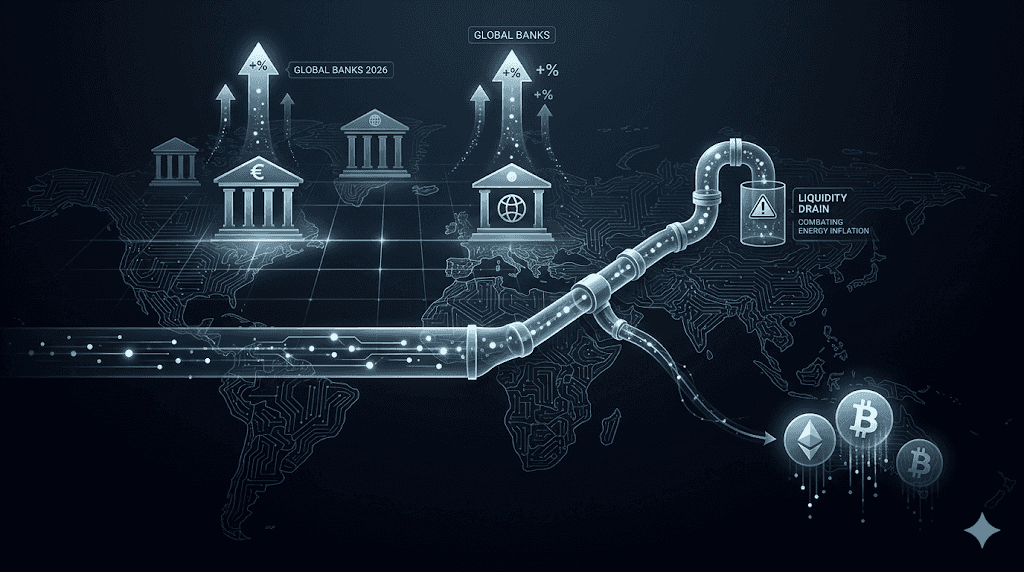
After a period of anticipated rate cuts, a sudden resurgence in global inflation, driven heavily by Middle Eastern geopolitical conflicts and soaring energy prices, has forced major institutions to reverse course. The European Central Bank (ECB) initiated this tightening cycle in June 2026 by hiking its key policy rates by 25 basis points, marking its first increase since 2023.
This macroeconomic shift directly impacts the cryptocurrency sector by restricting the flow of cheap fiat capital. When central banks raise rates, borrowing becomes expensive, and institutional investors rotate capital out of speculative digital assets into safer, yield-bearing traditional instruments.
Key Takeaways
-
Middle Eastern conflicts and soaring oil prices have triggered a severe global inflation crisis in 2026.
-
Led by the ECB's June 2026 hike, major global central banks are aggressively raising interest rates.
-
Rising interest rates systematically drain global fiat liquidity, suppressing demand and valuations across cryptocurrency markets.
-
Institutional investors are rotating capital out of speculative cryptocurrencies into safer, yield-bearing traditional bonds.
The 2026 Global Inflation Resurgence
Persistent geopolitical conflicts in the Middle East have severely disrupted critical global shipping lanes, causing massive spikes in fundamental energy and manufacturing costs. Sustained inflationary pressure leaves central banks with absolutely no choice but to tighten monetary policy.
The rapid escalation of these supply chain bottlenecks guarantees that inflation will remain structurally elevated throughout the entire calendar year. When baseline energy costs surge, the price of agricultural production, industrial manufacturing, and retail transportation mechanically increases. The compounding effect embeds persistent price hikes deeply into the core consumer economy.
Macroeconomic data from mid-2026 confirms that core inflation across major developed economies is tracking well above targeted levels. As inflation proves exceptionally stubborn, central bankers recognize that maintaining current interest rates will no longer suffice to cool the overheating economy. Consequently, a new cycle of coordinated global monetary tightening is now actively underway.
Energy Shocks and the Strait of Hormuz
The prolonged closure of the Strait of Hormuz is the primary catalyst driving the 2026 global inflation crisis. Because this critical maritime chokepoint handles a massive percentage of the world's daily crude oil shipments, its disruption immediately creates severe physical supply shortages. Brent crude prices have surged past $100 per barrel as a direct result of these logistical failures.
These surging energy costs act as a massive, unavoidable tax on global corporate operations and everyday retail consumers. When factories and shipping fleets pay significantly more for fuel, they systematically pass those increased expenses directly to the end buyer. This relentless cost-push inflation forces central banks to intervene aggressively by raising base interest rates to destroy excess consumer demand.
Energy-driven inflation is notoriously difficult for central banks to control because monetary policy cannot magically produce more oil. Raising interest rates simply makes borrowing more expensive, which slows down business expansion and cools consumer spending. By intentionally slowing the broader economy, central banks hope to reduce overall energy demand enough to stabilize runaway consumer prices.
The ECB Leads the Tightening Cycle
The European Central Bank officially became the first major global institution to hike interest rates in 2026, acting decisively in June. By raising its three key policy rates by 25 basis points, the ECB directly responded to eurozone inflation accelerating to 3.2 percent in May.
ECB President Christine Lagarde explicitly cited the intense inflationary pressures emanating from the Middle East conflict as the primary justification for the hike. The central bank raised its main deposit facility rate to 2.25 percent, prioritizing price stability over near-term economic expansion. The institution also revised its core inflation projections aggressively upward for the next two years.
This proactive tightening by the ECB sets a powerful precedent for other major central banks currently grappling with similar inflationary shocks. By abandoning its previous "look through" strategy regarding energy prices, the ECB acknowledges that the current inflation crisis is deeply structural. Financial markets now heavily anticipate that other global central banks will closely mirror this hawkish European monetary policy shift.
Central Bank Policies Worldwide
Major central banks globally are rapidly adopting hawkish monetary stances to combat the escalating energy-driven inflation crisis. Following the decisive action by the European Central Bank, institutions across North America and Asia are rigorously reassessing their current interest rate targets. The era of cheap global fiat liquidity has abruptly ended as policymakers prioritize combating consumer price instability over stimulating short-term economic growth.
The immediate synchronization of global monetary policy tightening creates a highly restrictive financial environment for all speculative asset classes. When central banks collectively raise borrowing costs, the total supply of available fiat currency systematically shrinks across the entire global economy. This coordinated liquidity drain makes it exceptionally difficult for high-risk assets like cryptocurrencies to sustain positive price momentum.
Financial analysts universally project that this hawkish policy environment will dominate the global macroeconomic landscape throughout the remainder of 2026. As long as geopolitical conflicts sustain high energy prices, central banks must maintain elevated interest rates to actively suppress domestic demand. This prolonged period of tight monetary policy dictates massive strategic shifts in global institutional capital allocation.
The Federal Reserve Outlook
The United States Federal Reserve is heavily expected to resume interest rate hikes in late 2026 as domestic inflation severely misses target metrics. With the US consumer price index running hot at 4.2 percent, Fed officials have completely discarded their previous forecasts for multiple rate cuts. The current inflationary data explicitly demands a highly restrictive American monetary policy response.
Minutes from recent Federal Open Market Committee meetings reveal a distinctly hawkish shift among top American monetary policymakers. The committee formally noted that additional policy firming will become absolutely appropriate if inflation persistently remains above the core two percent target. Surging global goods demand and tight domestic labor markets further compound the urgent necessity for higher American borrowing costs.
Because the US Dollar serves as the primary global reserve currency, Federal Reserve rate hikes uniquely impact international liquidity. When the Fed increases rates, it directly strengthens the dollar, making it incredibly expensive for emerging markets to service their dollar-denominated debts. This powerful dynamic efficiently vacuums excess fiat capital out of the highly speculative global cryptocurrency ecosystem.
The Bank of Japan and Bank of England
The Bank of Japan is aggressively accelerating its interest rate hikes to combat rising domestic inflation and stabilize its currency. Analysts project the Japanese central bank will raise its policy rate to 1.0 percent by July 2026, marking a historic departure from decades of negative rates.
Similarly, the Bank of England is maintaining a strictly hawkish posture as energy shocks threaten to embed inflation deeply into the British economy. Although UK policymakers temporarily held rates at 3.75 percent in early 2026, they officially warned that surging energy prices present material upside risks to inflation. The central bank remains entirely ready to hike rates aggressively if wage-setting behaviors continue driving consumer prices higher.
The simultaneous tightening by these massive global central banks completely eliminates the cheap capital that previously funded speculative technology investments. Institutional carry trades, where investors borrow cheaply in Japan to buy risky assets elsewhere, are rapidly becoming unprofitable and highly dangerous. This massive global deleveraging event fundamentally starves the cryptocurrency sector of its traditional institutional fiat inflows.
How Rising Rates Impact Cryptocurrency
Rising global interest rates directly suppress cryptocurrency valuations by systematically draining the fiat liquidity required to fuel digital asset markets. When central banks increase the cost of borrowing money, corporations and retail investors possess significantly less excess capital to deploy into highly volatile investments. This fundamental macroeconomic reality makes it exceptionally difficult for digital assets to achieve sustained price appreciation.
The cryptocurrency ecosystem historically thrives entirely on massive influxes of cheap, easily accessible fiat currency. During periods of loose monetary policy, investors eagerly take on massive risk to generate outsized market returns. However, when central banks actively destroy this excess liquidity through rate hikes, the digital asset market mechanically suffers from a severe lack of incoming buyer demand.
Furthermore, higher interest rates severely impact the massive leverage utilized across global cryptocurrency derivatives exchanges. As borrowing costs increase exponentially, maintaining highly leveraged long positions becomes financially unviable for average retail traders. This structural reduction in market leverage severely limits the total trading volume and overall market depth across the entire digital asset industry.
The Drain on Fiat Liquidity
Central bank rate hikes actively pull fiat currency out of the global economy, creating a massive liquidity vacuum that directly damages cryptocurrency markets. Higher interest rates strongly incentivize consumers and corporations to aggressively save their cash rather than spend or invest it. This fundamental shift in financial behavior starves digital asset exchanges of the fresh capital deposits necessary to drive token prices higher.
When borrowing becomes highly expensive, everyday retail traders suddenly lack the disposable income required to actively speculate on alternative cryptocurrencies. Retail investors are historically the primary driving force behind massive, euphoric digital asset rallies. Without their consistent daily capital inflows, the broader cryptocurrency market naturally experiences prolonged periods of severe price consolidation and downward momentum.
This massive liquidity drain is clearly visible in the rapidly declining trading volumes across all major centralized and decentralized digital asset exchanges. As fiat currency becomes increasingly scarce and valuable, market participants become highly reluctant to exchange it for highly volatile, non-yielding digital tokens. The fundamental macroeconomic environment simply does not currently support aggressive risk-on investment strategies.
Institutional Capital Rotation
Institutional asset managers are aggressively rotating capital out of cryptocurrencies and directly into traditional yield-bearing sovereign bonds. When central banks raise base interest rates, the guaranteed yields offered by government treasury bills become highly attractive to professional risk managers. Institutions simply cannot justify holding highly volatile digital assets when they can safely earn significant, risk-free returns holding government debt.
This massive capital rotation strictly mandates the rapid liquidation of existing institutional cryptocurrency portfolios. As traditional finance funds actively sell their massive Bitcoin and Ethereum holdings to purchase newly issued government bonds, extreme selling pressure completely overwhelms the spot market. This mechanical institutional dumping frequently triggers severe price crashes across the entire digital asset ecosystem.
The current hawkish macroeconomic environment completely destroys the popular narrative that major institutions will continuously blindly accumulate digital assets. Professional capital allocators are strictly bound by fiduciary duties to safely maximize risk-adjusted returns for their clients. During periods of severe global monetary tightening, traditional fixed-income securities fundamentally vastly outperform highly speculative decentralized blockchain networks.
Adapting Crypto Portfolios
Cryptocurrency investors must completely adapt their digital asset portfolios to properly survive the harsh macroeconomic realities of a global rate-hiking cycle. Navigating this highly restrictive financial environment requires a rigorous focus on strict capital preservation and advanced risk management. Speculating aggressively on unproven, low-capitalization altcoins is exceptionally dangerous when global fiat liquidity is rapidly evaporating.
Successful traders strictly prioritize assets that offer verifiable utility, strong tokenomics, or explicit safe-haven characteristics during periods of monetary tightening. Maintaining significantly larger cash or stablecoin reserves allows investors to easily weather sudden, unexpected market downturns. This highly defensive posturing ensures that your core trading capital survives the intense volatility generated by sudden central bank policy announcements.
Investors need closely monitor global macroeconomic data releases, particularly core inflation reports and official central bank policy statements. Because algorithmic trading bots instantly execute massive cryptocurrency sell orders based on hawkish economic news, human traders must remain highly vigilant. Understanding the direct correlation between traditional interest rates and digital asset prices is absolutely essential for long-term survival.
Defensive Assets and Stablecoins
Holding significant stablecoin reserves securely positions sophisticated investors to capitalize quickly on massive macroeconomic market overreactions. When hawkish central bank news triggers a completely irrational cryptocurrency market panic, traders holding stablecoins can instantly purchase heavily discounted premium assets.
During periods of high interest rates, many prominent cryptocurrency exchanges offer highly competitive passive yields strictly on stablecoin deposits. By securely staking these fiat-pegged assets, investors can generate consistent, predictable income while patiently waiting for broader market conditions to improve. This low-risk strategy perfectly offsets the negative impacts of global inflation without assuming massive directional market risk.
Managing High-Beta Altcoin Risk
Investors must aggressively reduce their overall exposure to highly speculative, high-beta altcoins during periods of active central bank monetary tightening. These low-capitalization tokens are exceptionally highly correlated with traditional risk assets, meaning they suffer the most severe price drops when global liquidity shrinks. The fundamental lack of deep market liquidity makes altcoins incredibly dangerous to hold during macro shocks.
When institutional and retail capital completely exits the broader cryptocurrency market, alternative tokens frequently lose massive percentages of their total value. Because these projects heavily rely on continuous venture capital funding to survive, higher borrowing costs severely threaten their long-term operational viability. Many early-stage blockchain networks simply will not survive a prolonged period of expensive global capital.
Traders can intelligently consolidate their digital portfolios into established, large-cap cryptocurrencies like Bitcoin that possess massive global liquidity pools. While major assets still experience significant volatility during rate hikes, their immense market depth prevents total catastrophic price collapse. Strict portfolio consolidation is an absolutely mandatory risk management strategy when global central banks are actively destroying excess fiat liquidity.
How to trade on KuCoin during rate hikes?
To trade effectively during a global interest rate hiking cycle, investors must utilize risk management tools to navigate heightened market volatility. Central bank tightening typically drains fiat liquidity, shifting institutional focus toward traditional yields and putting downward pressure on speculative digital assets.
To deploy defensive strategies on KuCoin, users need first complete the mandatory Identity Verification (KYC) process to unlock full deposit and trading functionalities.
Through the KuCoin Spot Trading interface, you can reallocate capital away from high-beta altcoins into highly liquid assets like Bitcoin or fiat-pegged stablecoins. Implementing strict stop-loss or conditional limit orders within the trading terminal helps protect capital from sharp, sudden market drawdowns fueled by macroeconomic announcements.
Additionally, idle stablecoin balances can be allocated into the KuCoin Earn ecosystem. Utilizing these flexible or fixed savings products allows users to capture passive yields, mitigating the erosive effects of inflation on purchasing power while waiting for broader global liquidity conditions to stabilize.
Conclusion
The resurgence of severe global inflation in 2026 has forced central banks worldwide to abandon rate cuts and commence a new cycle of aggressive monetary tightening. Driven heavily by the massive energy shock caused by the closure of the Strait of Hormuz, inflation has deeply embedded itself into the global economy. The European Central Bank has already initiated this hawkish shift by raising its key policy rates in June 2026, and the US Federal Reserve, Bank of Japan, and Bank of England are heavily expected to follow suit.
This coordinated global rate-hiking cycle creates a distinctly hostile macroeconomic environment for the entire cryptocurrency sector. Higher interest rates systematically drain vital fiat liquidity from global markets, making it incredibly expensive for institutions and retail traders to securely finance speculative digital asset investments. As traditional finance funds aggressively rotate their capital directly into highly attractive, yield-bearing sovereign bonds, digital assets face immense, continuous downward selling pressure.
FAQs
Why are central banks increasing interest rates in 2026?
Central banks are aggressively raising interest rates to combat a massive resurgence in global inflation. Severe geopolitical conflicts in the Middle East have completely disrupted global energy supplies, causing crude oil prices to surge exponentially. Central banks must make borrowing expensive to successfully slow down the economy and stop consumer prices from rising.
How do central bank rate hikes negatively affect cryptocurrency prices?
Rate hikes systematically drain excess fiat currency out of the global financial system by aggressively incentivizing consumers and institutions to save rather than spend. Without a massive, constant influx of cheap fiat liquidity to buy digital tokens, the cryptocurrency market experiences severe downward price pressure and rapidly declining overall trading volumes.
Why did the European Central Bank (ECB) raise rates in June 2026?
The ECB raised its key interest rates by 25 basis points because eurozone inflation unexpectedly accelerated to 3.2 percent in May. The institution explicitly stated that soaring energy costs stemming from the Middle East conflict forced them to proactively tighten monetary policy to successfully maintain long-term consumer price stability.
Why do institutional investors sell cryptocurrency when interest rates rise?
When central banks increase base interest rates, the guaranteed financial yields offered by extremely safe government treasury bonds become highly attractive. Institutional fund managers are legally bound to maximize risk-adjusted returns, so they actively sell highly volatile cryptocurrencies to securely purchase these safe, high-yielding traditional government debt instruments.
Disclaimer:This content is for informational purposes only and does not constitute investment advice. Cryptocurrency investments carry risk. Please do your own research (DYOR).