

Wildberries Lost Up to 10% of Its Warehouses After Drone Strikes: Why Ozon Shares and the MOEX Index Crashed
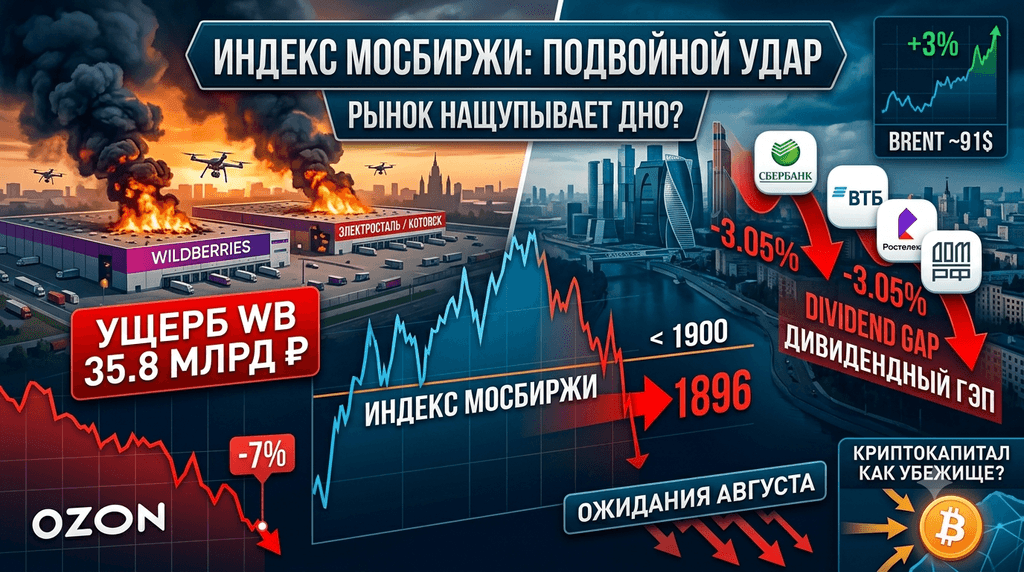
On Monday, the MOEX Index fell below 1,900 points for the first time since October 2022, while Ozon shares plunged nearly 7% at the open. The reason is twofold: a drone attack on Wildberries warehouses in Elektrostal and Kotovsk knocked out roughly 7–10% of the marketplace's logistics capacity, while several heavyweight stocks — Sberbank, VTB, DOM.RF, Rostelecom, and Basis — went ex-dividend at the same time. The damage to Wildberries from the burned warehouses could reach 35.8 billion rubles, and insurers are unlikely to cover it. Below, we break down what happened, who is losing how much, and when the market might find a bottom.
The drone attack knocked out roughly 7–10% of Wildberries' logistics capacity. The main blow fell on the warehouse complexes in Elektrostal and Kotovsk — facilities that were key nodes in the company's distribution network, handling a significant share of orders from the country's central regions.
Beyond physical damage to the buildings, the company also lost a substantial portion of the merchandise sellers had stored at these warehouses. Rebuilding logistics infrastructure on this scale typically takes several months, and some orders from the affected regions are already being rerouted to alternative distribution centers, which is temporarily straining the remaining network and could lengthen delivery times for customers in the affected areas.
The incident came amid a fresh wave of drone strikes on Russian regions more broadly, adding to an already tense news backdrop for the entire stock market. For investors, the key signal wasn't so much the destruction of specific buildings as the demonstration that critical infrastructure of a major business can be vulnerable even far from the front line.
According to Kommersant's estimate, the damage from the burned warehouses and lost merchandise could total between 20 billion and 35.8 billion rubles. That figure covers both the cost of rebuilding the buildings and equipment and compensation for the lost inventory.
Insurers are highly unlikely to cover the damage from the drone attack. The reason lies in the wording of the policies: damage from military actions and drone strikes typically falls under standard exclusions in insurance coverage, meaning compensation on that basis isn't legally owed.
A separate and more sensitive issue is compensation for sellers whose goods burned in the warehouses. Formally, Wildberries has no legal obligation to reimburse these losses. But reputational risk and the threat of sellers migrating to competing platforms make payouts from the company's own reserves a likely scenario — otherwise some sellers may start scaling back their cooperation with the marketplace.
This scenario is already being discussed in the market: analysts note that the question of seller relations could become a matter of corporate policy and reputation, not just accounting. If large sellers start moving en masse to competing platforms, it would hit Wildberries' turnover harder than the cost of rebuilding the warehouses themselves.
Ozon shares reacted to the drone attack with a sharp drop, even though the strike didn't hit the company's own infrastructure. The stock opened Monday's trading down nearly 7%, and analysts at Alfa Investments link this move directly to investors' negative reaction to the Wildberries warehouse incident.
The market logic here is simple: if military risks can hit the core logistics of one marketplace, the same is theoretically true for any e-commerce player, including Ozon. Investors are pricing in future cost increases — for physical warehouse security, enhanced protection, and potentially pricier insurance against force-majeure events. Against the backdrop of a broader market decline, investors also chose to quickly trim positions in high-beta tech and e-commerce stocks — the kind of shares that are typically sold off first when uncertainty rises.
An additional source of pressure was the overall weekend news backdrop: a new series of drone strikes on Russian regions created heightened nervousness in the market even before Monday's trading opened. In this environment, investors tend to act preemptively and sell off the stocks most sensitive to operational risk, without waiting for official management commentary on the real scale of the consequences for a specific company. That's why Ozon's drop was so sharp in the first minutes of trading, even though the attack caused no direct physical damage to the company's own infrastructure.
The MOEX Index broke below the 1,900-point mark because several major issuers closed their dividend registers simultaneously. According to Finam.ru, by 9:50 a.m. Moscow time on Monday the index was down 3.05%, sitting at 1,898.69 points, and at one point dipped to 1,896.43 points — a low not seen since October 2022.
Dividend gaps formed at the same time in shares of Sberbank, VTB, DOM.RF, Rostelecom, and Basis — all stocks that carry substantial weight in the index. Technically, the ex-dividend date means an automatic drop in the share price equal to the dividend paid, and when this happens simultaneously across several heavyweight stocks, the combined effect drags the entire index down in one move. Additional pressure on the market comes from geopolitical tension and the Bank of Russia's tight monetary policy — the key rate is being held at around 14.25%.
This drop wasn't a one-off episode in itself: the Russian stock market has now been declining for 19 straight trading weeks, regularly hitting new lows. Since the start of July, the MOEX Index has lost almost 18%, and since the start of the year the decline has reached around 30%. Against this backdrop, the dividend cutoffs weren't the root cause of the fall but rather a catalyst that sharply accelerated an already entrenched downward trend.
The one notable source of support for the market at the moment came from rising oil prices: Brent crude was up more than 3% at one point, approaching $91 a barrel amid escalation of the US-Iran crisis. The ruble, meanwhile, weakened only modestly — the interbank dollar rate ticked up slightly, and the Central Bank's official rate on July 20 stood at around 78.4 rubles per dollar. However, the rise in oil prices has not yet offset the pressure from the dividend gaps and geopolitical risks on the broader stock market.
Dividends Behind the Gaps
| Company | Dividend per Share | Comment |
| Sberbank | 37.64 rubles | Most liquid stock, fastest potential gap closure |
| VTB | 9.71 rubles | One-off, poorly predictable payouts |
| DOM.RF | 246.88 rubles | Short trading history, investors still watching |
| Rostelecom | 2.71 rubles | Notable debt load limits demand |
| Basis | 7.2 rubles (Q1) | Low-liquidity stock, risk of a long-unclosed gap |
Analysts aren't expecting a quick closure of the dividend gaps this season — the main constraint remains the high key rate. At around 14.25%, bank deposits and money market funds offer yields comparable to dividends but without the risk of a price drawdown, leaving investors with less incentive to immediately buy back the now-cheaper stocks.
Finam analysts believe the closure will most likely stretch over many months, with some stocks at risk of not closing their gap before the next dividend season. Historical experience shows a wide range of timelines: in some years Sberbank's gap has closed in under two weeks, while last season the process dragged on for almost nine months. On average over the past seven years, the gap-closing period for Sberbank has been just under four months. If the Bank of Russia keeps a hawkish tone at its upcoming meeting, or turns even more hawkish, the MOEX Index risks falling to 1,850 points. August generally has a reputation as an unstable month for the Russian market and the ruble, so analysts aren't expecting any notable pickup in trading activity before the start of autumn.
Forecasts for individual stocks vary considerably. Analysts are most confident about Sberbank's prospects — as the market's most liquid and predictable dividend stock, which investors traditionally buy back on dips faster than others. There's less consensus on VTB and DOM.RF: the former's dividends are considered one-off and hard to predict, while the latter's short trading history doesn't yet allow for an assessment of a typical gap-closing speed. For Rostelecom and Basis, some analysts, by contrast, expect a relatively quick gap closure — within one to two weeks — thanks to heavy overselling of the stocks even before the cutoff and the comparatively small size of the payouts themselves.
| Stock | Estimated Closure Speed | Key Factor |
| Sberbank | Weeks to several months | High liquidity and dividend predictability |
| VTB / DOM.RF | Several months or longer | One-off payouts or short trading history |
| Rostelecom / Basis | 1–2 weeks per some forecasts | Heavy overselling and small payout size |
Dividend reinvestment can only partially support the market — it won't reverse the downward trend. Dividend money typically reaches investors' accounts 2–3 weeks after the cutoff, meaning the main inflow of funds should be expected in late July to early August.
Some of these funds traditionally flow back into the most oversold dividend blue chips — chiefly Sberbank and DOM.RF, which analysts consider the highest-quality and most predictable stories in the market thanks to steady profit growth and high return on equity. However, given the current geopolitical uncertainty and the high key rate, a significant share of retail investors will most likely choose to move their dividend proceeds into short-term deposits or bonds offering comparable yields without market risk. As a result, the overall supporting effect for the index is likely to be limited.
Some analysts advise retail investors not to rush to put dividend cash fully back into stocks before the end of summer, given that risks of a further market drawdown amid geopolitics and tight regulatory policy remain elevated. Experts expect more active interest in large issuers' dividend stocks closer to September, once uncertainty around the Bank of Russia's key rate decisions eases.
Sharp drawdowns in local equity markets, like the current fall in the MOEX Index, typically reinforce broader risk-off sentiment among retail investors working with digital assets as well. When traditional markets are hit simultaneously by a geopolitical shock and dividend gaps, some capital temporarily shifts into defensive instruments, while some flows into liquid cryptocurrencies and stablecoins that allow positions to be repositioned quickly without being tied to a single jurisdiction.
For investors dependent on local equity indicators and the national currency, the crypto market often becomes an additional diversification channel precisely during periods of heightened turbulence. The ability to quickly move part of a portfolio into stablecoins or major cryptocurrencies reduces dependence on the dynamics of any one country's market and allows investors to ride out a period of high volatility without keeping capital exclusively in local instruments.
Trading on KuCoin during periods like this can be a reasonable choice, precisely because of the risk-management tools the platform provides. KuCoin offers access to a wide range of spot pairs and futures contracts, letting investors respond flexibly to shifting market sentiment — from quickly moving into stablecoins to opening hedging positions through derivatives.
For those looking to reduce portfolio volatility amid instability in local equity markets, KuCoin offers a convenient interface for converting into stablecoins, along with staking tools for earning yield on temporarily idle funds. The platform also provides access to analytical tools and market data, helping users make decisions based on up-to-date information rather than an emotional reaction to the news cycle.
Registration on the platform takes just a few minutes, and verified users gain access to the full range of features — from spot trading to advanced market analytics. This approach is especially relevant during periods when traditional markets show heightened unpredictability and investors need more flexibility to manage their capital on the fly.
The drone attack on Wildberries' warehouses in Elektrostal and Kotovsk knocked out up to 10% of the company's logistics capacity, with damage potentially reaching nearly 36 billion rubles — while insurance payouts are unlikely due to military exclusions in the policies. The incident triggered a sell-off in Ozon shares, reflecting investor concerns about rising costs across the entire e-commerce sector amid escalating geopolitical risks.
At the same time, the MOEX Index fell below 1,900 points for the first time since October 2022, driven by the simultaneous closing of dividend registers at several major issuers — Sberbank, VTB, DOM.RF, Rostelecom, and Basis. The decline extended a prolonged 19-week downtrend that has driven the index down almost 30% since the start of the year. The high key rate reduces the incentive for a quick closure of the resulting dividend gaps, and analysts warn of the risk of a further decline to 1,850 points should the Bank of Russia maintain a hawkish tone. Dividend reinvestment can only provide limited support to the market: a significant share of the payouts will most likely settle into deposits and bonds rather than flow back into stocks. Amid heightened uncertainty, some investors are considering diversification through crypto assets as a way to reduce dependence on local market conditions and preserve flexibility in managing capital until clearer signals emerge from regulators and the geopolitical situation.
The warehouse complexes in Elektrostal and Kotovsk were damaged — facilities that were significant nodes in the company's logistics network and handled a substantial share of order processing.
The company has no legal obligation to pay compensation for burned merchandise. However, given reputational risks and the threat of sellers moving to competing platforms, payouts from the company's own funds look like a likely scenario.
Ozon shares belong to the high-beta e-commerce sector, so investors sell them off faster than other stocks when geopolitical uncertainty rises, while also pricing in future increases in logistics security costs.
A dividend gap is the automatic drop in a stock's price on the register closing date, equal to the dividend paid out. When this happens simultaneously across several heavyweight index stocks, the combined effect drags down the entire market indicator.
The Bank of Russia's key rate is being held at around 14.25%. A high rate makes deposits and bonds an attractive alternative to stocks, which reduces demand for buying back shares that have dropped after dividend gaps and slows the recovery in prices.