

Why $PONS on Robinhood Chain Is Emerging as the Most Cost-Effective High-Revenue Token
2026/08/25 16:32:00
Introduction
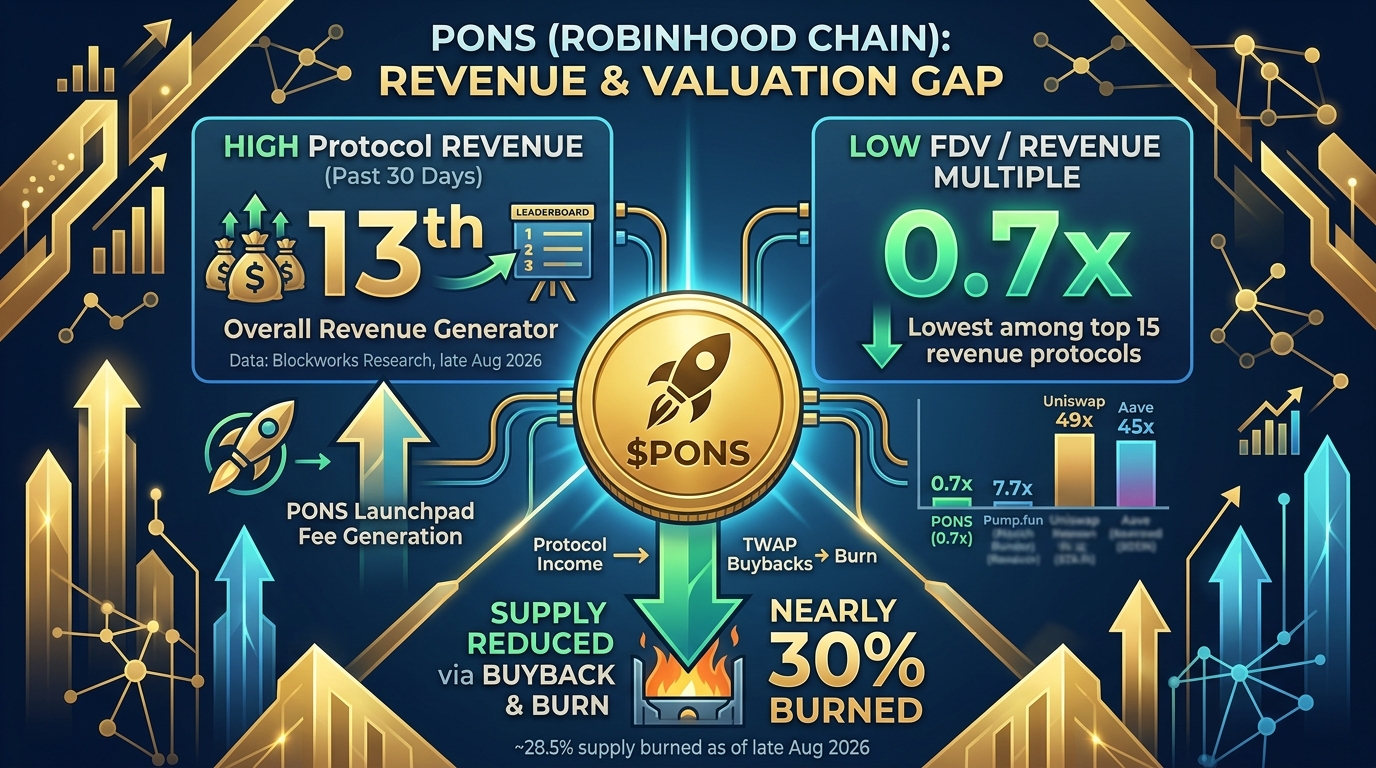
Did you know a token ranking among the top 15 revenue generators in crypto trades at a fully diluted valuation (FDV) to revenue multiple of just 0.7 times? According to Blockworks Research data from late August 2026, PONS on Robinhood Chain generated enough protocol income over the prior 30 days to place 13th overall yet carries the lowest valuation multiple among that elite group. This gap positions it as one of the most cost-effective high-revenue tokens available.
PONS powers Pons, the leading non-custodial token launchpad on Robinhood Chain. Roughly 80 percent of protocol fees flow into buybacks and burns, already reducing supply by nearly 30 percent. Market pricing remains conservative relative to peers, creating a compelling value case for those tracking on-chain activity and tokenomics.
What Is PONS and the Pons Launchpad on Robinhood Chain?
$PONS is the native token of Pons, a non-custodial launchpad on Robinhood Chain that enables anyone to create fixed-supply tokens and trade them from the first block. The platform functions as the primary token issuance venue on the chain, frequently compared to pump.fun on Solana.
Users deploy a token with a fixed 1 billion supply in a single transaction for a low launch fee of about 0.0005 ETH plus gas. In the V2 upgrade completed in July 2026, launches begin on a bonding curve before graduating into permanently locked Uniswap V4 liquidity pools. Liquidity cannot be removed by creators or the platform. Tokens trade primarily against WETH or other supported assets, including certain tokenized stocks in later versions.
This design creates a direct link between platform activity and $PONS value accrual through fees. High launch and trade volume translates into protocol revenue that supports the token’s deflationary model.
Why Does $PONS Rank High in Revenue but Low in Valuation Multiples?
$PONS ranks 13th in protocol revenue over the past 30 days while trading at the lowest FDV/revenue multiple—0.7 times—among the top 15 income-generating tokens, according to Blockworks Research analysis published around August 23, 2026. The data, drawn from CoinGecko and DefiLlama and annualized from recent figures, shows a clear disconnect between earnings power and market pricing.
Comparisons highlight the disparity. Pump.fun-related tokens sit near 7.7 times, while more established names such as Aave reach about 45 times, Uniswap around 49 times, and Chainlink over 212 times. Other tokens in the list range from 2.8 times for CARDS up to triple-digit multiples for several high-profile assets. At 0.7 times, the market applies little to no premium—and effectively a discount—to PONS’s recent income stream.
This conservative pricing stems from the token’s short history. Launched in mid-July 2026 alongside rapid growth on the new Robinhood Chain, $PONS has delivered strong early revenue but lacks multi-year track records that command higher multiples elsewhere. On-chain data from sources tracking protocol fees show daily and weekly collections in the tens to hundreds of thousands of dollars, supporting the ranking. Yet participants price in uncertainty about whether current volumes will persist once initial incentives, such as temporary gas waivers, fade.
The result is a valuation that treats substantial current revenue as temporary rather than durable. For observers focused on earnings relative to price, this creates one of the lowest multiples among high-income crypto assets in the latest data window.
How Does the Buyback and Burn Mechanism Drive Cost-Effectiveness?
Approximately 80 percent of protocol revenue is directed toward buying $PONS on the open market and permanently burning it, according to public project disclosures and on-chain verification. This mechanism has already reduced total supply by nearly 30 percent—around 28.5 percent or more than 285 million tokens out of the original 1 billion—as of late August 2026.
Fees collected by the protocol (primarily the platform’s share of the 1 percent trading fee) accumulate and fund timed weighted average price (TWAP) buybacks. Burned tokens go to a dead address, shrinking circulating and total supply with no possibility of return. Recent seven-day burn rates have removed millions of tokens, and daily activity continues to feed the process. Market cap figures in the $60–70 million range (with circulating supply near 715 million after burns) sit alongside ongoing reduction.
This creates a direct flywheel: higher launchpad volume generates more fees, more fees fund more buybacks, and burns tighten supply. Unlike tokens with large unlock schedules or inflation, $PONS has a fixed maximum with continuous deflation. Buyback run-rates implied by recent activity have been noted in the low double-digit percentage of market cap on an annualized basis under the full policy. The combination of high relative revenue and shrinking supply underpins the cost-effectiveness narrative—investors receive exposure to an income stream that actively reduces the share count.
On-chain transparency allows verification of fee inflows, collector balances, and individual burn transactions, reinforcing the mechanical link between platform success and token scarcity.
What Are the Risks and Market Concerns Around PONS Revenue Quality?
Market participants remain cautious about the sustainability and quality of $PONS revenue, citing the platform’s youth and potential for non-organic activity. Discussions around Blockworks Research data quickly raised questions about wash trading or inflated volumes that could overstate true economic activity.
Robinhood Chain itself launched only in early July 2026. Early growth benefited from factors such as a 90-day gas fee waiver and the exit of a competing launchpad, which funneled users toward Pons. Revenue has fluctuated, with reports of declines from July peaks even as absolute levels remain notable. Liquidity for $PONS itself can be relatively thin outside primary on-chain pools, and the broader chain’s long-term user retention is unproven.
Competitors, including lower-fee alternatives built on Uniswap technology, have appeared. Some analyses note that while Pons retains higher creator incentives (helping retain launch volume), fee competition could pressure margins. The burn rate itself is a policy choice rather than an immutable on-chain rule in all descriptions, introducing potential for future changes. Tokens of this size and age carry elevated risk of sharp drawdowns if activity slows.
These factors explain the depressed multiple. The 0.7 times figure reflects skepticism that current income levels will continue rather than outright dismissal of the existing numbers. Independent on-chain verification of fees and burns remains available, yet broader adoption of Robinhood Chain and genuine organic demand will determine whether the valuation gap closes.
How to Buy and Trade Emerging Tokens on KuCoin?
KuCoin provides a straightforward platform for accessing a wide range of cryptocurrencies and exploring opportunities in growing ecosystems. Users can register an account, complete verification where required, and deposit funds via supported methods including crypto transfers or fiat options depending on region.
Once funded, search for available trading pairs on the spot or other markets. KuCoin offers competitive fees, advanced order types, and tools for monitoring market data. For tokens tied to newer chains or launchpads, liquidity may first appear on decentralized venues; KuCoin listings expand access and convenience when available. Always verify contract addresses and network details for any on-chain transfers.
The exchange supports education resources, security features such as two-factor authentication, and a broad selection of assets. Traders interested in high-revenue or deflationary tokens can monitor market trends, set alerts, and manage positions with available risk tools. Starting with small sizes and conducting independent research remains essential given volatility in early-stage assets.
Conclusion
$PONS stands out because of its combination of top-tier recent revenue ranking, the lowest FDV/revenue multiple among peers at 0.7 times according to late August 2026 Blockworks Research data, and a clear buyback-and-burn model that has already retired nearly 30 percent of supply. As the leading launchpad token on Robinhood Chain, it captures fees from high volumes of fixed-supply token creation and trading. The inverted relationship between income and valuation creates the cost-effectiveness narrative relative to Pump.fun-linked assets and more mature protocols.
Supporting details include on-chain fee collection, transparent burns, and V2 mechanics that lock liquidity permanently. Counterbalancing factors include the platform’s short operating history, questions around revenue sustainability, potential competition, and dependence on continued activity on a young chain. Data points remain recent and subject to rapid change as volumes fluctuate.
Overall, the token illustrates how aggressive value accrual mechanics can produce standout metrics even in a skeptical market. Readers should weigh the verified on-chain economics against the inherent risks of early ecosystem tokens. Independent research and careful position sizing are necessary before any involvement with digital assets of this nature.
FAQs
$PONS operates on Robinhood Chain (chain ID 4663), an EVM-compatible Layer 2 associated with Robinhood. All primary trading and burns occur on this network.
How much of the $PONS supply has been burned?
As of late August 2026 on-chain data, approximately 28.5 percent—or more than 285 million tokens—of the original 1 billion supply has been permanently burned.
Does Pons custody user funds?
No. Pons is non-custodial. Users interact directly from their own wallets for launches and trades.
What percentage of fees goes to buybacks?
Public information indicates roughly 80 percent of protocol revenue (the platform’s share of fees) is allocated to $PONS buybacks and burns.
Is the 0.7x multiple based on recent data?
Yes. The figure comes from Blockworks Research analysis of the prior 30 days of revenue, annualized and compared against FDV, using sources including CoinGecko and DefiLlama as of around August 23, 2026.
Disclaimer: This article is for informational purposes only and does not constitute financial, legal, or investment advice. Always conduct your own research before interacting with digital assets.