

Why Nebius NBIS Stock Is Outperforming Neocloud Stocks as Oracle’s Project Jupiter Faces New Setbacks
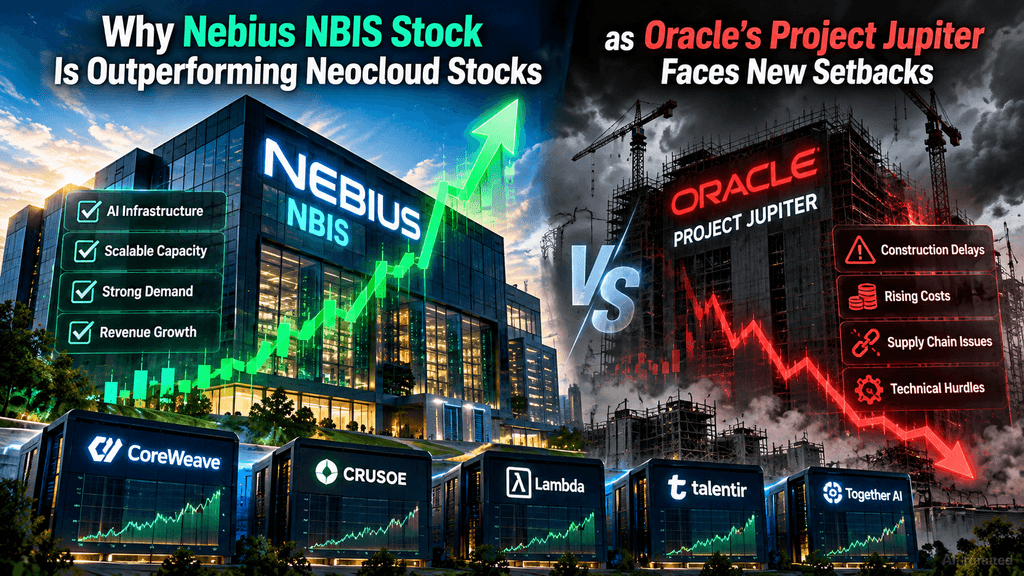
Nebius has emerged as one of the standout AI infrastructure stocks of 2026, with NBIS gaining attention as investors compare specialized neocloud stocks including CoreWeave and IREN. Strong AI cloud revenue growth, major contracts with Meta and Microsoft, higher GPU pricing and customer-funded expansion have strengthened the Nebius growth story, while Oracle’s Project Jupiter has highlighted a different side of the AI boom as power availability, financing and construction execution become increasingly important constraints. As demand for AI training and inference continues to rise, investors are looking beyond headline capacity announcements and focusing more closely on revenue quality, data center power access, capital spending and whether AI infrastructure companies can bring new computing capacity online efficiently.
Why Nebius NBIS Stock Is Outperforming CoreWeave IREN and Other Neocloud Stocks in 2026
Nebius has emerged as one of the strongest-performing neocloud stocks in 2026, supported by more than momentum around artificial intelligence. Investors have responded to rapid growth in its AI cloud business, increased access to high-performance computing capacity and a growing base of large enterprise customers. The company has also benefited from a market where demand for advanced GPUs remains strong, giving Nebius opportunities to improve utilization and pricing while scaling its infrastructure footprint. This combination of revenue growth and infrastructure expansion has helped make NBIS stock a closely watched name within the broader AI infrastructure market.
Nebius AI Cloud Growth and Major Enterprise Demand
A major reason for the strength in NBIS stock has been the company's ability to convert AI demand into contracted business. Nebius reported $582.3 million in group revenue for the second quarter of 2026, representing year-over-year growth of more than 450%, while its AI cloud operation accounted for most of that total. That growth has helped shift the investment case away from purely future expectations toward measurable revenue generation. Large enterprise customers also provide greater visibility into utilization as Nebius continues deploying new computing capacity across the United States and Europe. The company's annualized run-rate revenue has also expanded rapidly, demonstrating how quickly additional GPU deployments can translate into higher cloud sales when demand remains strong.
The company's expansion comes as organizations increasingly need dedicated infrastructure for model training, inference and enterprise AI applications. Rather than competing only on access to GPUs, Nebius is building a broader cloud platform around high-performance computing, networking and AI software infrastructure. That positioning has become increasingly relevant as customers look for alternatives to traditional hyperscale cloud providers and demand more specialized environments for intensive AI workloads. Growth in AI inference could further expand this market because production AI applications often require continuous computing capacity after models have already been trained.
Why Investors Are Separating Nebius From Other Neocloud Stocks
The performance gap between Nebius and peers such as CoreWeave and IREN reflects growing differentiation within the AI cloud infrastructure market. CoreWeave operates at a much larger revenue scale and has built one of the industry's biggest contracted backlogs, while IREN is rapidly transforming its business from Bitcoin mining toward AI cloud services. Nebius sits between those models, combining rapid cloud growth with major enterprise contracts and infrastructure partnerships designed to support continued expansion. Investors are therefore comparing not only revenue growth but also customer quality, contract duration, infrastructure economics and the amount of capital required to support each additional megawatt of computing capacity.
That does not remove the risks attached to the business. Nebius still requires billions of dollars of capital for GPUs, data centers and power infrastructure, and maintaining high growth will depend on delivering new capacity without allowing financing costs or operational delays to erode returns. The market is therefore rewarding growth, but it is also becoming more selective about which neocloud companies appear capable of turning that growth into sustainable infrastructure economics. As the sector matures, free cash flow, returns on invested capital and GPU utilization rates could become increasingly important alongside headline revenue growth.
What Oracle’s Project Jupiter Setback Reveals About AI Data Center Power Financing and Execution Risks
Oracle’s Project Jupiter setback has become a useful example of the constraints facing the rapidly expanding AI infrastructure industry. Project Jupiter in New Mexico is designed to support up to 2.45 gigawatts of installed fuel-cell capacity, yet challenges involving power infrastructure, permitting and project financing have drawn attention to how difficult it can be to translate enormous AI investment plans into operating data centers. Oracle issued a force-majeure notice connected with possible power delays, although Oracle has maintained that the project remains on schedule and Blue Owl has said the notice does not change the parties' financial commitments. The situation highlights an increasingly important distinction between strong demand for AI computing and the practical difficulty of building the physical infrastructure required to satisfy that demand.
Project Jupiter Power Delays Highlight the AI Data Center Energy Bottleneck
Power is quickly becoming one of the most important bottlenecks in the AI data center buildout. Project Jupiter is expected to depend heavily on dedicated energy infrastructure, including gas-powered fuel cells and supporting pipeline capacity. Delays affecting a pipeline intended to serve the site, along with outstanding permitting requirements for parts of the power system, illustrate why securing land and GPUs is only part of the challenge. New AI campuses require enormous amounts of reliable electricity, and delays involving generation, transmission or regulatory approvals can postpone when billions of dollars of computing equipment begin generating revenue. As individual AI campuses move toward gigawatt-scale power requirements, access to electricity is increasingly becoming a competitive advantage for data center developers and neocloud providers.
Project Jupiter Financing Pressure Shows How AI Infrastructure Debt Is Changing
Financing risk is also receiving more attention as the cost of building AI infrastructure rises. Around $18 billion of loans associated with Project Jupiter came under pressure in September, highlighting growing investor scrutiny of debt-heavy data center developments. The issue is broader than Oracle alone. AI projects increasingly involve complex arrangements between cloud providers, infrastructure owners, lenders and customers, meaning investors must evaluate not only demand but also how financial risk is distributed if construction takes longer than expected or borrowing costs rise. As debt issuance tied to AI infrastructure expands, project economics and financing terms are becoming as important as headline capacity announcements. Higher interest expenses can materially affect the eventual return on a data center that requires billions of dollars of upfront spending before meaningful cloud revenue begins.
Why Project Jupiter Raises Broader Execution Risks for AI Infrastructure Companies
Project Jupiter demonstrates how execution risk can emerge even when underlying AI demand remains strong. Developers must coordinate power, cooling, networking, construction, chip deliveries, financing and regulatory approvals across projects that can take years to complete. A setback in one part of that chain can delay the entire campus, pushing out customer deployments and revenue recognition. This makes delivery schedules increasingly important for companies that have already signed multiyear AI infrastructure contracts. It also explains why investors are paying closer attention to operational milestones rather than valuing projects solely on announced gigawatts or potential contract values.
The lesson applies across the neocloud industry. Nebius, CoreWeave and IREN are all spending heavily to bring additional AI capacity online, but investors are increasingly looking beyond planned megawatts toward actual delivery. Companies able to secure power, control construction costs and complete projects on schedule may gain an advantage as the AI data center cycle shifts from announcing ambitious developments to proving that those facilities can operate reliably at scale. The ability to match new capacity with committed customers will also matter because unused GPU clusters can create significant depreciation and financing costs without generating sufficient revenue.
How Nebius Meta and Microsoft Deals GPU Pricing Power and Customer Prepayments Support AI Cloud Growth
Nebius is supporting its AI cloud growth through a combination of long-term customer commitments, stronger pricing for GPU capacity and customer-funded infrastructure expansion. These factors give the company greater visibility into how new data center capacity may be used once it becomes operational. They also provide an important financial buffer in an industry where advanced computing equipment must often be purchased long before customers generate the full value of their contracts. This model is becoming particularly relevant as next-generation AI systems require larger clusters of GPUs and higher-density power infrastructure.
Meta and Microsoft Deals Strengthen Nebius AI Cloud Revenue Visibility
Nebius's agreements with Meta and Microsoft have become central to its long-term growth strategy. The Meta infrastructure agreement announced in 2026 could be worth approximately $27 billion over five years, including dedicated infrastructure and additional computing capacity tied to future NVIDIA systems. Nebius also has a multiyear Microsoft agreement originally valued at roughly $17.4 billion, with contractual options that could increase the overall value. These contracts provide large anchor customers for future data center capacity and reduce some of the uncertainty associated with expanding before demand is secured. They also give Nebius exposure to hyperscaler AI spending at a time when major technology companies continue allocating large capital budgets to generative AI and cloud infrastructure.
The challenge now is execution rather than simply signing contracts. Nebius has said it has delivered scheduled capacity tranches to Microsoft while continuing to build infrastructure for additional customers. Each successful deployment strengthens confidence that the company can turn large contract values into recurring cloud revenue. At the same time, the size of these commitments increases the importance of securing sufficient GPUs, power and data center space to meet delivery schedules without driving costs excessively higher. Future growth will therefore depend on how efficiently Nebius can synchronize infrastructure construction with customer demand rather than simply expanding capacity as quickly as possible.
GPU Pricing Power and Customer Prepayments Improve Nebius Growth Economics
Nebius has also benefited from strong GPU pricing power as companies compete for access to advanced computing infrastructure. The company has reported higher pricing on some existing GPU capacity, while certain shorter-duration deployments can generate particularly high revenue per megawatt. Strong pricing allows Nebius to increase the economic value of installed capacity rather than relying exclusively on physical expansion to support revenue growth. Pricing trends are especially important for neocloud economics because GPU hardware depreciates quickly and providers need to generate attractive revenue while each generation of chips remains commercially competitive.
Customer prepayments add another layer to that model. Nebius has said that around 70% of deals closed during the second quarter included upfront payments, which in many cases covered a substantial share of the associated capital expenditure. For a company investing billions in infrastructure, receiving customer cash before full service delivery can reduce near-term funding pressure and partially offset the need for new debt or equity. That does not make the business capital-light, but it can improve the economics of expansion when compared with projects that must be fully financed before customers begin contributing cash. Prepayments can also help align infrastructure investment more closely with confirmed demand, reducing some of the risk associated with building speculative capacity.
Nebius vs CoreWeave and IREN on Revenue Growth Debt AI Capacity Capex and Key Risks
The competition among Nebius, CoreWeave and IREN illustrates how different business models are emerging within the neocloud industry. Each company is benefiting from rapid AI adoption, but they differ in revenue scale, debt levels, operating capacity and exposure to infrastructure costs. Those differences are becoming more meaningful as investors look beyond demand growth and focus on financial efficiency and the ability to deliver new AI capacity. Comparing these metrics can provide a clearer picture of how each neocloud is positioned as AI infrastructure spending continues to expand.
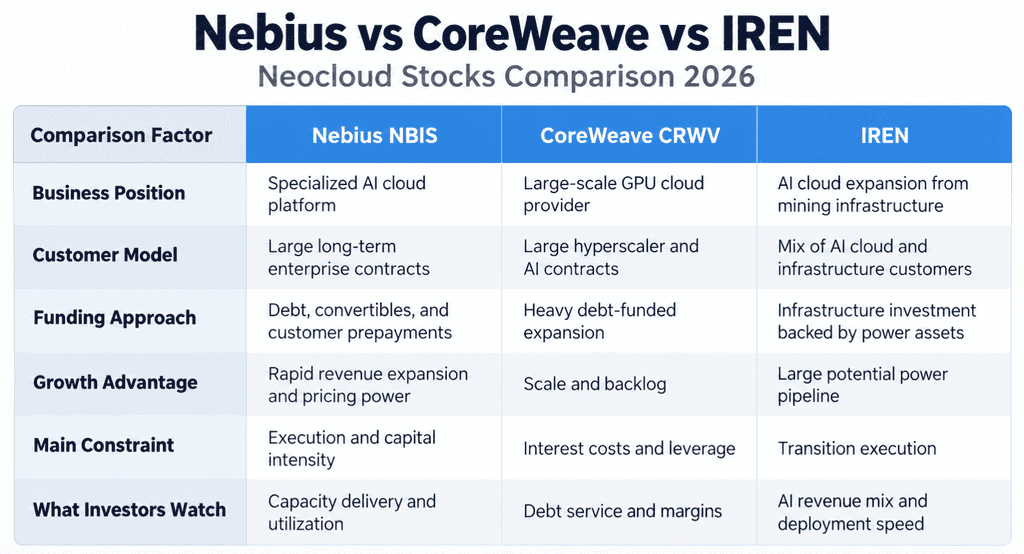
The comparison below highlights how Nebius, CoreWeave and IREN differ across business model, funding strategy, growth advantages and key execution risks. It provides a quick snapshot of the factors investors are watching as competition intensifies across the neocloud and AI infrastructure market.
Revenue Growth Shows Different Stages of the Neocloud Expansion
Nebius reported $582.3 million in Q2 2026 group revenue, while CoreWeave generated approximately $2.58 billion during the same quarter, making CoreWeave the larger operator by current revenue scale. IREN remains early in its AI cloud transition, although its AI Cloud Services revenue rose sharply to approximately $128.8 million for fiscal 2026, compared with $16.4 million the previous year. The comparison shows three companies at different stages of development, with CoreWeave emphasizing scale, Nebius posting exceptionally rapid cloud growth and IREN building a larger AI business on top of an infrastructure base originally developed for Bitcoin mining. For investors comparing NBIS, CRWV and IREN stock, both growth rates and the quality of the revenue supporting that expansion deserve attention.
Debt and Capex Are Becoming Critical for AI Infrastructure Stocks
Capital intensity remains one of the biggest challenges for all three businesses. Nebius spent roughly $5.7 billion on capital expenditure during Q2 2026 and has raised additional funding through secured debt and convertible notes. CoreWeave has also relied heavily on debt to finance rapid expansion, with total indebtedness reaching $35.6 billion by the end of June and quarterly net interest expense around $640 million. IREN is increasing investment as it deploys additional GPUs and converts more of its power portfolio toward AI workloads. For investors, the key question is therefore not simply who can build the most infrastructure, but which company can earn attractive returns after financing costs, depreciation and ongoing data center operating expenses are included.
AI Capacity and Contracted Demand Will Determine Future Scale
CoreWeave reported an active power footprint of roughly 1.5 GW, giving it one of the largest operating bases among independent AI cloud providers. IREN reported about 40 MW of operational AI cloud capacity at the end of fiscal 2026 while highlighting a broader development pipeline supported by several gigawatts of potential power access. Nebius is also expanding rapidly across multiple regions, with much of its future capacity linked to enterprise demand. The ability to bring those megawatts online at high utilization will be more important than raw capacity announcements because underused infrastructure can quickly weaken returns. Long-term winners in the neocloud market may therefore be determined by a combination of power access, contracted utilization, revenue per megawatt and deployment speed.
Key Risks for Nebius CoreWeave and IREN Investors
The largest risks across neocloud stocks now center on execution, financing and technology cycles. Higher interest rates can make debt-funded infrastructure more expensive, while power shortages and permitting problems can postpone deployments. GPU technology also advances quickly, creating depreciation risk if older hardware loses pricing power sooner than expected. CoreWeave must manage its large debt load, IREN must execute its transition toward AI cloud services, and Nebius must maintain rapid growth while financing an unusually aggressive buildout. Customer concentration and changing AI hardware economics add further uncertainty, making balance-sheet strength and disciplined capital allocation increasingly important as competition intensifies.
🔥 Beyond the Headlines: What KuCoin 5.0 Means for You
Market news moves fast — but where you act on it matters just as much. This October, KuCoin launches KuCoin 5.0, transforming KuCoin into a rebuilt platform. Here's what actually changes for you:
-
One account for everything. Older platforms split your money across separate "spot," "margin," and "futures" accounts and expected you to understand why. KuCoin 5.0's unified account removes that entirely — deposit once, and everything is simply there (only available to VIPs for now).
-
Stocks, indices, and commodities. KuCoin 5.0 expands beyond crypto into global markets. When crypto chops sideways and equities rally (or the reverse), you rotate in minutes instead of opening a brokerage account and waiting days for fiat rails.
-
Real-world assets (RWA). Tokenized exposure to traditional assets like commodities, right inside your crypto account. One of the fastest-growing segments in global finance is no longer reserved for institutions — you access it from the same balance you trade with.
-
Earn while you learn. Not ready to trade? KCUSD lets your stablecoins earn daily, auto-compounding interest. The lowest-stress way to put your idle deposit to work for 4% yield.
-
An AI assistant in plain language. Ask questions, get market context, understand what you're looking at — built into the platform, no jargon required.
-
An app that doesn't overwhelm. Faster, cleaner, and consistent — intuitive from the first tap, not after a tutorial.
-
Safety you can check, not just trust. A MiCAR-licensed EU entity, Proof of Reserves you can verify yourself, and internationally certified security (SOC 2 Type II, ISO 27001:2022).
Create your account in minutes — and start on the platform built for where crypto is going, not where it's been.
In Conclusion
Nebius’s performance in 2026 shows how the AI infrastructure market is becoming more selective as investors distinguish between rapid growth and the ability to finance and deliver that growth efficiently. NBIS benefits from expanding AI cloud revenue, large enterprise commitments, GPU pricing power and customer prepayments, while CoreWeave and IREN offer different combinations of scale, power capacity and financing exposure. At the same time, Oracle’s Project Jupiter demonstrates why electricity, permitting, debt costs and construction timelines are becoming central risks for large AI data center projects. As the neocloud sector matures, investors are likely to focus increasingly on contracted demand, capacity delivery, utilization, financing costs and returns on invested capital when assessing which AI cloud providers can build durable businesses.
FAQs
What is a neocloud company and how is it different from a hyperscaler?
A neocloud is a specialized cloud provider focused heavily on GPU computing, AI training and inference workloads. Unlike hyperscalers such as Microsoft Azure, AWS or Google Cloud, neoclouds generally concentrate more narrowly on high-performance AI infrastructure rather than offering a similarly broad range of cloud software and enterprise services. Their appeal often comes from access to advanced GPUs, specialized AI clusters and infrastructure optimized for compute-intensive workloads.
Why are investors paying more attention to power availability in AI data centers?
AI clusters can require hundreds of megawatts or even gigawatts of continuous electricity. Because new power generation, transmission and grid connections can take years to build, electricity availability can determine how quickly an AI data center becomes operational even when customer demand and computing hardware are already secured. Power access is therefore becoming an important competitive advantage in the global AI infrastructure market.
What does force majeure mean for a data center project?
A force-majeure provision can protect contracting parties when extraordinary circumstances outside their reasonable control prevent them from meeting certain obligations. In data center projects, this may involve events affecting power delivery, permitting or construction, although the exact consequences depend on the wording of each contract. A force-majeure notice does not automatically mean that a project has been canceled.
Why do customer prepayments matter for AI cloud companies?
Prepayments provide cash before the full contracted service is delivered. That can help an AI cloud provider pay for GPUs, networking equipment and data center construction while reducing the amount of new debt or equity needed to fund each expansion project. They can also provide evidence that customers are willing to commit financially before new capacity comes online.
What financial metrics are useful when comparing neocloud stocks?
Useful measures include revenue growth, backlog, adjusted EBITDA, debt, interest expense, capital expenditure, free cash flow, customer concentration, GPU utilization and revenue per megawatt. Looking at several metrics together provides a better picture than comparing revenue growth alone, particularly because AI infrastructure businesses can grow rapidly while consuming large amounts of capital.
Disclaimer: This article is for informational purposes only and does not constitute investment advice. Crypto assets can be highly volatile, and market conditions, token liquidity and project developments may change rapidly. Readers should conduct their own research and assess their risk tolerance before making financial decisions.