

Why Has NVIDIA Stock Fallen More Than 30%? Jensen Huang's Resignation and Michael Burry's Warning Explained
Introduction
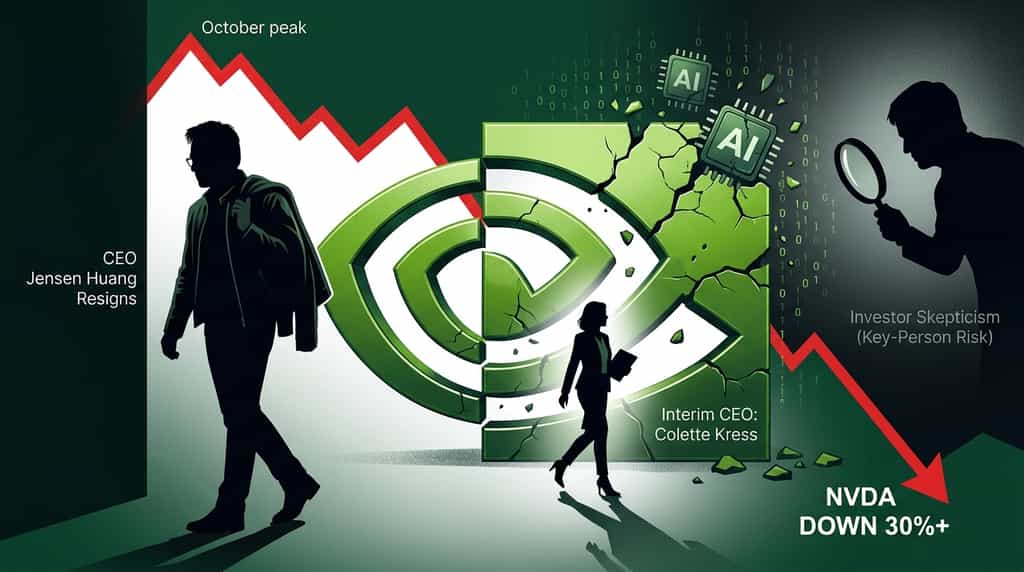
NVIDIA (NASDAQ: NVDA) shares have fallen more than 30% from their October 6, 2026, record high, as concerns about AI spending, valuation, and the company's leadership have converged. The situation escalated on November 12, when co-founder Jensen Huang resigned as president, CEO, and a member of the board, effective immediately. CFO Colette Kress was appointed interim CEO while the board begins searching for a permanent successor.
The leadership change has also intensified attention on investor Michael Burry's criticism of NVIDIA's management structure, customer relationships, financing practices, and long-term competitive position. However, the stock decline does not establish that NVIDIA's underlying business is deteriorating at the same rate. Understanding the sell-off requires separating its immediate leadership shock from broader concerns about AI infrastructure demand, profitability, and corporate governance.
Quick Answer: Why Has NVIDIA Stock Fallen More Than 30%?
NVIDIA's decline reflects several overlapping concerns rather than one isolated event:
-
Leadership uncertainty: Jensen Huang's abrupt departure raises questions about succession, strategic continuity, and the company's dependence on its founder.
-
AI investment sustainability: Investors are reassessing whether massive spending on AI infrastructure can generate sufficient long-term returns.
-
Competitive and margin pressure: Concerns about alternative AI chips, customer bargaining power, and future pricing may affect NVIDIA's growth expectations.
-
Governance and customer relationships: Michael Burry has highlighted key-person risk and questioned aspects of NVIDIA's commercial practices.
-
Valuation repricing: A sharp share-price decline reflects changing expectations and risk premiums, but it does not automatically mean the stock is undervalued.
The central question is whether the recent sell-off primarily reflects temporary uncertainty around leadership or a more fundamental reassessment of NVIDIA's long-term business model.
Why Did Jensen Huang Resign as NVIDIA CEO?
NVIDIA confirmed on November 12 that Jensen Huang had resigned as president, CEO, and a member of the board, effective immediately. The company appointed CFO Colette Kress as interim CEO and said the board would begin searching for a permanent successor.
According to NVIDIA's official leadership transition announcement, Kress will continue serving as CFO while holding the interim CEO position. Harvey C. Jones was appointed the company's first-ever board chair.
The announcement followed public scrutiny of Huang's personal relationships and questions surrounding his leadership. The company has not stated that its operating strategy or product roadmap has been suspended. Its announcement instead emphasized continuity in customer commitments, operations, and product development.
For investors, however, the significance extends beyond the immediate circumstances of the departure.
Why Does Huang's Departure Matter to NVIDIA's Business?
Huang has been closely associated with NVIDIA's product strategy, customer relationships, and development of its accelerated computing ecosystem. His leadership has helped the company evolve from a graphics processor supplier into a central provider of AI computing infrastructure.
This creates a form of key-person risk: the possibility that a company's performance, strategic direction, or commercial relationships depend heavily on one individual.
Three areas deserve particular attention:
-
Strategic decision-making: Huang has played a central role in communicating NVIDIA's long-term technology roadmap and identifying new markets. A successor will need to maintain strategic continuity while making independent decisions.
-
Customer and partner relationships: Large cloud providers, AI developers, and enterprise customers interact with NVIDIA across complex, multiyear infrastructure projects. A leadership transition may create uncertainty about how these relationships evolve.
-
Organizational coordination: Replacing a founder who has been deeply involved in product development and business decisions requires more than appointing another experienced executive. The company must demonstrate that its leadership structure can operate effectively without depending on one individual.
Kress has extensive experience within NVIDIA's finance organization, having joined in 2013. However, financial leadership experience and the ability to lead a global technology company are not identical responsibilities. The board's permanent succession decision will therefore be an important development for investors.
What Is Michael Burry Warning Investors About NVIDIA?
Michael Burry's criticism focuses on NVIDIA's dependence on Huang, the company's customer relationships, its financing arrangements, and the sustainability of its competitive position. His comments should be treated as an individual investor's analysis, not as an established finding about the company's conduct or future performance.
In his November 12 Substack commentary, titled The Don Goes Down: What Jensen's Fall Means, Burry emphasized key-person risk and questioned whether a new CEO could replace Huang's role in NVIDIA's commercial and organizational structure. He also raised concerns about the company's market position and customer relationships.
Why Has NVIDIA's Valuation Become a Bigger Concern?
A falling share price can change a company's valuation, but a lower valuation multiple does not automatically make a stock inexpensive.
The central issue is how much future growth is already reflected in the share price. NVIDIA's valuation has historically depended on expectations that demand for accelerated computing and AI infrastructure would continue expanding rapidly.
When those expectations become less certain, investors may apply a lower earnings multiple even if the company's current revenue and earnings remain strong.
Several valuation questions are becoming more important:
-
Earnings growth: Can NVIDIA maintain a high growth rate as its revenue base becomes larger?
-
Gross margins: Can the company maintain its pricing power as competition and customer bargaining power evolve?
-
Capital expenditure across the AI ecosystem: Will customers continue expanding infrastructure at the pace implied by current purchase plans?
-
Cash conversion: Can reported earnings translate into sustainable cash generation as the company manages inventory, supply commitments, and customer payment terms?
-
Leadership continuity: Can the next CEO maintain the strategic execution and commercial relationships established under Huang?
The forward price-to-earnings ratio is one way to assess valuation, but it depends on analysts' earnings estimates and the share price used in the calculation. A reported multiple should therefore be interpreted with its date and methodology rather than treated as a fixed measure of value.
The upcoming November 17 earnings announcement may provide additional information about demand, margins, and management's outlook. However, the market may also focus on how Kress communicates the company's strategy during the leadership transition.
What Should Investors Watch After Jensen Huang's Resignation?
The next phase of NVIDIA's story will depend on whether the company can demonstrate operational continuity and maintain its financial performance without Huang as CEO. Several developments may be particularly important.
First, the permanent CEO succession process. Investors will want to understand whether the board selects an internal or external candidate, how responsibilities are distributed, and whether the new leadership structure can maintain strategic execution.
Second, NVIDIA's next earnings report. Revenue guidance, gross margin, inventory, customer payment terms, and commentary on data center demand will help investors assess whether the recent market concerns are reflected in the company's operating performance.
Third, customer demand and competitive developments. The behavior of large cloud providers and AI developers will provide evidence about the durability of infrastructure spending. Competition from alternative accelerators and in-house chip programs may also influence NVIDIA's pricing power.
Fourth, the relationship between AI investment and monetization. Infrastructure spending can remain high for some time, but customers ultimately need to generate sufficient economic returns from their AI systems. Slower monetization could affect future capital expenditure plans.
Finally, governance and regulatory developments. Any formal investigations, company disclosures, or changes to commercial practices should be evaluated based on documented findings rather than speculation or social media commentary.
Taken together, these indicators will help distinguish a temporary repricing caused by leadership uncertainty from a longer-term change in NVIDIA's growth and profitability outlook.
Conclusion
NVIDIA's more than 30% decline from its October 2026 high reflects a combination of leadership uncertainty, changing AI investment expectations, valuation pressure, and concerns about the company's long-term competitive position. Jensen Huang's resignation has added a significant governance and succession issue to an already volatile period.
Michael Burry's criticism highlights questions about NVIDIA's dependence on its founder, customer relationships, financing arrangements, and future margins. These concerns deserve attention, but they remain an individual investor's analysis rather than proof that the company's business model is failing.
NVIDIA's latest reported financial results still show substantial revenue growth, strong data center demand, and high gross margins. Its large supply commitments and working capital requirements also illustrate the operational scale and complexity of its business.
The key issue is whether NVIDIA can preserve its competitive position and financial performance under new leadership while the AI infrastructure market continues to evolve. The next earnings report, the permanent CEO appointment, customer spending patterns, and margin trends will provide more concrete evidence than short-term share-price movements alone.
FAQs
Q1: Why did NVIDIA stock fall more than 30% from its October 2026 high?
NVIDIA shares declined amid concerns about AI infrastructure spending, valuation, competition, and leadership uncertainty. Jensen Huang's resignation on November 12 added further pressure.
Q2: Has Jensen Huang officially resigned as NVIDIA CEO?
Yes. NVIDIA announced on November 12, 2026, that Huang had resigned as president, CEO, and a member of the board, effective immediately. CFO Colette Kress was appointed interim CEO.
Q3: What is Michael Burry's main concern about NVIDIA?
Burry has highlighted key-person risk, NVIDIA's customer relationships, financing arrangements, and the possibility of slower growth and margin pressure. These are his analytical views, not established findings about the company's future performance.
Disclaimer
This general market information, possibly from third-party, commercial, or sponsored sources, is provided for reference and educational purposes only and does not constitute financial or investment advice, an offer, solicitation, or guarantee. We disclaim liability for its accuracy, completeness, reliability, and any resulting losses. Investments/trading are risky; past performance doesn’t guarantee future results. Users should research, judge prudently, and take full responsibility. For further details, please consult KuCoin’s Terms of Use and Risk Disclosure."