

Why Greenland Stocks Surged After Trump’s US Denmark Arctic Security Deal With GLND GRML and CRML Explained
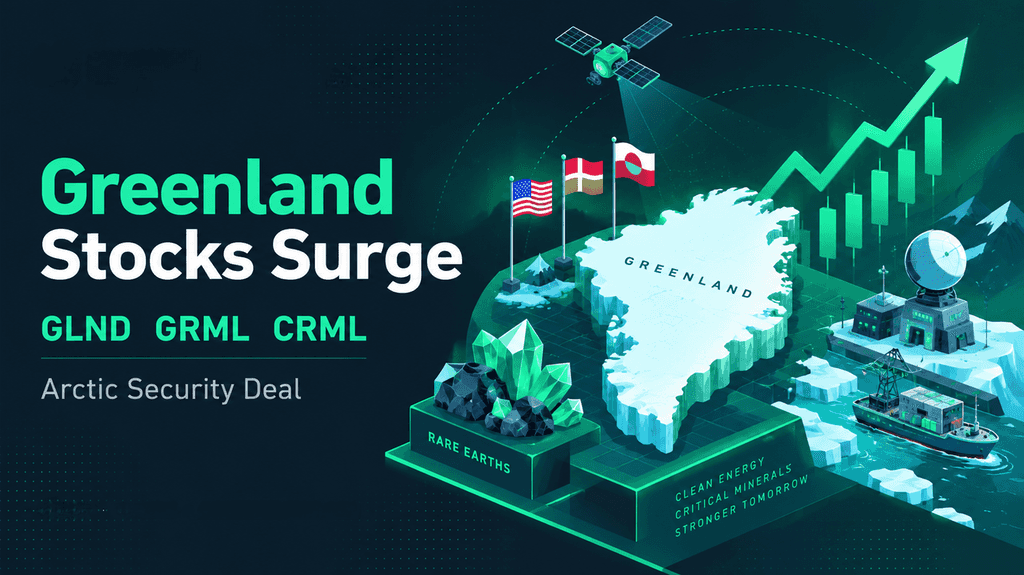
Greenland stocks have moved into the market spotlight after the United States, Denmark and Greenland signed a new Arctic security agreement that expands the American military presence on the strategically important island. The September 22, 2026 agreement has increased investor attention on Greenland Energy GLND, Greenland Mines GRML and Critical Metals CRML, three Nasdaq-listed companies with exposure to Greenland energy, rare earths and critical minerals. The initial reaction was dramatic, with GRML rising more than 230 percent, GLND gaining around 140 percent and CRML advancing nearly 39 percent.
The rally is about more than Arctic defense. Greenland sits at the intersection of U.S. security strategy, rare earth supply diversification, energy exploration and competition over critical minerals used in advanced technology and defense industries. China's dominance across key parts of the rare earth supply chain has made alternative sources increasingly important to the United States and its allies. However, the Greenland security agreement itself does not guarantee new mining rights, project financing or commercial success for GLND, GRML or CRML. Understanding what these companies actually own and what could happen next is therefore essential for investors following the Greenland stock rally.
Why Greenland Stocks GLND GRML and CRML Surged After the US Denmark Greenland Arctic Security Deal
Greenland-linked stocks moved sharply higher as investors reacted to the new security agreement between the United States, Denmark and Greenland. Signed during the United Nations General Assembly in New York on September 22, the agreement allows an expanded American military presence while recognizing the sovereignty and territorial integrity of the Kingdom of Denmark and Greenlanders' right to self-determination. The development pushed companies with direct exposure to the island's resources into focus because investors increasingly see Greenland as relevant not only to Arctic defense but also to Western energy and critical mineral supply chains.
How the Greenland Security Deal Triggered the GLND GRML and CRML Rally
The agreement expands U.S. military access beyond the existing Pituffik Space Base and includes facilities at Narsarsuaq in southern Greenland and Mestersvig in eastern Greenland. The arrangement builds on the longstanding defense relationship surrounding Greenland while increasing NATO's role in Arctic security. Greenland's location between North America and Europe already makes the island strategically significant for missile warning, surveillance and North Atlantic defense, and the new agreement has reinforced that importance.
Investors quickly connected the security development with Greenland's natural resources. By the September 21 close, GRML had gained roughly 230 percent, GLND around 140 percent and CRML nearly 39 percent. The differences in performance also show that investors were responding to company-specific developments rather than simply buying every Greenland-linked stock at the same rate.
GRML had an additional catalyst on the same day. Greenland Mines announced an application for another 262 square kilometers immediately east of its existing Sarfartoq license. Approval would expand the company's position there from roughly 192 square kilometers to about 454 square kilometers. That development gave investors another operational reason to follow GRML while broader geopolitical interest in Greenland was already accelerating.
Why Greenland Rare Earths Energy and Critical Minerals Are Driving Investor Interest
Greenland's appeal to investors comes from the overlap between Arctic security and resource security. Rare earth elements such as neodymium and praseodymium are used in high-performance permanent magnets found in electric motors, wind turbines, electronics and defense equipment. Other Greenland projects target precious metals and hydrocarbons, creating several different ways for listed companies to gain exposure to the island's resource potential. For crypto-focused readers, this connection between physical assets and blockchain-based markets also fits into the broader development of real-world asset tokenization, which can include assets such as stocks, commodities, bonds and real estate.
Several factors are supporting interest in Greenland-linked stocks
-
Western governments are trying to diversify critical mineral supply chains away from heavy dependence on China
-
Greenland's geographic position gives it growing importance in Arctic defense and North Atlantic security
-
Companies are advancing projects involving rare earth elements, energy resources and precious metals
-
Infrastructure improvements could eventually support resource development in remote Arctic areas
-
New strategic partnerships and long-term customer agreements could make selected projects easier to finance
The distinction between expectations and confirmed commercial benefits remains important. The security agreement itself has not automatically awarded GLND, GRML or CRML new mining licenses, oil permits or government contracts. Much of the stock-market response therefore reflects expectations about what greater U.S. strategic involvement could eventually mean for Greenland's economy and resource sector rather than an immediate change in project economics.
GLND GRML and CRML Explained Through Greenland Energy Rare Earth Projects and Strategic Assets
The sharp interest in GLND, GRML and CRML has placed three very different Greenland resource stories under the same investment theme. Greenland Energy is focused primarily on frontier oil exploration, Greenland Mines is developing rare earth and precious-metal assets, and Critical Metals is building a broader rare earth development and processing strategy around Tanbreez. Their future prospects therefore depend on different commodities, development milestones and regulatory requirements.
GLND and the Jameson Land Basin Energy Exploration Story
Greenland Energy Company GLND is an exploration-stage oil and gas company focused on the Jameson Land Basin in East Greenland. Through its operating structure, the company has rights tied to approximately 2.1 million acres across three exploration licenses and can earn up to a 70 percent working interest after funding the first two exploration wells. Independent engineering work by Sproule ERCE estimated up to approximately 13 billion barrels of gross unrisked 3U prospective recoverable oil across the license area.
The size of that estimate makes Jameson Land a potentially significant exploration opportunity, but it should not be confused with proven oil reserves. Greenland Energy's SEC filings make clear that the estimate relates to prospective resources that remain unconfirmed by drilling. The company has not established commercial oil production in the basin, and geological results from future exploration wells will ultimately determine whether commercially recoverable hydrocarbons are present.
Permitting and execution are therefore major factors for GLND stock investors. Development of a frontier Arctic oil project requires regulatory approvals, significant capital, infrastructure and successful drilling before prospective resources can move closer to commercial classification. That makes operational milestones at Jameson Land potentially more important to GLND's longer-term outlook than geopolitical attention alone.
GRML and the Sarfartoq Rare Earth Magnet District
Greenland Mines GRML is building its rare earth strategy around the Sarfartoq project in western Greenland. The ST1 deposit is enriched in neodymium and praseodymium, two elements particularly important in permanent magnets. Greenland Mines reports a hybrid open-pit and underground mineral resource containing approximately 6.9 million tons of indicated resources grading 1.60 percent TREO and another 5.3 million tons of inferred resources grading 0.96 percent TREO. Mineral resources are not the same as mineral reserves and do not by themselves demonstrate commercial viability.
The company's initial assessment for ST1 includes a high-case pre-tax NPV of about $2.05 billion. Greenland Mines also estimates that planned annual NdPr oxide production under its development scenario could represent around 34 percent of the volume refined outside China based on 2025 consumption levels. These figures are projections based on project assumptions rather than current production or revenue, so investors still need to follow feasibility work, permitting, financing and construction decisions.
GRML also has exposure beyond the ST1 deposit
-
The company's new license application covers approximately 262 additional square kilometers around Sarfartoq
-
Other known rare earth targets include ST40, ST19, ST24, ST31 and ST43
-
Greenland Mines completed 104.8 tonnes of bulk sampling during its 2026 field program at the Skaergaard project
-
Skaergaard adds exposure to palladium, platinum and gold alongside the company's rare earth strategy
The additional Sarfartoq ground remains an exploration opportunity rather than an established mineral resource. Greenland Mines has stated that no mineral resource has yet been defined within the newly applied-for area, while further technical work is also required before Skaergaard reaches later stages of project evaluation.
CRML and the Tanbreez Heavy Rare Earth Project
Critical Metals CRML is advancing the Tanbreez Rare Earth Project in southern Greenland. The project is particularly relevant to the critical-mineral discussion because of its exposure to heavy rare earth elements used across specialized industrial, technology and defense applications. Critical Metals is attempting to extend its strategy beyond extraction by developing downstream processing capacity that could connect Greenland resources with Western industrial markets.
On September 16, Critical Metals reported laboratory work showing more than 99 percent dissolution of eudialyte concentrate and outlined its proposed Romanian refinery strategy. The refinery is being designed to process up to 100,000 tonnes of concentrate per year, with current company modelling projecting approximately $1.8 billion to $2.2 billion in annual refinery revenue. These figures remain forward-looking projections based on assumptions around processing, prices, capital costs and future production rather than existing revenue.
Several developments could determine how the CRML story evolves
-
Tanbreez provides exposure to heavy rare earth elements with strategic industrial applications
-
The proposed Romanian refinery is designed for up to 100,000 tonnes of concentrate feed annually
-
Company modelling projects annual refinery revenue reaching approximately $1.8 billion to $2.2 billion
-
Those refinery figures remain forward-looking estimates and do not represent current CRML revenue
-
The mine-to-metals strategy is designed to link Greenland resources with processing capacity serving Western markets
For investors, this means CRML is increasingly being positioned as more than a mining exploration stock. Its longer-term investment case depends on whether Tanbreez development and downstream processing plans can move from technical studies and corporate agreements into financed commercial operations.
What the Greenland Security Deal Could Mean for Rare Earths Critical Minerals and Greenland Stocks
The Greenland security agreement could have implications beyond defense because it puts more attention on Arctic infrastructure, strategic investment and critical mineral supply chains. It does not automatically fund mines or guarantee commercial development, but stronger political and security ties could influence the environment in which Greenland resource projects seek financing, infrastructure and Western customers. For Greenland stocks, the next phase will depend on whether geopolitical attention eventually produces measurable economic activity.
Greenland Could Gain a Larger Role in Western Critical Mineral Supply Chains
China's position in rare earth mining and processing remains one of the biggest reasons alternative sources are strategically important. Supply restrictions and trade tensions have repeatedly highlighted the difficulty of quickly replacing established mining, separation and refining capacity. Greenland's mineral potential has therefore attracted additional attention as Western governments and companies search for geographically diversified sources of rare earth elements and other critical materials.
Greenland cannot replace China's rare earth industry quickly. Building a mine requires geological confirmation, environmental approvals, financing and infrastructure, while producing usable rare earth materials requires additional separation and refining capacity. Still, Greenland's political relationship with Denmark, Europe and the United States could make selected projects strategically relevant as Western governments look for new sources of critical minerals.
Infrastructure Financing and Customers Could Become the Bigger Catalysts
For resource companies operating in Greenland, one of the largest challenges is turning geological potential into commercially viable projects. Arctic mining can require substantial spending on ports, transport, power systems, processing facilities and workforce logistics. Greater international attention could become meaningful if it contributes to real infrastructure or financing arrangements rather than remaining limited to political statements.
Long-term customer relationships will also matter. Offtake agreements can give developers a clearer path to future demand and may support financing discussions before a project enters production. Investors following Greenland resource companies should therefore watch for developments involving government financing, infrastructure partnerships, processing facilities and binding customer agreements rather than assuming the security deal itself changes project economics.
Potential long-term catalysts include
-
New U.S. or European financing for strategic mineral projects
-
Additional offtake agreements with industrial customers
-
Investment in ports, roads, electricity and Arctic logistics
-
Expansion of rare earth separation and refining outside China
-
Environmental and development permits reaching key approval stages
-
Partnerships connecting Greenland resources with U.S. and European manufacturers
These developments would provide more direct evidence of commercial progress than geopolitical headlines alone.
What Investors Should Watch Next for Greenland Stocks
The initial rally demonstrated how quickly Greenland stocks can react to political and geopolitical news, especially when companies have relatively small market capitalizations or limited trading histories. Future performance is likely to become increasingly dependent on company-specific execution. For GLND that means permitting and drilling progress. For GRML it includes technical development at Sarfartoq and exploration across its wider district. For CRML it includes Tanbreez development, processing plans and financing.
Investors should also pay close attention to capital requirements. Exploration and mine development can require substantial additional funding before companies generate meaningful operating cash flow. Equity issuance, project financing, construction costs, commodity prices and regulatory delays can therefore affect shareholder outcomes even when the underlying resource remains strategically attractive. The Greenland security agreement has raised the region's visibility, but commercial execution will ultimately matter more than the first stock-market reaction.
🔥 Beyond the Headlines: What KuCoin 5.0 Means for You
Market news moves fast — but where you act on it matters just as much. This October, KuCoin launches KuCoin 5.0, transforming KuCoin into a rebuilt platform. Here's what actually changes for you:
-
One account for everything. Older platforms split your money across separate "spot," "margin," and "futures" accounts and expected you to understand why. KuCoin 5.0's unified account removes that entirely — deposit once, and everything is simply there (only available to VIPs for now).
-
Stocks, indices, and commodities. KuCoin 5.0 expands beyond crypto into global markets. When crypto chops sideways and equities rally (or the reverse), you rotate in minutes instead of opening a brokerage account and waiting days for fiat rails.
-
Real-world assets (RWA). Tokenized exposure to traditional assets like commodities, right inside your crypto account. One of the fastest-growing segments in global finance is no longer reserved for institutions — you access it from the same balance you trade with.
-
Earn while you learn. Not ready to trade? KCUSD lets your stablecoins earn daily, auto-compounding interest. The lowest-stress way to put your idle deposit to work for 4% yield.
-
An AI assistant in plain language. Ask questions, get market context, understand what you're looking at — built into the platform, no jargon required.
-
An app that doesn't overwhelm. Faster, cleaner, and consistent — intuitive from the first tap, not after a tutorial.
-
Safety you can check, not just trust. A MiCAR-licensed EU entity, Proof of Reserves you can verify yourself, and internationally certified security (SOC 2 Type II, ISO 27001:2022).
Create your account in minutes — and start on the platform built for where crypto is going, not where it's been.
Conclusion
The U.S. Denmark Greenland Arctic security agreement has pushed Greenland deeper into the global conversation around Arctic defense, rare earths, critical minerals and energy security, helping trigger extraordinary interest in GLND, GRML and CRML. Yet the three stocks represent very different opportunities. Greenland Energy is pursuing frontier oil exploration at Jameson Land, Greenland Mines is developing the Sarfartoq rare earth district alongside Skaergaard, and Critical Metals is advancing Tanbreez while pursuing downstream rare earth processing.
For investors watching Greenland stocks in 2026, the next important developments are likely to come from permits, drilling results, mineral studies, financing, infrastructure commitments, offtake agreements and project construction rather than the security agreement alone. Greenland's geopolitical importance may continue to keep these companies in focus, but transforming strategic resources into commercial production remains a complex and capital-intensive process. That makes confirmed operational progress particularly important when assessing whether the recent Greenland stock rally develops into a longer-term investment theme.
FAQs
Does the United States now control Greenland’s rare earth minerals
No. The security agreement expands U.S. defense involvement in Greenland but does not transfer ownership of Greenland or its natural resources to the United States. Greenland remains a self-governing territory within the Kingdom of Denmark, while the agreement recognizes the Kingdom's sovereignty and territorial integrity and Greenlanders' right to self-determination.
Does the Greenland security deal give US companies priority for mining projects
The publicly reported agreement does not automatically award U.S. companies mining licenses or exclusive rights to Greenland mineral deposits. Mining projects remain subject to Greenland's regulatory framework and company-specific permitting requirements. Strategic investment may receive greater attention under the new security relationship, but that is separate from granting commercial mining rights.
Why are rare earth elements considered strategically important
Rare earth elements are essential inputs for technologies including high-performance permanent magnets, electric motors, electronics, wind turbines and defense systems. Elements such as neodymium, praseodymium, dysprosium and terbium are particularly important for magnet technologies. Their strategic importance increases when mining and processing capacity is concentrated among a relatively small number of suppliers.
What should investors watch next for GLND GRML and CRML
For GLND, exploration approvals and eventual drilling at Jameson Land are major milestones. For GRML, investors can monitor Sarfartoq technical work, its expanded exploration position and development progress at ST1. For CRML, attention is likely to remain on Tanbreez development, downstream processing plans, financing and customer agreements. Across all three companies, investors should also monitor capital requirements, potential share dilution, regulatory decisions and whether project timelines remain on schedule.
Disclaimer
The information provided on this page may originate from third-party sources and does not necessarily represent the views or opinions of KuCoin. This content is intended solely for general informational purposes and should not be considered financial, investment, or professional advice. KuCoin does not guarantee the accuracy, completeness, or reliability of the information, and is not responsible for any errors, omissions, or outcomes resulting from its use. Investing in digital assets carries inherent risks. Please carefully evaluate your risk tolerance and financial situation before making any investment decisions. For further details, please consult KuCoin’s Terms of Use and Risk Disclosure.