

Why Did META Stock Surge 11%? Muse AI Tops Apple’s App Store as Wells Fargo Lifts Target to $796
Introduction
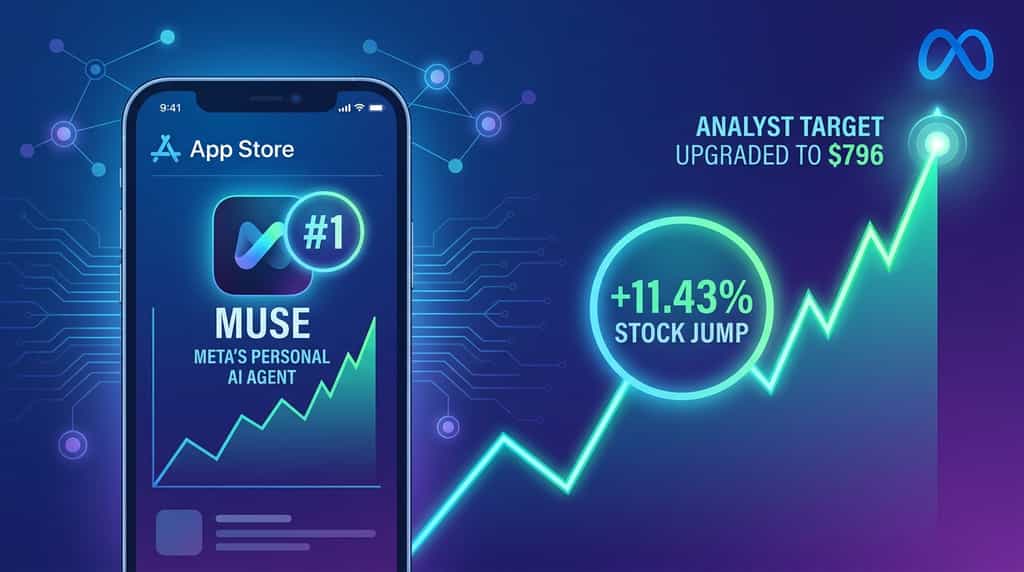
Did one consumer AI app and one Wall Street note move a $1.8 trillion company in a single session? Yes. META stock closed at $741.25 on September 21, 2026, up $76.02 or 11.43%, according to Meta’s investor stock data. The jump followed two catalysts: Muse, Meta’s personal AI agent, reached the top of Apple’s U.S. free App Store chart, and Wells Fargo raised its price target to $796 from $640 while keeping an Overweight rating.
The move arrived days before Meta Connect on September 23–24, 2026. Investors treated App Store ranking plus an analyst reset as evidence that Meta’s rebuilt AI effort is reaching consumers, not only data centers.
Why Did META Stock Jump More Than 11% on September 21?
META rose because investors priced in faster consumer adoption of Muse and a higher long-term earnings multiple from Wells Fargo, not because Meta reported new quarterly revenue that day.
According to Meta’s official stock information page, shares closed at $741.25 on September 21, 2026, after opening near $680.29. The session high reached $753.00 and the low sat at $679.60. Volume printed about 48.7 million shares, versus an average near 18.8 million. That volume spike shows the rally was not a thin after-hours print.
The two catalysts arrived together. Wells Fargo analyst Ken Gawrelski lifted the firm’s target from $640 to $796. Muse ranked No. 1 among free iPhone apps in the United States, ahead of ChatGPT on the chart check that circulated with the note. Connect begins two days later, so traders had a near-term event to hang the new target on.
What Did Wells Fargo Change in Its META Price Target?
Wells Fargo raised its META price target to $796 from $640 and kept an Overweight rating because it now assigns a higher multiple to 2027 earnings after early Muse and Muse Spark traction.
The $156 increase is a valuation-multiple story more than a 2026 profit upgrade. Reports of the note say Wells Fargo left revenue estimates unchanged and cut its 2026 operating income view by about 12%, largely for an expected $10 billion legal-settlement charge in the third quarter. The higher target came from stretching the multiple to 25 times the firm’s 2027 earnings estimate, up from 20 times.
That structure matters. The bank did not claim next-quarter ads would explode. It claimed Meta finally has a product narrative that can support a richer multiple if Muse usage holds. Gawrelski pointed to Muse Spark and the Muse assistant and said Meta “now has a story to tell.”
From Friday’s close near $665.23, $796 implied roughly 19% upside before Monday’s rally. After the close at $741.25, the same target left mid-single-digit to high-single-digit upside, depending on the exact reference print. Connect therefore became the next test, not another target hike.
What Is Muse AI and Why Did It Top Apple’s App Store?
Muse is Meta’s personal AI agent that completes tasks rather than only answering questions, and its No. 1 U.S. free App Store ranking is the first mass-market proof that consumers will download that agent at scale.
Meta’s September 8, 2026 newsroom post describes Muse as a secure, private agent that “doesn’t just answer questions, it actually does the work.” Official capabilities include staying on top of tasks, taking projects off a user’s plate, and turning long-term goals into action plans. Muse runs on Muse Secure VM, a dedicated secure computer with its own browser, and can work across daily apps. Each person controls how much access the agent receives.
Rollout is U.S.-first on iOS, Android, and muse.ai, with AI glasses support planned. Meta says Muse is free for most needs, with subscription plans for heavier use. That pricing design is why App Store rank matters. A free top chart position can flood the funnel. Paid conversion is the later question.
Muse Spark is the model family behind agentic work. Wells Fargo cited Muse Spark, including the 1.3 generation in some recaps, as evidence that Meta’s model cadence has recovered after prior delays. Ranking ahead of ChatGPT on the free U.S. iPhone chart does not prove retention. It does prove discovery. For a two-week-old product launched September 8, discovery is the first hurdle investors watch.
How Does Muse Fit Meta’s Broader AI Reset?
Muse is the consumer face of a lab rebuild that now includes a chief AI officer, a new model family, and a paid layer called Meta One.
CEO Mark Zuckerberg hired Scale AI co-founder Alexandr Wang as chief AI officer after last year’s model delays and questions about infrastructure spend. The company now ships several models inside the Muse family rather than a single chatbot brand. That shift from “assistant that talks” to “agent that acts” is what Wells Fargo is underwriting.
On September 15–16, 2026, Meta’s newsroom introduced Meta One, a subscription across Facebook, Instagram, WhatsApp, and Meta AI. Official takeaways say plans are rolling out gradually, with more than 50 features launched and 15 million subscriptions and trials to date. Core experiences stay free. Paid tiers add AI usage, expression tools, and creator or business features. Media generation in Meta AI can use Muse models.
Those 15 million subscriptions and trials include trials, so paying users are a smaller unknown set. The figure still shows Meta is packaging AI into a commercial layer across apps that already reach billions of people. Muse can sit beside that layer: free agent for tasks, paid caps for heavy compute.
On September 21, 2026, Meta also announced Petal, a subsea cable it describes as the first to deliver petabit-scale capacity across an ocean, linking the United States and France over about 7,000 kilometers at 1 petabit per second, with service targeted for 2029. That is infrastructure, not an app chart. It signals Meta is still building the pipes that agent traffic would need if Muse usage compounds.
What Risks Could Reverse the META Surge?
Chart rank can fade, paid conversion can disappoint, and legal or capex charges can cap 2026 earnings even if 2027 multiples stay rich.
App Store leadership is a snapshot. If Muse drops after launch-week curiosity, the “story to tell” shrinks. If users refuse deep app permissions, the agent cannot send mail, book travel, or fill forms at the quality Meta advertised on September 8.
Wells Fargo’s own cut to 2026 operating income for a large settlement charge shows the target hike is not a clean earnings upgrade. Infrastructure spend remains huge. Petal’s 2029 in-service date shows how long some AI pipes take. Reality Labs still sits beside Family of Apps as a smaller, loss-heavy segment on Meta’s own business description.
Competition is not static. ChatGPT already holds consumer mindshare. Other agents will copy task-completion features. Platform owners can block agents. Those frictions are product risks, not ticker noise.
Beyond the Headlines: What KuCoin 5.0 Means for You
Market news moves fast — but where you act on it matters just as much. This October, KuCoin launches KuCoin 5.0, transforming KuCoin into a rebuilt platform. Here's what actually changes for you:
-
One account for everything. Older platforms split your money across separate "spot," "margin," and "futures" accounts and expected you to understand why. KuCoin 5.0's unified account removes that entirely — deposit once, and everything is simply there.
-
Stocks, indices, and commodities. KuCoin 5.0 expands beyond crypto into global markets. When crypto chops sideways and equities rally (or the reverse), you rotate in minutes instead of opening a brokerage account and waiting days for fiat rails.
-
Real-world assets (RWA). Tokenized exposure to traditional assets like commodities, right inside your crypto account. One of the fastest-growing segments in global finance is no longer reserved for institutions — you access it from the same balance you trade with.
-
Earn while you learn. Not ready to trade? KCUSD lets your stablecoins earn daily, auto-compounding interest. The lowest-stress way to put your idle deposit to work for 4% yield.
-
An AI assistant in plain language. Ask questions, get market context, understand what you're looking at — built into the platform, no jargon required.
-
An app that doesn't overwhelm. Faster, cleaner, and consistent — intuitive from the first tap, not after a tutorial.
-
Safety you can check, not just trust. A MiCAR-licensed EU entity, Proof of Reserves you can verify yourself, and internationally certified security (SOC 2 Type II, ISO 27001:2022).
Create your account in minutes — and start on the platform built for where crypto is going, not where it's been.
Conclusion
META surged 11.43% to $741.25 on September 21, 2026, because Muse reached the top of Apple’s U.S. free App Store and Wells Fargo raised its target to $796 from $640.
Muse, launched September 8, 2026, is Meta’s task-completing agent, free for most use with paid tiers for heavier work. Meta One already reports 15 million subscriptions and trials across apps. Connect on September 23–24 is the next proof point for usage and monetization. Risks remain: retention, platform access, legal charges, and capex.
The session re-rated a cash-rich ads company as an agent platform in one day. Whether $796 holds depends on numbers Meta still has to show, not on a single chart position.
FAQs
Is Muse the same product as Meta AI?
No. Meta AI is the assistant across Meta apps. Muse is a separate personal agent built to complete tasks with a secure VM and browser. Meta One can add paid AI usage on top of free Meta AI.
Does a No. 1 App Store rank mean Muse is profitable?
No. Rank measures downloads and discovery. Profit depends on retention, compute cost, and conversion to paid Muse or Meta One plans.
What official price did META close at after the surge?
According to Meta’s investor stock page, META closed at $741.25 on September 21, 2026, up 11.428% on the printed change of $76.02.
Can crypto on KuCoin replace owning META shares?
No. Crypto pairs can trade the AI sentiment wave. They do not confer equity, dividends, or voting rights in Meta Platforms.
Disclaimer: This article is for informational purposes only and does not constitute financial, legal, or investment advice. Always conduct your own research before interacting with digital assets.