

Why Did Bitcoin Fall Below Glassnode's Short-Term Holder Cost Basis as Stablecoin Supply Dropped by $14.2 Billion?
Introduction
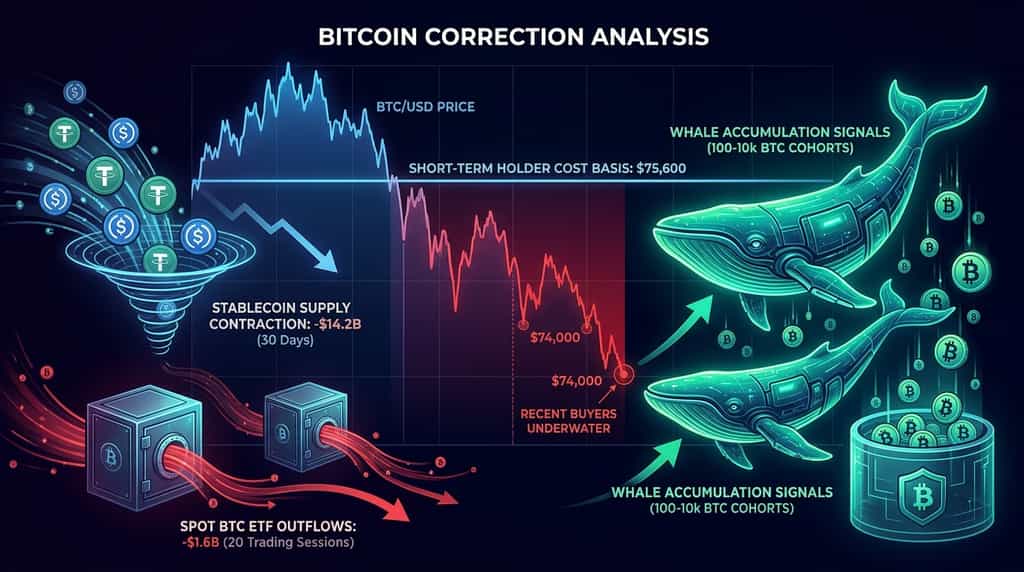
Bitcoin's decline below the Short-Term Holder (STH) Cost Basis of $75,600 highlights weakening demand from recent buyers, while a $14.2 billion contraction in stablecoin supply over 30 days points to declining liquidity across the crypto market. According to Glassnode's November 11, 2026, on-chain analysis, Bitcoin price was trading near $74,000, with only around 35% of short-term holder coins remaining in profit. U.S. spot Bitcoin ETFs also recorded $1.6 billion in net outflows over 20 trading sessions.
However, the market picture is not uniformly bearish. Some large Bitcoin wallet cohorts have resumed accumulation, while much of the leveraged long-position liquidation activity near the current price has already been cleared. The key question is whether these signs of buying interest can offset weakening capital inflows and help Bitcoin reclaim its recent buyers' cost basis.
Quick Answer: What Does Bitcoin Falling Below $75,600 Mean?
Bitcoin trading below the $75,600 Short-Term Holder Cost Basis means that the average investor who acquired BTC within the previous 155 days is now holding at an unrealized loss. At the same time, declining stablecoin supply, ETF redemptions, and a negative Coinbase Premium indicate that demand from several important market segments has weakened.
Key observations from Glassnode's November 11 report include:
-
Recent buyers are underwater: Only around 35% of short-term holder coins remain in profit, compared with nearly all of them at the September high.
-
Stablecoin liquidity is contracting: Total stablecoin supply declined by $14.2 billion over 30 days, marking its fastest contraction since June 2022.
-
U.S. investment demand has weakened: Spot Bitcoin ETFs recorded $1.6 billion in net outflows over 20 trading sessions.
-
Some large wallets are accumulating: Wallets holding 100-1,000 BTC and 1,000-10,000 BTC showed accumulation signals over the past week.
-
Important price levels remain in focus: $75,600 is the short-term holder cost basis, $77,500 is the True Market Mean, and $73,000 is the lower boundary of the recent monitoring range.
The overall picture suggests that Bitcoin is experiencing a correction with limited new capital entering the market. Although some on-chain indicators show early buying interest, a broader recovery in demand has not yet been confirmed.
Why Is Bitcoin Below the Short-Term Holder Cost Basis?
Bitcoin's decline below the Short-Term Holder Cost Basis indicates that recent market participants have moved from unrealized profits into losses, potentially increasing their sensitivity to further price declines.
Glassnode defines short-term holders as investors whose coins have been held for fewer than 155 days. Their aggregate cost basis estimates the average acquisition price of this cohort and helps assess whether relatively recent buyers are collectively in profit or at a loss.
As of November 11, 2026, Glassnode placed this level at approximately $75,600, while Bitcoin was trading near $74,000.
How Many Recent Bitcoin Buyers Are Currently in Loss?
Around 65% of short-term holder coins were below their acquisition price, leaving approximately 35% in profit. This represents a significant change from September, when nearly all short-term holder coins were profitable.
The shift matters because investors who bought at higher prices may respond differently when the market falls below their entry levels. Some may continue holding through volatility, while others may sell to limit losses or reduce exposure.
Glassnode's Cost Basis Distribution metric provides further detail about where recent holders accumulated their BTC. Approximately two-thirds of short-term holder coins were positioned above the current market price, distributed across three acquisition-price bands between August and October. These bands extended as high as $83,600.
This creates a potential supply overhang during a recovery. If Bitcoin rebounds toward these acquisition levels, some holders may consider selling near breakeven, creating resistance as the market attempts to move higher.
Below the current price, the most concentrated acquisition area was between $62,000 and $66,000, where investors accumulated Bitcoin around the August low.
Which Bitcoin Price Levels Matter Next?
Three levels provide useful reference points for evaluating whether the recent correction is stabilizing or developing into a longer consolidation.
| Price Level | On-Chain Significance | Market Implication |
| $75,600 | Short-Term Holder Cost Basis | A recovery above this level would put the average recent buyer back near breakeven |
| $77,500 | True Market Mean | Reclaiming this level could return approximately half of short-term holder coins to profit |
| $73,000 | Lower boundary of the recent monitoring range | A sustained break below this area could indicate a longer consolidation |
| $58,500 | June 2026 low | A closing price below this level would invalidate the August trend change identified by Glassnode |
The broader market structure established in August has not yet been invalidated. The September high represented the first higher high since Bitcoin's 2025 all-time high, while the current price remained substantially above the June low of $58,500.
However, a recovery above $75,600 alone would not confirm a sustained trend reversal. A move back above the True Market Mean at $77,500 would provide additional evidence that recent buyers are returning to profitability.
Why Is the $14.2 Billion Stablecoin Supply Decline Important?
The $14.2 billion reduction in stablecoin supply over 30 days suggests that the pool of dollar-denominated assets available within the crypto ecosystem is contracting.
Stablecoins function as a form of cash within crypto markets. Traders and investors often hold them on exchanges or in blockchain wallets before purchasing Bitcoin, other digital assets, or participating in decentralized finance applications.
When total stablecoin supply expands, it can indicate that additional dollar-denominated liquidity is entering the ecosystem. Conversely, a contraction may reflect redemptions, reduced issuance, or other changes in circulating supply.
Glassnode reported that the latest 30-day contraction was the fastest since June 2022.
How Does Stablecoin Supply Affect Bitcoin Demand?
A shrinking stablecoin supply can reduce the amount of readily available capital within crypto markets. When fewer stablecoins are circulating, there may be less immediately available buying capacity to absorb selling pressure.
However, it is important to distinguish between a decline in aggregate stablecoin supply and a direct measurement of capital leaving the crypto market. A supply contraction does not necessarily mean that every dollar of reduced supply has been converted into fiat currency and withdrawn. Redemptions, changes in issuance, and movements between different stablecoin arrangements can all affect the aggregate figure.
The broader significance comes from the fact that stablecoin contraction is occurring alongside other indicators of weakening demand.
Glassnode also observed that Tether was trading slightly below its $1 reference value. A persistent deviation from the intended peg can reflect temporary imbalances between buying and selling demand, liquidity conditions, or market confidence.
If the 30-day change in total stablecoin supply returns to positive territory, that would provide an initial indication that the supply of dollar-denominated liquidity is expanding again. It would not, by itself, confirm that the additional liquidity is being deployed into Bitcoin.
Why Are U.S. Bitcoin ETFs and Coinbase Data Showing Weak Demand?
U.S. investment demand has weakened, with spot Bitcoin ETFs recording net outflows and the Coinbase Premium remaining negative throughout the decline from the September high.
These indicators matter because they provide different perspectives on demand from investors accessing Bitcoin through traditional financial markets and major U.S. trading venues.
What Do Bitcoin ETF Outflows Indicate?
Glassnode reported that U.S. spot Bitcoin ETFs recorded approximately $1.6 billion in net outflows over the 20 trading sessions preceding November 11.
On November 9, cumulative outflows crossed the $1.5 billion threshold that Glassnode uses to identify an extended outflow period.
Although the current outflow period remains relatively shallow compared with several historical episodes, the direction of flows suggests that ETF demand has not been strong enough to offset selling pressure.
Historical observations also require careful interpretation. Glassnode noted that in previous outflow periods, ETF inflows generally returned after Bitcoin had already established a price low. Therefore, renewed inflows may help confirm improving demand after a recovery has begun, rather than reliably identifying the exact market bottom in advance.
What Does a Negative Coinbase Premium Mean?
The Coinbase Premium compares Bitcoin's price on Coinbase with its broader global market price. A positive premium means BTC trades at a higher price on Coinbase, while a negative premium indicates a discount relative to the wider market.
Because Coinbase is an important venue for U.S. investors, the metric is often used as an indicator of relative buying demand from that market.
Glassnode's analysis adjusts for the effect of Tether trading below its $1 reference value, which could otherwise make the Coinbase discount appear larger than it actually is.
The 30-day average Coinbase Premium remained negative throughout Bitcoin's decline from the September high, reaching its deepest discount since February.
This suggests that U.S. buying demand has been relatively weak. A sustained return to positive territory over several weeks would provide stronger evidence that demand from U.S. market participants is recovering.
How Are Treasury Yields Adding Pressure to Bitcoin?
Higher Treasury yields may create an additional headwind for Bitcoin because they increase the return available from interest-bearing assets and can tighten financial conditions for risk-sensitive investments.
Glassnode highlighted the U.S. two-year Treasury yield as an indicator of market expectations for Federal Reserve policy. At approximately 4.75%, the yield stood 75 basis points above the Fed's cited policy rate of 4%.
The two-year yield reflects the market's expected average short-term interest-rate environment over the bond's remaining maturity, alongside term and other risk premiums. It should not be interpreted as a direct forecast that the Federal Reserve will necessarily raise rates by 75 basis points.
Nevertheless, the gap indicates that bond-market pricing remained relatively restrictive.
The historical comparison is also relevant. In June 2022, the difference between the two-year Treasury yield and the Fed's policy rate reached approximately 244 basis points, more than three times the current gap. The spread had also narrowed since late October.
This suggests that although interest-rate expectations remain a potential constraint on risk assets, the current environment is not identical to the sharp repricing seen in 2022.
For Bitcoin, the important consideration is whether yields continue rising or stabilize. A sustained increase could further constrain risk appetite, while easing rate expectations may reduce one source of macroeconomic pressure.
Are Large Bitcoin Holders Accumulating During the Decline?
Some large Bitcoin wallet cohorts have started accumulating again, but the buying activity remains concentrated among a relatively narrow group of holders.
Glassnode's Accumulation Trend Score measures whether different wallet cohorts are increasing or reducing their BTC balances, with greater weight assigned to larger wallets. A score closer to 1 indicates accumulation, while a score closer to 0 indicates distribution.
Over the week preceding the November 11 report, two wallet cohorts recorded scores above 0.5:
-
Wallets holding 100-1,000 BTC.
-
Wallets holding 1,000-10,000 BTC.
Both groups had spent much of October distributing their holdings before showing renewed buying activity. However, the broader market picture remains mixed. Other cohorts, including wallets holding more than 10,000 BTC and smaller wallets with less than 1 BTC, continued to reduce their balances.
This distinction is important. Accumulation by large wallets can indicate that some investors consider lower prices attractive, but it does not establish that the market as a whole has returned to buying.
The same two cohorts also showed accumulation signals in late September, but that buying activity did not persist. A more convincing change in market behavior would require broader participation from additional wallet groups.
Conclusion
Bitcoin's decline below the $75,600 Short-Term Holder Cost Basis reflects growing pressure on recent buyers, while the $14.2 billion contraction in stablecoin supply highlights weaker liquidity conditions across the crypto market. ETF outflows, a persistently negative Coinbase Premium, and Bitcoin's underperformance against major U.S. equity indices provide additional evidence that demand has weakened.
However, the correction has not invalidated every positive market signal. Much of the nearby leveraged long liquidation activity has already been cleared, resting buy orders have outweighed sell orders in the observed spot order books, and wallets holding 100-10,000 BTC have shown early signs of accumulation.
The key distinction is between isolated buying activity and a broad recovery in capital demand. Reclaiming $75,600 would improve the short-term holder profitability picture, while a sustained move above $77,500 would provide additional confirmation. Conversely, a sustained break below $73,000 could point to a longer consolidation. A closing price below the June low of $58,500 would invalidate the August trend change identified in Glassnode's analysis.
Ultimately, stablecoin supply, ETF flows, U.S. buying activity, and broader wallet accumulation will help determine whether Bitcoin's current correction is stabilizing or developing into a more extended period of weakness.
FAQs
-
What Is Bitcoin's Short-Term Holder Cost Basis?
Bitcoin's Short-Term Holder Cost Basis is the estimated average acquisition price of coins held for fewer than 155 days. Glassnode placed this level at approximately $75,600 in its November 11, 2026, analysis. When BTC trades below it, the average short-term holder is at an unrealized loss.
-
Why Did Stablecoin Supply Fall by $14.2 Billion?
Glassnode reported that total stablecoin supply contracted by $14.2 billion over the 30 days preceding its November 11 report. This was the fastest contraction since June 2022. The decline may reflect redemptions and reduced issuance, indicating that the pool of dollar-denominated liquidity within the crypto ecosystem is shrinking.
-
Does Bitcoin Falling Below $75,600 Mean a Bear Market Has Started?
No. Falling below the Short-Term Holder Cost Basis indicates that recent buyers are collectively at an unrealized loss, but it does not independently establish a long-term bear market. Glassnode identified $73,000 as a near-term level to monitor and $58,500 as the June low below which its August trend-change assessment would be invalidated.
-
Why Are Bitcoin ETF Outflows Important?
Spot Bitcoin ETF outflows indicate that investors are withdrawing more capital from these investment products than they are adding during the measured period. Glassnode reported approximately $1.6 billion in net outflows over 20 trading sessions. Sustained inflows could provide evidence that demand through traditional investment channels is recovering.
-
Are Bitcoin Whales Buying the Dip?
Some large wallet cohorts are showing early accumulation signals. Glassnode reported that wallets holding 100-1,000 BTC and 1,000-10,000 BTC recorded Accumulation Trend Scores above 0.5 over the preceding week. However, other wallet cohorts continued reducing their holdings, so broad-based accumulation has not yet been established.
Disclaimer
This general market information, possibly from third-party, commercial, or sponsored sources, is provided for reference and educational purposes only and does not constitute financial or investment advice, an offer, solicitation, or guarantee. We disclaim liability for its accuracy, completeness, reliability, and any resulting losses. Investments/trading are risky; past performance doesn’t guarantee future results. Users should research, judge prudently, and take full responsibility. For further details, please consult KuCoin’s Terms of Use and Risk Disclosure."