

Why Could Higher Interest Rates Slow Bitcoin Buying at Corporate Treasury Firms?
Introduction
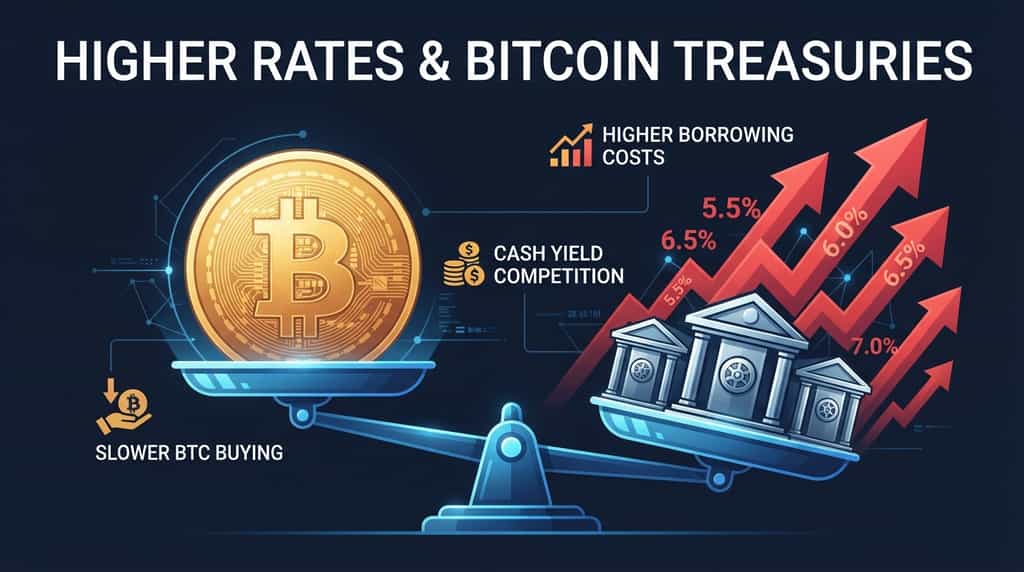
Higher interest rates can slow Bitcoin buying at corporate treasury firms by raising corporate borrowing costs, increasing the yield on cash and short-term government debt, and tightening capital market conditions for equity and convertible debt issuance. When benchmark interest rates remain elevated or rise, companies that finance Bitcoin acquisitions through debt, equity offerings, or excess cash reserves face higher financing expenses and stronger competition from risk-free or low-risk yields.
While long-term digital asset holders often focus on Bitcoin’s fixed supply cap of 21 million coins, corporate treasury teams operate under fiduciary duties, debt covenants, and liquidity requirements. As of November 2026, treasury companies evaluating Bitcoin allocations must weigh capital costs, balance sheet volatility, and refinancing risks against potential long-term appreciation.
Key Takeaways
Higher interest rates tend to curb or delay corporate Bitcoin purchases by making capital more expensive and raising the hurdle rate for non-yielding assets.
-
Higher Debt and Financing Costs: Elevated interest rates increase coupons on newly issued corporate debt and raise floating-rate borrowing expenses, reducing the attractiveness of taking on leverage to buy Bitcoin.
-
Attractive Cash and Treasury Yields: Higher short-term interest rates allow corporate cash and money market instruments to earn meaningful yields, increasing the opportunity cost of holding non-yielding digital assets.
-
Tighter Equity and Convertible Markets: Higher rates often pressure valuation multiples and raise investor yield expectations, making at-the-market equity sales or convertible note issuance less favorable for funding treasury purchases.
-
Balance Sheet and Liquidity Discipline: When funding conditions tighten, treasury managers prioritize operating liquidity, debt service coverage, and working capital buffers over volatile balance sheet additions.
-
Cycle Dependence: The impact varies by company structure; firms with long-term fixed-rate financing or substantial existing reserves face different immediate pressures than firms reliant on ongoing capital raises.
How Do Higher Interest Rates Raise the Cost of Funding Bitcoin Purchases?
Higher interest rates increase the cost of funding Bitcoin purchases by raising interest expenses on new or floating-rate debt and increasing the return investors demand when providing growth or acquisition capital.
Many public and private companies that accumulate Bitcoin as a treasury reserve asset do not rely solely on retained operating cash flow. Instead, some finance acquisitions through senior secured notes, convertible debentures, credit facilities, or equity issuance. When central banks hold policy rates higher or markets reprice rate expectations upward, benchmark yields—such as government bond yields and reference lending rates—climb across the curve. For a treasury firm, higher base rates translate into higher coupon payments on new debt or higher interest charges on variable-rate credit lines.
Higher financing costs directly affect a company’s cash flow statement. Unlike revenue-generating operating equipment or yield-bearing financial instruments, spot Bitcoin does not pay interest, dividends, or cash distributions. If a company borrows capital at a high interest rate to buy an asset that produces no ongoing cash yield, the firm must fund the interest obligation from operating profits, existing cash balances, or future capital raises. Even when a company uses convertible debt—where investors accept a lower coupon in exchange for equity conversion upside—elevated interest rates raise the baseline return threshold required by bond buyers, often forcing issuers to offer higher conversion premiums, shorter maturities, or stricter terms.
Consider a hypothetical treasury company evaluating a $100 million Bitcoin allocation funded through debt or hybrid financing. If prevailing borrowing costs rise from 4% to 7%, annual gross interest expense increases from $4 million to $7 million, before accounting for underwriting fees or tax effects. Over several years, those recurring cash outflows reduce free cash flow available for operations, research, or debt repayment, making management more cautious about expanding Bitcoin exposure during high-rate periods.
Why Does Opportunity Cost Increase for Non-Yielding Assets Like Bitcoin?
Opportunity cost increases for non-yielding assets like Bitcoin during high-rate periods because cash equivalents and short-term sovereign debt offer higher nominal returns with lower price volatility.
Corporate treasurers are tasked with managing liquidity, preserving principal, and matching cash inflows to upcoming liabilities such as payroll, supplier invoices, taxes, and capital expenditures. Traditionally, operating cash and short-term reserves sit in bank deposits, money market funds, or short-duration government bills. When interest rates are near zero, holding cash yields almost nothing, which can make alternative stores of value or risk assets look comparatively more appealing to firms with surplus liquidity.
When interest rates are higher, short-term yields become a tangible alternative for idle corporate cash. A treasury manager holding excess liquidity can earn interest on cash equivalents without exposing short-term working capital to sharp drawdowns in digital asset markets. Because Bitcoin does not generate periodic yield on its own, holding it instead of interest-bearing cash or short-term treasuries carries a clearer measurable yield trade-off on paper.
| Treasury Allocation Factor | Lower Interest Rate Environment | Higher Interest Rate Environment | Typical Impact on Bitcoin Buying |
| Debt & Credit Financing Cost | Lower benchmark rates reduce coupon and borrowing costs | Higher benchmark rates raise interest expenses and tighten credit | Can slow debt-funded Bitcoin acquisitions |
| Cash & Short-Term Yield | Low or near-zero yields on cash and money market funds | Higher yields on cash equivalents and short-term bills | Increases opportunity cost of holding non-yielding assets |
| Capital Market Conditions | Often more accommodating equity and convertible issuance | Higher discount rates and stricter investor return hurdles | May limit or raise the cost of capital-raise funding |
| Liquidity & Risk Posture | Greater willingness to deploy excess capital into risk assets | Stronger focus on cash preservation, covenants, and buffers | Encourages more selective or measured purchases |
This dynamic does not mean every company stops buying Bitcoin whenever rates rise. Firms with strong recurring cash flows, minimal debt, and a long-term strategic mandate may still allocate capital if leadership views current valuations as attractive relative to their multi-year thesis. However, for treasuries balancing short-term yield against price volatility, higher rates raise the bar that Bitcoin’s expected appreciation must clear to justify taking on mark-to-market fluctuations.
How Do Higher Rates Affect Equity Issuance and Capital Market Access?
Higher interest rates can slow Bitcoin buying at treasury firms by raising discount rates used in equity valuation, increasing investor demand for yield, and making new share or convertible offerings more dilutive or costly.
Many Bitcoin treasury strategies depend on capital markets access rather than operating cash flow alone. Companies frequently issue common stock, preferred shares, or convertible bonds to raise funds and deploy the proceeds into Bitcoin. The feasibility and attractiveness of those transactions depend heavily on broader financial conditions, equity market sentiment, and credit spreads.
Higher interest rates affect capital raising through several connected channels:
-
Higher Discount Rates and Valuation Pressure: In financial modeling, higher risk-free rates increase the discount rate applied to future cash flows, which can weigh on equity valuations—especially for growth-oriented or volatile sectors. Lower share prices mean a company must issue more shares to raise the same dollar amount, increasing dilution for existing shareholders.
-
Stricter Credit and Convertible Terms: Investors buying corporate bonds or convertible notes compare those instruments against government yields and investment-grade credit. When rates are higher, fixed-income and hybrid investors demand stronger yields, tighter covenants, or more attractive equity conversion terms.
-
Selective Risk Appetite: Institutional investors often adjust portfolio risk budgets when borrowing is expensive, becoming more selective about funding companies whose primary thesis centers on a volatile digital asset.
If a treasury firm’s stock trades at a narrower premium to its net asset value—or at a discount—issuing new shares to buy Bitcoin becomes less accretive on a per-share basis. Management teams focused on per-share Bitcoin metrics or shareholder dilution may pause share issuance until market conditions and valuation multiples improve.
What Role Do Debt Covenants, Refinancing, and Accounting Rules Play?
Debt covenants, upcoming refinancing walls, and fair-value accounting rules influence whether a treasury firm can or wants to buy Bitcoin when interest rates are elevated.
Even a company that has already accumulated Bitcoin does not evaluate new purchases in isolation. Corporate finance teams must look at the entire balance sheet, including existing debt maturities, covenant ratios, and how price swings appear on financial statements.
Debt Service and Refinancing Considerations
If a firm has floating-rate debt or bonds maturing within the next one to three years, higher rates can increase refinancing costs when those obligations roll over. Credit rating agencies and lenders closely monitor interest coverage ratios and liquidity buffers. When refinancing looks more expensive, preserving cash to pay down debt or maintain liquidity cushions often takes precedence over buying additional Bitcoin.
Mark-to-Market Volatility and Balance Sheet Optics
Under fair-value accounting standards applicable to digital assets, fluctuations in Bitcoin’s market price are reflected in earnings or balance sheet valuations depending on the specific accounting treatment and reporting period. While accounting rules do not change the underlying tokens a company holds, sharp price swings alongside higher financing costs can make earnings appear more volatile to equity analysts and credit counterparties. Firms that rely on external financing are particularly mindful of how balance sheet volatility interacts with lender expectations and market perception.
How Can Analysts and Investors Evaluate Corporate Bitcoin Treasury Strategies?
Analysts and investors can evaluate a corporate Bitcoin treasury strategy by examining how the company funds its purchases, how much debt it carries, and how resilient its core business is to higher rates.
Rather than treating all Bitcoin treasury firms alike, market observers typically look at the mechanics behind each company’s balance sheet:
-
Funding Source: Determine whether Bitcoin purchases are funded from surplus operating cash flow, existing reserves, equity issuance, or debt. Purchases backed by steady free cash flow carry different rate sensitivity than those funded with high-cost debt.
-
Debt Maturity Schedule and Rate Structure: Check whether existing debt is fixed-rate or floating-rate, when maturities fall due, and whether the company faces near-term refinancing in a higher-rate environment.
-
Core Operating Cash Flow: Assess whether the company’s underlying business generates reliable cash flow or requires external capital to cover operating expenses and interest payments.
-
Liquidity Buffer: Review unrestricted cash and short-term liquid assets relative to near-term obligations so the firm is not forced to sell assets during market drawdowns.
-
Governance and Risk Disclosures: Read risk factors, treasury policies, and regulatory disclosures to understand how the board governs digital asset exposure and market risk.
Conclusion
Higher interest rates can slow Bitcoin buying at corporate treasury firms by increasing borrowing costs, making interest-bearing cash and short-term debt more competitive, and tightening equity and convertible financing conditions. Because Bitcoin does not generate ongoing interest or cash yield, elevated rates raise its opportunity cost relative to yield-bearing instruments and increase the financial burden of debt-funded accumulation.
At the same time, the impact is not uniform across all companies. Firms with strong operating cash flows, low leverage, and well-spaced debt maturities are generally better positioned than companies dependent on frequent capital raises or floating-rate borrowing. Examining funding sources, interest obligations, liquidity buffers, and balance sheet structure provides a clearer view of how rate environments shape corporate Bitcoin demand over time.
FAQs
Why do higher interest rates make debt-funded Bitcoin buying harder for companies?
Higher interest rates increase the borrowing cost on new loans, bonds, and floating-rate credit facilities, raising recurring interest expenses for the company. Because Bitcoin pays no interest or yield, higher debt costs can strain cash flow and reduce the appeal of borrowing to acquire it.
How does higher interest on cash affect corporate Bitcoin adoption?
When short-term interest rates are higher, cash and money market instruments generate more interest income with lower price volatility. Corporate treasurers managing operating liquidity may favor earning yield on cash over shifting funds into a volatile, non-yielding asset like Bitcoin.
Do all companies stop buying Bitcoin when interest rates rise?
No, not all companies stop buying Bitcoin when rates rise. Firms that generate strong free cash flow, carry minimal debt, or issue equity under favorable conditions may still buy Bitcoin if their leadership and board support the allocation.
How do higher interest rates affect convertible debt and share issuance for treasury firms?
Higher rates raise the baseline return expectations of investors and can pressure equity valuations, making new share or convertible note offerings more costly or dilutive. When capital markets become less favorable, companies that rely on financing rounds to buy Bitcoin may slow their pace of accumulation.
What balance sheet metrics matter most when rates are elevated?
Key metrics include cash flow coverage of interest payments, debt maturity timelines, fixed versus floating interest exposure, and unrestricted cash reserves. Together, these indicators show whether a company can comfortably service obligations without restricting operations or selling assets under stress.
Disclaimer
This general market information, possibly from third-party, commercial, or sponsored sources, is provided for reference and educational purposes only and does not constitute financial or investment advice, an offer, solicitation, or guarantee. We disclaim liability for its accuracy, completeness, reliability, and any resulting losses. Investments/trading are risky; past performance doesn’t guarantee future results. Users should research, judge prudently, and take full responsibility. For further details, please consult KuCoin’s Terms of Use and Risk Disclosure.