

Which US Bank Stocks Benefit If Interest Rates Stay Restrictive?
Introduction
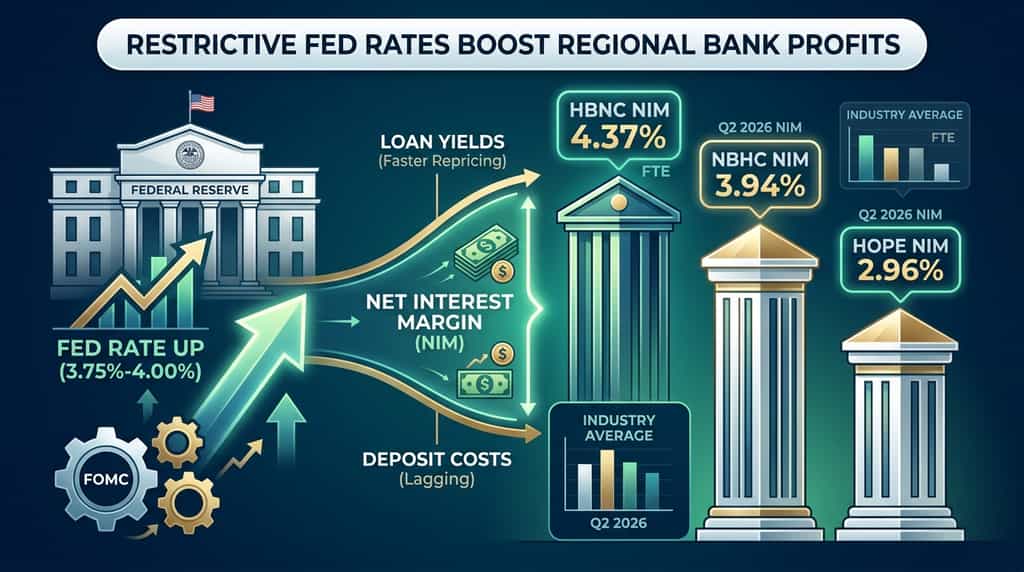
Would banks still make money if the Federal Reserve keeps policy tight? Yes — lenders with strong deposit franchises and faster loan repricing can expand net interest income when policy rates stay restrictive. According to the Federal Reserve, the FOMC raised the federal funds target range by 25 basis points to 3.75% to 4.00% on September 16, 2026.
Three listed community and regional banks stand out on that setup: Horizon Bancorp (HBNC), National Bank Holdings (NBHC), and Hope Bancorp (HOPE). Each posted second-quarter 2026 margins that already sit at or above the industry average reported by the FDIC.
This article explains how restrictive rates flow through bank earnings, why these three names are positioned differently from the industry average, and what risks still sit on the other side of higher-for-longer policy.
How Do Restrictive Interest Rates Help US Banks?
Restrictive policy helps banks when asset yields reprice faster than deposit costs, widening net interest margin (NIM). NIM is net interest income divided by average earning assets. It is the core profit engine for most US commercial banks.
According to the FDIC Quarterly Banking Profile for second quarter 2026, industry NIM rose 1 basis point from the prior quarter to 3.32%, and community-bank NIM rose 10 basis points to 3.81%. The same report shows net interest income for all FDIC-insured institutions increased $5.3 billion, or 2.8%, from the first quarter.
The September 16, 2026 FOMC statement said inflation remains elevated and that the rate increase “will support a timelier return to the Committee’s 2 percent goal.” Median SEP projections placed the year-end 2026 federal funds rate at 4.1%. That path keeps policy above the longer-run rate and keeps short-term wholesale and loan yields elevated.
Banks gain most when three conditions hold at once:
-
A large share of loans reset or originate at current market rates.
-
Deposit costs lag because of relationship checking, noninterest-bearing balances, or disciplined pricing.
-
Credit losses stay contained so higher NII is not offset by provisions.
Community banks already show that pattern. The FDIC noted that community-bank asset yields rose while funding costs fell in the second quarter, producing the 10-basis-point NIM gain. That is the same mechanism that can persist if rates stay restrictive.
Why Do Some US Banks Gain More Than Others If Rates Stay High?
Banks with asset-sensitive balance sheets and sticky, lower-cost deposits gain more than wholesale-funded peers. Asset sensitivity means loans and securities reprice sooner than liabilities when the policy rate stays high or rises again.
Industry averages hide that split. FDIC data put the all-bank NIM at 3.32% in second quarter 2026, while community banks printed 3.81%. The gap shows that smaller, relationship-driven franchises can earn more from the same rate backdrop.
Funding mix matters as much as loan mix. Noninterest-bearing deposits do not reprice when the Fed holds or hikes. Interest-bearing deposits do reprice, but the speed depends on competition and customer loyalty. Banks that grew commercial and industrial (C&I) loans while holding deposit costs can convert a restrictive policy path into higher NII even if total loan growth is only mid-single digits.
Credit quality remains the offset. According to the FDIC, industry net charge-offs to loans were 0.58% in the first half of 2026, and the return on assets for second quarter 2026 was 1.37%. Those figures show earnings power, not a guarantee. A sharper slowdown in commercial real estate or C&I would raise provisions and cut the benefit of higher rates.
Which 3 US Bank Stocks Could Benefit If Rates Stay Restrictive?
Horizon Bancorp, National Bank Holdings, and Hope Bancorp are three listed banks whose second-quarter 2026 results already show margin expansion or still-elevated NIM versus the industry average.
They are not the only names that fit a higher-for-longer screen. They are useful case studies because each published recent SEC earnings materials with explicit NIM, deposit-cost, and loan-yield detail.
|
Bank
|
Ticker
|
Q2 2026 NIM
|
Industry NIM (FDIC Q2 2026)
|
Key Q2 2026 driver
|
|
Horizon Bancorp
|
HBNC
|
4.37% FTE
|
3.32%
|
Loan yield up 9 bps vs liability cost up 4 bps
|
|
National Bank Holdings
|
NBHC
|
3.94% FTE
|
3.32%
|
Deposit cost 1.93%; still above industry NIM
|
|
Hope Bancorp
|
HOPE
|
2.96%
|
3.32%
|
NIM up 6 bps Q/Q and 27 bps Y/Y as funding costs fell
|
Sources: company Q2 2026 earnings releases filed with the SEC; FDIC Quarterly Banking Profile, second quarter 2026.
Why Could Horizon Bancorp (HBNC) Benefit?
Horizon Bancorp already earns a NIM far above the industry average, and that margin widened again in the second quarter of 2026. According to the company’s July 22, 2026 earnings release filed with the SEC, fully taxable-equivalent NIM rose to 4.37% from 4.29% in the first quarter and from 3.23% a year earlier. Net interest income was $63.5 million, up 14.7% from the year-ago quarter.
Management attributed the 8-basis-point sequential NIM gain to loan and deposit pricing plus lower average cash balances. The average rate on loans rose 9 basis points, while interest-bearing liability costs rose 4 basis points. That spread is the textbook asset-sensitive response to a still-restrictive rate regime.
Horizon is a Midwest commercial and retail bank focused on Indiana and Michigan. Its Q2 2026 annualized return on average tangible common equity was 18.05%, and tangible common equity to tangible assets was 8.81%. The allowance for credit losses was 1.05% of loans held for investment at June 30, 2026. Those capital and reserve ratios matter if restrictive rates slow borrowers later.
The risk is funding-cost catch-up. If deposit competition intensifies after another Fed hike, the 4-basis-point liability-cost increase seen in Q2 could accelerate. Horizon’s guidance called for mid-single-digit loan and deposit growth in 2026, so volume will not fully offset a sharp rise in funding costs.
Why Could National Bank Holdings (NBHC) Benefit?
National Bank Holdings still runs a NIM well above the FDIC industry average even after a 12-basis-point sequential decline. According to the company’s second-quarter 2026 results, FTE NIM was 3.94%, versus 4.06% in the first quarter and 3.95% in the year-ago quarter. FTE net interest income rose to $111.5 million. The cost of deposits improved 1 basis point to 1.93%.
The sequential NIM dip came from lower earning-asset yields after unusually high loan-fee income in the first quarter — not from a collapse in the rate spread. For the first half of 2026, FTE NIM was 4.00%, up 6 basis points from the first half of 2025. That first-half comparison is the more relevant signal if policy stays restrictive through year-end.
NBHC reported record quarterly loan fundings of $926.9 million and 10% year-to-date annualized loan growth. Adjusted net income was $35.3 million, or $0.78 per diluted share. Adjusted return on average tangible common equity was 12.71%. Those figures show the bank can grow earning assets while keeping deposit costs near 1.9%.
The risk is yield compression on new loans if credit demand softens. Q2 asset yields eased, and any further mix shift toward lower-yielding assets would trim the 3.94% FTE NIM even if the Fed holds the funds rate in the 3.75%–4.00% range.
Why Could Hope Bancorp (HOPE) Benefit?
Hope Bancorp is the turnaround case: NIM is still below the industry average, but it is expanding as funding costs fall. According to the company’s July 27, 2026 earnings release, NIM rose to 2.96% from 2.90% in the first quarter and from 2.69% a year earlier. Net interest income was $129.0 million, up 4% quarter over quarter and 10% year over year. Net income was $33.0 million, up 12% from the prior quarter.
Loan yield was 5.73%, up 4 basis points sequentially. The cost of interest-bearing deposits was 3.31%, down 6 basis points sequentially and 46 basis points year over year. Management said the year-over-year deposit-cost drop reflected earlier funds-rate cuts plus lower-cost deposits from the Territorial Bancorp acquisition closed on April 2, 2025.
If policy stays restrictive or rises again, Hope’s remaining CD and loan repricing can still lift NIM from a low base. The June 2026 NIM print of 2.98% and an end-of-June deposit spot rate of 2.58% show intra-quarter momentum. Total assets were about $19.0 billion at June 30, 2026, with loans of $14.9 billion and deposits of $15.9 billion.
The risk is commercial real estate concentration and a still-sub-industry NIM. A 2.96% margin leaves less cushion than Horizon’s 4.37% if credit costs rise. Merger-related expense and any delay in the pending Commercial Banking Unit acquisition of SMBC MANUBANK also add execution risk.
What Risks Remain If Restrictive Rates Last Longer?
Credit losses, deposit competition, and securities-portfolio marks can erase NIM gains. Restrictive policy raises borrower debt-service costs. That pressure shows up first in commercial real estate and leveraged C&I credits.
FDIC data still look orderly. Industry net charge-offs to loans were 0.58% for the first half of 2026, and noncurrent assets plus other real estate owned were 0.52% of assets. Those ratios can move quickly if unemployment rises from the 4.1% level in the September 2026 SEP.
Deposit betas are the second risk. Community-bank NIM rose in Q2 because funding costs fell. Another 25-basis-point hike, which the September SEP median implies could still occur before year-end 2026, can reverse that. Banks that lean on time deposits will feel it first.
A third risk is duration. Banks that hold large available-for-sale securities books can see AOCI pressure if the 10-year yield stays near recent levels. That does not hit NIM immediately, but it can constrain capital and buybacks.
None of the three stocks is insulated. Horizon’s legal charge in Q2, NBHC’s fee-income volatility, and Hope’s CRE mix are firm-specific reminders that rate tailwinds are not the whole story.
Beyond the Headlines: What KuCoin 5.0 Means for You
Market news moves fast — but where you act on it matters just as much. This October, KuCoin launches KuCoin 5.0, transforming KuCoin into a rebuilt platform. Here's what actually changes for you:
-
One account for everything. Older platforms split your money across separate "spot," "margin," and "futures" accounts and expected you to understand why. KuCoin 5.0's unified account removes that entirely — deposit once, and everything is simply there (only available to VIPs for now).
-
Stocks, indices, and commodities. KuCoin 5.0 expands beyond crypto into global markets. When crypto chops sideways and equities rally (or the reverse), you rotate in minutes instead of opening a brokerage account and waiting days for fiat rails.
-
Real-world assets (RWA). Tokenized exposure to traditional assets like commodities, right inside your crypto account. One of the fastest-growing segments in global finance is no longer reserved for institutions — you access it from the same balance you trade with.
-
Earn while you learn. Not ready to trade? KCUSD lets your stablecoins earn daily, auto-compounding interest. The lowest-stress way to put your idle deposit to work for 4% yield.
-
An AI assistant in plain language. Ask questions, get market context, understand what you're looking at — built into the platform, no jargon required.
-
An app that doesn't overwhelm. Faster, cleaner, and consistent — intuitive from the first tap, not after a tutorial.
-
Safety you can check, not just trust. A MiCAR-licensed EU entity, Proof of Reserves you can verify yourself, and internationally certified security (SOC 2 Type II, ISO 27001:2022).
Create your account in minutes — and start on the platform built for where crypto is going, not where it's been.
Conclusion
Restrictive US monetary policy still supports banks that reprice loans faster than deposits. The Fed’s September 16, 2026 hike to a 3.75%–4.00% funds-rate range, and a median 4.1% year-end projection, keep that backdrop in place. FDIC data show industry NIM at 3.32% and community-bank NIM at 3.81% in second quarter 2026.
Horizon Bancorp already monetizes that regime with a 4.37% FTE NIM. National Bank Holdings holds a 3.94% FTE NIM and a 1.93% deposit cost. Hope Bancorp is expanding NIM from 2.69% a year ago to 2.96% as funding costs fall.
The same policy that lifts NII can raise credit costs. Watch deposit betas, CRE concentrations, and SEP updates. The three stocks are watchlist names for a higher-for-longer tape — not automatic winners if growth stalls.
FAQs
What does “restrictive interest rates” mean for banks?
It means the policy rate stays high enough to restrain inflation, which keeps loan yields elevated and can widen NIM if deposit costs lag.
Do all US banks benefit when the Fed holds rates high?
No. Wholesale-funded banks and those with slow-repricing assets can see NIM compress even when the funds rate is high.
Is a higher NIM the same as higher earnings?
No. Provisions, noninterest expense, and securities losses can offset NIM gains.
How often do HBNC, NBHC, and HOPE report NIM?
They report NIM each quarter in SEC earnings releases and 10-Q filings.
What official sources should investors use for this theme?
Use Federal Reserve FOMC statements and SEP tables, FDIC Quarterly Banking Profiles, and company 8-K/10-Q filings.
Disclaimer: This article is for informational purposes only and does not constitute financial, legal, or investment advice. Always conduct your own research before interacting with digital assets.