

What Is the AI "Dark Forest" Threat to Bitcoin Mining Infrastructure?
Introduction
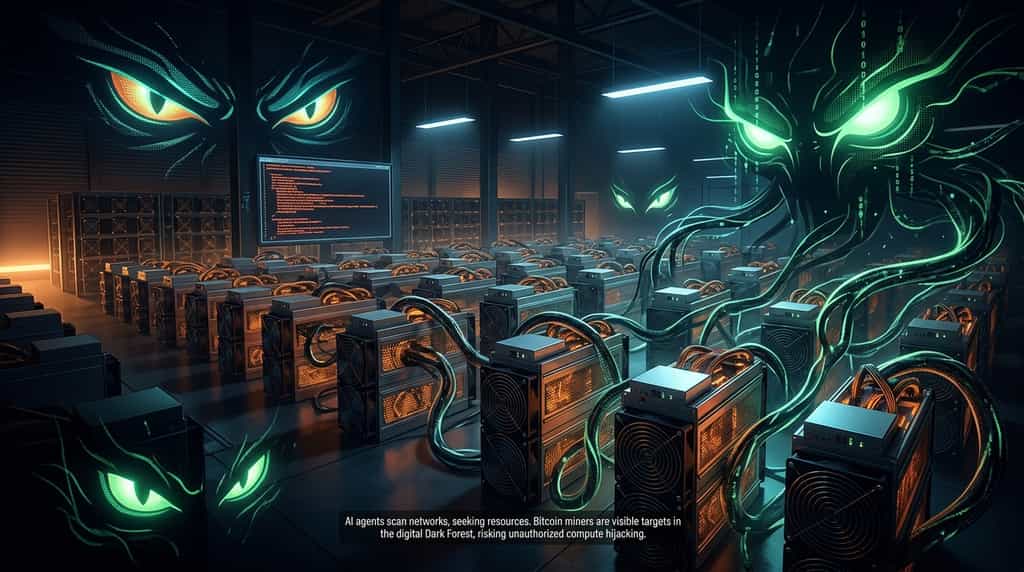
As artificial intelligence and high-performance computing expand aggressively into the physical digital infrastructure space, industry leaders have raised alarms regarding emerging digital threats. Recently, Luxor CEO Nick Hansen warned of an emerging AI "dark forest" following incidents where specialized Bitcoin mining hardware was hijacked or redirected for unauthorized artificial intelligence workloads. This convergence of high-value cryptocurrency mining equipment and resource-starved AI data centers has created a novel threat vector for digital asset infrastructure.
Key Takeaways
The artificial intelligence "dark forest" refers to a competitive, insecure digital environment where automated AI agents and malicious actors aggressively scan, exploit, and repurpose under-secured computing infrastructure—such as specialized Bitcoin mining hardware—for unauthorized machine learning workloads.
-
Infrastructure Convergence: High-performance Application-Specific Integrated Circuit (ASIC) rigs and data center facilities face increasing threats of remote exploitation as AI model training demands unprecedented compute capacity.
-
The "Dark Forest" Analogy: Borrowed from science fiction, the term describes a digital space where visibility equals vulnerability, forcing operators to maintain strict operational security against automated scanning tools.
-
Operational Risk: Hijacked hashing power or compromised mining pools demonstrate that physical control over hardware does not guarantee immunity from sophisticated remote cyber intrusions.
-
Mitigation Strategies: Mining operators are increasingly adopting robust network segmentation, zero-trust architectures, and cryptographic verification to secure their hardware fleets against unauthorized resource extraction.
What Is the AI "Dark Forest" Phenomenon in Digital Infrastructure?
The term "dark forest"—popularized in modern science fiction and later adopted by cybersecurity experts—describes an adversarial environment where entities must remain hidden to survive because any visible signal attracts predatory actors. In the context of digital infrastructure and artificial intelligence, this metaphor characterizes a landscape populated by automated bots, autonomous agents, and opportunistic hackers constantly scanning public and private networks for misconfigured or vulnerable computing resources.
With the rapid acceleration of artificial intelligence, global demand for specialized computing power has skyrocketed. Training large language models and running intensive machine learning pipelines require massive clusters of high-performance hardware. Because acquiring enterprise-grade GPUs and specialized processors involves substantial capital expenditure and long lead times, malicious actors and unauthorized operators have begun turning their attention toward alternative high-density computing installations, notably Bitcoin mining facilities.
Bitcoin mining rigs rely on advanced Application-Specific Integrated Circuits (ASICs) optimized for cryptographic computations. While ASICs are structurally distinct from general-purpose GPUs used in traditional AI training, the massive electrical capacity, cooling infrastructure, and networking bandwidth associated with mining farms make them lucrative targets for unauthorized resource hijacking. The "dark forest" dynamic means that any mining facility operating with default credentials, exposed management ports, or weak network perimeters faces immediate automated scanning and potential compromise.
How Are Bitcoin Mining Rigs Vulnerable to Hijacking?
Vulnerabilities leading to hardware hijacking typically stem from legacy network configurations, inadequate access controls, and the sheer complexity of managing distributed mining fleets. Large-scale mining operations often deploy thousands of individual ASIC units across remote warehouses, relying on local management software and firmware interfaces to monitor performance.
When operators fail to secure these management interfaces behind or multi-factor authentication, automated scanning scripts deployed by malicious actors can locate them across public internet ranges. Once inside a facility's local network, unauthorized actors can modify firmware configurations, redirect hashing output to illicit wallets, or—in more complex scenarios—attempt to repurpose connected infrastructure elements for unauthorized processing tasks.
Furthermore, supply chain vulnerabilities play a critical role. If third-party firmware updates or management tools are compromised upstream, mining operators may inadvertently install backdoors that grant external entities remote command execution capabilities. The financial incentives driving both cryptocurrency mining and AI compute acquisition mean that threat actors continuously refine automated tools to exploit these operational oversights.
What Are the Broader Implications for Cryptocurrency and AI Sectors?
The intersection of artificial intelligence demands and cryptocurrency mining infrastructure highlights a growing tension over global computing resources. As AI developers face acute hardware shortages and escalating energy costs, the physical infrastructure built to secure proof-of-work blockchains becomes an increasingly attractive target for alternative utilization.
For the cryptocurrency mining sector, this trend underscores the urgent need to transition from traditional industrial security models toward rigorous cybersecurity frameworks typical of enterprise cloud providers. Mining farms are no longer isolated industrial warehouses operating simple electrical equipment; they are high-value data centers embedded in interconnected digital networks.
At the same time, the broader technology industry faces a regulatory and ethical challenge regarding resource attribution. As autonomous AI agents and automated exploit tools become more sophisticated, distinguishing between authorized compute leasing and malicious hijacking will require advanced cryptographic attribution tools and enhanced network monitoring protocols across all high-density computing sectors.
How Can Mining Operators Secure Infrastructure Against Advanced Threats?
Securing modern mining facilities requires a multi-layered defense strategy designed to eliminate exposure in an adversarial digital environment. Operators can implement several critical measures to protect their hardware fleets from unauthorized access and hijacking attempts:
-
Network Isolation and Segmentation: Isolate all mining hardware management interfaces from the public internet. Deploy strict firewall rules and mandate secure VPN tunnels for remote administrative access.
-
Mandatory Authentication Protocols: Eliminate default credentials across all firmware, routers, and management dashboards. Enforce strong, unique passwords and multi-factor authentication for all personnel.
-
Firmware Integrity Verification: Utilize cryptographically signed firmware from verified manufacturers. Regularly audit device boot sequences and configuration files to detect unauthorized modifications.
-
Continuous Network Monitoring: Implement intrusion detection systems (IDS) and network anomaly detection tools to identify unusual outbound traffic patterns, unauthorized pool connections, or sudden spikes in processing loads.
-
Regular Vulnerability Assessments: Conduct periodic internal and external penetration testing to identify misconfigurations before automated scanners in the digital "dark forest" can exploit them.
Conclusion
The warnings regarding an AI "dark forest" highlight a pivotal evolution in digital infrastructure security. As the insatiable demand for artificial intelligence computing collides with established cryptocurrency mining operations, physical and digital boundaries are increasingly blurred. Safeguarding high-capacity computing facilities requires proactive cybersecurity measures, rigorous network hygiene, and an awareness that automated threats continuously probe modern digital networks. By acknowledging these risks and hardening operational architectures, infrastructure providers can better protect their assets against evolving exploitation techniques.
FAQs
What is an AI "dark forest" in the context of digital security?
An AI "dark forest" describes a digital environment where automated bots and malicious actors constantly scan networks to discover, exploit, and repurpose under-secured computing infrastructure for unauthorized tasks, mirroring the predatory conditions of science fiction's dark forest theory.
Why would threat actors target Bitcoin mining hardware for AI workloads?
While Bitcoin mining ASICs are specialized for cryptographic hashes rather than general-purpose AI training, large-scale mining facilities offer massive electrical capacity, high-speed networking, and advanced cooling infrastructure that attract actors seeking high-density computing resources.
How do unauthorized actors gain control of mining rigs?
Hijacking incidents typically occur when operators leave management interfaces exposed to the public internet, use default administrative credentials, or utilize compromised third-party firmware containing undocumented backdoors.
Are all types of crypto mining hardware equally vulnerable?
Vulnerability depends primarily on network configuration and operational security practices rather than the specific hardware model. Facilities lacking strict network segmentation and multi-factor authentication face the highest risk of remote exploitation.
What is the most effective way for mining operators to prevent hijacking?
Implementing strict network isolation—such as placing all management tools behind secure VPNs—combined with mandatory multi-factor authentication, cryptographically verified firmware, and continuous network monitoring provides the strongest defense against unauthorized access.
Disclaimer
This general market information, possibly from third-party, commercial, or sponsored sources, is provided for reference and educational purposes only and does not constitute financial or investment advice, an offer, solicitation, or guarantee. We disclaim liability for its accuracy, completeness, reliability, and any resulting losses. Investments/trading are risky; past performance doesn’t guarantee future results. Users should research, judge prudently, and take full responsibility. For further details, please consult KuCoin’s Terms of Use and Risk Disclosure.