

Tether’s BotPsy AI Model Outperforms Larger Models in Benchmarks: What to Know
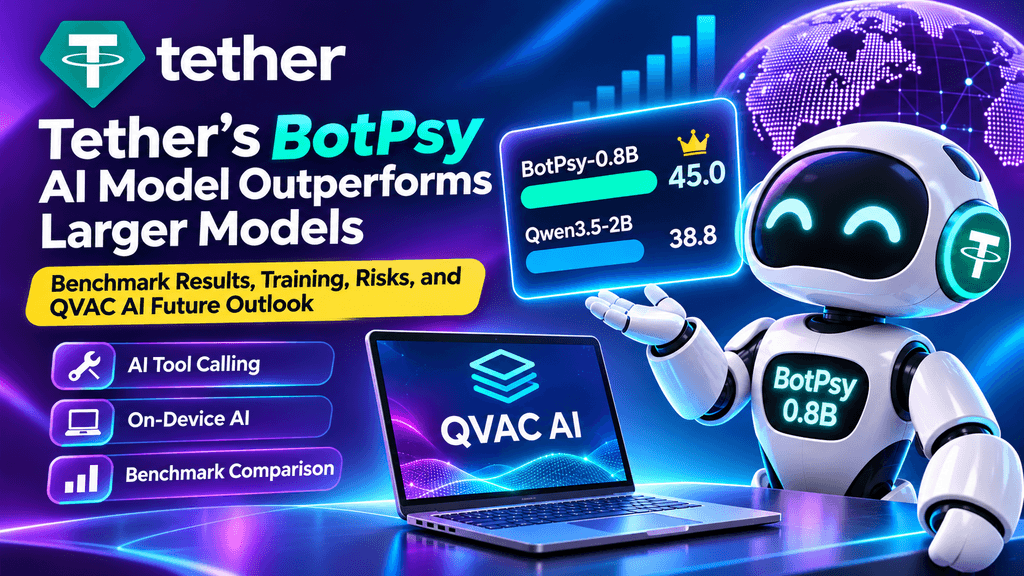
Tether, the issuer of the USDT stablecoin, has expanded its artificial intelligence research with the launch of QVAC BotPsy-0.8B, a compact AI model that reportedly outperformed larger competitors in several agentic benchmarks. Announced on November 11, 2026, the 800-million-parameter model surpassed Alibaba's Qwen3.5-2B on five of six selected tests, according to Tether's evaluations. The results highlight growing interest in smaller, specialized AI systems capable of executing software commands and handling multi-step tasks. However, questions remain about benchmark comparability, real-world reliability, and security. Understanding BotPsy's architecture, training methods, performance results, and connection to Tether's broader QVAC strategy provides a clearer picture of its potential significance.
Key Takeaways
-
Tether AI Research launched QVAC BotPsy-0.8B on November 11, 2026, introducing an 800-million-parameter AI model designed for tool calling and multi-step task automation.
-
BotPsy outperformed the larger Qwen3.5-2B model on five of six agentic benchmarks in Tether's evaluations, demonstrating advantages in specialized AI tasks.
-
The model uses supervised fine-tuning, knowledge distillation, and reinforcement learning to improve instruction following, function calling, and task execution.
-
BotPsy supports local AI deployment through downloadable, quantized model formats, potentially reducing dependence on centralized cloud infrastructure.
-
Despite its benchmark performance, BotPsy faces limitations in complex reasoning, multilingual tasks, information retrieval, and security-sensitive applications.
-
Tether's broader QVAC initiative aims to expand decentralized, privacy-focused AI capabilities, although commercial adoption and real-world reliability remain uncertain.
What Is Tether’s BotPsy AI Model and How Does It Work?
Tether’s BotPsy AI model, officially named QVAC BotPsy-0.8B, is an open-weight artificial intelligence system designed to perform everyday tasks through tool calling and multi-step automation. Announced by Tether AI Research on November 11, 2026, the model contains 800 million parameters and builds on Alibaba’s Qwen3.5-0.8B architecture. Unlike conventional chatbots that primarily generate text responses, BotPsy is designed to interact with applications, execute commands, and complete tasks involving calendars, emails, files, and device settings. In Tether's published evaluations, BotPsy outperformed the larger Qwen3.5-2B model on five of six agentic benchmarks, highlighting the potential of specialized small AI models for local deployment.
How BotPsy Uses AI Tool Calling to Complete Everyday Tasks
BotPsy operates through a process known as AI tool calling, which allows a language model to select and request actions from software applications rather than simply answer questions. When a user asks an assistant to schedule a meeting, for example, BotPsy can identify the appropriate calendar function, generate the required arguments, and interpret the results returned by the application. More complex requests may involve several connected actions, such as checking availability, resolving scheduling conflicts, updating appointments, and creating reminders. The model can also work with supported functions for messaging, document management, web searches, and device controls. Similar tool-based capabilities are being explored through AI agents in crypto, although BotPsy's documented applications focus on general software tasks rather than blockchain transactions. However, the host application must provide the tools, permissions, and execution environment before BotPsy can perform these actions.
A distinguishing feature is BotPsy's ability to respond when an attempted action fails. In an ACEBench evaluation described by Tether, the model was asked to send a meeting reminder but encountered two problems: Wi-Fi was disabled, and the messaging inbox was full. Instead of repeatedly attempting the failed operation, BotPsy enabled Wi-Fi, cleared inbox space, and completed the message-sending task. The underlying Qwen3.5-0.8B model continued retrying unsuccessfully in the same scenario. This example illustrates why multi-step reasoning and error recovery matter for AI agents that interact with applications. Nevertheless, the demonstrated behavior comes from a controlled benchmark and does not establish reliable performance across every real-world application.
BotPsy’s Qwen3.5 Architecture and On-Device AI Capabilities
BotPsy uses Alibaba's Qwen3.5-0.8B as its foundation, retaining a compact architecture while specializing its behavior for agentic workflows. Its 800-million-parameter size reduces the memory requirements associated with storing model weights compared with substantially larger language models, making it suitable for exploring deployment on smartphones, laptops, and personal computers. Tether has released the model weights through Hugging Face under the Apache 2.0 license, allowing developers to integrate the model into compatible applications. Quantized GGUF versions are also available, including a Q4_K_M model file of approximately 0.53 GB. These smaller formats can reduce storage and memory demands, although actual inference speed and hardware compatibility depend on the device and software configuration.
The release also supports Tether's broader QVAC (QuantumVerse Automatic Computer) initiative, which focuses on developing specialized AI systems that can operate on user-controlled hardware. Local inference can reduce the need to transmit user requests to centralized AI providers, potentially giving individuals greater control over sensitive information and application data. However, external functions such as web searches, messaging, and online bookings may still require network connections and access to third-party services. BotPsy is currently distributed as a developer-oriented model rather than a complete consumer assistant, and Tether's longer-term vision includes connecting smartphones, personal computers, and trusted peer-to-peer infrastructure. Its practical significance lies in demonstrating how compact, task-focused AI models could support more capable personal assistants without depending entirely on large cloud-hosted language models.
Tether BotPsy vs Qwen3.5-2B: Benchmark Results and Performance Comparison
Tether's BotPsy AI model demonstrated stronger performance than Alibaba's larger Qwen3.5-2B-Think on five of six agentic benchmarks published on November 11, 2026. Despite having just 800 million parameters compared with Qwen's 2 billion, BotPsy achieved higher scores in function calling, multi-step task execution, and tool-based problem-solving. According to Tether AI Research's technical evaluation, BotPsy recorded an unweighted average score of 45.0, compared with 38.8 for Qwen3.5-2B-Think and 24.7 for its underlying Qwen3.5-0.8B model. These results demonstrate the potential benefits of specialized AI training, although the comparison reflects selected benchmarks rather than overall artificial intelligence capabilities.
BotPsy vs Qwen3.5-2B Benchmark Scores and Tool-Calling Performance
BotPsy achieved its strongest results in tests measuring how effectively AI agents select tools, execute commands, and complete tasks across multiple interactions. On the Berkeley Function Calling Leaderboard (BFCL v4), BotPsy scored 44.0, compared with 37.7 for Qwen3.5-2B-Think, while its ACEBench score reached 58.7 against 55.4. The smaller model also led on τ-bench, scoring 51.5 versus 46.5, and ToolSandbox, where it recorded 64.6 against 41.2. BrowseComp-Plus results favored BotPsy at 4.5 versus 2.8, although both scores indicate substantial difficulty with complex information retrieval. Qwen3.5-2B-Think maintained an advantage on Claw-Eval, scoring 48.9 against BotPsy's 46.5. Across the six tests, BotPsy's average was approximately 16% higher than the larger model's, based on Tether's unweighted benchmark figures.
The performance gap was particularly notable in multi-turn agentic workflows, which require AI models to maintain context, interpret changing conditions, and coordinate successive actions. In BFCL v4's multi-turn evaluation, BotPsy scored 46.1, compared with 23.8 for Qwen3.5-2B-Think and just 7.5 for its original 0.8B base model. On the τ²-bench telecommunications tasks, BotPsy achieved 82.5 against the larger Qwen model's 69.3, suggesting stronger performance in simulated customer-support interactions involving troubleshooting and policy constraints. BotPsy also scored 86.1 on BFCL's hallucination-focused tests, which assess whether a model avoids inappropriate function calls when no suitable tool is available. These findings suggest that specialized post-training can improve an AI agent's decisions about when and how to use software tools, although benchmark success does not guarantee the same reliability in unrestricted real-world environments.
Where Qwen3.5-2B Performs Better and Why Benchmark Methodology Matters
Despite BotPsy's advantage in selected tool-use benchmarks, Qwen3.5-2B-Think remains substantially stronger in broader knowledge assessments. In Tether's evaluations, the larger model scored 59.9 on GPQA Diamond, compared with BotPsy's 38.1, and achieved 65.5 on MMLU-Pro against 48.9. These tests examine knowledge-intensive reasoning and complex question answering, demonstrating that specialized agent training does not eliminate the advantages of additional model capacity.
Another important consideration is the difference between evaluation methodologies. Tether reported a BFCL v4 score of 37.7 for Qwen3.5-2B-Think, whereas Alibaba's official Qwen3.5-2B model documentation lists 43.6 under its own testing configuration. Different sampling parameters, prompting methods, and evaluation procedures can affect benchmark outcomes, meaning scores generated under separate conditions should not be compared as equivalent measurements. Tether's reported BotPsy score of 44.0 therefore should not be treated as a directly established victory over Alibaba's separately reported 43.6. The broader implication is that focused training can help smaller AI models outperform larger alternatives on specific tasks, while overall performance continues to depend on the workload, evaluation conditions, and model capabilities being measured.
How Tether Trained BotPsy for AI Tool Calling and On-Device Applications
Tether AI Research developed BotPsy through a four-stage post-training process designed to improve AI tool calling, instruction following, and reasoning efficiency without increasing the model's parameter count. Detailed in its November 11, 2026 technical report, the training pipeline combines supervised fine-tuning, multi-teacher knowledge distillation, and two rounds of reinforcement learning. This approach focuses on helping compact AI models execute structured commands while retaining useful general capabilities. The development also supports Tether's broader QVAC initiative, which aims to reduce reliance on centralized AI infrastructure through specialized models operating on personal devices.
How Supervised Fine-Tuning, Knowledge Distillation, and Reinforcement Learning Improved BotPsy
The first training stage involved supervised fine-tuning (SFT) using examples of successful tool interactions, including individual commands, parallel function calls, multi-step operations, and situations where an AI assistant should avoid unnecessary actions. Tether then applied multi-teacher on-policy distillation, allowing BotPsy to learn from three specialized Qwen3.5-4B teacher models trained for tool use, general reasoning, and instruction following. During this process, the smaller model generated its own responses while the appropriate teacher provided token-level feedback. This helped address a common challenge in specialized AI development: improving performance on targeted tasks without excessively weakening broader reasoning and knowledge capabilities. Tether's technical report indicates that the distillation stage recovered general capabilities that had deteriorated during initial fine-tuning.
The final two stages used reinforcement learning based on DAPO (Decoupled Clip and Dynamic Sampling Policy Optimization), with rewards determined by predefined rules and automated verification. The first round emphasized accurate function calling, including whether BotPsy selected the correct tool, supplied valid arguments, and followed the required output format. Rather than treating every incorrect response equally, the reward mechanism provided partial credit for matching tool names and argument values, giving the model more detailed feedback on mistakes. The second round expanded training to mathematics, coding, knowledge questions, structured outputs, and simulated workplace tasks. This broader approach helped balance specialized agent behavior with general reasoning ability. According to Tether's evaluations, BotPsy's IFEval instruction-following score increased from 59.7 for the base model to 90.8 after training, although these remain developer-reported benchmark results.
On-Device AI Efficiency, Deployment Opportunities, and Future QVAC Development
A significant outcome of BotPsy's training is its reported reduction in unnecessary reasoning, which could improve response efficiency on devices with limited computing resources. On GPQA Diamond questions answered correctly by all five models in Tether's comparison, BotPsy generated an average of 3,690 reasoning tokens, compared with 11,563 for its underlying Qwen model, representing a reduction of approximately 68%. Its repetitive reasoning rate on IFBench also declined from 22.9% to 1.4%. Generating fewer tokens can reduce computational work and potentially improve latency, although the company has not established equivalent performance gains across consumer smartphones. Tether's published GGUF evaluations, conducted on November 6–7, 2026 using NVIDIA H100 hardware, provide evidence about compressed model performance rather than everyday mobile-device speed. For developers, these efficiency improvements create opportunities to explore local AI assistants that rely less on cloud inference, external API pricing, and continuous internet connectivity.
BotPsy also represents a further step in Tether's expansion into decentralized AI infrastructure following the April 9, 2026 launch of its QVAC SDK. The company's future development plans include deeper local personalization through QVAC Fabric, encrypted peer-to-peer search capabilities through Hypersearch, and task delegation between smartphones, home computers, and trusted network nodes. These developments could eventually support applications combining compact language models with specialized speech, vision, and translation systems. However, Tether has not established a confirmed commercial launch schedule for a fully integrated BotPsy assistant, nor has it disclosed revenue forecasts or measurable financial benefits from the model. The potential market implications include greater competition in edge AI software, lower dependence on centralized inference providers, and new opportunities for developers building privacy-focused applications. Whether these advantages translate into widespread adoption will depend on independent performance verification, hardware compatibility, security controls, and the practical reliability of future QVAC integrations.
Tether BotPsy’s Limitations, Security Risks, and Future Outlook for QVAC AI
Despite its strong performance in selected AI agent benchmarks, Tether's BotPsy-0.8B faces important limitations involving complex task execution, information retrieval, security, and real-world reliability. The model is primarily designed for low- to medium-difficulty tasks, making it less suitable for demanding workflows that require extensive reasoning, sensitive information, or autonomous decision-making. Tether's November 11, 2026 research report acknowledges these weaknesses while outlining plans to expand its QVAC ecosystem. The model's longer-term significance will depend on whether its efficiency advantages translate into dependable applications across consumer devices.
Limitations in Complex AI Tasks and Multilingual Performance
BotPsy's performance declines as tasks become more complicated, particularly when several tools, instructions, or information sources must be coordinated. In Tether's application-level evaluations, the model achieved an overall score of 75 on simple single-tool scenarios but only 39.5 on complex workflows. Multi-step information retrieval was particularly challenging, producing a score of just 15 compared with 79 for simpler retrieval tasks. Its instruction-following performance also weakened across longer conversations, while multilingual testing showed substantially lower results in Hindi than in English and several other supported languages. These findings suggest that practical applications may require task complexity limits, fallback mechanisms, and human oversight rather than unrestricted automation.
Security Vulnerabilities and Privacy Challenges for AI Agents
Security remains a major obstacle for autonomous AI assistants because tool-calling models can interact with external information and potentially perform consequential actions. In Tether's automated safety evaluations, BotPsy generated unsafe responses in 21% of harmful-request tests and 31% of prompt-injection tests, demonstrating that specialized training has not eliminated security vulnerabilities. Prompt injection is especially concerning when an AI agent interprets malicious instructions embedded in emails, webpages, or other untrusted material as legitimate commands. Although local processing can limit dependence on cloud infrastructure, it does not automatically prevent unauthorized tool actions, data exposure, or compromised integrations. Production deployments would require permission controls, restricted tool access, secure handling of credentials, and user confirmation before sensitive operations. Tether explicitly advises against using BotPsy for high-stakes financial, medical, or other sensitive decisions.
Future QVAC AI Development and Potential Market Implications
Tether's longer-term QVAC strategy involves expanding local AI capabilities through technologies such as QVAC Fabric, which supports device-based model customization, and Hypersearch, which is intended to strengthen decentralized information retrieval. Future development also envisions coordination between smartphones, personal computers, and trusted peer-to-peer computing resources, potentially allowing smaller devices to delegate demanding workloads without relying exclusively on centralized AI services. Such capabilities could create opportunities for privacy-focused productivity software, enterprise automation, and developers seeking alternatives to cloud-based inference. The wider convergence of AI and crypto is also generating interest in decentralized computing and alternative digital business models, although BotPsy has not announced token integration. However, Tether has not announced a confirmed timeline for a fully integrated BotPsy consumer assistant or disclosed revenue projections tied to its adoption. Future progress will depend on independent evaluations, mobile hardware performance, secure software integration, developer participation, and the ability to maintain reliability as agent workflows become more complex.
Conclusion
Tether's BotPsy-0.8B demonstrates how specialized training can help smaller AI models compete with larger alternatives in tool calling, instruction following, and multi-step automation. Its reported victories across five of six agentic benchmarks highlight progress in efficient AI development, while its compact architecture supports Tether's broader ambitions for on-device and decentralized artificial intelligence.Nevertheless, BotPsy's benchmark achievements do not establish superiority across all AI tasks or guarantee real-world reliability. Security vulnerabilities, complex workflow limitations, and the lack of independently verified consumer-device performance remain important challenges. As Tether continues developing its QVAC ecosystem, the model's longer-term significance will depend on whether these experimental advantages translate into secure, practical, and widely usable AI applications.
FAQs
Where can users download Tether’s BotPsy AI model?
Tether's BotPsy-0.8B is publicly available through Hugging Face in standard model-weight and GGUF formats. Developers can download the model, review its documentation, and integrate it into compatible local AI applications without relying on a proprietary model API.
Is Tether BotPsy free to use for commercial projects?
BotPsy is released under the Apache 2.0 license, which generally permits commercial use, modification, and redistribution, subject to license conditions. Developers remain responsible for complying with applicable third-party licenses, data-protection requirements, and other relevant laws.
What software supports running BotPsy locally?
BotPsy supports common AI inference frameworks, including Hugging Face Transformers, llama.cpp, vLLM, and Ollama-compatible GGUF deployments. Developers must configure the appropriate runtime and tool integrations, while performance depends on available hardware and model settings.
How much storage and memory does BotPsy require?
The published BotPsy GGUF files range from approximately 0.53 GB to 1.52 GB, depending on precision. However, these are model file sizes rather than total RAM requirements. Actual memory consumption also depends on the inference engine, context length, and runtime overhead.
Does BotPsy require an internet connection to function?
BotPsy can generate responses locally without a continuous internet connection once the model and necessary software are installed. However, operations involving online searches, cloud applications, or remote services still require network access. Offline inference does not automatically make every connected workflow offline.
Disclaimer: This general market information, possibly from third-party, commercial, or sponsored sources, is provided for reference and educational purposes only and does not constitute financial or investment advice, an offer, solicitation, or guarantee. We disclaim liability for its accuracy, completeness, reliability, and any resulting losses. Investments/trading are risky; past performance doesn’t guarantee future results. Users should research, judge prudently, and take full responsibility. For further details, please consult KuCoin’s Terms of Use and Risk Disclosure.