

VTB and T-Bank Digital Crypto-Depository: How the Legalization of Cryptocurrencies Will Transform Russia's Financial Market
2026/07/03 15:30:00
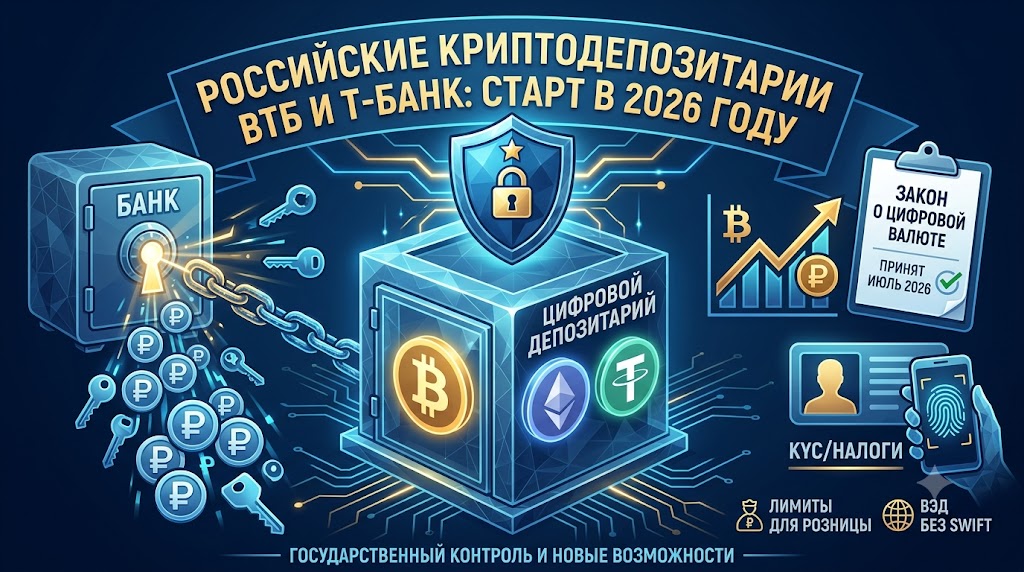
The collapse of trust in foreign trading platforms is forcing Russia's largest financial conglomerates to urgently establish domestic infrastructure for legal operations with digital currencies. Can state-backed banks guarantee the security of your decentralized savings, or will this new initiative turn into a tool for total tax oversight? According to official statements from the management of VTB Bank and the T-Technologies group (which controls T-Bank) at the Central Bank's Financial Congress in July 2026, a large-scale project is being launched in Russia to create regulated digital depositories for the storage, accounting, and circulation of cryptocurrencies. This step marks the final shift of Russian authorities away from attempts to completely ban digital currencies toward tight regulation and integration into the traditional banking system. The launch of the new infrastructure is expected by the end of 2026, which will radically alter the user experience for both retail investors and participants in foreign economic activity.
Is VTB's Crypto-Depository Project a Genuine Initiative?
Yes, the plans of VTB and T-Bank to launch digital depositories are entirely real and backed by the final stages of adopting specialized federal legislation. According to Andrey Yatskov, Head of Brokerage Services at VTB, the credit institution is fully prepared to operate as a digital depository. The bank will begin official storage, accounting, and circulation of digital currencies strictly within the timeframes established by the new legislation, following the final settlement of accompanying regulations by the Bank of Russia.
The institutional readiness of the largest banks is based on the following legal and organizational stages:
-
Legislative Framework: In April 2026, the draft law "On Digital Currency and Digital Rights" was officially introduced to the State Duma of the Russian Federation and has already successfully passed its first reading. This document legalizes new professional market participants — crypto exchanges and digital depositories.
-
Timeline for Law Adoption: According to a statement by Anatoly Aksakov, Chairman of the State Duma Committee on the Financial Market, in July 2026, the bill will be finalized and passed before the end of July 2026, during the current spring session of the State Duma.
-
Launch of First Trades: Vladimir Chistyukhin, First Deputy Governor of the Bank of Russia, indicated in July 2026 that actual legal operations with cryptocurrencies within the new legal framework are set to start as early as November 2026.
-
Simplified Licensing Procedure: According to the text of the bill, commercial banks that already hold a standard depository license from the Central Bank will not need to obtain a separate document. They will only need to send an official notification to the regulator regarding the start of their cryptocurrency operations.
Given that VTB is already included in the registry of information system operators issuing digital financial assets (DFAs), the bank possesses all the necessary technological and regulatory infrastructure for an immediate start. This rules out any probability of the initiative remaining solely on paper.
How Will the Digital Crypto-Depository Work for Ordinary Citizens?
Retail clients will be able to buy, sell, and store cryptocurrency directly within their familiar mobile banking app, without needing to use third-party wallets or crypto exchanges. As Vyacheslav Tsyganov, Executive Director of T-Bank, stated at the Central Bank's Financial Congress in July 2026, the primary goal of this integration is the complete removal of technical barriers for everyday users.
The internal architecture of the retail crypto service will be structured as follows:
-
Unified Interface: Inside a single banking application (for instance, in "T-Investments" or VTB's brokerage service), users will simultaneously view balances for ruble accounts, stock portfolios, and digital currency asset holdings.
-
Comprehensive Analytics: The bank will provide clients with familiar tools to track performance, including price charts, transaction history, and automatic calculation of the average weighted purchase price of assets.
-
Technological Foundation: The physical storage of cryptocurrencies will be implemented on top of currently operating digital financial assets (DFA) platforms — such as the "Atomyze" blockchain platform, where the structure of "T-Technologies" holds a 33% stake. Atomyze has already launched a pilot DFA project issued on Bitcoin, which includes automated market making.
Thanks to this approach, purchasing Bitcoin or Ethereum will become indistinguishable for citizens from buying shares in Russian companies or units in mutual funds. The bank handles all the technical complexities associated with generating private keys and securing blockchain nodes.
Are the New Depositories Being Created for Foreign Trade or Retail Investors?
The new crypto-infrastructure is being established to simultaneously address two tasks — securing settlements in foreign economic activity (FEA) under sanctions and legalizing the domestic retail market. The state is pursuing pragmatic goals, dividing its approaches toward corporate clients and ordinary citizens.
For large corporations and international trade, specific "anti-sanction provisions" have been added to the draft law. These rules allow Russian importers and exporters to legally use cryptocurrency and stablecoins for settlements with foreign counterparties, entirely bypassing the SWIFT system and reducing the risks of payment blockages by unfriendly nations. In this scenario, VTB's digital depository will act as a legal gateway where companies can accumulate digital currency for subsequent cross-border transactions.
For retail investors, a strict protection system is being established to eliminate uncontrolled speculation. According to the official approaches of the Bank of Russia announced in July 2026, operations of individuals will be regulated as follows:
| Investor Category | Operations Volume Limitations | Access Requirements |
| Unqualified Investor (Individual) | Limit up to 300,000 rubles per year | Mandatory passing of a risk awareness test |
| Qualified Investor | No volume limitations | Compliance with Central Bank criteria regarding capital or professional experience |
Thus, the state is not attempting to ban retail investments, but is introducing a system of mandatory questionnaires and limits to prevent massive capital losses by unqualified citizens in the volatile crypto market.
Does Transitioning to Bank Depositories Mean a Complete Loss of Anonymity?
Yes, utilizing official digital depositories of VTB or T-Bank completely eliminates transaction anonymity and entails 100% control by tax authorities. For the decentralized crypto community, the launch of such platforms represents a compromise that only institutional players and conservative retail users will accept.
Registration in a state-approved banking crypto-service automatically triggers the following oversight processes:
-
Total Verification (KYC): Access to a cryptocurrency account is opened only after linking a verified profile with Russian passport details and an Individual Taxpayer Number (INN).
-
Direct Integration with the FNS: Because the new law officially recognizes cryptocurrency as legal property, information on all transactions, profits realized, and movement of digital assets will be automatically forwarded to the Federal Tax Service (FNS).
-
Monitoring Source of Funds: Bank compliance will conduct strict oversight under Federal Law 115-FZ, requiring verification of the legal source of the fiat rubles used to acquire cryptocurrency.
For proponents of Web3 philosophy and classic Bitcoin, such a system is unacceptable, so they will continue using non-custodial cold wallets and decentralized exchanges (DEX). However, for millions of ordinary citizens, transparency and the automatic calculation of taxes by the bank will be viewed as an advantage, eliminating the risks of card blockages under 115-FZ during P2P transactions.
Should You Trade Cryptocurrency on KuCoin Amid New Banking Initiatives?
The extensive toolkit of the international KuCoin platform provides traders with far greater opportunities for profit than the tightly constrained frameworks of Russian banking crypto-depositories. While internal Russian services impose a strict limit of 300,000 rubles per year for ordinary citizens and offer a meager selection of assets, KuCoin opens up full access to the global digital finance market.
The list of key advantages of trading on KuCoin includes:
-
Absence of Artificial Limits: You can operate with any volume of capital without needing to confirm qualified investor status under Russian Central Bank standards.
-
Colossal Selection of Assets: Hundreds of trading pairs, innovative tokens, spot, marginal, and futures trading tools are available on the platform, whereas Russian banks will limit themselves to just BTC and ETH in the initial stages.
-
Confidentiality and Freedom: You maintain control over your investment strategy without the automatic real-time transmission of data regarding every transaction to local fiscal authorities.
If you aim to maximize returns, utilize advanced trading bots, and maintain access to high liquidity anywhere in the world, registering and trading on KuCoin remains the optimal choice for the modern crypto investor.
Conclusion
The initiative of VTB Bank and the T-Technologies group to create regulated digital depositories marks the beginning of a new era in Russia's financial market. The historic consensus achieved between the Ministry of Finance, the Central Bank, and the State Duma has resulted in the formation of a transparent legal framework, which will be finalized before the end of July 2026. Integrating crypto-assets into familiar mobile banking interfaces will legitimize the market, protect millions of inexperienced investors from fraudulent schemes, and provide businesses with a legal instrument to bypass international payment restrictions during cross-border settlements.
At the same time, the ecosystem being built by the state is custodial and fully transparent to fiscal authorities, fundamentally contradicting the original idea of decentralization. The introduction of strict 300,000-ruble limits for unqualified retail investors significantly curtails the potential for building substantial investment capital domestically. Under these conditions, global cryptocurrency exchanges continue to serve as an indispensable tool for traders who require maximum liquidity, a broad spectrum of derivatives, and independence from local regulatory barriers.
Frequently Asked Questions (FAQ)
What amount of tax will be levied on income from selling cryptocurrency through Russian banks?
The Personal Income Tax (PIT) will be a standard 13% on net profits, calculated from the difference between the purchase price and the selling price of the asset. In cases where the aggregate annual income exceeds 2.4 million rubles, the tax rate on the excess amount will rise to 15%.
Will I be able to transfer Bitcoins from my personal cold wallet to a VTB depository?
Yes, this capability is technically envisioned through DFA platforms; however, every incoming transaction from an external address will be subjected to rigorous AML checks to ensure the "cleanness" of the coins and will require documentary proof of the legal origin of those assets.
Will stablecoins like USDT be available in Russian banking crypto-applications?
Yes, stablecoins will be admitted into circulation since they are a key payment mechanism for importers and exporters within cross-border settlements, but their domestic turnover for settlements between residents will remain strictly prohibited.
Are cryptocurrency deposits in digital depositories protected by the Deposit Insurance Agency (DIA)?
No, the state deposit insurance program (up to 1.4 million rubles) applies exclusively to traditional ruble and foreign currency bank accounts and deposits. Digital currencies are recognized as property, and the investor independently bears all risks associated with asset valuation fluctuations or the operator's insolvency.
Will it be possible to pay with cryptocurrency in Russian stores after the launch of depositories?
No, the utilization of cryptocurrency as a legal tender for goods, works, and services within the territory of the Russian Federation remains strictly prohibited under the Constitution and the provisions of the new draft law.