

VTB and Crypto Instruments: How the Bank Plans to Be Among the First in Russia to Get a License
Introduction
VTB estimates the Russian market for crypto instruments at several tens of billions of rubles — and the bank intends to capture a significant share of it. Dmitry Pyanov, First Deputy President and Chairman of VTB's Management Board, stated that the bank expects to be one of the first to obtain licenses for crypto-instrument operations and to offer such services to clients within a regulated Russian perimeter. The trigger was the law "On Digital Currencies and Digital Rights," which the State Duma passed in its second and third readings on July 21, 2026 — it takes effect on September 1, 2026, and for the first time systematically legalizes the circulation of cryptocurrency in the country.
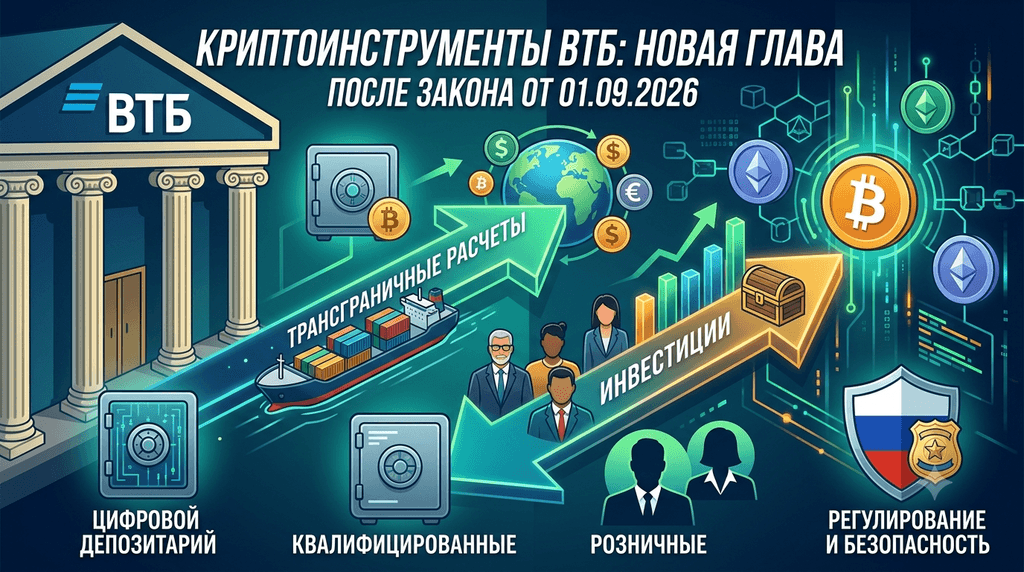
Why now, and why is VTB in such a hurry to claim this niche? The answer is tied not only to the bank's commercial ambitions but also to a broader goal — reducing dependence on blocked currency channels. A digital depository will handle the accounting and custody of digital assets, an experimental legal regime will open the door to cross-border settlements, and qualified investors will be the first audience for the new products.
What Legal Foundation Have Crypto Operations in Russia Received?
Cryptocurrency in Russia is now officially recognized as property subject to judicial protection — regardless of whether the owner previously declared it. This key change is enshrined in the law "On Digital Currencies and Digital Rights," which the State Duma passed in July 2026 and which becomes fully effective on September 1, 2026.
Before this point, the legal landscape developed gradually. Initially, cryptocurrency operations in Russia were effectively banned, and the only legal instrument remained digital financial assets (DFAs) — tokenized rights regulated under a separate DFA law dating back to 2020. Then, in March 2024, an experimental legal regime (ELR) came into effect, which for the first time allowed a limited circle of companies to use digital assets for settlements under select foreign trade contracts.
The new 2026 law turns this practice from a narrow experiment into a systemic norm. The document establishes rules for the operation of crypto exchangers, digital depositories, brokers, trust managers, management companies, and trading organizers. Russians will gain the ability to legally invest in cryptocurrency through Russian exchanges and use the services of licensed intermediaries, rather than resorting to gray-market schemes through intermediaries or foreign legal entities.
The regulator and supervisory authority in this area is the Bank of Russia. The Central Bank will approve the ELR program, coordinate it with relevant agencies, and set requirements for information disclosure, anti-money-laundering (AML) controls, and de-anonymization of participants. The Russian government, in coordination with the Central Bank and the FSB, will additionally be able to introduce a special regime for the circulation of digital currencies — for example, to protect economic interests and state security. The law also provides for a transition period: crypto exchangers will be allowed to operate without being included in the Central Bank's registry until July 1, 2027.
It's important to understand that the new law doesn't create regulation from scratch — it builds on an already functioning framework. The first version of the ELR for cross-border settlements launched back in March 2024, but it only covered settlements using digital financial assets under a narrow set of foreign trade contracts, not cryptocurrency itself. The 2026 law extends this model to cryptocurrency and simultaneously allows for the circulation of foreign digital rights in Russia, and Russian digital rights abroad, which should make it easier to integrate domestic digital instruments into settlements with foreign partners. The topic of stablecoins also deserves attention: regulated stablecoins are increasingly viewed as the operational backbone for cross-border payments amid companies' limited access to traditional banking infrastructure — and this is precisely the niche that the infrastructure being built by VTB and other banks is aiming for.
Why Is VTB Rushing to Enter the Crypto-Instruments Market?
VTB's main motive is not to miss out on a share of commission income in a market the bank itself estimates at several tens of billions of rubles. According to Dmitry Pyanov, the key competitive factor will be speed: the bank that first offers clients a high-quality, convenient customer journey will be able to capture a significant share of the market. Several of Russia's largest banks have already begun preparing infrastructure for buying, selling, storing, and accounting for cryptocurrency — and VTB does not intend to fall behind.
There is also a more strategic context. Amid limited access to traditional SWIFT channels, cryptocurrency and digital assets are becoming an alternative cross-border settlement tool for Russian exporters and importers trading with China, India, and Middle Eastern countries. The new law explicitly permits the use of cryptocurrency for cross-border settlements under foreign trade agreements — but only within the framework of the experimental legal regime, whose program is approved by the Bank of Russia. For a bank with a large corporate client base, this opens up the ability to offer businesses a settlement tool that isn't tied to unfriendly financial infrastructure.
The third element of VTB's strategy is embedding crypto instruments into the bank's existing digital ecosystem alongside the digital ruble and DFAs. This combination allows the bank to avoid building disjointed products and instead create a unified platform of digital financial services, where a client can move between traditional assets, the digital ruble, DFAs, and cryptocurrency within a single perimeter — primarily on the "VTB My Investments" platform.
Behind this logic lies a broader state objective — reducing the role of the dollar and its associated infrastructure in settlements with key trading partners. Traditional SWIFT payments, under sanctions pressure, face waiting times of several weeks and a high risk of funds being returned due to excessively cautious compliance by foreign banks. Integrating the digital ruble with crypto instruments and digital rights from other jurisdictions — potentially including the digital yuan in the future — is seen as a way to reduce dependence on intermediary currencies like the dollar in settlements across Eurasia and BRICS. A bank with an extensive network of export- and import-oriented corporate clients gains a natural competitive advantage here over niche crypto platforms.
What Is VTB's Digital Depository, and How Will It Protect Client Assets?
The digital depository is not simply a tool for buying and selling cryptocurrency — it's a system for storing private keys, registering ownership rights, and clearing transactions. Dmitry Pyanov himself calls the depository "the most resource-intensive and technologically complex component" of VTB's new crypto-instrument ecosystem.
The depository's task is to relieve clients of the classic crypto-market problem of "not your keys, not your coins," where the asset owner must personally store private keys and bear full responsibility for their safekeeping. The bank is offering the opposite model: institutional custody with state-level regulatory oversight, similar to depository record-keeping for securities in the traditional stock market.
This approach solves two problems at once. First, it reduces risk for clients who lack the technical expertise to manage cold wallets on their own. Second, it gives the regulator the ability to ensure oversight, AML controls, and de-anonymization of participants — requirements the Bank of Russia imposes on all licensed crypto-market operators. This is precisely why the bank expects the depository infrastructure to become both a barrier to entry for competitors and a competitive advantage for VTB at the market's launch.
Who Will Be Able to Trade Crypto Instruments Through VTB?
The primary audience at launch will be qualified investors and institutional clients, not the mass retail segment. This category of market participants will be the first to gain access to structured products — derivatives and notes linked to crypto assets — which can be used for hedging risk or for large-scale cross-border settlements.
For ordinary, non-qualified investors, access will be organized differently. Regulation is expected to include strict limits on investment volume and, most likely, no ability to withdraw private keys or transfer assets to a personal cold wallet. In effect, retail clients will operate within a closed loop — buying and selling crypto instruments inside the "VTB My Investments" app without gaining direct control over the underlying asset.
| Client Category | Available Instruments | Restrictions |
| Qualified investors / institutions | Structured derivatives, notes on crypto assets, foreign-trade settlements | Must meet qualified-investor status requirements |
| Non-qualified (retail) investors | Buying/selling crypto instruments within the app | Investment caps, no withdrawal to a personal wallet |
This model fundamentally distinguishes bank-based crypto instruments from foreign exchanges like Binance or OKX, where users can freely withdraw assets to their own wallet. VTB, by contrast, offers a closed, regulated ecosystem — less flexible, but more protected from a compliance and state-oversight standpoint.
What Risks Will VTB Face When Launching Its Crypto Services?
The main risk for VTB is secondary sanctions, since the bank is already under heavy international sanctions pressure. It remains an open question whether addresses and assets held in VTB's digital depository will be flagged and blocked by international compliance tools such as Chainalysis — which would directly affect the ability of counterparties from third countries to work with these assets without incurring secondary risks of their own.
The second risk relates to liquidity. The regulated Russian perimeter is being built as a kind of walled environment — a "white box" with controlled capital inflows and outflows. The question is whether such a closed system will have enough trading volume and market depth to offer clients competitive pricing and trade execution comparable to global exchanges.
The third factor is regulatory alignment between Russia and counterparty countries. Cross-border crypto settlements only work when both sides of a transaction recognize that payment route as legal. Even with a fully built domestic infrastructure, the success of VTB's cross-border scenario depends on the willingness of partners in China, India, or Gulf countries to accept settlements in crypto assets through Russia's regulated perimeter.
The experience of corporate clients is telling: demand for legal crypto settlements in foreign trade activity surged even before the law was passed, and once it takes effect, AML screening of a foreign counterparty becomes a mandatory part of every such transaction. If a partner transfers funds from an address linked to sanctioned structures, this carries direct legal consequences for the Russian company involved in the transaction — and, by extension, for the bank servicing it.
Finally, VTB itself does not expect a quick payoff. According to Pyanov, in 2026 the bank does not anticipate a significant positive financial impact from its crypto direction — this year will be spent investing in building infrastructure, and the crypto-instruments market, in the bank's estimation, will not be fully operational before 2027. Meanwhile, VTB's quarterly net profit for the first half of 2026 already fell 20% year-on-year, to 225.2 billion rubles, and the bank has shifted its full-year forecast toward the lower end of the 600–650 billion ruble range — meaning this new infrastructure is being built under pressure on current profitability.
How to Trade Crypto Instruments on KuCoin While VTB Prepares Its Launch
While Russia's bank-based crypto services are still at the infrastructure-building stage, access to crypto instruments is already available through specialized platforms like KuCoin. Unlike the bank product, which won't launch before 2027 and will come with tight limits for retail investors, an exchange provides direct access to spot and derivatives trading across a wide range of assets today.
Registering on KuCoin takes just a few minutes and doesn't require waiting for banking infrastructure to be licensed. Users complete verification, fund their account, and gain access to trading pairs, risk-management tools, and market analytics. For those who want to test strategies ahead of time, before bank-based crypto products become widely available, this approach means not having to wait until 2027 — you can start working with cryptocurrency now, with a flexibility that a regulated banking perimeter is unlikely to offer retail clients in its early years.
Join KuCoin 9th Anniversary Trading Campaign
KuCoin is celebrating its 9th anniversary with a special platform campaign filled with exclusive rewards, trading activities, and limited-time offers. Don’t miss the chance to participate and enjoy the benefits as the exchange marks nine years of growth and innovation. Visit the official campaign page now:

Conclusion
VTB expects to become one of the first Russian banks to obtain a license for crypto-instrument operations once the law "On Digital Currencies and Digital Rights" takes effect on September 1, 2026. The bank's strategy rests on three pillars: the "VTB My Investments" platform, a digital depository for asset custody and record-keeping, and the integration of crypto instruments into a unified ecosystem alongside the digital ruble and DFAs.
The market, which VTB estimates at several tens of billions of rubles, is projected by the bank to become fully operational only in 2027 — 2026 will be spent building infrastructure without a notable financial impact. At launch, the primary audience will be qualified investors and institutional clients using structured products and cross-border settlements under the experimental legal regime, while retail investors will get more limited, closed-loop access within the bank's app.
At the same time, the bank will need to navigate non-trivial challenges: reducing secondary-sanctions risk, ensuring sufficient liquidity within the regulated perimeter, and securing recognition of cross-border settlements from partner countries. How quickly VTB overcomes these challenges will determine whether the bank holds on to the leadership it has claimed in this new market.
Frequently Asked Questions
1. When does Russia's cryptocurrency law take effect?
The law "On Digital Currencies and Digital Rights" takes effect on September 1, 2026, except for certain provisions that will come into force later. Crypto exchangers were granted a transition period and may operate without being included in the Central Bank's registry until July 1, 2027.
2. How does a digital financial asset (DFA) differ from cryptocurrency under the new law?
A DFA is a tokenized right regulated under a separate law on digital financial assets since 2020 and has long been used for settlements. Cryptocurrency, by contrast, previously had no systemic legal status in Russia, and only the 2026 law recognized it for the first time as property subject to judicial protection, regardless of prior declaration.
3. Can a private investor withdraw cryptocurrency purchased through VTB to a personal wallet?
Based on the model described by the bank, retail (non-qualified) investors will be subject to limits on transaction volume and will most likely not be able to withdraw private keys or transfer assets to their own cold wallet — transactions will take place within a closed loop inside the bank's app.
4. Which banks besides VTB are preparing to launch crypto instruments in Russia?
According to a VTB representative, several of Russia's largest banks have already begun building infrastructure for cryptocurrency trading — for buying, selling, storing, and accounting for assets within a regulated system. The bank did not disclose specific names of other participants, noting only that the market will be divided among those who offer clients a convenient service the fastest.
5. What is the experimental legal regime (ELR), and why is it needed for cryptocurrency?
The ELR is a special mechanism that allows the Bank of Russia to test new financial practices, including cryptocurrency settlements under foreign trade contracts, before they are fully codified into legislation. The ELR program is approved by the Central Bank in coordination with relevant agencies, and participation is limited to a defined circle of companies and the duration of the experiment.
Disclaimer : This material is provided for informational purposes only and does not constitute financial, investment, legal, or tax advice. Transactions involving cryptocurrencies and tokenized assets carry substantial risks — including price volatility, limited liquidity, counterparty exposure, and the potential for total loss of invested capital. Readers should conduct their own research and, where appropriate, consult a qualified professional before making any financial decisions.