

Why ZEC Is Pumping in 2026: The Bitcoin Bid Trophy Explained
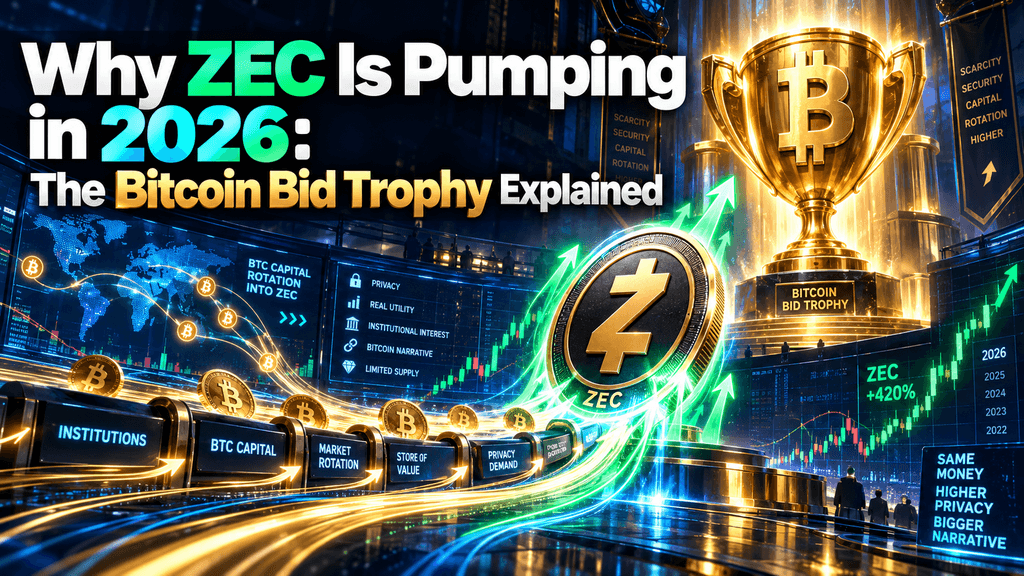
Zcash Surges Into Crypto’s Top Ten as Institutional Demand and Privacy Adoption Accelerate
Zcash has achieved one of the most remarkable and noteworthy performances in the highly competitive cryptocurrency market of 2026. Emerging from a position of relative obscurity, where it was ranked outside the top 80 by market capitalization just a year prior, ZEC has impressively climbed into the prestigious global top ten. At one point, ZEC was trading near the impressive price of $1,600, ultimately stabilizing around the $1,500 mark, with a substantial market capitalization approaching $25 billion. This significant upward movement has been propelled by a confluence of factors, including the launch of various institutional products, an increase in the usage of on-chain privacy features, strategic network governance decisions, and a distinctive structural capital-flow pattern that market analysts and observers have aptly labeled the Bitcoin Bid Trophy.
This feature aims to delve into the verified catalysts, relevant market data, and the analytical framework that underpins this remarkable rally, drawing insights from recent reporting and on-chain indicators to elucidate the reasons behind ZEC's impressive outperformance compared to most major assets in the market this year. The advancement of ZEC in 2026 is a testament to the successful establishment of a credible and effective privacy complement to Bitcoin. This development has successfully attracted institutional capital through the introduction of regulated financial products and has also encouraged spillover buying from Bitcoin holders who are seeking limited exposure beyond a pure concentration in BTC. This dual appeal has significantly contributed to ZEC's rise and prominence in the cryptocurrency space.
Institutional Gateways Opened by the Grayscale ZCSH Listing
The single most measurable structural change arrived on August 25, 2026, when Grayscale converted its Zcash Trust into a spot exchange-traded product listed on NYSE Arca under the ticker ZCSH. This became the first U.S.-listed spot product focused on a privacy-oriented cryptocurrency. Within weeks, the fund accumulated hundreds of millions in assets; by mid-to-late September, reports placed assets under management near or above $900 million, with multi-day streaks of net inflows and one period showing roughly $284 million in monthly additions. The product carries a 2.5 percent expense ratio and allows traditional brokerage accounts to gain ZEC exposure without direct custody of the underlying tokens. Because subscriptions can occur in-kind, the mechanism creates continuous spot demand as new shares are created against physical ZEC. Market participants noted that the launch removed a long-standing friction: previously, institutions seeking privacy exposure lacked a compliant, exchange-traded vehicle. The resulting inflows coincided with ZEC’s rapid rise from sub-$50 levels a year earlier into four-figure prices and a top-ten market-cap ranking.
Data from tracking platforms confirmed that the fund held several percent of circulating supply at peak points, illustrating how concentrated institutional buying can move a relatively smaller-cap asset. This channel also broadened the buyer base beyond native crypto participants. Traditional allocators who already held Bitcoin or other large-cap crypto products could now add a privacy sleeve through the same account infrastructure. Analysts observed that the persistence of inflows, sixteen consecutive days of net additions in one reported stretch, signaled sustained rather than one-off demand. The listing further coincided with broader market recovery periods, amplifying the price impact. While expense ratios and tracking dynamics remain relevant considerations for long-term holders, the immediate effect was a visible expansion of accessible demand that helped propel ZEC’s market capitalization from hundreds of millions into the tens of billions range within months.
Shortly after the U.S. product gained traction, European investors received a parallel route. On September 21–22, 2026, 21Shares launched a physically backed Zcash exchange-traded product on Euronext Paris and Amsterdam under the ticker ZCASH. The product carries a 2.5 percent annual fee and is custodied by established digital-asset specialists. Although it launched with a modest initial asset base, the listing marked the first such European vehicle dedicated to ZEC and immediately expanded the geographic and regulatory footprint for institutional and retail access. Price action around the announcement showed ZEC already trading near $1,540 before the formal listing, then briefly reaching approximately $1,651 before a partial retracement. The European product complements the U.S. ETF by offering another regulated wrapper that can attract capital subject to different jurisdictional preferences and distribution networks.
Market observers noted that the dual-listing environment, U.S. equity markets plus major European exchanges, reduces single-region dependency and potentially smooths liquidity across time zones. Because the ETP is physically backed, creations and redemptions again translate into spot market activity. Combined with the Grayscale vehicle, the two products have established a clearer institutional on-ramp than any prior privacy coin had achieved. This infrastructure shift helps explain why ZEC’s advance has been more durable than earlier privacy-coin cycles that relied primarily on retail speculation. The presence of regulated products also provides a reference point for future product development and may encourage additional issuers to explore similar offerings, further embedding ZEC within traditional portfolio construction frameworks.
The Bitcoin Bid Trophy Concept Clarified by Market Analysts
Bankless co-founder David Hoffman articulated a capital-flow pattern he termed the Bitcoin Bid Trophy in a widely discussed analysis published around September 23–24, 2026. The concept describes how a relatively smaller asset can absorb spillover buying pressure from Bitcoin holders who maintain a strong preference for BTC as the primary holding yet allocate a modest portion of capital elsewhere for specific reasons. Bitcoin’s market capitalization, measured in the multi-trillion-dollar range, creates a large reservoir of potential demand. When even a small fraction of that capital rotates into an asset perceived as complementary, particularly one that preserves Bitcoin-like monetary properties while adding a distinct feature, the price impact on the smaller asset can be substantial. Hoffman positioned ZEC in 2026 as analogous to Ethereum’s role in certain earlier cycles, arguing that the privacy narrative and institutional accessibility had created a sufficiently strong Schelling point for Bitcoin holders seeking limited diversification.
The framework emphasizes relative scale rather than absolute dollar gains. A $25 billion market capitalization remains a fraction of Bitcoin’s size, so incremental allocation from the larger pool can sustain upward pressure. Hoffman noted that the consensus around “BTC only” is powerful yet not absolute; holders remain subject to incentives, and a credible hedge or complement can attract capital without requiring a full narrative abandonment of Bitcoin. This dynamic helps account for ZEC’s ability to rise even during periods when Bitcoin itself showed more modest gains. The analysis does not claim permanent one-way price action; rather, it explains the concentrated bid that has characterized the recent advance. Subsequent commentary from other market participants has echoed the observation that ZEC’s relative performance versus Bitcoin has been a defining feature of the 2026 privacy-coin recovery.
Rising Shielded Supply Signals Organic Privacy Demand
On-chain data has reinforced the narrative with measurable usage growth. Reports tracking the shielded pool, the portion of ZEC held in addresses that leverage zero-knowledge proofs to conceal transaction details, showed the shielded supply rising to multi-month or multi-year highs. One dataset cited approximately 4.91 million ZEC in shielded form, recovering from a mid-year trough near 4.38 million. Shielded transactions have accounted for a substantial and increasing share of network activity, with some estimates placing the figure near 59 percent of volume in recent periods, up from lower levels in prior years. This shift indicates that privacy features are being utilized rather than remaining purely theoretical. Higher shielded balances reduce the liquid supply available on transparent exchanges, creating a mechanical tightening that can amplify price responses to new demand.
The growth in shielded activity coincides with broader concerns about blockchain surveillance tools and the increasing sophistication of transaction-graph analysis. Users and institutions seeking confidentiality for legitimate reasons have found Zcash’s optional privacy model attractive because it retains the ability to disclose information selectively via viewing keys when required for compliance or auditing. Analysts have interpreted the rising shielded percentage as evidence that demand is not solely speculative; a portion of the circulating supply is being locked into private use cases. This dynamic supports the longer-term sustainability of the rally by aligning price appreciation with actual network utility rather than purely narrative momentum. Continued monitoring of shielded-pool metrics remains one of the clearest real-time indicators of whether organic adoption is keeping pace with market interest.
Network Upgrade 7 Governance Vote Reinforces Monetary Continuity
In mid-September 2026, the Zcash community concluded a significant governance process for Network Upgrade 7. Roughly 2.4 million ZEC participated, representing a substantial share of the eligible supply. Voters overwhelmingly supported reducing target block times from 75 seconds to 25 seconds while retaining the existing Bitcoin-style halving schedule. Approval rates exceeded 98–99 percent on the key proposals. Faster block times improve confirmation speed and overall network responsiveness, particularly for private transactions that already carry higher computational overhead. Preservation of the halving mechanism maintains the scarcity trajectory familiar to Bitcoin holders and reinforces the “private Bitcoin” framing that has gained traction.
The vote itself demonstrated high engagement and consensus around core monetary design. Developers subsequently targeted a mainnet activation window in early November, subject to readiness criteria. Market reaction around the vote results included sharp price advances, reflecting participant confidence that the network would evolve without altering its fundamental supply schedule. The decision also resolved earlier debates about emission curves, locking in a predictable path that institutions and long-term holders can model. By combining performance improvements with monetary continuity, the NU7 process has reduced uncertainty around the protocol’s future direction at a moment when external capital is evaluating the asset more closely.
Short-Squeeze Dynamics Amplified Price Momentum
Derivatives markets contributed mechanical upward pressure during several breakout sessions. Reports documented tens of millions of dollars in short liquidations on single days as ZEC moved through key psychological levels such as $1,000 and $1,200. One session saw approximately $45 million in liquidations, the majority from short positions. When leveraged shorts are forced to cover, they must buy the underlying asset, creating additional demand that can accelerate an existing rally. Elevated futures volume and open interest during these periods indicated that speculative positioning had become a meaningful factor alongside spot institutional flows.
The interaction between ETF-driven spot demand and derivatives positioning produced a self-reinforcing cycle on several occasions. As the price advanced, short covering added fuel, which in turn attracted additional momentum buyers. While such dynamics can reverse when positioning becomes crowded on the long side, the documented liquidation cascades in September provided concrete evidence of how leverage amplified the move. Traders monitoring funding rates, open interest, and liquidation heatmaps have used these metrics to gauge the sustainability of short-term surges. The presence of both institutional spot vehicles and active derivatives markets has created a more complete market structure than earlier privacy-coin cycles possessed.
Privacy Narrative Gains Traction Amid Broader Surveillance Concerns
Zcash’s technical design, optional zero-knowledge privacy layered on a Bitcoin-like monetary base, has resonated as financial surveillance tools grow more capable. AI-enhanced blockchain analytics have made transparent ledgers more transparent, increasing the perceived value of selective privacy. Commentators have described ZEC as one of the few major assets still aligned with early cypherpunk principles of confidential transactions. This framing has attracted both retail users seeking practical privacy and institutions evaluating complementary exposures. Paradigm co-founder Matt Huang publicly confirmed a firm position in ZEC and characterized it as a privacy complement to Bitcoin, adding institutional validation to the narrative.
The optional nature of shielding remains important. Users can choose transparent addresses when disclosure is desired or required, while shielded addresses protect details by default. Viewing keys enable selective transparency for auditors or counterparties. This flexibility has helped Zcash navigate regulatory environments more effectively than fully opaque privacy designs in some jurisdictions. As the privacy-coin sector’s combined market capitalization expanded substantially in 2026, with ZEC accounting for a majority share, the asset has become the primary vehicle through which the broader privacy thesis is expressed in liquid markets.
Mining Economics Strengthen Network Security
Rising ZEC prices have improved mining profitability relative to Bitcoin on certain metrics. Research noted that ZEC miners could earn roughly twice as much per rig and several times more per megawatt-hour under prevailing conditions. This shift has coincided with increased mining activity and expansion plans by specialized operators. Higher rewards attract more hash rate, which in turn strengthens network security, an important consideration for an asset positioning itself as a monetary complement. One operator expanded a credit facility specifically to fund additional Zcash mining capacity, including plans to accumulate ZEC as a hedge.
Improved economics also support the long-term viability of the proof-of-work security model. As issuance declines through halvings, sustained price levels become more important for miner revenue. The recent profitability upswing has therefore reinforced the security narrative at a time when institutional holders are evaluating operational resilience. Continued monitoring of hash-rate trends and miner concentration remains relevant for assessing whether the network can maintain robust decentralization as capital inflows grow.
Supply Scarcity Dynamics Mirror Bitcoin’s Design
Zcash inherits Bitcoin’s 21-million-unit hard cap and halving schedule. The most recent halving reduced daily issuance, and the NU7 decision preserved that direction. Combined with rising shielded balances that effectively remove coins from liquid circulation, the available float has tightened relative to new demand. Market participants have described this interaction as a textbook supply-squeeze setup when institutional inflows arrive against a fixed and gradually decelerating issuance schedule.
Because the monetary policy is transparent and predictable, analysts can model future supply more confidently than for assets with discretionary issuance. The scarcity framing resonates with Bitcoin holders already accustomed to fixed-supply narratives. When that familiarity is paired with the privacy feature set, the resulting product becomes easier to evaluate within existing mental models. The relative scarcity versus Bitcoin’s far larger market capitalization further underpins the Bitcoin Bid Trophy logic: even modest reallocations can produce outsized effects on the smaller asset.
Market Structure and Liquidity Evolution
The combination of U.S. and European listed products, active derivatives markets, and growing on-chain usage has produced a more mature market structure for ZEC than existed in prior cycles. Daily trading volumes have expanded into the billions during peak periods, and open interest in futures has risen alongside price. Liquidity improvements reduce slippage for larger orders and support the presence of institutional participants who require reliable execution. The share-split announcement for the Grayscale product, intended to lower the per-share price and improve accessibility, further illustrates efforts to enhance market usability.
These structural developments reduce the likelihood that the rally is purely a thin-market phenomenon. While volatility remains elevated, as evidenced by rapid advances followed by partial retracements, the underlying infrastructure now includes regulated vehicles, deeper order books, and measurable on-chain activity. This evolution supports the analytical case that the current cycle rests on more durable foundations than earlier privacy-coin episodes that lacked comparable institutional channels.
Market Factors and Sustainability Considerations
Despite the strong fundamental and technical drivers, several considerations remain relevant. Cryptocurrency markets are inherently volatile; rapid advances can reverse if inflows slow or broader risk appetite declines. Expense ratios on the listed products affect net returns for long-term holders. Regulatory attitudes toward privacy-enhancing technologies continue to evolve across jurisdictions and could influence future product development or on-chain usage patterns. On the protocol side, successful activation of network upgrades and continued growth in shielded activity will be important markers of whether utility keeps pace with market interest.
The Bitcoin Bid Trophy framework itself implies that continued spillover demand depends on the perceived credibility of ZEC as a complement. Any erosion of that perception, through technical issues, governance disputes, or competing narratives, could reduce the intensity of the bid. Market participants therefore monitor both traditional indicators such as ETF flows and on-chain metrics alongside qualitative assessments of the privacy and monetary narratives. The recent rally has demonstrated that multiple reinforcing catalysts can produce substantial price discovery; sustaining those gains will require ongoing alignment between product accessibility, network utility, and capital-flow dynamics.
🔥 Beyond the Headlines: What KuCoin 5.0 Means for You
Market news moves fast — but where you act on it matters just as much. This October, KuCoin launches KuCoin 5.0, transforming KuCoin into a rebuilt platform. Here's what actually changes for you:
-
One account for everything. Older platforms split your money across separate "spot," "margin," and "futures" accounts and expected you to understand why. KuCoin 5.0's unified account removes that entirely — deposit once, and everything is simply there (only available to VIPs for now).
-
Stocks, indices, and commodities. KuCoin 5.0 expands beyond crypto into global markets. When crypto chops sideways and equities rally (or the reverse), you rotate in minutes instead of opening a brokerage account and waiting days for fiat rails.
-
Real-world assets (RWA). Tokenized exposure to traditional assets like commodities, right inside your crypto account. One of the fastest-growing segments in global finance is no longer reserved for institutions — you access it from the same balance you trade with.
-
Earn while you learn. Not ready to trade? KCUSD lets your stablecoins earn daily, auto-compounding interest. The lowest-stress way to put your idle deposit to work for 4% yield.
-
An AI assistant in plain language. Ask questions, get market context, understand what you're looking at — built into the platform, no jargon required.
-
An app that doesn't overwhelm. Faster, cleaner, and consistent — intuitive from the first tap, not after a tutorial.
-
Safety you can check, not just trust. A MiCAR-licensed EU entity, Proof of Reserves you can verify yourself, and internationally certified security (SOC 2 Type II, ISO 27001:2022).
Create your account in minutes — and start on the platform built for where crypto is going, not where it's been.
FAQs
What exactly is the Bitcoin Bid Trophy and how does it apply to ZEC?
The term, popularized by Bankless co-founder David Hoffman in a September 2026 analysis, describes a structural capital-flow pattern in which a smaller cryptocurrency absorbs spillover buying from Bitcoin holders. Bitcoin’s multi-trillion-dollar market creates a large pool of capital. When even a modest percentage of those holders allocate a portion of their holdings to an asset viewed as complementary, preserving scarcity and proof-of-work characteristics while adding privacy, the price impact on the smaller asset can be significant.
How have institutional products specifically contributed to the price advance?
Grayscale’s ZCSH spot product, listed on NYSE Arca in late August 2026, provided the first major U.S. regulated vehicle for ZEC exposure and rapidly accumulated assets approaching or exceeding $900 million. Continuous in-kind subscriptions translate into ongoing spot demand. The subsequent 21Shares physically backed ETP on Euronext exchanges extended access to European investors under a similar structure. Together, these products removed a long-standing barrier that had limited institutional participation.
Has on-chain privacy usage actually increased during the rally?
Yes. Multiple data sources reported rising shielded supply, with one dataset showing approximately 4.91 million ZEC in the shielded pool after recovering from a mid-year low near 4.38 million. Shielded transactions have represented a growing share of network volume, reaching estimates near 59 percent in some recent periods. This growth indicates that privacy features are being used rather than remaining dormant.
What did Network Upgrade 7 vote decide and why does it matter?
In September 2026, roughly 2.4 million ZEC participated in the NU7 governance process. Voters supported reducing block times from 75 seconds to 25 seconds by margins above 99 percent while retaining the existing Bitcoin-style halving schedule by similarly decisive margins. Faster blocks improve confirmation times and network responsiveness, particularly for private transactions.
Did derivatives markets play a material role in the price moves?
Yes. Several breakout sessions featured substantial short liquidations, with one reported day seeing approximately $45 million in liquidations, predominantly from short positions. Forced covering requires buying the asset, adding mechanical demand that can accelerate an existing advance. Elevated futures volume and open interest during these periods confirmed that leveraged positioning had become an important secondary factor alongside spot institutional flows.
Disclaimer: This content is for informational purposes only and does not constitute investment advice. Cryptocurrency investments carry risk. Please do your own research (DYOR).