

Why Did Jupiter (JUP) Rise Following the Bullish Tokenized Stock Collateral and Ledger Clear-Signing Updates?
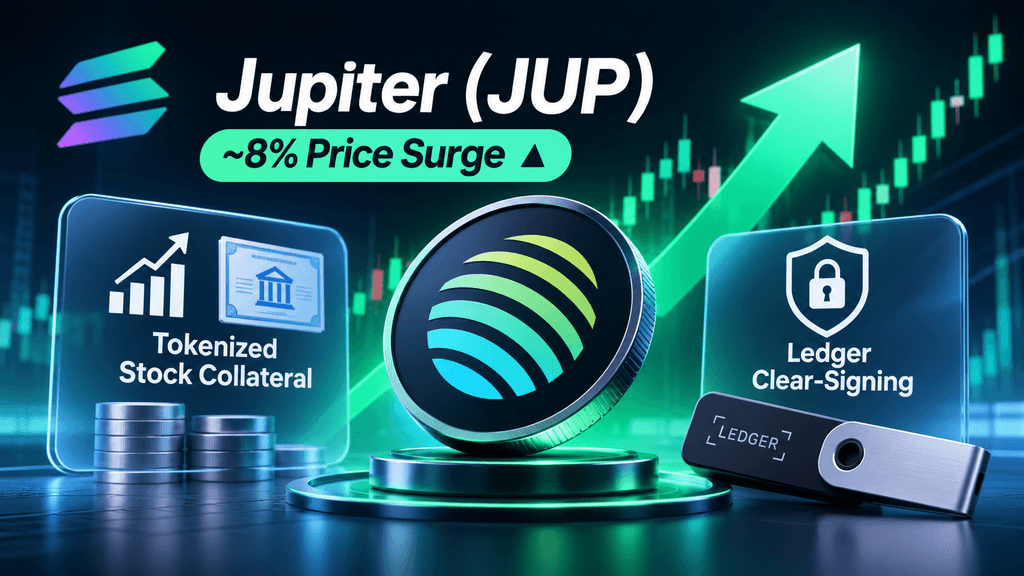
The price of Jupiter (JUP), the native governance token of the Solana-based decentralized exchange aggregator, gained approximately 8% intraday following two ecosystem announcements: a planned partnership with digital asset platform Bullish to integrate tokenized publicly listed equities as collateral on Jupiter Lend, and the rollout of Ledger clear-signing support across Jupiter's Solana interface. Together, these developments address two persistent barriers in decentralized finance (DeFi)—expanding institutional-grade collateral options beyond volatile crypto assets and improving self-custody transaction security.
For market participants evaluating JUP's price reaction, the announcements signal deeper integration between regulated traditional financial assets and on-chain liquidity protocols, alongside stronger user protection against blind-signing exploits on Solana.
Quick Answer
Jupiter (JUP) rose roughly 8% intraday after announcing plans to accept tokenized shares of publicly listed companies as loan collateral through Bullish and integrating Ledger hardware wallet clear-signing on Solana.
-
Tokenized Equity Collateral: Jupiter and Bullish announced plans to bring tokenized shares of publicly traded companies onto Jupiter Lend, enabling users to borrow against traditional equity holdings on-chain.
-
Compliance-Focused Architecture: The integration relies on Bullish's regulated digital asset infrastructure to support compliant stock-backed lending use cases rather than synthetic or unregulated equity derivatives.
-
Ledger Clear-Signing Support: Jupiter became one of the first decentralized applications (dApps) on Solana to support Ledger clear-signing, allowing hardware wallet users to verify human-readable transaction details before approval.
-
Market Impact: The dual announcements drove an approximately 8% intraday price gain in JUP as traders priced in expanded collateral utility and lower security friction for self-custody users.
-
Key Qualification: Tokenized equity lending remains subject to jurisdictional eligibility rules, know-your-customer (KYC) requirements, and smart contract liquidation parameters once deployed.
What Is the Jupiter and Bullish Tokenized Stock Collateral Integration?
The Jupiter and Bullish initiative is a planned collaboration to integrate tokenized shares of publicly listed companies into Jupiter Lend, allowing borrowers to pledge compliant digital representations of equities as collateral for on-chain loans.
In traditional decentralized finance (DeFi) lending protocols, collateral is predominantly restricted to volatile crypto assets such as SOL, ETH, or wrapped Bitcoin. While effective for crypto-native leverage, this model exposes borrowers to sudden market-wide drawdowns and excludes investors whose wealth is held in traditional equities. By incorporating tokenized stocks sourced through Bullish—an institutional digital asset exchange and financial services platform—Jupiter Lend aims to bridge traditional capital markets with Solana's high-throughput lending infrastructure.
Unlike synthetic stock tokens from earlier DeFi cycles, which often tracked equity prices via oracle feeds without direct share backing or regulatory oversight, compliant tokenized shares are structured to represent verifiable claims on underlying publicly traded equities within regulated frameworks. Through Bullish's infrastructure, eligible participants can use these tokenized assets to access on-chain liquidity without liquidating their long-term equity positions.
| Feature | Traditional Crypto-Backed DeFi Lending | Tokenized Equity Lending (Jupiter Lend & Bullish) |
| Primary Collateral | Native cryptocurrencies and wrapped tokens (e.g., SOL, WBTC) | Tokenized shares of publicly listed companies |
| Underlying Backing | On-chain digital assets locked in smart contracts | Regulated equity representations issued via institutional infrastructure |
| Access Requirements | Permissionless wallet connection | Subject to jurisdictional compliance, KYC, and transfer restrictions |
| Price Volatility Profile | High, 24/7 crypto market volatility | Tied to underlying public equity market performance and trading hours |
| Primary Use Case | Crypto-native leverage and yield strategies | Unlocking liquidity against stock holdings without selling shares |
How Does Tokenized Stock-Backed Lending Work on Jupiter Lend?
Tokenized stock-backed lending on Jupiter Lend operates by locking eligible tokenized equity tokens inside a smart contract vault to borrow stablecoins or other supported digital assets up to a specified loan-to-value (LTV) ratio.
When a user deposits tokenized shares into Jupiter Lend, the protocol calculates the collateral value using price feeds that reflect the underlying public equity's market value. Borrowers can then draw liquidity—typically in dollar-pegged stablecoins—while retaining economic exposure to the underlying stock. Because the position is overcollateralized, the smart contract continuously monitors the ratio between the borrower's debt and the market value of the pledged shares.
Several operational mechanics distinguish tokenized equity collateral from standard crypto collateral:
Compliance and Eligibility Gating: Because tokenized shares of publicly listed companies fall under securities and financial regulations in most jurisdictions, access to minting, holding, or pledging these tokens typically requires identity verification and adherence to geographic restrictions managed through Bullish's compliance framework.
Market-Hour Pricing Dynamics: Publicly listed equities trade during established exchange hours, whereas Solana DeFi protocols operate continuously. Lending protocols supporting tokenized stocks must account for overnight price gaps, corporate actions such as dividends or stock splits, and liquidity conditions when setting LTV limits and liquidation thresholds.
Liquidation Mechanics: If the value of the pledged tokenized shares falls below the maintenance margin threshold, the protocol's liquidation mechanism sells or transfers the collateral to repay the outstanding loan, protecting liquidity providers from bad debt.
For more foundational context on how decentralized aggregators and tokenized assets operate, readers can review educational guides on what Jupiter (JUP) is on Solana and how tokenized real-world assets (RWAs) work in crypto.
Why Does Ledger Clear-Signing Matter for Jupiter Users on Solana?
Ledger clear-signing allows hardware wallet users interacting with Jupiter to read exact, human-readable transaction parameters on their device screen before approving a trade or lending action, eliminating the security risks of blind signing.
Historically, complex smart contract interactions on Solana required hardware wallet users to enable "blind signing." Under blind signing, a Ledger device displays only a cryptographic hash or generic confirmation prompt rather than the specific token amounts, destination addresses, or slippage limits encoded in the transaction. If a user's browser interface or front-end connection was compromised, an attacker could alter the underlying transaction payload without the user noticing on their hardware device.
By becoming one of the first applications on Solana to implement Ledger's clear-signing standard, Jupiter translates raw Solana instruction data into verified, human-readable fields directly on the hardware wallet's secure screen. Users can independently verify:
-
Exact Input and Output Assets: Confirmation of which tokens are leaving the wallet and which tokens are expected in return.
-
Transaction Amounts and Limits: Verification of exact quantities, minimum received amounts, and protocol fee parameters.
-
Authorized Program Interactions: Confirmation that the transaction interacts strictly with authentic Jupiter smart contracts rather than malicious look-alike addresses.
As DeFi protocols expand into higher-value institutional and real-world asset (RWA) use cases such as stock-backed borrowing, eliminating blind signing is a practical prerequisite for risk-conscious traders and treasury managers using self-custody hardware wallets.
Why Did JUP Gain Approximately 8% Following These Announcements?
JUP's roughly 8% intraday rally reflects market repricing around two complementary catalysts: addressable market expansion through compliant tokenized equities and reduced technical friction for self-custody capital inflows.
In cryptocurrency markets, governance and ecosystem tokens often respond most strongly when product announcements address both sides of protocol adoption—new revenue or volume drivers on one hand, and lower user risk on the other. The Bullish integration expands Jupiter Lend's potential collateral base beyond crypto-native assets into the multi-trillion-dollar public equities market. Even modest adoption of stock-backed borrowing can increase total value locked (TVL), stablecoin borrowing demand, and protocol fee generation across the Jupiter ecosystem.
Simultaneously, the Ledger clear-signing integration directly addresses a long-standing security concern among larger Solana holders. High-net-worth individuals and institutional desks frequently mandate hardware wallet custody with clear-signing verification before deploying capital into on-chain swap routers or lending markets. Releasing both updates concurrently reinforced the narrative that Jupiter is maturing from a retail-focused decentralized exchange aggregator into broader financial infrastructure on Solana.
What Should Users Consider Before Using Tokenized Stock Lending or Clear-Signing?
Before using tokenized equity collateral on Jupiter Lend or relying on hardware wallet clear-signing, users should evaluate regulatory eligibility, equity market-hour risks, and hardware firmware requirements.
While both features expand Jupiter's functionality, each carries specific operational boundaries that participants must understand:
-
Jurisdictional and KYC Restrictions: Unlike permissionless crypto-to-crypto swaps on Jupiter, tokenized shares of publicly listed companies are subject to securities laws. Users in restricted jurisdictions—including the United States and other regions with strict securities registration rules—may be ineligible to hold or borrow against tokenized stocks unless specifically permitted under applicable exemptions.
-
Weekend and After-Hours Liquidation Risk: Because underlying stock exchanges close overnight and on weekends, sharp earnings announcements or macroeconomic news outside standard market hours can cause gap openings. Borrowers should maintain conservative LTV ratios to avoid sudden liquidations when equity prices update.
-
Smart Contract and Custodial Dependencies: Tokenized equity lending introduces dual layers of risk: on-chain smart contract risk within Jupiter Lend and off-chain custodial or issuer risk associated with the entity holding the underlying shares.
-
Device and App Update Requirements: To use Ledger clear-signing on Jupiter, users must ensure their Ledger device firmware, Solana device application, and wallet browser extension are updated to versions that support the clear-signing metadata standard.
Conclusion
Jupiter's approximately 8% intraday price gain following its announcements with Bullish and Ledger highlights how institutional asset integration and self-custody security upgrades influence market sentiment in decentralized finance. By planning to integrate tokenized shares of publicly listed companies into Jupiter Lend through Bullish's regulated infrastructure, Jupiter is positioning its lending protocol to serve borrowers seeking on-chain liquidity against traditional equity portfolios. At the same time, adopting Ledger clear-signing on Solana removes a critical blind-signing vulnerability, enabling hardware wallet users to verify transaction details directly on their devices.
For users and market observers, the long-term impact of these developments will depend on regulatory onboarding, liquidity depth for tokenized equities, and sustained adoption by self-custody participants. Evaluating jurisdictional eligibility, collateral volatility, and smart contract mechanics remains essential before engaging with tokenized asset lending protocols.
FAQs
-
Why did the price of Jupiter (JUP) increase by about 8%?
JUP gained approximately 8% intraday following two major ecosystem announcements: plans with Bullish to integrate tokenized shares of publicly listed companies as collateral on Jupiter Lend, and the launch of Ledger clear-signing support on Solana. Market participants viewed the updates as expanding Jupiter's addressable collateral market while strengthening hardware wallet security.
-
How does tokenized stock collateral work on Jupiter Lend?
Tokenized stock collateral allows eligible users to deposit compliant digital representations of publicly traded shares into Jupiter Lend smart contracts and borrow stablecoins or other supported digital assets against their value. The borrower retains price exposure to the underlying shares while accessing on-chain liquidity, subject to loan-to-value limits and liquidation thresholds.
-
Who is Bullish and what is its role in the Jupiter Lend integration?
Bullish is an institutional digital asset exchange and financial services platform operating under regulated frameworks. In the planned Jupiter Lend integration, Bullish provides the compliant tokenized equity infrastructure needed to issue and support tokenized shares of publicly listed companies for on-chain lending use cases.
-
What is Ledger clear-signing on Solana?
Ledger clear-signing is a security feature that translates raw Solana smart contract instructions into human-readable transaction details displayed directly on a Ledger hardware wallet screen. It replaces blind signing, allowing Jupiter users to verify exact token amounts, asset types, and contract interactions before approving a transaction.
-
Can anyone use tokenized shares as collateral on Jupiter Lend?
No, access to tokenized shares of publicly listed companies is typically restricted by jurisdiction and requires identity verification (KYC) due to securities regulations. Availability depends on the user's country of residence and the compliance requirements enforced by the tokenized asset issuer and Bullish.
Disclaimer
This general market information, possibly from third-party, commercial, or sponsored sources, is provided for reference and educational purposes only and does not constitute financial or investment advice, an offer, solicitation, or guarantee. We disclaim liability for its accuracy, completeness, reliability, and any resulting losses. Investments/trading are risky; past performance doesn’t guarantee future results. Users should research, judge prudently, and take full responsibility. For further details, please consult KuCoin’s Terms of Use and Risk Disclosure.