



BlackRock BUIDL Project and Background Introduction: BlackRock’s Crypto Strategy
2026/04/02 23:16:28
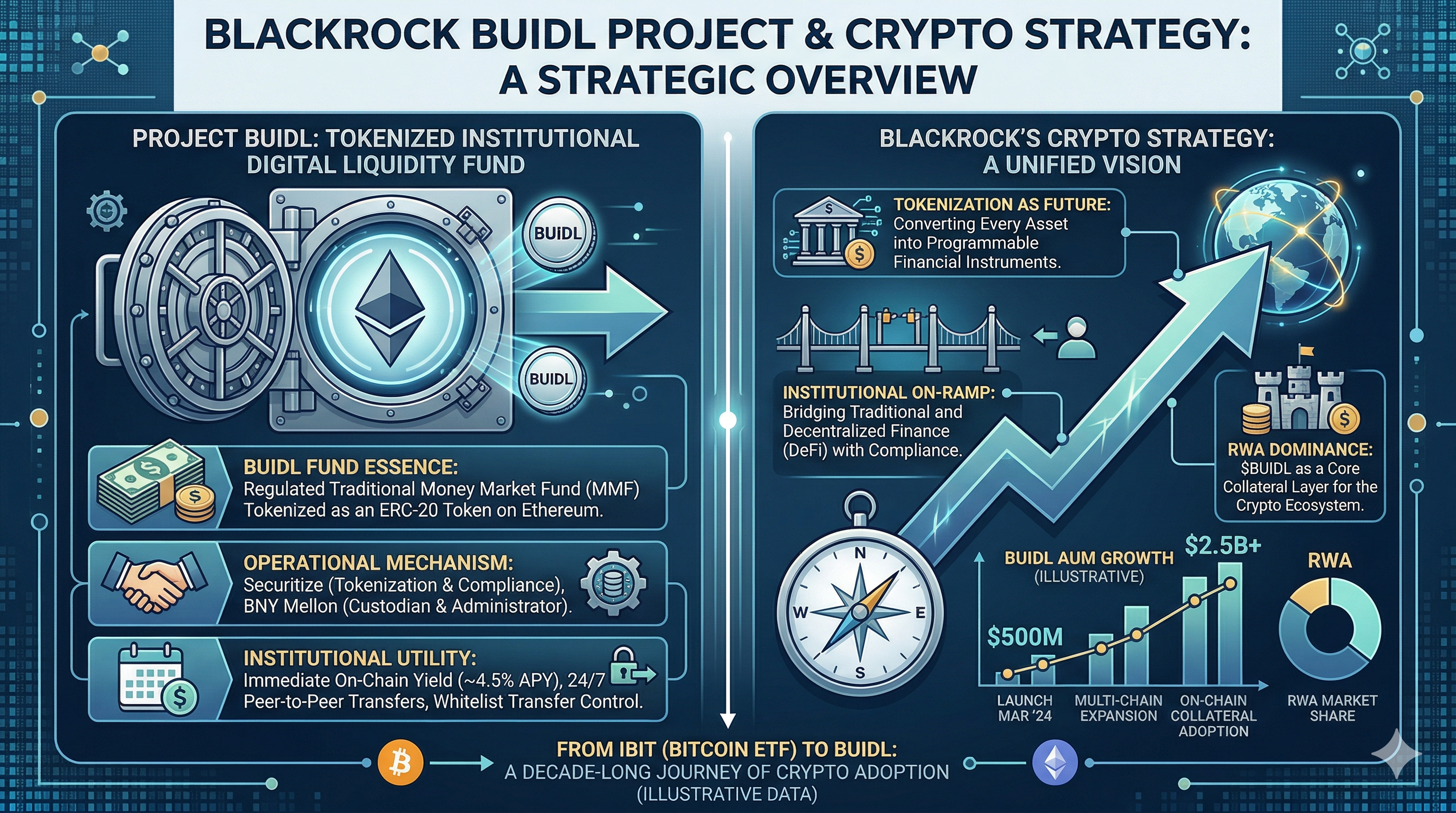
BlackRock’s BUIDL project is not just another crypto experiment, it represents a deliberate shift by the world’s largest asset manager toward integrating blockchain into traditional finance. Through tokenized funds, strategic partnerships, and infrastructure-level innovation, BlackRock is positioning itself at the center of a new financial system where assets move on-chain, yield becomes programmable, and institutional capital flows directly into digital ecosystems.
BlackRock’s Entry Into Crypto: A Strategic Shift
BlackRock did not enter crypto as a speculative player. Its approach has been calculated, gradual, and rooted in institutional demand. Over the past few years, the firm has shifted from skepticism to active participation, driven largely by client interest and the growing legitimacy of digital assets. This transition became especially visible when BlackRock launched its spot Bitcoin ETF and began integrating crypto access into its Aladdin platform through partnerships with firms like Coinbase.
What makes BlackRock different is scale. With trillions of dollars under management, its decisions signal broader institutional trends. When it moves into crypto, it is not chasing hype, it is building infrastructure. The firm’s strategy focuses on connecting traditional financial systems with blockchain-based systems, rather than replacing them entirely.
This is important. Instead of promoting decentralization as an ideology, BlackRock treats blockchain as a tool for efficiency. Faster settlement, improved transparency, and new liquidity channels are the primary goals. This mindset has shaped its investments, partnerships, and product launches.
The BUIDL fund emerges directly from this strategy. It is not designed for retail speculation but for institutional-grade capital deployment. In that sense, BlackRock’s crypto journey is less about Bitcoin itself and more about how financial markets can evolve using blockchain rails.
What Is the BUIDL Fund? A Tokenized Money Market Explained
The BlackRock USD Institutional Digital Liquidity Fund, commonly referred to as BUIDL, is a tokenized money market fund built on blockchain infrastructure. Unlike traditional crypto assets, BUIDL represents real-world financial instruments, primarily U.S. Treasury bills and repurchase agreements.
Each BUIDL token corresponds to a share in the fund and maintains a stable value of approximately $1. This stability is not achieved through algorithmic mechanisms or crypto collateral, but through the underlying assets managed by BlackRock.
What makes BUIDL unique is how it distributes yield. Instead of price appreciation, returns are paid out directly to token holders in the form of dividends. This mirrors traditional money market funds but introduces a new layer of programmability. Investors can hold, transfer, or integrate these tokens into other blockchain applications while still earning yield. The fund launched in March 2024 and quickly attracted significant institutional interest, reaching hundreds of millions in assets within a short period. In simple terms, BUIDL transforms a conservative financial product into a blockchain-native asset. It combines the safety profile of government-backed securities with the flexibility of digital tokens, creating a bridge between traditional finance and decentralized ecosystems.
Why Tokenization Matters to BlackRock
Tokenization, the process of representing real-world assets on blockchain, is at the core of BlackRock’s digital strategy. For the firm, tokenization is not a trend but a structural upgrade to financial markets. It allows assets like bonds, funds, and equities to exist as programmable units that can move instantly across global networks.
This shift has profound implications. Traditional financial systems rely on intermediaries, settlement delays, and fragmented infrastructure. Tokenized assets, by contrast, can be transferred peer-to-peer, settled in real time, and integrated into automated financial systems.
BUIDL demonstrates this clearly. By placing a money market fund on-chain, BlackRock enables 24/7 trading, faster settlement, and seamless integration with digital platforms. The firm also sees tokenization as a way to unlock liquidity. Assets that were previously difficult to trade or access can become more flexible and widely distributed. This could expand participation in financial markets, particularly among institutions seeking efficiency.
Importantly, tokenization allows financial products to interact with smart contracts. This means yields can be distributed automatically, collateral can be managed dynamically, and transactions can be executed without manual intervention. For BlackRock, tokenization is not about replacing the financial system, it is about rebuilding it with better infrastructure.
How BUIDL Actually Works on Blockchain
At a technical level, BUIDL operates as a tokenized representation of a traditional fund. Investors purchase tokens that correspond to shares in the underlying portfolio, which consists primarily of short-term U.S. government securities. These tokens are issued and managed on blockchain networks, initially on Ethereum, allowing them to be transferred and tracked in real time. Unlike traditional fund shares, which may take days to settle, BUIDL tokens can move instantly between participants.
One of the most notable features is on-chain dividend distribution. Instead of waiting for periodic payouts through banking systems, investors receive yield directly through token mechanisms. This creates a more efficient and transparent process. Additionally, BlackRock has integrated verification systems that provide continuous proof of the fund’s underlying assets. This addresses one of the biggest concerns in digital finance: whether tokens are truly backed by real-world value.
The design also allows BUIDL tokens to be used beyond simple investment. They can function as collateral, be integrated into decentralized finance applications, or be traded across platforms. In essence, BUIDL combines the reliability of traditional finance with the flexibility of blockchain, creating a hybrid model that is both familiar and innovative.
The Institutional Angle: Why BUIDL Targets Big Money
BUIDL is not designed for everyday retail users. It is built specifically for institutional investors, hedge funds, asset managers, and large financial entities. This focus reflects BlackRock’s broader strategy of bringing institutional capital into the crypto ecosystem, not through speculation but through familiar financial structures. By anchoring its approach in products that mirror traditional money market funds, BlackRock is effectively translating blockchain innovation into a language institutions already understand, risk-adjusted yield, capital preservation, and operational efficiency.
The requirements for participation are high, often involving significant minimum investments, stringent compliance checks, and verified investor status. This ensures that the fund operates within a controlled and professional environment, aligning with global regulatory expectations. Why focus on institutions? Because they control the overwhelming majority of global capital flows, from pension funds to sovereign wealth funds. If blockchain is to evolve into core financial infrastructure, it must first integrate with these entities’ operational frameworks. That means offering predictable returns, auditability, liquidity management, and seamless compatibility with existing systems such as portfolio management platforms and custodial services. BUIDL’s structure directly addresses these needs, positioning it as infrastructure rather than an experimental asset.
BUIDL meets these requirements by offering a low-risk, yield-generating instrument backed by real-world assets like U.S. Treasuries, while also existing natively on blockchain networks such as Ethereum. This dual nature allows institutions to plug tokenized assets into digital workflows, including automated treasury management, collateralization, and on-chain settlement. It provides a familiar entry point for institutions that may be hesitant to engage with more volatile crypto assets. The result is a product that functions as a strategic gateway. Instead of immediately allocating capital to cryptocurrencies, institutions can begin with tokenized representations of instruments they already trust. This gradual onboarding reduces friction, builds confidence in blockchain infrastructure, and ultimately accelerates the migration of institutional capital into on-chain financial systems.
BUIDL as Collateral: A New Financial Primitive
One of the most important developments around BUIDL is its use as collateral in trading environments. Major platforms have begun accepting BUIDL tokens as a form of collateral, allowing institutions to leverage their holdings without liquidating them.
This is a significant shift. In traditional finance, high-quality collateral plays a central role in enabling leverage and liquidity. By bringing this concept on-chain, BUIDL introduces a new financial primitive for digital markets. Because the fund is backed by stable, income-generating assets, it is considered a reliable form of collateral. It also offers an advantage over stablecoins, which may not provide yield.
This dual function, serving as both an investment and collateral, makes BUIDL particularly attractive to institutional users. It allows them to optimize capital efficiency while maintaining exposure to low-risk assets. The ability to use tokenized funds in this way highlights the broader potential of blockchain-based finance. Assets are no longer static; they become dynamic components of a larger financial system.
Multi-Chain Expansion and Ecosystem Growth
BlackRock has not limited BUIDL to a single blockchain. Instead, it has expanded the fund across multiple networks, including Ethereum and others, to increase accessibility and functionality. This multi-chain approach reflects a key insight: different blockchains serve different purposes. Some prioritize speed, others focus on security or cost efficiency. By operating across multiple networks, BUIDL can reach a broader range of users and applications.
This expansion also supports integration with various decentralized finance ecosystems. As BUIDL becomes available on more platforms, it can be used in lending, trading, and liquidity provision. The goal is not just distribution but interoperability. BlackRock is building a system where tokenized assets can move seamlessly between environments, increasing their utility and value. This strategy positions BUIDL as more than a standalone product, it becomes part of a larger digital financial ecosystem.
How Tokenized Treasury Funds Are Bridging Traditional Finance and Blockchain Infrastructure
Tokenized Treasury funds like BlackRock’s BUIDL are not abstract experiments, they are operational financial products that directly connect government debt markets to blockchain rails. Instead of holding Treasury bills through custodians and settlement agents, investors receive blockchain-based tokens that represent claims on real-world assets such as U.S. T-bills and repurchase agreements. These tokens maintain a stable value while distributing yield directly on-chain, eliminating layers of intermediaries that traditionally slow down settlement and obscure transparency. In practice, this means ownership records, income flows, and transfers are all executed on a shared ledger, with BlackRock’s fund already distributing over $100 million in yield through automated, on-chain mechanisms.
What makes this bridge structurally important is the convergence of infrastructure rather than ideology. Traditional finance still handles asset management, compliance, and portfolio construction, while blockchain handles issuance, transfer, and programmability. In BUIDL’s case, BlackRock manages the underlying portfolio, while firms like Securitize tokenize shares and enforce regulatory controls, ensuring that only verified institutional participants can interact with the asset. This hybrid model allows tokenized funds to retain the legal and risk frameworks of traditional money markets while gaining blockchain advantages like near-instant settlement and 24/7 transferability. The result is not a replacement of TradFi, but a layered upgrade where financial instruments can exist simultaneously in both systems.
The broader implication is that tokenized Treasuries are becoming foundational liquidity primitives in digital markets. Because they combine price stability with yield, they are increasingly used as collateral across trading and lending platforms, something traditional money market funds cannot easily achieve in real time. BlackRock’s expansion of BUIDL across multiple blockchains, including Ethereum, Polygon, and Avalanche, further reinforces this role by making the asset interoperable across ecosystems rather than confined to a single network. As adoption grows, these tokenized funds are effectively turning government debt into programmable, globally accessible collateral, reshaping how capital moves between institutions and digital financial systems.
Conclusion
BlackRock’s BUIDL project is a clear signal that the future of finance is not purely decentralized or traditional, it is hybrid. By combining trusted financial instruments with blockchain infrastructure, BlackRock is building a system that enhances efficiency without abandoning stability.
The significance of BUIDL lies not just in what it is, but in what it represents. It demonstrates that tokenization is no longer theoretical, it is operational, scalable, and increasingly adopted.
As more institutions explore similar models, the line between traditional finance and crypto will continue to blur. And at the center of that transformation, BlackRock is positioning itself not as a participant, but as an architect.
FAQ
1. What is BlackRock’s BUIDL fund?
It is a tokenized money market fund that invests in U.S. Treasury assets and operates on blockchain.
2. Is BUIDL a cryptocurrency?
No, it represents traditional financial assets in token form.
3. Who can invest in BUIDL?
Primarily institutional investors with large capital allocations.
4. Why is BUIDL important?
It shows how traditional finance can move on-chain while maintaining stability.
Disclaimer
This content is for informational purposes only and does not constitute investment advice. Cryptocurrency investments carry risk. Please do your own research (DYOR).