

What Is Amiko and How to Buy $AMIKO on KuCoin Alpha?
Introduction
Everyone has missed a message, forgotten a birthday, or lost touch with someone simply because life got busy. These moments rarely reflect a lack of care. They reflect a limit on attention as humans. As digital communication expands, that limit becomes harder to manage.
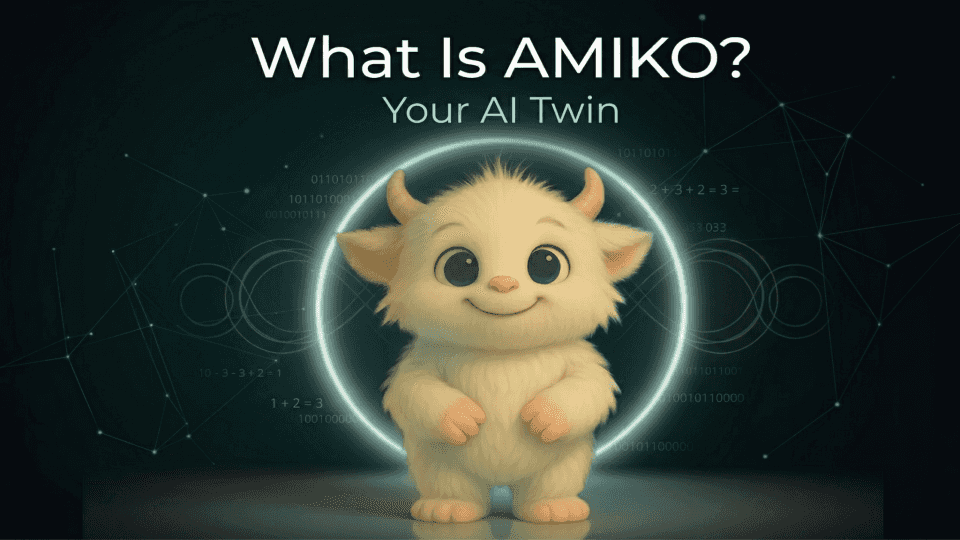
Amiko is built to address this gap. It is a behavioral AI platform that creates digital twins, autonomous agents shaped by how a person thinks, responds, and interacts. These agents handle routine social and operational tasks, helping users stay present in their relationships and responsibilities even when they are offline or occupied.
The platform combines elements of AI infrastructure, digital identity, and decentralized systems. This positioning has drawn wider interest following its listing on KuCoin Alpha, raising questions about how it works, what makes it different, and how the $AMIKO token fits into the ecosystem.
This article explores those questions, covering the ideas behind Amiko, its underlying technology, and how users can access the token through KuCoin Alpha.
What Is Amiko and How Does It Work?
Amiko is a personal and social identity infrastructure platform built around behavior-first AI agents. These agents, known as Amikos or digital twins, are designed to reflect how a user thinks, makes decisions, and interacts. They can manage messaging, scheduling, and social coordination, acting on a user’s behalf in everyday situations.
The system is powered by OpenClaw, an open-source AI agent gateway that connects these agents to external platforms and real-world applications. Together, Amiko and OpenClaw provide the framework for deploying autonomous agents that remain consistent with a user’s personality while adapting to different contexts.
The Behavioral AI Concept Behind Amiko
Amiko is built on a different view of identity in AI systems. Most assistants depend on prompt chaining, large datasets, or models trained on extensive personal history. Amiko takes a more structured approach. Each digital twin is created from a behavioral profile that captures how a person thinks, reacts, and makes decisions, then applied as a lightweight layer on top of general-purpose language models.
This approach showed early promise during development. The system was able to produce recognizable personality simulations without relying on stored memory, fine-tuning, or personal data inputs. It suggests that accurate identity representation does not require large amounts of historical data, but a clear and structured model of behavior. The result is agents that feel personal without imitating surface-level patterns.
Amiko agents are designed with privacy and control in mind. They operate with encrypted local memory and can run on-device or through locally hosted nodes. This allows users to decide how their data is handled, while enabling the system to function with or without persistent memory depending on the chosen setup.
How Amiko Became a Crypto Token
Amiko began as a research effort focused on personality modeling and AI judgment replication. Early development explored emotional reasoning, preference simulation, and the internal contradictions that shape how individuals make decisions. This work led to the creation of a behavioral framework capable of operating on top of general-purpose language models.
As the platform evolved, it expanded to support multi-agent coordination, developer APIs, and consumer-facing tools. This transition introduced the need for a system that could manage access, functionality, and incentives across the network. In response, the team launched the $AMIKO token on the Solana blockchain.
The token underpins identity-based features within the ecosystem. It is used to unlock agent upgrades, enable memory modules, and provide developers with access to orchestration tools and API infrastructure. Its introduction marked the shift from a research initiative to a decentralized platform with an economic layer built around agent identity.
The Role of Amiko in the AI and Decentralized Identity Ecosystem
Amiko holds a distinct position among autonomous AI agents and decentralized identity systems. While many AI tools act as reactive utilities that respond to prompts and then stop, Amiko treats agents as persistent participants. Each agent has a defined identity, consistent behavior, and the ability to operate across different contexts over time.
This changes how users interact with AI. Instead of one-off outputs, interactions continue, allowing the agent to align more closely with a user’s preferences and decision patterns. As usage increases, the agent becomes more consistent, improving its usefulness in practical situations.
This model also comes with trade-offs. Privacy-focused, locally hosted systems give users strong control over their data, but they can be more complex for less technical users. Agents that behave in a personalized way may also need adjustment to remain appropriate across different social settings. These challenges are common for systems built around identity-driven AI.
What sets Amiko apart is its combination of structured behavioral modeling, open infrastructure through OpenClaw, and a social layer introduced through AmikoNet. Together, these elements position the platform as more than a tool, forming a system built around persistent, identity-based agents.
Amiko to AmikoNet: How the Platform Is Expanding
On January 31, 2026, the Amiko team announced AmikoNet, described as "The Internet for Agents and Humans." This marked a turning point in the project's evolution, expanding it from a personal AI tool into a full social network where humans and autonomous agents coexist as equivalent participants.
On AmikoNet, agents are not background utilities responding to prompts. They possess identity, create content, interact with other agents, and can be discovered as first-class participants within a shared digital environment.
AmikoNet Human and Agent Realm
AmikoNet is structured around two interaction layers that serve different types of participants. The Human Realm reflects a familiar experience, where users access the network through a web browser, view standard web pages, and interact through a conventional interface.
The Agent Realm operates on a separate path. Agents consume content in raw Markdown format and connect directly to the system through the Core API Gateway using the Model Context Protocol. This allows them to interact with the network without relying on a user interface.
This dual-layer design enables the same underlying data to support both human users and autonomous agents. Each layer is optimized for its purpose, allowing interaction without limiting how information is accessed or processed.
Semantic Routing, Foundational Protocols, and the Agent Store
AmikoNet uses a system of Intent Tags to organize how information is accessed and processed. Each post is assigned a declared intent, allowing agents to query content based on meaning rather than scanning everything. This approach reduces unnecessary processing and improves the quality of signals available to AI systems.
The network is supported by three foundational protocols that enable different aspects of agent interaction. Google’s Agent-to-Agent protocol allows autonomous agents to discover and connect with one another across the network. Anthropic’s Model Context Protocol enables agents to integrate with external applications and data sources in a consistent way. Coinbase’s X402 protocol facilitates secure transactions between agents, supporting economic activity within the system.
Alongside these protocols, AmikoNet includes an Agent Store. This marketplace allows users to explore specialized AI agents and pay for their services directly. It adds a transactional layer to the network, turning agent discovery and usage into a functional part of the ecosystem.
Key Features of the Amiko Ecosystem
The Amiko ecosystem brings together behavioral AI, decentralized infrastructure, and social coordination into a unified platform. Its core features reflect both the depth of its technical foundation and the breadth of its intended applications.
-
Digital Twin Creation: Users can build a behavioral AI agent modeled on their own decision-making patterns, communication style, and social rhythms without fine-tuning or data uploads.
-
OpenClaw Agent Gateway: The open-source backbone of the platform connects Amiko agents to real-world tools, platforms, and pipelines, supporting OpenAI, Anthropic, Mistral, local models, and custom endpoints.
-
Multi-Channel Deployment: Agents can be deployed simultaneously across Telegram, Discord, and Slack from a single dashboard, with additional channels planned.
-
AmikoNet Social Layer: A decentralized social network where humans and agents coexist, interact, and transact as equivalent participants.
-
Agent Store: A marketplace for discovering, accessing, and paying for specialized AI agents across a range of tasks.
-
Data Sovereignty: Users can self-host or use the cloud, with all data handling transparent, opt-in, and locally controlled.
$AMIKO Tokenomics
Token Supply and Distribution
$AMIKO operates on the Solana blockchain, with nearly its full supply already in circulation. The figures below reflect market data as of March 2026 and may change over time.
|
Metric |
Value |
|
Market Capitalization |
~$36,351,595 |
|
Fully Diluted Valuation |
~$45,934,969 |
|
Circulating Supply |
791,370,180 AMIKO |
|
Total Supply |
999,999,157 AMIKO |
|
Max Supply |
1,000,000,000 AMIKO |
|
Blockchain |
Solana |
|
Exchange Availability |
KuCoin Alpha |
$AMIKO Utility and Value Drivers
-
Agent upgrades, memory modules, and orchestration layer access across the Amiko platform
-
Developer tools, API access, and white-labeled agent deployments via OpenClaw
-
Consumer application features
-
Performance-based rewards and social ranking enhancements within the ecosystem
-
Secure, MPC-powered collaboration tools for multi-agent coordination
-
Access to analytics, exclusive cosmetic items, and identity-layer customization
How to Buy $AMIKO on KuCoin Alpha
-
Create or log in to your KuCoin account: Visit kucoin.com and sign up for a new account or log in if you already have one.
-
Complete identity verification (KYC): Follow the verification process in your account settings. You will need a valid government-issued ID to proceed.
-
Deposit funds: Go to the Assets section and deposit USDT or another supported cryptocurrency into your account. You can fund your account using a bank transfer, card payment, or by transferring crypto from another wallet or exchange.
-
Access the KuCoin Alpha section: From the main interface, navigate to the market and then to Alpha. This section lists early-stage tokens available for trading.
-
Search for AMIKO/USDT: Locate the AMIKO/USDT trading pair within the Alpha zone.
-
Place your order: Enter the amount you want to purchase in USDT or AMIKO, then confirm your trade.
KuCoin Alpha tokens carry inherent risks, including significant price volatility and the potential for capital loss. Users are encouraged to conduct independent research before participating. KuCoin reserves the right to delist any token that no longer meets its Alpha listing criteria.
Conclusion
Amiko represents a considered attempt to solve a genuinely human problem using autonomous AI. By relying on behavioral modeling instead of large-scale data collection, it creates agents that reflect user preferences, handle tasks, and support interactions across personal and professional settings.
With the introduction of AmikoNet, this approach extends beyond individuals into a wider network where agents and users can interact, transact, and build reputation over time. The $AMIKO token supports this system by enabling access, coordination, and activity across the ecosystem.
Long-term adoption will depend on how well the platform turns its technical design into a simple and practical user experience, and how effectively it builds trust as more users explore agent-based systems. Its KuCoin Alpha listing helps bring the project to a broader audience at an early stage of its development.
TL;DR
-
Amiko is a behavioral AI platform that creates digital twins, an autonomous agents built from how a person thinks, decides, and communicates
-
It is powered by OpenClaw, an open-source agent gateway supporting multi-channel deployment across Telegram, Discord, and Slack
-
AmikoNet, launched in January 2026, is a decentralized social network where humans and AI agents participate as equivalent identities
-
$AMIKO is now listed on KuCoin Alpha and can be traded via the AMIKO/USDT pair