

Is Tesla Quietly Becoming a Physical AI Platform? Why FSD Subscriptions Matter More Than Car Sales
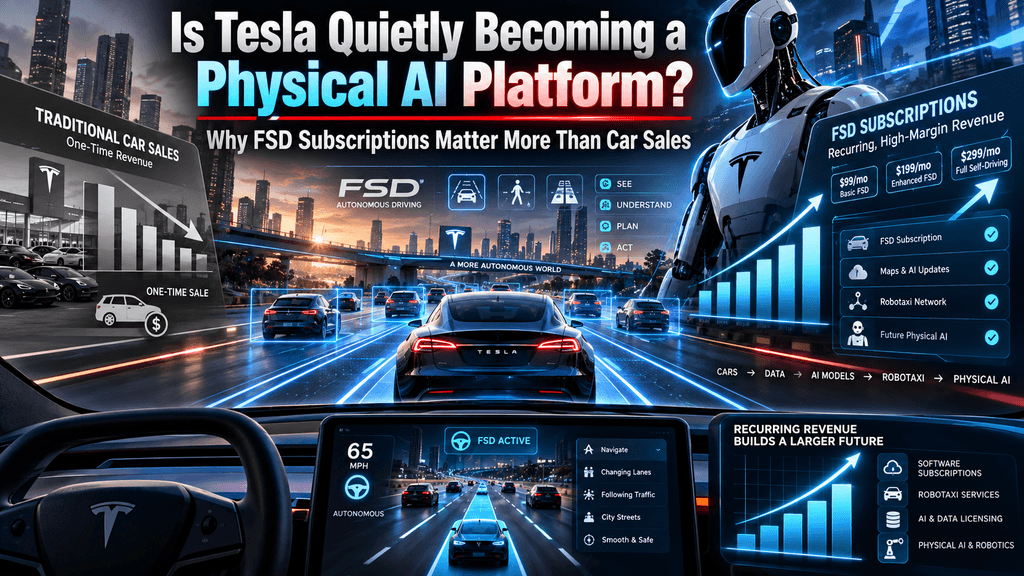
Tesla’s Shift From EV Manufacturer to Physical AI Platform
Tesla reported record Q2 2026 revenue of $28.2 billion and delivered 480,126 vehicles, yet the more consequential development sat in the software metrics. Active Full Self-Driving subscriptions reached 1.48 million, a 56 percent year-over-year increase and the largest quarterly addition in company history. North American attach rates crossed 55 percent of new deliveries. At the same time, Tesla began Cybercab production, expanded unsupervised Robotaxi operations to seven U.S. metros, and accelerated Optimus humanoid robot manufacturing toward hundreds of units per week.
These moves reflect a deliberate reorientation: the car is increasingly treated as a sensor-rich platform that generates recurring software revenue and real-world training data for broader physical AI applications. Tesla is transitioning from a pure electric-vehicle manufacturer into a physical AI company whose highest-margin growth engine is the FSD subscription model, which already generates hundreds of millions in annualized recurring revenue while feeding the data flywheel needed for robotaxi and humanoid robotics.
FSD Subscriber Base Hits 1.48 Million After Record Quarterly Gains
Tesla closed the second quarter of 2026 with 1.48 million active FSD subscriptions, up 56 percent from the prior year and approximately 200,000 higher than the end of Q1. Management confirmed this represented the largest single-quarter addition on record. Roughly 45 percent of the total, or about 666,000 customers, pay the $99 monthly subscription, while the remainder hold earlier one-time purchases. At the current subscription price, the monthly recurring portion alone generates roughly $66 million, equating to nearly $800 million in annualized revenue from paying subscribers. Cumulative lifetime vehicle deliveries stood at 9.7 million, implying an overall FSD penetration rate near 15 percent of the fleet. The company has removed the one-time purchase option in most markets, ensuring future growth flows almost entirely into the recurring stream.
This shift converts what was once a high-ticket optional feature into a predictable, high-margin software annuity that requires no additional hardware cost per incremental user. The financial character of this revenue differs sharply from vehicle sales. Once the neural networks are trained and the software is deployed over the air, marginal cost approaches zero. Gross margins on pure software therefore sit far above automotive hardware margins, which have faced sustained pressure from pricing competition and elevated capital spending. Tesla’s shareholder update and earnings commentary explicitly linked part of the quarter’s ancillary revenue growth to rising FSD subscriptions. The data also show that customers in markets with regulatory approval for FSD exhibit elevated interest in Tesla vehicles, reinforcing the software’s role as a demand driver rather than a mere add-on.
North American Attach Rates Cross 55 Percent of New Deliveries
In North America, more than 55 percent of vehicles delivered in Q2 2026 included an active FSD subscription at the time of purchase, a company record. Tesla’s sales teams report that a growing share of customers enter showrooms primarily seeking the self-driving capability and treat the vehicle itself as the necessary hardware platform. This behavioral shift marks a meaningful change in the customer value proposition. Previously, FSD functioned as an expensive optional upgrade purchased by a minority of buyers. Under the subscription model and with prominent placement in the ordering flow, it has become a default consideration for a majority of new owners in the region.
The attach-rate improvement carries direct implications for long-term revenue visibility. Because subscriptions renew monthly, each new vehicle that leaves the factory with FSD activated creates a multi-year revenue stream whose duration depends on customer retention rather than one-time payment. Tesla has also noted that FSD versions continue to improve through end-to-end neural networks trained on both customer and Robotaxi real-world data. As the software becomes more capable, retention is expected to rise, further strengthening the recurring-revenue base. The same data network that improves FSD simultaneously supplies training material for unsupervised Robotaxi operations and for Optimus, creating internal synergies that pure software companies or pure hardware manufacturers cannot easily replicate.
Subscription Model Converts One-Time Sales Into Predictable Recurring Revenue
Tesla’s decision in early 2026 to eliminate the one-time FSD purchase option in most markets forced the economics toward subscriptions. The previous model generated large but lumpy revenue when a customer paid several thousand dollars upfront. The $99 monthly plan lowers the barrier to entry, expands the addressable customer base, and produces smoother cash flows. With 1.48 million active users and roughly 45 percent already on monthly billing, the company has established a visible software annuity that scales with fleet size rather than with new vehicle volume alone.
High-margin software revenue carries strategic value beyond the income statement. It improves the quality of earnings, supports higher valuation multiples typically associated with platform businesses, and provides a hedge against cyclical declines in vehicle demand. In Q2, Tesla’s overall operating margin compressed to 1.4 percent amid heavy capital expenditure on AI infrastructure, yet the FSD contribution helped offset pressure in the core automotive segment. Management has indicated that future FSD monetization growth will come predominantly from subscriptions, confirming the intentional pivot toward a recurring-revenue model.
Cumulative FSD Miles Approach: 12 Billion and Feed the Data Flywheel
Tesla’s supervised FSD fleet has accumulated nearly 12 billion miles of real-world driving data. Each additional mile improves the end-to-end neural networks that power both consumer FSD and unsupervised Robotaxi operations. The company trains foundation models on a combination of customer fleet data and dedicated Robotaxi data, creating a continuous improvement loop. Regulatory approvals in additional European countries have already produced elevated vehicle interest and incremental FSD miles in those markets.
This data advantage constitutes a core element of Tesla’s physical AI thesis. Competing autonomy developers must either collect equivalent real-world miles through their own fleets or rely more heavily on simulation. Tesla’s installed base of millions of vehicles equipped with cameras and compute hardware supplies a continuous stream of edge-case data that is difficult to replicate. The same data corpus is being applied to Optimus training, where the company has amassed more than 500,000 hours of motion and task data and aims to double that volume. The result is a single AI stack that improves driving performance while simultaneously advancing general-purpose robotics capabilities.
Robotaxi Operations Expand to Seven U.S. Metros With Zero Notable Incidents
Unsupervised robotaxi service is now live in seven major U.S. metropolitan areas. The fleet has logged more than 380,000 unsupervised miles with no notable incidents reported by management, and weekly unsupervised miles are growing at double-digit rates. Cybercab production has begun at Gigafactory Texas, and employee rides on production vehicles have started on the factory campus. These steps move Robotaxi from pilot status toward a scalable commercial service.
The economics of robotaxi depend on utilization, density, and regulatory clearance rather than on vehicle sales volume. Each additional city launch benefits from the same FSD software stack and from the data already collected by the consumer fleet. Because the software improves continuously, the incremental cost of opening a new market trend lowers over time. While current Robotaxi revenue remains modest relative to the overall business, the combination of expanding geographic coverage and rising unsupervised miles positions the service as a future high-margin platform that leverages the same physical AI foundation already monetized through FSD subscriptions.
Optimus Production Ramps to Hundreds of Units Weekly Amid AI Challenges
Tesla has increased Optimus humanoid robot production to several hundred units per week at the Fremont facility, roughly a tenfold rise from second-quarter levels. Management is targeting a continuous line capable of more than 1,000 robots weekly by the end of 2026. The company ended Model S and Model X production in May 2026 and reallocated those lines and engineering resources to Optimus. Current units are primarily used internally for testing, training, and data collection.
Despite the production ramp, generalization remains a constraint. Sources familiar with the program report that teaching the robot even basic new tasks can require several days, and behavior can be unpredictable outside trained scenarios. Tesla is building a library of fundamental behaviors that the AI can recombine while continuing to collect motion-capture and camera data. The company plans to lease rather than sell early units to selected commercial customers whose environments resemble its own factories, mirroring the FSD data-collection strategy. Hardware reliability issues with hands and supplier consistency also persist, indicating that volume manufacturing and useful general intelligence are advancing on different timelines.
Capital Expenditure Exceeds $5 Billion as Tesla Builds AI Infrastructure
Q2 2026 capital expenditure reached $5.79 billion, more than double the prior quarter, driving free cash flow negative. Full-year 2026 CapEx is guided above $25 billion and is expected to remain elevated for several years. Spending covers AI compute capacity, next-generation inference chips, battery and semiconductor manufacturing, Cybercab and Optimus production lines, and energy storage expansion. Tesla is also arranging debt capacity of up to $30 billion to support the investment cycle.
This level of investment is consistent with a platform transition rather than incremental product development. Building proprietary AI silicon, expanding data center capacity, and standing up entirely new manufacturing lines for robots and purpose-built robotaxis require multi-year capital commitments. The near-term result is compressed automotive margins and negative free cash flow. The longer-term rationale is that the resulting infrastructure will support high-margin software and autonomy services whose unit economics improve with scale. Investors are therefore evaluating Tesla less on traditional automotive metrics and more on progress toward physical AI milestones.
Vehicle Deliveries Remain Important but No Longer Define the Growth Narrative
Tesla delivered 480,126 vehicles in Q2 2026, a 25 percent year-over-year increase and a two-year quarterly high. Model 3 and Model Y continue to dominate volume. Yet management commentary increasingly frames vehicle sales as the mechanism that places sensor-equipped platforms into customers’ hands rather than as the primary long-term value driver. In markets where FSD has regulatory approval, vehicle demand itself appears supported by interest in the software capability.
The distinction matters for valuation. Hardware sales generate lower margins, require continuous production investment, and face competitive pressure. Software subscriptions and future autonomy services scale with far lower incremental cost. As the installed base of FSD-capable vehicles grows, the potential software revenue pool expands even if annual vehicle deliveries stabilize or grow more slowly. Tesla’s own language in recent filings and calls emphasizes bringing artificial intelligence into the real world through FSD, Robotaxi, and Optimus, positioning the automotive business as the foundation rather than the final product.
Energy Storage and Services Provide Complementary High-Margin Streams
Energy storage deployments reached 13.5 GWh in the quarter, and the Services and Other segment recorded $648 million in gross profit at a 14 percent margin, an all-time high for that business. Used-vehicle sales, supercharging, and maintenance contribute to this line, while energy storage benefits from utility and data-center demand. These businesses already demonstrate the company’s ability to extract recurring or high-margin revenue from its existing customer base and manufacturing expertise.
Together with FSD subscriptions, the energy and services segments illustrate a broader shift away from pure vehicle-unit economics. Each additional vehicle sold increases the potential for supercharging revenue, insurance products tied to safety score, and future autonomy services. Energy storage, meanwhile, supplies the grid-scale batteries that support the AI data centers Tesla itself is building. The combination creates internal demand for the company’s own products while diversifying revenue away from cyclical vehicle sales.
Regulatory Approvals in Europe Unlock Incremental FSD Demand
Tesla received FSD (supervised) approvals in the Netherlands, Lithuania, Estonia, Denmark, and Belgium. Customers in these markets have already driven more than 50 million kilometers on the system. Management reports elevated interest in Tesla vehicles in jurisdictions where FSD is available. Additional European approvals remain in process, and progress continues in China. Each new market expands both the addressable subscription base and the real-world data collected for model training.
Regulatory expansion is therefore dual-purpose. It directly increases potential subscription revenue and simultaneously enlarges the data set that improves the underlying AI. Because the same software stack powers both consumer FSD and unsupervised Robotaxi, approvals for supervised operation lay groundwork for later unsupervised commercial services. The geographic broadening of FSD also reduces concentration risk associated with North American demand and provides a clearer path for international Robotaxi deployment once local regulations permit.
Physical AI Positioning Reframes Tesla’s Competitive Landscape
Tesla’s public communications now describe the company as focused on bringing artificial intelligence into the real world through vehicles, robots, and energy products. This framing places it in competition not only with traditional automakers but also with specialized autonomy firms, humanoid robotics startups, and large AI laboratories. The integrated stack, vehicles as data collectors, proprietary inference hardware, end-to-end neural networks, and a growing robot fleet, creates barriers that pure-play software or pure-play hardware competitors must overcome separately.
The practical implication is that Tesla’s valuation increasingly rests on the credibility of its physical AI roadmap rather than on near-term automotive margins. Progress is measured by FSD subscriber growth, unsupervised miles, Optimus production rates, and the quality of the data flywheel. Setbacks in any of these areas can affect sentiment more than a single quarter of vehicle deliveries. Conversely, sustained gains in subscription attach rates and Robotaxi utilization strengthen the case that the company is successfully converting its manufacturing scale into an AI platform advantage.
High Capital Intensity Tests Near-Term Profitability While Building Long-Term Moats
The simultaneous ramp of Cybercab, Optimus, AI compute, and semiconductor capacity has pushed capital expenditure to levels that currently exceed free cash flow generation. Operating income fell 57 percent year-over-year in Q2 despite record revenue. Management has been transparent that elevated spending will continue for multiple years. The strategic bet is that the resulting capabilities, higher FSD performance, scalable Robotaxi density, and useful humanoid robots will eventually produce software and service margins that more than offset the investment.
Investors therefore face a classic platform-transition trade-off. Near-term profitability is sacrificed to build the infrastructure and data assets required for autonomy and robotics. Success depends on execution speed, regulatory progress, and the continued improvement of the underlying neural networks. The FSD subscription metrics already provide measurable evidence that one element of the platform is generating real, high-margin revenue. The remaining elements, unsupervised Robotaxi at scale and commercially useful Optimus units, remain earlier in their commercial trajectories but share the same AI foundation.
🔥 Beyond the Headlines: What KuCoin 5.0 Means for You
Market news moves fast — but where you act on it matters just as much. This October, KuCoin launches KuCoin 5.0, transforming KuCoin into a rebuilt platform. Here's what actually changes for you:
-
One account for everything. Older platforms split your money across separate "spot," "margin," and "futures" accounts and expected you to understand why. KuCoin 5.0's unified account removes that entirely — deposit once, and everything is simply there (only available to VIPs for now).
-
Stocks, indices, and commodities. KuCoin 5.0 expands beyond crypto into global markets. When crypto chops sideways and equities rally (or the reverse), you rotate in minutes instead of opening a brokerage account and waiting days for fiat rails.
-
Real-world assets (RWA). Tokenized exposure to traditional assets like commodities, right inside your crypto account. One of the fastest-growing segments in global finance is no longer reserved for institutions — you access it from the same balance you trade with.
-
Earn while you learn. Not ready to trade? KCUSD lets your stablecoins earn daily, auto-compounding interest. The lowest-stress way to put your idle deposit to work for 4% yield.
-
An AI assistant in plain language. Ask questions, get market context, understand what you're looking at — built into the platform, no jargon required.
-
An app that doesn't overwhelm. Faster, cleaner, and consistent — intuitive from the first tap, not after a tutorial.
-
Safety you can check, not just trust. A MiCAR-licensed EU entity, Proof of Reserves you can verify yourself, and internationally certified security (SOC 2 Type II, ISO 27001:2022).
Create your account in minutes — and start on the platform built for where crypto is going, not where it's been.
FAQs
How large is Tesla’s current FSD subscription revenue stream?
Tesla reported 1.48 million active FSD users at the end of Q2 2026. Approximately 45 percent of those users, or roughly 666,000, pay the $99 monthly subscription. This produces about $66 million in monthly recurring revenue, or nearly $800 million on an annualized basis from the subscription cohort alone. Earlier one-time purchasers still contribute to the total active base but do not generate ongoing monthly payments.
Why did Tesla eliminate the one-time FSD purchase option?
Removing the upfront purchase forces new customers into the monthly subscription model. This converts what had been a single large payment into a stream of recurring revenue, improves cash-flow predictability, and expands the addressable market by lowering the initial financial barrier. Management has stated that the bulk of future FSD monetization will come from subscriptions, confirming the intentional design of the change.
What is the significance of the 55 percent North American attach rate?
More than half of new vehicles delivered in North America during Q2 2026 left the factory with an active FSD subscription. This indicates that FSD has moved from a niche optional feature to a mainstream consideration for the majority of buyers in the region. Higher attach rates accelerate the growth of the recurring-revenue base and increase the volume of real-world data available for continuous model improvement.
How does FSD data contribute to Tesla’s broader AI efforts?
The supervised FSD fleet has accumulated nearly 12 billion miles of real-world driving. These miles train the same end-to-end neural networks used for consumer FSD, unsupervised Robotaxi, and elements of Optimus behavior. Additional data from Robotaxi operations and from Optimus motion-capture sessions further enrich the training sets. The result is a unified data advantage that improves multiple product lines simultaneously.
What progress has Tesla made with unsupervised Robotaxi?
Unsupervised operations are active in seven U.S. metropolitan areas. The fleet has completed more than 380,000 unsupervised miles with no notable incidents reported by the company, and weekly unsupervised miles are growing at double-digit rates. Cybercab production has started in Texas, providing a purpose-built vehicle for future fleet expansion.
Is Optimus production already at commercial scale?
Tesla is manufacturing several hundred Optimus units per week and targeting more than 1,000 weekly by the end of 2026. Current output is used mainly for internal testing and data collection. Generalization of tasks and hardware reliability, particularly with the hands, remain active development challenges. Early commercial deployments are expected to take the form of leases to selected industrial customers rather than broad sales.
Disclaimer: This content is for informational purposes only and does not constitute investment advice. Investments carry risk. Please do your own research (DYOR).