

SanDisk Soars Nearly 14% on Explosive Long-Term Guidance: How AI Storage Demand Is Turning Compute Infrastructure into a Cash-Generating Asset
2026/08/14 10:57:00
Introduction
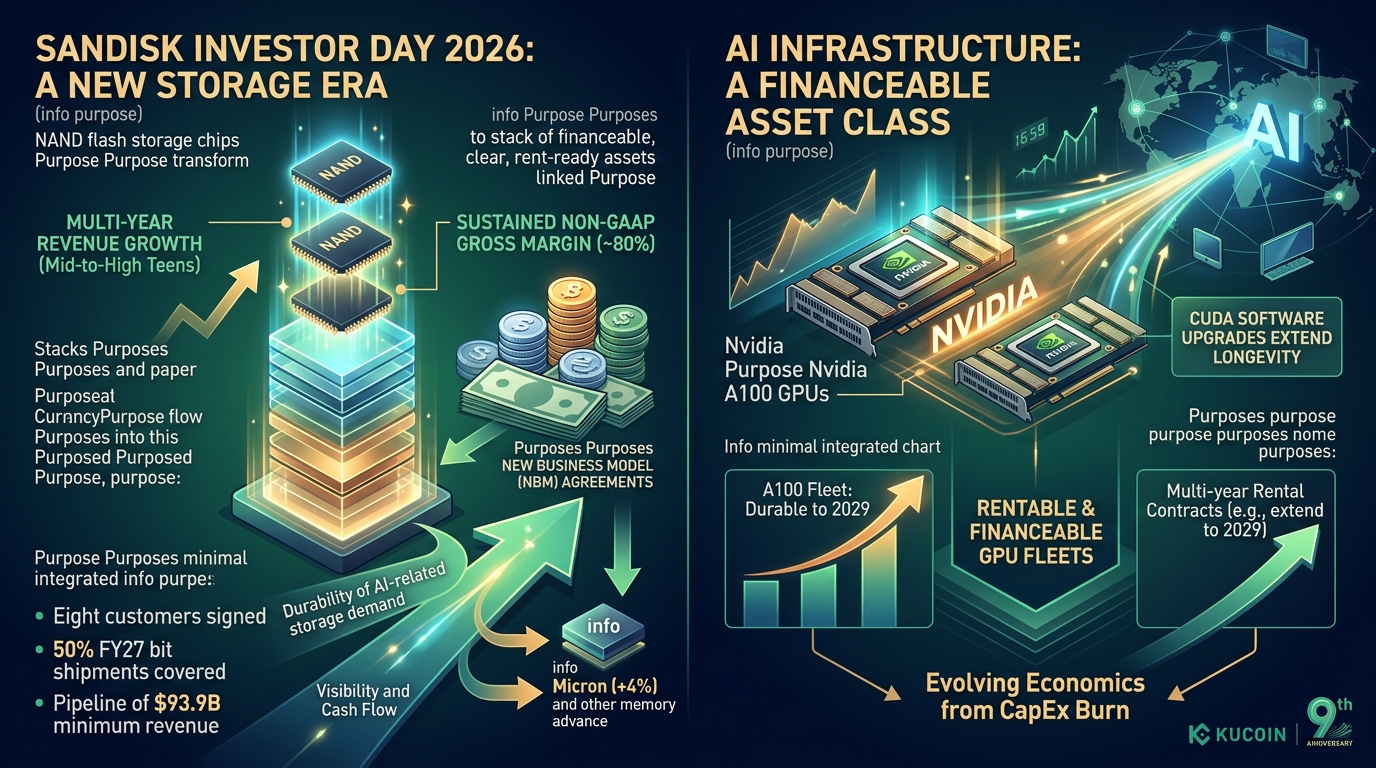
SanDisk shares jumped nearly 14% after the company unveiled a multi-year financial model at its 2026 Investor Day that projects mid-to-high teens revenue growth through fiscal 2030 alongside sustained non-GAAP gross margins near 80%. The guidance, backed by multi-year New Business Model agreements already covering roughly half of fiscal 2027 bit shipments and two-thirds of fiscal 2028 shipments, lifted the broader storage sector—with Micron rising about 4% and other memory names following higher.
Combined with Nvidia CEO Jensen Huang’s recent comments that A100 GPUs remain mission-capable through 2029 thanks to CUDA software upgrades, the moves signal a deeper shift: AI infrastructure is evolving from pure CapEx burn into financeable, rentable assets that generate predictable cash flows.
What Did SanDisk Announce at Its 2026 Investor Day?
SanDisk presented a clear long-term financial framework covering fiscal years 2028 through 2030 that emphasizes sustainable growth and high profitability. According to the company’s official release and investor presentations dated August 13, 2026, management expects revenue to grow at a mid-to-high teens rate annually, consistent with bit growth, while non-GAAP gross margins remain around 80% and non-GAAP operating margins near 75%. Adjusted free cash flow margins are targeted at approximately 50% after taxes, capital expenditures, and working capital needs. Operating expenses are modeled at roughly 5% of revenue. The company also committed to returning 100% of excess cash to shareholders after reinvesting in the business.
These targets stand out in an industry historically defined by sharp cyclical swings. SanDisk’s confidence rests on a structural change in how it sells NAND flash. The company has shifted a growing portion of its business to New Business Model (NBM) agreements that lock in committed volumes, binding contractual frameworks, minimum financial guarantees, and structured pricing. As of the Investor Day, SanDisk has signed such agreements with eight customers. These contracts already cover about 50% of fiscal 2027 bit shipments and approximately two-thirds of fiscal 2028 bit shipments. The agreements average around four years in length, with some extending to five years, and collectively represent a minimum revenue pipeline of roughly $93.9 billion at floor pricing, supported by about $16.5 billion in financial guarantees.
By converting a meaningful share of traditional spot or short-term NAND sales into multi-year committed demand, SanDisk reduces exposure to the classic memory cycle of oversupply and price collapses. Demand from data-center and edge customers for AI inference workloads continues to outpace supply, keeping bits on allocation beyond calendar 2026 and into later years, according to recent company commentary.
How Are New Business Model Agreements Reducing Storage Industry Cyclicality?
NBM agreements directly address the historical volatility of the NAND market by aligning customer capacity needs with SanDisk’s production planning over multiple years. Traditional memory sales left manufacturers exposed to sudden shifts in spot pricing and inventory swings. The new contracts include volume commitments, minimum financial protections, and pricing mechanisms that provide greater visibility into both revenue and cash flow.
Company executives have emphasized that these deals reflect customers’ conviction in long-term AI-driven storage demand. Several customers have already returned after initial signings to expand volumes based on stronger-than-expected requirements. The structure helps SanDisk plan capacity more efficiently while giving hyperscalers and other large buyers supply assurance in a tight market. As a result, a larger portion of SanDisk’s future bits is effectively de-risked from pure commodity pricing dynamics.
This shift supports the elevated margin targets. With a substantial base of committed, higher-value business, the company can sustain gross margins near the 80% level even as it continues to grow bit shipments in the mid-to-high teens range. The model also underpins stronger free cash flow generation, which in turn funds both capacity investments and aggressive shareholder returns, including expanded buyback authorizations.
Why Did the Broader Storage Chip Sector Rally Alongside SanDisk?
SanDisk’s guidance acted as a sector catalyst because it reinforced the durability of AI-related storage demand rather than a temporary price spike. Shares of SanDisk rose nearly 14% on the day of the Investor Day, according to contemporaneous market reports. Micron gained around 4%, while other memory and storage names, including Western Digital, also advanced. The move reversed recent sector pressure that had prompted investors to search for alternative AI narratives such as optical communications or neocloud infrastructure.
The rally reflects renewed confidence that AI storage needs—driven by larger models, longer context windows, KV-cache requirements, and inference scaling—will support elevated pricing and utilization for longer than earlier skeptics assumed. SanDisk’s own recent results already showed the impact: fiscal 2026 revenue reached $20.25 billion, up 175% year-over-year, with data-center strength a primary driver and non-GAAP gross margins expanding sharply. Management continues to guide for sequential growth in the current quarter supported by both higher volumes and pricing.
Market participants interpreted the long-term model as evidence that the storage upcycle is becoming more structural. Instead of pure cyclical recovery, the combination of tight supply, AI-specific demand, and multi-year customer commitments points to a more predictable earnings trajectory for leading NAND producers.
How Does Nvidia’s Comments on GPU Longevity Reinforce the AI Infrastructure Thesis?
Nvidia CEO Jensen Huang stated that the A100 fleet remains mission-capable from 2020 through 2029, underscoring the unusually long useful life of Nvidia’s compute resources. Huang highlighted that CUDA software enables continuous upgrades to older architectures, keeping GPUs rentable, durable, and financeable. The comments followed reports of multi-year rental contracts for A100 GPUs extending into 2029 at attractive rates.
This perspective challenges earlier narratives that rapid hardware obsolescence would limit returns on AI CapEx. When older GPUs retain high utilization and residual value through software support, the economics of data-center infrastructure improve. Operators can treat fleets as productive assets that generate ongoing rental or service cash flows rather than pure depreciating equipment that must be replaced every few years.
The parallel for storage is clear. Just as CUDA extends the economic life of Nvidia silicon, multi-year NBM contracts and sustained AI inference demand can stabilize NAND utilization and pricing. Together, these developments suggest AI infrastructure is transitioning from continuous heavy CapEx spending into a model closer to financeable, cash-flow-producing assets. Higher residual values and longer utilization periods support more confident capital allocation across both compute and storage layers.
What Broader Shift Is Occurring in AI Infrastructure Economics?
AI infrastructure is moving from a pure consumption model—constant new builds and rapid replacement—toward one in which installed capacity continues to generate returns over extended periods. Long-lived GPU fleets supported by software, combined with committed multi-year storage contracts, reduce the risk of stranded CapEx. Hyperscalers and specialized operators gain better visibility into total cost of ownership, while suppliers such as SanDisk gain more predictable revenue streams.
Key indicators to watch going forward include secondary-market or rental pricing for older GPU generations and overall utilization rates. If those metrics remain resilient, storage demand is likely to stay elevated for longer as data centers continue to expand capacity and optimize existing fleets. SanDisk’s guidance and Nvidia’s longevity comments provide two recent data points supporting this view and help counter earlier concerns about an abrupt AI hardware bust.
The storage sector’s recent rebound, led by SanDisk’s nearly 14% advance, reflects investors pricing in this more durable demand picture. While short-term volatility remains inherent to semiconductors, the structural elements—tight supply, AI workload growth, and contractual visibility—have strengthened.
KuCoin Offers A More Stable Option in A Volatile Market
If you worry about the frequent ups and downs in the market, and pursue a more stable option to earn money passively, KuCoin is the right place to come:
-
Simple Earn: Deposit and withdraw tokens anytime, earning stable returns.
-
Kucoin Earn: Earn stable profits with professional asset management.
-
Hold to Earn: Earn rewards by holding assets in Funding, Trading, Margin, Futures, Mining, and Unified Accounts.
-
Staking: Unlock the earning potential of on-chain assets.
-
Advanced Investments: Advanced Investments offer a variety of structured products to help your money grow in any market.
-
Shark Fin: Principal Protection and Guaranteed Gains
-
Dual Investment: Buy low and sell high with transparent return calculations.
-
Snowball: High yields, with price protection.
-
Discount Buy: Buy crypto at discount prices.
-
KCS Loyalty: Level up to enjoy exclusive perks by staking ≥ 1 KCS.
-
KuCoin Wealth: Discover future value and begin your smart investing journey.
-
KCS Benefits: Hold and stake KCS to access benefits across the platform.
-
KCS Staking 2.0: Participate in KCS on-chain governance to earn yield.

Conclusion
SanDisk’s 2026 Investor Day guidance of mid-to-high teens revenue growth and sustained ~80% gross margins through fiscal 2030, underpinned by New Business Model agreements covering half of fiscal 2027 and two-thirds of fiscal 2028 bit shipments, delivered a powerful positive signal to the storage market. The nearly 14% share price rise, together with gains in peer stocks such as Micron, reflected investor recognition that AI-driven storage demand is becoming more predictable and less purely cyclical.
Nvidia CEO Jensen Huang’s affirmation that A100 GPUs can remain productive through 2029 via CUDA further supports the idea that AI compute and storage infrastructure are evolving into longer-lived, financeable assets capable of generating ongoing cash flows. The combination of multi-year customer commitments, tight industry supply, and software-enabled hardware longevity strengthens the case for sustained benefits across the memory sector. While semiconductor markets will continue to experience volatility, the recent guidance and commentary provide clearer visibility into the multi-year trajectory of AI-related storage demand.
FAQs
What are SanDisk’s key financial targets for fiscal 2028–2030?
SanDisk expects mid-to-high teens annual revenue growth consistent with bit growth, non-GAAP gross margins of approximately 80%, non-GAAP operating margins near 75%, and adjusted free cash flow margins of about 50%.
How many New Business Model agreements has SanDisk signed?
SanDisk has signed NBM agreements with eight customers. These cover roughly 50% of fiscal 2027 bit shipments and about two-thirds of fiscal 2028 bit shipments.
Why did Micron and other storage stocks rise after SanDisk’s announcement?
The guidance reinforced the durability of AI storage demand and reduced concerns about a near-term cyclical downturn, lifting sentiment across the memory sector.