

Quantum Computing Threat to Blockchain: Why Tether’s Mint Keys Are More Valuable Than Satoshi’s Bitcoins
2026/08/11 14:00:00
Key Takeaways
-
The Core Quantum Threat: Shor’s algorithm enables quantum computers to derive private keys from exposed public keys on-chain, threatening Elliptic Curve Cryptography (ECC) without needing device-level hacks.
-
Liquidity Control vs. Fixed Asset Theft: Satoshi’s ~1.1 million Bitcoins represent a fixed, illiquid treasury that would trigger instant market crashes if moved. Tether’s USDT minting keys provide infinite synthetic leverage to drain global market liquidity silently.
-
The "Silent Q-Day" Risk: Early quantum attacks are expected to mimic routine insider threats or credential leaks rather than obvious protocol breaches, allowing adversaries to exploit active smart contract admin keys unnoticed.
-
Mempool & Admin Vulnerabilities: Unconfirmed transactions in the mempool and active smart contract multi-sig keys broadcast public keys repeatedly, making them primary targets for real-time quantum interception.
-
Industry Transition to PQC: Blockchain networks are accelerating the adoption of Post-Quantum Cryptography (PQC) standards—such as NIST-approved ML-DSA (Dilithium)—while platforms like KuCoin safeguard assets via institutional multi-sig cold storage architectures.
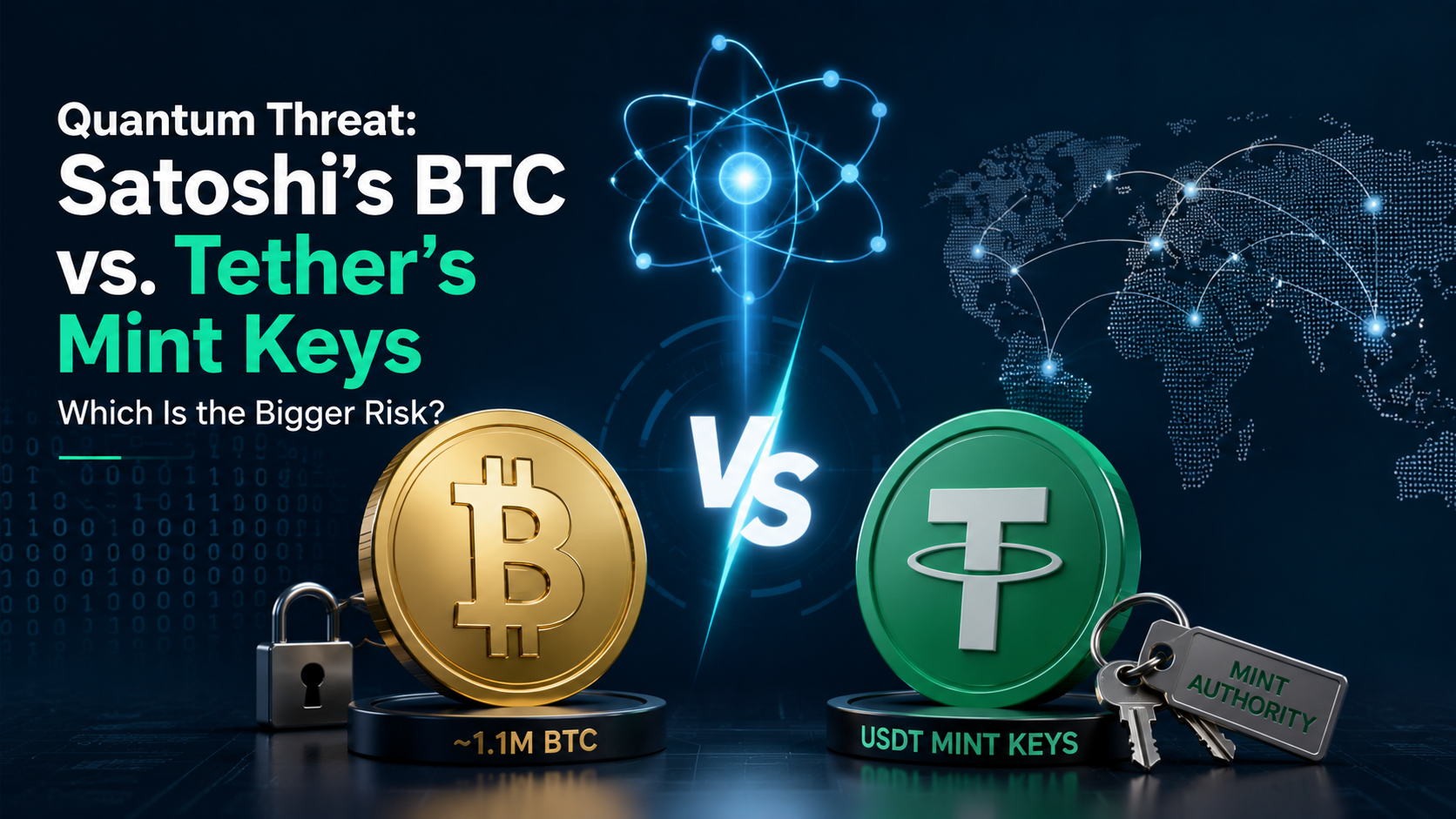
Quantum computing represents an existential threat to modern blockchain security by threatening to break Elliptic Curve Cryptography (ECC) faster than classical supercomputers. While public concern often focuses on the potential theft of Satoshi Nakamoto's dormant ~1.1 million Bitcoins—worth roughly $65 billion—security analysts increasingly warn that administrative credentials, such as Tether's stablecoin minting keys, pose a far greater systemic target. A quantum adversary possessing Tether’s minting keys could issue billions in unbacked USDT to drain market liquidity across centralized and decentralized venues without crashing market prices overnight. This article evaluates why operational control over market liquidity outweighs fixed asset theft, how quantum algorithms threaten asymmetric encryption, and what steps crypto platforms like KuCoin are taking to prepare for post-quantum cryptography.
How Does Quantum Computing Threaten Modern Blockchain Cryptography?
Quantum computers leverage quantum mechanics to break asymmetric encryption schemes that underpin digital signatures on modern blockchains. Elliptic Curve Cryptography (ECC)—specifically the secp256k1 curve utilized by Bitcoin and Ethereum—relies on the computational hardness of the Elliptic Curve Discrete Logarithm Problem (ECDLP). Classical supercomputers would require billions of years to derive a private key from a known public key using brute force. However, quantum processors executing Shor’s algorithm can solve ECDLP in polynomial time, deriving private keys in a matter of hours or minutes once hardware capabilities reach fault-tolerant thresholds.
The primary vulnerability stems from public key exposure on public ledgers. When a user transmits a transaction from a blockchain address, the corresponding public key is exposed to the peer-to-peer network and stored permanently on-chain. According to an August 2026 report by ForkLog citing quantum security research from Quantus Network, a quantum computer with sufficient logical qubits can analyze this public key to calculate the matching private key, granting full authorization to sign transactions and transfer funds without ever breaching local devices or software interfaces.
Quantum acceleration affects digital signatures and cryptographic hashing in fundamentally different ways. Digital signatures based on RSA or ECDSA face total compromise under Shor’s algorithm, whereas cryptographic hash functions like SHA-256 and RIPEMD-160 are far more resilient. Grover’s algorithm offers only a quadratic speedup against hashing functions, meaning doubling the output size effectively preserves classical security levels. Consequently, blockchain consensus mechanisms relying on SHA-256 remain structurally sound against quantum brute force, while user wallets and smart contract administrative keys remain highly exposed to key derivation attacks once public keys become visible.
Why Are Tether's Mint Keys More Valuable to a Quantum Attacker Than Satoshi's Bitcoins?
Tether's USDT minting keys represent infinite synthetic leverage across global crypto markets, whereas Satoshi Nakamoto's estimated 1.1 million Bitcoins constitute a fixed, highly monitored, and illiquid treasury. If a quantum attacker were to crack the legacy Pay-to-Public-Key (P2PK) addresses holding Satoshi’s coins and attempt to liquidate them, automated market monitoring tools would trigger instant global alerts. The resulting market panic and massive sell-side slippage would collapse spot prices before the attacker could cash out more than a fraction of the paper wealth. In contrast, gaining control over Tether's smart contract minting keys provides the ability to generate unlimited USDT on-chain, creating immediate control over the foundational medium of exchange powering global digital asset liquidity.
USDT operates as the dominant quote currency and primary collateral asset across both centralized exchanges and decentralized lending protocols. Based on an August 2026 market report published by Economic Times, global cryptocurrency market capitalization stands at $2.21 trillion, with Bitcoin hovering around $65,000 and USDT accounting for the vast majority of daily trading volume. An attacker in possession of compromised minting keys could mint billions of dollars in synthetic USDT across multiple blockchains like Ethereum, Tron, and Solana. By routing these unbacked stablecoins through automated market makers (AMMs) and decentralized lending pools, the attacker could swap synthetic USDT for hard assets such as ETH, BTC, and liquid staking tokens before emergency pausing mechanisms or blacklist parameters could be deployed by protocol administrators.
The economic yield from stealing liquidity keys vastly exceeds the practical proceeds of dumping a massive, fixed supply of Bitcoin. According to an August 2026 performance report published by CoinGecko Research, KuCoin alone processed an average daily trading volume of $1.99 billion in spot markets and $3.07 billion in perpetual futures during the first half of 2026, demonstrating how deeply stablecoins are woven into exchange liquidity depth. Exploiting Tether's administrative keys allows an attacker to extract active market liquidity from active trading pairs globally rather than crashing the bid side of an illiquid order book. Furthermore, Tether holds massive real-world reserve backing—including 146 tons of physical gold valued at $18.8 billion alongside substantial US Treasury holdings as reported in an August 2026 financial coverage update by Times of India—making its tokenized stablecoin the ultimate proxy for fiat liquidity in Web3.
| Threat Parameter | Satoshi Nakamoto's Bitcoin Holdings | Tether (USDT) Smart Contract Minting Keys |
| Asset Nature | Fixed supply (~1.1 million BTC) held in dormant addresses | Infinite generation capability for synthetic reserve tokens |
| Exposure Mechanism | On-chain P2PK scripts exposing unhashed public keys | Smart contract admin multi-sig keys exposed during signing |
| Market Slippage Impact | Massive price collapse upon selling; low realized value | Low initial slippage when distributed across deep AMM pools |
| Detection Speed | Immediate global blockchain monitoring alerts | Delayed detection; can be masked as operational or key leaks |
| Systemic Risk | Sentiment collapse and temporary market panic | Systemic insolvency across DeFi, CEX liquidity, and lending |
What Is the "Silent Q-Day" Threat and How Could Initial Quantum Hacks Go Undetected?
Initial quantum attacks against cryptocurrency networks will likely manifest as unexplained wallet thefts rather than dramatic, headline-grabbing network breaches. The popular concept of "Q-Day"—the specific day quantum hardware breaks standard public-key cryptography—assumes an obvious, catastrophic event where legacy networks collapse simultaneously. However, security experts emphasize that early quantum attacks will mimic conventional security incidents such as phishing, insider threats, compromised multi-sig configurations, or local malware infections.
Silent exploitation allows a quantum-capable state actor or sophisticated criminal enterprise to maintain operational stealth while siphoning funds continuously. Based on an August 2026 statement by Quantus Network CEO Christopher Smith, when a high-security institution or multi-sig wallet suffers a breach without any physical or digital footprint, the absence of traditional attack vectors may be the only forensic indicator of quantum key derivation. By targeting active commercial entities, liquidity providers, and treasury wallets in piecemeal fashion, quantum adversaries can prolong their access before protocol developers initiate emergency post-quantum hard forks.
Preserving stealth is particularly advantageous when targeting enterprise infrastructure like stablecoin treasuries or cross-chain bridges. Cracking a dormant Satoshi-era address instantly announces to the global community that ECDSA-256 cryptography is broken, triggering immediate emergency code migrations and protocol halts. Conversely, making off with individual treasury keys or smart contract management roles allows attackers to blend in with everyday security breaches. This strategic asymmetry makes active operational infrastructure—such as Tether’s minting authorities or exchange hot wallets—far more attractive targets for early quantum capability deployment than historical coin hoards.
How Do Mempool Hijacking and Smart Contract Admin Keys Amplify Systemic Quantum Risk?
Mempool transaction interception allows fast-clock quantum computers to execute real-time "on-spend" attacks against active blockchain transactions before they are confirmed in a block. When a user submits a transaction from a previously unexposed Address (such as a Pay-to-Witness-Public-Key-Hash address), the public key is revealed in the public mempool while awaiting miner validation. A quantum adversary running Shor's algorithm on a high-speed processor could extract the public key from the unconfirmed transaction, calculate the private key, and broadcast a competing transaction with a higher gas fee to steal the funds within the typical 10-minute Bitcoin block confirmation window.
Smart contract administrative keys and cross-chain bridge multi-sig keys concentrate systemic risk into single failure points that affect millions of users simultaneously. Unlike basic peer-to-peer transfers where a compromised key affects a single user balance, smart contract admin keys govern protocol parameters, emergency pause functions, token minting functions, and collateral vaults across decentralized finance. If a quantum computer cracks the underlying cryptographic keys of a major bridge multi-sig, the attacker can drain locked collateral backing wrapped tokens across multiple layer-1 and layer-2 networks at once.
The vulnerability of smart contract infrastructure is compounded by the frequency with which administrative keys must interact with the blockchain. Every time a multi-sig signer approves an upgrade, adjusts a parameter, or rebalances reserves, their public key is broadcast to the network and permanently stored on-chain. According to quantum resource estimation research published in arXiv in early 2026, breaking ECDSA-256 requires fewer than 1,500 fault-tolerant logical qubits executing under 90 million Toffoli gates. This reduced resource threshold means active administrative keys with publicly visible transaction histories are already sitting in the crosshairs of emerging quantum hardware architectures.
What Post-Quantum Cryptography Mitigations Are Blockchain Networks Adopting in 2026?
Blockchain networks are actively developing Post-Quantum Cryptography (PQC) standards to replace vulnerable elliptic curve algorithms with lattice-based signature schemes. The National Institute of Standards and Technology (NIST) finalized primary post-quantum algorithms, emphasizing lattice-based standards like Module-Lattice-Based Digital Signature Algorithm (ML-DSA, formerly Dilithium) and Stateless Hash-Based Digital Signature Algorithm (SLH-DSA, formerly SPHINCS+). Blockchain core developers are creating soft-fork and hard-fork upgrade paths to integrate these quantum-resistant signature schemes directly into wallet addresses and smart contract execution environments.
Lattice-based signature schemes present trade-offs between cryptographic security, transaction size, and verification throughput on public ledgers. Standard ECDSA signatures require only 64 bytes of storage space, whereas quantum-safe signatures like ML-DSA require several kilobytes per signature. This increase in signature size increases block storage requirements, elevates gas fees, and reduces overall transaction throughput on decentralized networks. To mitigate these scalability constraints, developers are exploring zero-knowledge proof aggregations (STARKs) and hash-based signature schemes that compress post-quantum proofs before writing them to the chain.
| Cryptographic Scheme | Mathematical Assumption | Signature Size | Quantum Security Level | Primary Blockchain Use Case |
| ECDSA (secp256k1) | Elliptic Curve Discrete Logarithm | ~64 bytes | Vulnerable to Shor's algorithm | Legacy Bitcoin and Ethereum addresses |
| ML-DSA (Dilithium) | Module Learning With Errors (Lattice) | ~2,420 bytes | Quantum-resistant (NIST Standard) | Next-generation user accounts & PQC wallets |
| SLH-DSA (SPHINCS+) | Hash-Function Security | ~7,856 bytes | Quantum-resistant (Stateless) | High-security cold storage & root signatures |
| STARK-based Proofs | Collision-Resistant Hashing | Variable (compressed) | Quantum-resistant (Hash-based) | Rollups, layer-2 scaling & state compression |
Transition timelines have accelerated as major technology conglomerates set concrete deployment deadlines. Google has established a 2029 deadline to migrate its global technical infrastructure to post-quantum standards, prompting cryptocurrency developers to target similar transition windows. Major blockchain protocols are introducing proposals—such as Bitcoin's BIP-360 framework—to enable users to migrate funds from legacy P2PK and exposed addresses into quantum-resistant taproot outputs or lattice-based account abstractions before fault-tolerant quantum hardware becomes operational.
How Can You Trade and Protect Digital Assets on KuCoin Against Emerging Quantum Risks?
KuCoin provides a secure trading environment equipped with institutional-grade security, multi-layered cold storage architecture, and robust risk management controls to shield user assets from emerging cybersecurity threats. While quantum computing development continues toward commercial viability, centralized exchanges like KuCoin insulate retail and institutional traders by housing the vast majority of user reserves in offline, multi-signature cold wallets that are not exposed to public mempool vulnerabilities or unconfirmed transaction broadcasting.
To maximize account security on KuCoin, users should implement advanced account protection features alongside safe wallet management practices:
-
Enable Multi-Factor Authentication (2FA): Protect login and withdrawal requests using hardware security keys (FIDO2/WebAuthn) or time-based one-time password (TOTP) apps rather than SMS verification.
-
Utilize Whitelisted Withdrawal Addresses: Lock withdrawal destinations to pre-approved addresses to prevent unauthorized transfers even in the event of credential leaks.
-
Practice Address Hygiene for Self-Custody: Avoid reusing blockchain addresses when transferring funds to self-custody wallets, ensuring public keys remain hidden behind cryptographic hashes until transactions are broadcast.
-
Leverage KuCoin's Spot and Futures Markets: Trade deep liquidity pools for USDT, BTC, and ETH on KuCoin, benefiting from real-time platform risk monitoring and institutional custody safeguards.
By combining proactive platform-level security upgrades with personal account hygiene, traders can securely navigate the digital asset market while the broader blockchain industry transitions toward post-quantum cryptographic standards.
Conclusion
Quantum computing poses a fundamental challenge to the cryptographic foundations of blockchain technology by rendering Elliptic Curve Cryptography vulnerable to polynomial-time attacks. While media headlines frequently highlight the dramatic potential theft of Satoshi Nakamoto's dormant 1.1 million Bitcoins, operational reality reveals that Tether's minting keys represent a far more dangerous target. Possessing administrative control over USDT enables an attacker to generate infinite synthetic liquidity, drain decentralized financial protocols, and extract hard assets without triggering instant market-wide price collapses. Security researchers emphasize that initial quantum attacks will likely occur quietly, disguised as routine private key leaks or operational failures rather than an overt "Q-Day" event. In response, the cryptocurrency ecosystem is actively developing and implementing post-quantum cryptography signature schemes—such as ML-DSA and STARK-based proofs—to secure user funds and protocol admin structures. Platform security remains paramount during this multi-year transition, and trading on institutional-grade exchanges like KuCoin ensures that your digital asset portfolio remains protected by advanced custody solutions and real-time risk management systems.
FAQs
What is Shor's algorithm and how does it affect Bitcoin security?
Shor's algorithm is a quantum computing algorithm that solves prime factorization and discrete logarithms in polynomial time. It affects Bitcoin security by allowing a sufficiently powerful quantum computer to derive a private key from an exposed public key, bypassing the mathematical difficulty that protects Elliptic Curve Cryptography (ECDSA).
Are unused Bitcoin addresses safe from quantum computing attacks?
Yes, unused Bitcoin addresses that have never sent an outgoing transaction are significantly safer from quantum attacks. These addresses store funds under a public key hash (such as SHA-256 and RIPEMD-160), which hides the actual public key from the public ledger until a transaction is signed and broadcast.
How does Grover's algorithm impact Bitcoin mining?
Grover's algorithm provides a quadratic speedup for searching unstructured databases, which applies to cryptographic hash functions like SHA-256 used in Bitcoin mining. However, a quadratic speedup only doubles the required key size to maintain security, and Bitcoin's automatic difficulty adjustment mechanism counteracts any gradual quantum mining advantage.
Can Tether freeze USDT if a minting key is compromised by a quantum computer?
Tether maintains smart contract functions on networks like Ethereum and Tron that allow protocol administrators to blacklist addresses and freeze USDT tokens. However, if a quantum attacker compromises the top-level administrative multi-sig keys directly, they could potentially disable or override these freezing mechanisms before emergency responses can be executed.
What is the estimated timeline for quantum computers to threaten cryptocurrency networks?
Industry researchers and quantum hardware developers estimate that fault-tolerant quantum computers capable of breaking 256-bit elliptic curve cryptography could emerge between 2028 and 2035. Major technology companies like Google have established 2029 as their target deadline for migrating core infrastructure to post-quantum cryptography standards.