

Is Exchange Custody Safer Than Self-Custody? CZ’s Take on Bitcoin Losses
2026/08/04 16:32:00
Introduction
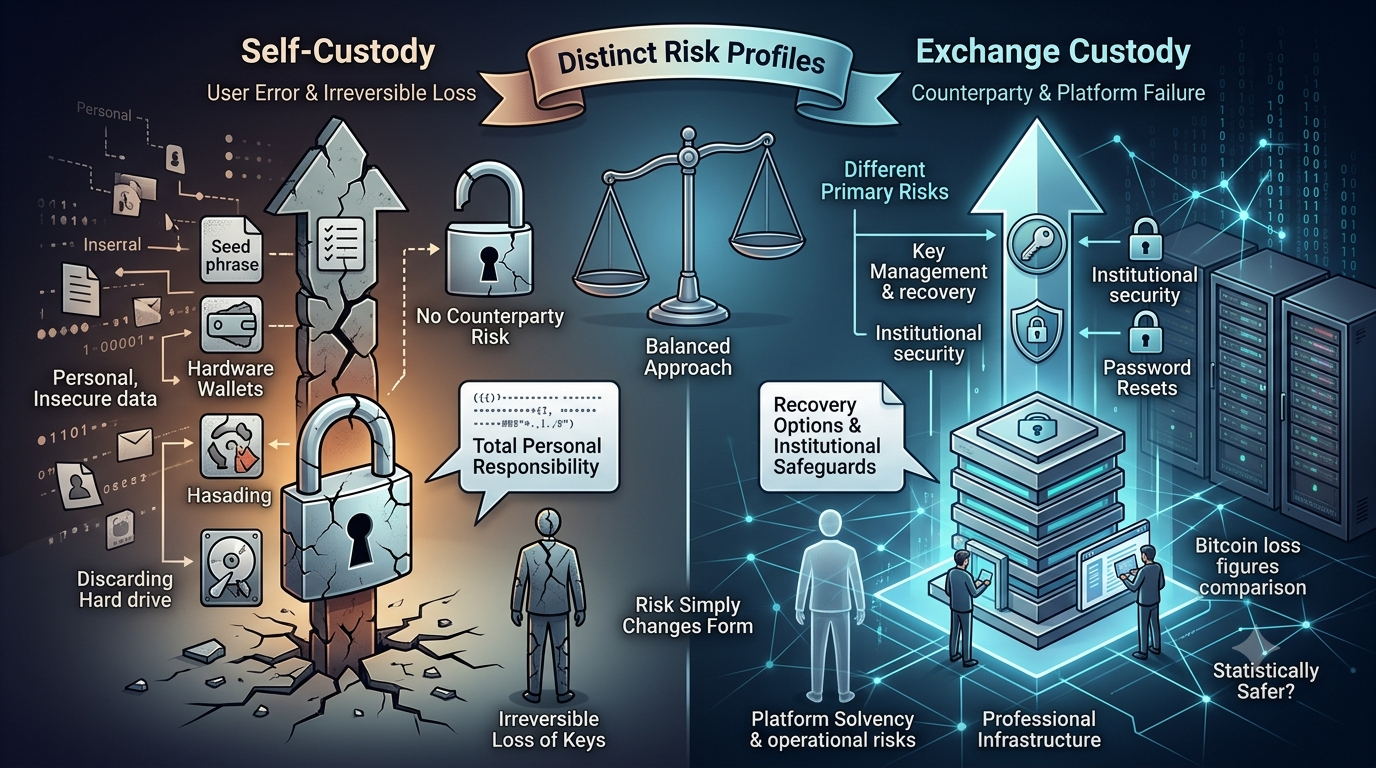
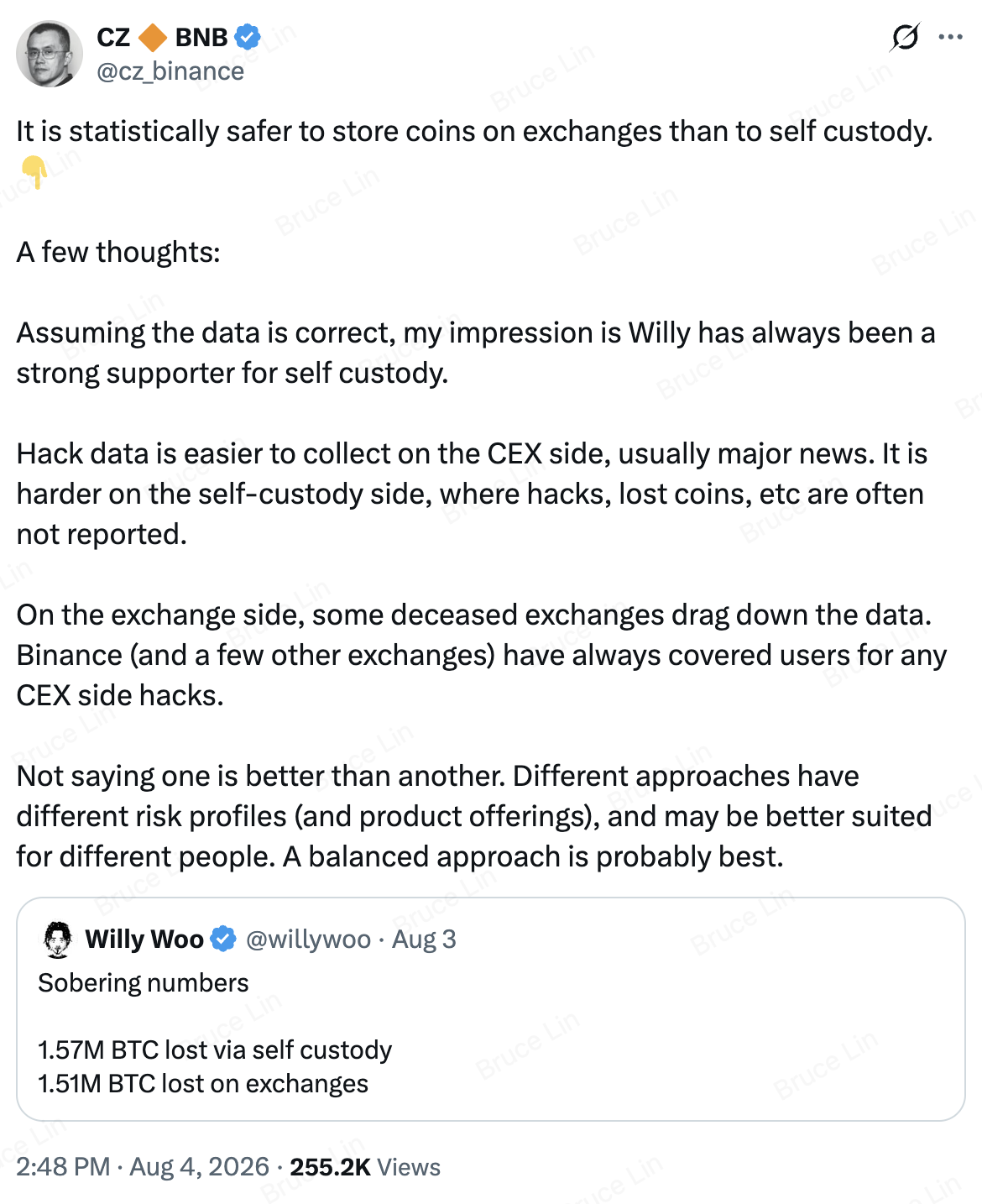
Did you know that roughly 1.57 million Bitcoin may have been permanently lost through self-custody errors while about 1.51 million were lost on exchanges, according to on-chain analyst Willy Woo’s recent figures? Binance founder Changpeng Zhao (CZ) responded that if those numbers hold, exchange custody can appear statistically safer than self-custody for many users. Self-custody versus exchange custody is not a simple contest of which is always better. Each carries distinct risks—user error and irreversible loss on one side, counterparty and platform failure on the other. CZ emphasized data biases, the role of failed exchanges in the statistics, and the value of a balanced approach rather than absolute preference for either model.
This article breaks down the latest data, the real risks of each option, practical factors that decide which fits different users, and how reputable platforms manage custody today.
What Did CZ Actually Say About Self-Custody Versus Exchange Custody?
CZ stated that it is statistically safer to store coins on exchanges than to self-custody, based on Willy Woo’s sobering numbers of 1.57 million BTC lost via self-custody against 1.51 million lost on exchanges. He immediately qualified the claim. Assuming the data is accurate, he noted that Willy Woo has long supported self-custody. Exchange hack data is easier to collect because major incidents make the news. Self-custody losses—lost seed phrases, discarded hard drives, forgotten passwords, or unreported thefts—rarely receive public disclosure and are harder to quantify. Failed or deceased exchanges also pull the exchange-side numbers lower. Major platforms such as Binance have historically covered users for exchange-side hacks.
CZ did not declare one method superior for everyone. Different approaches carry different risk profiles and product offerings. They suit different people. A balanced approach is probably best. This stance aligns with his earlier comments that most users lack the technical discipline for perfect self-custody and that reputable large exchanges with staying power can serve as a practical option alongside self-custody for those who handle seed phrases correctly.
How Do Self-Custody and Exchange Custody Differ in Practice?
Self-custody means the user alone controls the private keys, usually through a hardware wallet, software wallet, or paper backup. Exchange custody means the platform holds the keys and maintains internal account balances; the user interacts with an interface rather than signing on-chain transactions for every move.
Self-custody eliminates counterparty risk. No exchange insolvency, freeze, or internal mismanagement can lock or seize the funds. The trade-off is total personal responsibility. Lose the seed phrase or hardware device without a proper backup and the assets are gone forever. Exchange custody shifts key management and recovery options to the platform. Password resets, support processes, and institutional security infrastructure become available. The cost is exposure to the platform’s operational, security, and solvency risks.
Recent events illustrate both sides. The Coldcard hardware-wallet vulnerability, linked to a firmware issue affecting random-number generation on certain devices, has led to losses estimated around 1,300–1,400 BTC (roughly $88–100 million) across thousands of addresses. Many holders who followed best practices for self-custody still suffered. At the same time, historical exchange failures such as Mt. Gox, QuadrigaCX, and FTX remain clear examples of platform risk.
Neither model removes risk. They relocate it.
What Are the Main Risks of Exchange Custody in 2026?
Exchange custody primarily exposes users to counterparty risk: the chance that the platform is hacked, becomes insolvent, freezes withdrawals, or faces regulatory action that restricts access. Large platforms remain attractive targets because they concentrate assets. Even with improved security practices, multi-signature setups, cold storage, and monitoring, sophisticated attacks or internal failures can occur. Account freezes for compliance reviews or legal orders can temporarily or permanently limit access depending on jurisdiction.
Not every exchange carries equal risk. Platforms with long operating histories, transparent reserves reporting, robust security investments, and a track record of covering user losses in past incidents present lower practical risk than smaller or poorly managed venues. Convenience remains high: instant trading, password recovery, customer support, and inheritance-related features on some platforms reduce the chance of permanent personal lockout.
What Are the Main Risks of Self-Custody?
Self-custody risks center on the individual. Seed phrase loss, device destruction, incorrect backups, phishing of recovery information, and supply-chain or firmware vulnerabilities in hardware wallets can all result in irreversible loss. The recent Coldcard incident shows that even offline devices are not immune if key generation contains weaknesses. Inheritance becomes complicated without careful planning; family members may never recover the assets if no clear process exists.
Successful self-custody requires disciplined practices: durable offline backups (often metal), tested recovery procedures, avoidance of digital storage of seeds, and, for larger amounts, multi-signature or multi-vendor setups. Users who master these steps remove platform risk entirely. Users who treat seed phrases casually face higher personal loss rates than those who keep modest balances on established exchanges.
Who Should Prefer Self-Custody and Who Should Prefer Exchange Custody?
Self-custody suits users with larger long-term holdings, technical comfort, and willingness to maintain rigorous security routines. It is the only way to eliminate counterparty risk completely and to interact directly with decentralized applications. Exchange custody suits active traders who need liquidity and speed, beginners still learning the ecosystem, and anyone who values account recovery and institutional-grade infrastructure over absolute key control. Many experienced holders adopt a hybrid model: keep trading capital on a reputable exchange and move long-term or larger holdings into carefully managed self-custody.
CZ’s balanced recommendation reflects this reality. Different people face different primary risks. Matching the custody method to personal skill, portfolio size, and use case produces better outcomes than following a single slogan.
Should You Trade or Hold Crypto on KuCoin?
KuCoin offers a regulated, security-focused exchange environment designed for both new and experienced users. The platform combines deep liquidity, a wide range of trading pairs, and institutional-grade custody practices that include cold storage, multi-signature controls, and continuous monitoring. Users benefit from account recovery options, customer support, and features that reduce the chance of permanent personal lockout while still enabling fast trading and portfolio management.
For those who prefer not to manage private keys daily, KuCoin provides a practical custody solution backed by operational history and security investment. Active traders can keep working capital on the platform for efficiency and move longer-term holdings elsewhere if desired. Registration is straightforward, and the platform supports both spot and derivatives markets with tools that help users manage risk. Whether you choose full self-custody, exchange custody, or a mix, selecting a platform with transparent practices and strong safeguards forms a core part of responsible crypto ownership. Explore KuCoin’s security features and open an account to experience a balanced approach to custody and trading.
Conclusion
CZ’s recent comments, grounded in Willy Woo’s loss estimates of approximately 1.57 million BTC from self-custody and 1.51 million from exchanges, highlight that exchange custody can appear statistically safer for many users once data biases are considered. Self-custody removes counterparty risk but introduces irreversible personal error risk. Exchange custody provides recovery options and professional infrastructure at the cost of platform dependence.
Neither is universally superior. The better choice depends on the user’s technical ability, holding size, time horizon, and primary concern—losing keys versus trusting a third party. Recent hardware-wallet incidents and historical exchange failures both serve as reminders that risk simply changes form. A balanced strategy that matches custody method to personal circumstances remains the most practical path. Users who understand the trade-offs and apply appropriate safeguards—whether through disciplined self-custody practices or carefully chosen platforms—stand the best chance of protecting their assets over the long term.
FAQs
Is self-custody always riskier than leaving crypto on an exchange?
No. For disciplined users who maintain secure, tested backups and avoid common errors, self-custody eliminates platform failure risk and can be safer overall. For less experienced users, exchange recovery options often reduce the chance of permanent loss.
How accurate are the 1.57 million versus 1.51 million Bitcoin loss figures?
They represent one analyst’s recent compilation. Exact totals are inherently difficult because many self-custody losses go unreported while exchange incidents are more visible. The relative closeness of the numbers is what prompted CZ’s statistical observation.
Can I recover funds if I lose my self-custody seed phrase?
Generally no. Without the seed phrase or a properly configured multi-signature recovery path, the funds are permanently inaccessible. This is the core irreversible risk of self-custody.
Do major exchanges cover users in the event of a hack?
Some large exchanges have historically compensated users for certain security incidents. Coverage policies, insurance arrangements, and proof-of-reserves practices vary by platform and should be reviewed individually.
What is a practical hybrid custody approach?
Keep only the amount needed for active trading on a reputable exchange and move the majority of long-term holdings into well-secured self-custody (preferably hardware with verified backups or multi-signature setups). Adjust the split according to personal risk tolerance and technical comfort.