

How to Mine Monero (XMR) in 2026: A Complete Beginner's Guide to CPU Mining
2026/03/26 17:42:02
When most people think of cryptocurrency mining in 2026, they picture massive, warehouse-sized industrial facilities packed with millions of dollars worth of specialized ASIC hardware. While it is true that mining giants have completely monopolized networks like Bitcoin, there is one major cryptocurrency that remains fiercely loyal to Satoshi Nakamoto’s original decentralized vision of "one CPU, one vote." That cryptocurrency is Monero (XMR).
If you are wondering how to mine Monero from the comfort of your own home, the good news is that the network is intentionally designed to keep everyday users in the game. Thanks to its unique, ASIC-resistant algorithm, anyone with a standard desktop computer or laptop can participate in securing the world’s leading privacy coin.
In this complete beginner’s guide, we will break down exactly how Monero mining works today, the hardware and software you need to get started, and the step-by-step process to earn your first XMR.
Key Takeaways
-
Monero utilizes the RandomX algorithm, which is strictly optimized for everyday computer processors.
-
As of late 2022 and continuing indefinitely through 2026, Monero is in its "Tail Emission" phase.
-
Joining an established Monero mining pool is the only reliable way for beginners to earn consistent, predictable payouts.
-
Setting up your mining operation requires only two main tools: a secure digital wallet and standard mining software, with XMRig remaining the undisputed industry leader.
-
If mining proves too slow or costly for your setup, directly trading or buying XMR on a top-tier exchange is often the most efficient alternative.
What is Monero (XMR) Mining and How Does It Work?
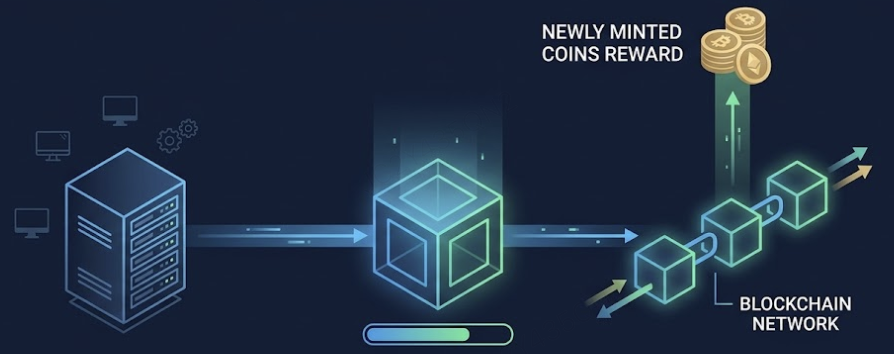
At its core, cryptocurrency mining is the process of using computer hardware to solve complex cryptographic puzzles. By solving these puzzles, miners verify transactions, secure the blockchain network, and in return, are rewarded with newly minted coins. However, the exact mechanics of how Monero achieves this in 2026 is fundamentally different from industry giants like Bitcoin.
To understand how Monero mining works today, you need to understand two critical concepts that define its ecosystem: the RandomX algorithm and Tail Emission.
The RandomX Algorithm
In the early days of crypto, anyone could mine Bitcoin on a laptop. Today, Bitcoin mining is dominated by massive corporations using Application-Specific Integrated Circuits (ASICs), expensive, specialized machines designed to do nothing but mine crypto.
Monero firmly rejects this centralized corporate model. To keep mining accessible to the average person, Monero utilizes a unique Proof-of-Work (PoW) algorithm called RandomX. Introduced to actively resist the development of ASICs, RandomX is engineered to run optimally on standard computer processors (CPUs). It essentially levels the playing field, making extremely expensive graphics cards and specialized ASIC miners highly inefficient. Because of RandomX, the everyday multi-core processor sitting inside your home PC is actually the most powerful and efficient tool for mining XMR.
Tail Emission
If you are starting your mining journey in 2026, you are operating entirely within Monero's Tail Emission phase.
Most cryptocurrencies have a hard-capped supply and periodically cut their mining rewards in half. Monero takes a different approach to ensure long-term network security. Having reached its initial supply curve in late 2022, Monero's block reward will never drop to zero. Instead, it is permanently fixed at 0.6 XMR per block.
With a new block discovered approximately every two minutes, this continuous tail emission guarantees that CPU miners around the world will always have a predictable financial incentive to keep their computers running and the privacy network secure.
The Basic Workflow
When you turn on your mining software, your computer's CPU joins the global network. It begins guessing random strings of numbers to solve the current block's cryptographic puzzle. When the puzzle is solved and transactions are verified, the 0.6 XMR reward is distributed to the miners who contributed their computing power.
Solo Mining vs. Pool Mining: Which is Best for XMR?
Once you understand the mechanics of the RandomX algorithm, the next major decision you must make is how you want to connect your hardware to the network. Every beginner faces the classic cryptocurrency crossroads: should you mine entirely on your own, or should you team up with others?

To determine the best path for your hardware, let's break down the mechanics and realistic expectations of both methods in 2026.
Solo Mining
Solo mining is exactly what it sounds like. Your computer connects directly to the Monero blockchain and attempts to solve cryptographic puzzles entirely on its own.
-
The Pros: If your CPU successfully solves a block, you keep the entire 0.6 XMR block reward, plus all associated transaction fees. You do not have to pay a percentage to a pool operator.
-
The Cons: In 2026, the global hash rate (total computing power) of the Monero network is massive. Competing against millions of other CPUs with just a single home computer is mathematically similar to buying a lottery ticket. Depending on your processor, it could literally take years, or even decades, of running your PC 24/7 before you successfully mine a single block.
Pool Mining
Because solo mining is highly impractical for everyday users, the vast majority of miners utilize Pool Mining. A mining pool is a network of thousands of individual miners who combine their computing power into one massive entity.
-
How it Works: When the pool successfully mines a block, the 0.6 XMR reward is split among all participants based on the amount of computing power (hash rate) they contributed to the effort.
-
The Pros: Pool mining provides consistent, predictable payouts. Instead of waiting years for a massive payout that may never come, you earn tiny fractions of Monero every single day or week.
-
The Cons: Traditional mining pools usually charge a small fee (typically 1% to 2%) for maintaining the server infrastructure.
Which is Best?
For 99% of beginners and everyday home computer users, Pool Mining is the only logical choice. It guarantees that your hardware's effort translates into actual, measurable earnings.
Furthermore, the Monero ecosystem in 2026 highly encourages the use of P2Pool (Peer-to-Peer Pool). Unlike traditional centralized pools, P2Pool is completely decentralized, meaning it charges 0% fees, pays out instantly, and prevents any single corporate pool from gaining too much control over the Monero network.
If you want to support privacy while actually seeing XMR hit your wallet, joining a pool is your first essential step.
Can You Still Mine Monero on a PC?
Because the RandomX algorithm is aggressively ASIC-resistant and heavily penalizes graphics cards (GPUs), you do not need to spend thousands of dollars on a flashy multi-GPU mining rig. Instead, the profitability and efficiency of your Monero mining operation relies almost entirely on the brain of your computer: the Central Processing Unit (CPU).
If you are evaluating your current desktop or planning to build a dedicated Monero mining rig in 2026, here are the critical hardware components you need to focus on:
The CPU
While Intel processors are perfectly capable of mining XMR, the undisputed champions of the RandomX algorithm are AMD Ryzen processors.
The secret to Monero mining lies in the CPU's L3 Cache. RandomX requires exactly 2MB of L3 cache per mining thread to operate at peak efficiency. AMD processors, particularly the Ryzen 9 series and the enterprise-grade Threadripper series, are famous for packing massive amounts of L3 cache alongside high core counts. If your processor has 32MB of L3 cache, it can efficiently run 16 mining threads simultaneously. The more threads you can run, the higher your hash rate (mining speed).
RAM (Memory)
Your CPU cannot mine efficiently if it cannot access data quickly. For RandomX, your system's Random Access Memory (RAM) acts as the highway feeding information to the processor.
-
Capacity: You do not need a massive amount of RAM; 8GB to 16GB is more than enough for a dedicated mining rig.
-
Speed and Latency: You need fast RAM with low latency. Modern DDR4 or DDR5 memory kits with tight timings will significantly boost your CPU's hash rate.
-
Dual-Channel Mode: This is non-negotiable. You must install your RAM in pairs (e.g., two 8GB sticks instead of one 16GB stick) to utilize dual-channel memory bandwidth. Failing to do this can cripple your mining performance by up to 50%.
Cooling and Power Supply
Mining Monero will push your CPU to 100% utilization, 24 hours a day, 7 days a week. This generates an enormous amount of heat.
-
Cooling: Do not rely on the stock cooler that came in the CPU box. You must invest in a high-end aftermarket air cooler (like a Noctua NH-D15) or a robust All-in-One (AIO) liquid cooler to prevent thermal throttling and protect your hardware from degrading.
-
Power Supply (PSU): Because you are not running multiple high-draw GPUs, your overall power consumption will be relatively low. A high-quality, Gold or Platinum-rated 500W to 750W PSU is usually more than sufficient to run a dedicated CPU mining rig safely and efficiently.
Ultimately, if you have a modern desktop computer with a decent multi-core processor and adequate cooling, you already have everything you need to start mining Monero today.
Best Monero Mining Software and Wallets for 2026
Before your processor can start solving cryptographic puzzles, you need the right software stack. Setting up a Monero mining operation requires two distinct pieces of software: a secure digital wallet to receive your payouts and a mining program to actually execute the RandomX algorithm.
To ensure maximum security and efficiency in 2026, here are the industry-standard tools you should use:
The Best Monero Wallets
Before you configure your miner, you must generate a Monero address to receive your mining rewards. Because Monero is a privacy coin, you cannot simply mine directly to a centralized exchange address without facing potential compatibility or regulatory issues. You need a private, non-custodial wallet.
-
Monero GUI Wallet (Desktop): This is the official wallet developed by the core Monero team. It is the gold standard for security. For beginners, it features a "Simple Mode" that allows you to use the wallet without downloading the entire massive Monero blockchain. It is available for Windows, macOS, and Linux.
-
Cake Wallet (Mobile): If you prefer managing your crypto on your phone, Cake Wallet is the most trusted open-source mobile wallet in the XMR community. It is available on iOS and Android, features a beautiful user interface, and allows you to easily copy your Monero address to paste into your mining setup.
The Best Monero Mining Software
While there were several competing mining programs in the past, the landscape in 2026 is incredibly straightforward. There is one undisputed king of Monero CPU mining:
-
XMRig: XMRig is an open-source, highly optimized CPU miner. It is universally considered the best and most efficient software for the RandomX algorithm. It is actively updated, completely free to use, and extracts the absolute maximum hash rate out of AMD and Intel processors.
While XMRig is a command-line interface tool, it is surprisingly easy to use. The XMRig website even features an intuitive "Configuration Wizard" that generates the exact line of code you need to start mining instantly.
With your wallet address copied and XMRig downloaded to your computer, you are now fully equipped to join a pool and start earning.
How to Start Mining Monero Today:Step-by-Step Guide:
Step 1: Generate Your Receive Address
Open your chosen wallet and navigate to the "Receive" tab. Here, you will find your public Monero address. Copy this address to your clipboard; this is exactly where the mining pool will send your earned XMR.
Step 2: Download XMRig and Set Antivirus Exclusions
Navigate to the official XMRig website or their verified GitHub page to download the latest release for your operating system.
-
Crucial Tip: Almost all antivirus programs (including Windows Defender) will instantly flag XMRig as a virus and delete it. This is a false positive. Because malicious hackers often hide mining software inside computer viruses to steal processing power, antivirus scanners block all mining code by default. To fix this, create a new empty folder, tell your antivirus to "exclude" or "ignore" that specific folder, and extract the XMRig files directly into it.
Step 3: Choose a Mining Pool and Configure Your Setup
To connect your computer to a pool, you need to tell XMRig where to send its computing power. The easiest way to do this in 2026 is by using the XMRig Configuration Wizard found on their official website.
-
Click on the "Wizard" tab.
-
Select "Add Pool" and choose a reputable pool (or select a custom decentralized pool like P2Pool).
-
Paste the Monero wallet address you copied in Step 1.
-
The wizard will automatically generate a command-line string or a downloadable
config.jsonfile.
Step 4: Update the Configuration File
If you downloaded the
config.json file from the wizard, simply drag and drop it into your excluded XMRig folder, replacing the default file that is already there. Alternatively, you can right-click the start.bat (Windows) file, select "Edit," and paste the command line generated by the wizard, ensuring your wallet address is clearly visible in the text.Step 5: Run as Administrator
This is the most important step for maximizing your profitability. Do not just double-click the program. Right-click the XMRig executable (or your
start.bat file) and select "Run as Administrator." Running the miner with administrator privileges allows XMRig to enable a feature called "Huge Pages". This allows your CPU to access its memory much faster, instantly boosting your hash rate by up to 30% to 50%.Once the black command-prompt window opens and you see green text indicating "accepted shares," congratulations, your computer is now successfully mining Monero!
Is Monero Mining Profitable?
Now that your computer is successfully running the RandomX algorithm, the ultimate question remains: is Monero mining actually profitable in 2026? The honest answer is that while Monero mining is incredibly accessible, it is not a get-rich-quick scheme. For the average user, profitability is determined by a strict mathematical formula: your CPU's hash rate minus your local electricity costs.
The Reality of Home Mining
If you are running a top-tier AMD Ryzen 9 processor and live in an area with extremely cheap electricity, you can generate a modest passive income. However, if you are using an average laptop or an older Intel processor in a region with high energy costs, your electricity bill will likely exceed the value of the XMR you mine.
For many in the Monero community, CPU mining is less about immediate financial profit and more about ideological support, contributing hash rate to secure the world's leading decentralized privacy network.
The Better Alternative: Trading XMR Directly
If you have run a Monero mining calculator and realized that your hardware will only yield a few fractions of a coin per month, there is a much faster and more efficient way to gain exposure to the asset. Instead of leaving your computer running at 100% capacity 24/7, putting wear and tear on your hardware, you can acquire Monero instantly on a globally trusted exchange.
For investors who want to capitalize on Monero's price movements without the hassle of configuring software and monitoring hardware temperatures, utilizing a highly liquid platform like KuCoin is the optimal strategy.
-
Spot Trading: If you already hold stablecoins like USDT, you can bypass the mining process entirely and execute trades instantly on the highly liquid KuCoin XMR/USDT spot market. This allows you to accumulate Monero at your target price through strategic limit orders.
-
Direct Purchase: If you are starting with fiat currency, you can easily use KuCoin's fiat gateways to directly buy crypto using a credit card, debit card, or bank transfer, and then seamlessly swap it for XMR.
Ultimately, whether you choose to support the network through CPU mining or build your portfolio through direct trading on KuCoin, Monero remains one of the most fundamentally unique and resilient digital assets in the 2026 cryptocurrency landscape.
Conclusion
Mining Monero in 2026 remains one of the most accessible entry points into the cryptocurrency world. Thanks to the ASIC-resistant RandomX algorithm and the perpetual Tail Emission, anyone with a standard home CPU can actively contribute to securing the world's leading privacy network. While solo mining has become a cryptographic lottery, joining a decentralized pool and utilizing optimized software like XMRig ensures consistent, predictable rewards. However, if you find that your local electricity costs outweigh your hardware's profitability, buying and trading XMR directly on secure platforms like KuCoin is a highly efficient alternative.
FAQs
Can I mine Monero on my smartphone?
Technically, yes. There are Android apps available that can run the RandomX algorithm. However, it is highly discouraged. Smartphones lack the cooling infrastructure required to handle continuous 100% CPU utilization. Mining on a phone will rapidly overheat the device, severely degrade your battery health, and potentially destroy your phone, all for just a few pennies worth of XMR per month.
How long does it take to mine 1 XMR?
This depends entirely on your CPU's hash rate and your mining uptime. For an average home computer, it could theoretically take over a year of continuous 24/7 solo mining to accumulate a full 1 XMR. This is exactly why beginners are encouraged to use pool mining, where you receive fractional payouts on a regular daily or weekly basis instead of waiting for a whole coin.
Do I need an expensive GPU to mine Monero?
No. Monero specifically designed its RandomX algorithm to be heavily ASIC and GPU-resistant. Buying an expensive graphics card for XMR mining is a waste of money, as a high-end AMD CPU will vastly outperform a top-tier GPU in terms of both mining efficiency and hash rate.
Is Monero mining legal?
In the vast majority of countries, mining Monero is perfectly legal, just like mining Bitcoin or Ethereum. However, because XMR is a privacy coin, certain jurisdictions with extremely strict cryptocurrency bans or specific privacy-coin regulations may restrict its use or trade. Always verify your local financial and cryptocurrency laws before starting a dedicated mining operation.
What is the best CPU for Monero mining in 2026?
The AMD Ryzen 9 series and AMD Threadripper processors are currently the undisputed champions of Monero mining. Their massive L3 cache sizes and high multi-core performance make them incredibly efficient and profitable when running the RandomX algorithm.