

How Does a 19-Month High in the US Dollar Index Affect Cryptocurrency Markets?
Introduction
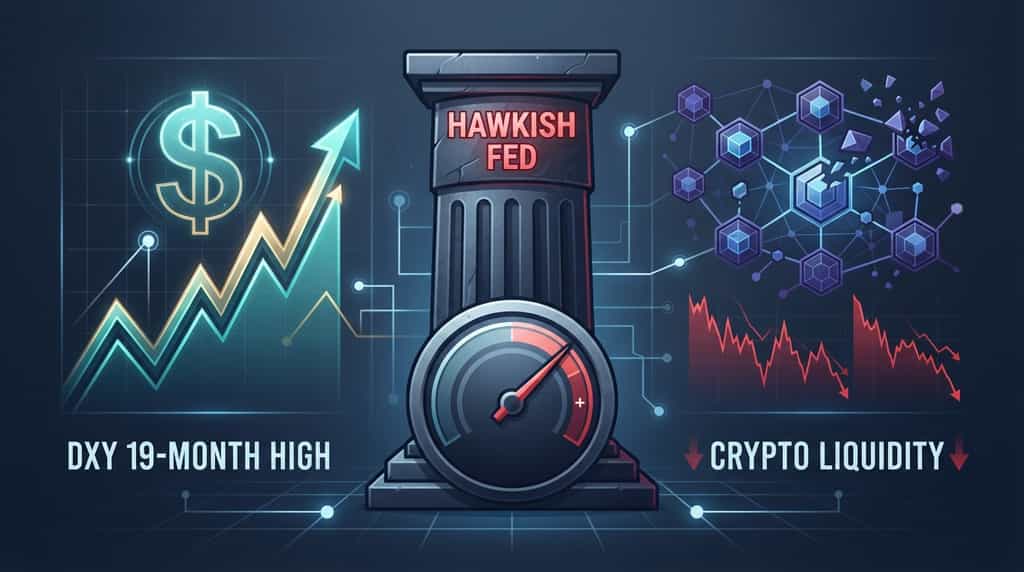
A fresh 19-month high in the US Dollar Index (DXY) — reported on November 19, 2026 alongside a hawkish Federal Reserve undertone — generally tightens global liquidity conditions and creates downward or volatile pressure on US dollar-priced digital assets such as Bitcoin. When the US dollar strengthens against a basket of major foreign currencies, dollar-denominated risk assets often face headwinds as borrowing costs stay elevated, cash yields remain competitive, and cross-border liquidity becomes more selective.
Whether cryptocurrency markets fall immediately or diverge depends on several factors, including interest rate expectations, sovereign bond yields, institutional ETF flows, and whether dollar strength reflects resilient US economic growth or restrictive monetary policy. A rising DXY does not guarantee a prolonged crypto downturn on its own, nor does it affect every token identically, because digital assets respond to both macroeconomic liquidity and crypto-native catalysts.
Key Takeaways
A surge in the US Dollar Index to a 19-month high signals firmer demand for the US dollar amid hawkish Federal Reserve expectations, which typically acts as a headwind for liquidity-sensitive assets like cryptocurrencies.
-
Liquidity tightening is the primary transmission channel: Higher policy rate expectations and firm US yields raise the opportunity cost of holding non-yielding assets such as Bitcoin, while tightening dollar funding across global markets.
-
Correlation is regime-dependent, not fixed: Cryptocurrencies often exhibit an inverse relationship with the US dollar during inflation or interest-rate shocks, yet periods of strong US economic expansion or spot ETF demand can temporarily offset dollar headwinds.
-
Altcoins usually experience higher beta than Bitcoin: When dollar liquidity tightens, capital tends to concentrate in larger, more liquid assets or stablecoins rather than smaller, higher-risk digital assets.
-
Policy signals matter alongside spot index levels: Markets react not only to the DXY reaching a 19-month high on November 19, 2026, but also to incoming inflation and labor data that shape how long a hawkish Federal Reserve stance persists.
What Is the US Dollar Index (DXY) and Why Does a 19-Month High Matter?
The US Dollar Index (DXY) is a trade-weighted index that measures the value of the US dollar against a basket of six major foreign currencies: the euro, Japanese yen, British pound, Canadian dollar, Swedish krona, and Swiss franc. Reaching a 19-month high indicates that the US dollar has climbed to its strongest level relative to those major peer currencies since early spring 2025, reflecting broad currency momentum rather than a brief intraday fluctuation.
A multi-month high in the DXY matters to financial markets because the US dollar serves as the primary global funding currency, reserve asset, and benchmark pricing unit for international trade and digital asset liquidity. As reported on November 19, 2026, the move to a 19-month high coincided with a hawkish Federal Reserve undertone, signaling that policymakers are maintaining a cautious or restrictive posture toward inflation and interest rate cuts.
When market participants price in a more hawkish Federal Reserve, short-term and intermediate US interest rate expectations typically firm up. That shift strengthens the dollar against foreign currencies whose central banks are cutting rates faster, growing more slowly, or facing weaker domestic demand. For global investors, a stronger DXY changes both currency translation values and broader financial conditions across equities, commodities, sovereign debt, and digital assets.
How Does a Hawkish Federal Reserve Transmit Dollar Strength to Crypto?
A hawkish Federal Reserve undertone strengthens the US dollar by keeping interest rate expectations elevated, which in turn tightens financial conditions and increases competition for global capital against cryptocurrencies. Rather than affecting blockchain code directly, monetary policy and dollar strength influence digital assets through interest rates, liquidity, and investor risk appetite.
Interest Rates and Opportunity Cost
Cryptocurrencies such as Bitcoin do not pay interest, dividends, or coupon yields. When hawkish Federal Reserve commentary keeps policy rates higher for longer or pushes Treasury yields higher, holding cash equivalents or short-duration government debt becomes comparatively more attractive on a risk-adjusted basis. Investors evaluating where to park capital may require higher expected returns from volatile assets like digital assets to justify holding them.
Global Dollar Liquidity and Risk Appetite
The US dollar underpins much of global wholesale funding, cross-border credit, and leveraged trading liquidity. When a hawkish central bank stance drives the DXY to a 19-month high, financial conditions tend to tighten at the margin, prompting leveraged traders to reduce risk exposure and institutions to trim high-beta allocations. Because digital asset markets operate 24/7 and often rely on margin or derivatives liquidity, shifts in dollar funding can quickly show up in spot price swings and funding rates.
| Transmission Channel | What Happens During a Hawkish Dollar Surge | Potential Impact on Digital Assets |
| Interest Rate Expectations | Markets price in higher or longer-held policy rates | Increases opportunity cost of holding non-yielding crypto assets |
| Sovereign Yields | Benchmark bond yields adjust to inflation and policy signals | Competes with risk assets for institutional and treasury allocations |
| Global Liquidity | Dollar funding conditions become more selective | Can weigh on leverage, market depth, and speculative risk appetite |
| Foreign Exchange Dynamics | Major currencies weaken against the USD basket | Alters local-currency purchasing power and cross-border flows |
Why Do Cryptocurrencies Sometimes Diverge From the US Dollar Index?
Cryptocurrencies do not move in lockstep with the US Dollar Index because digital assets are shaped by structural adoption, on-chain activity, and market-specific catalysts alongside macroeconomic forces. While a 19-month high in the DXY often pressures risk assets, an inverse correlation is a tendency rather than an ironclad law of physics.
One major source of divergence is the reason behind the dollar's rise. If the DXY climbs because US inflation remains sticky and forces tighter monetary policy, the resulting rate pressure can weigh on valuations across growth stocks and cryptocurrencies. Conversely, if US economic growth is robust and corporate earnings are expanding, strong risk appetite or institutional inflows into regulated crypto products can partially cushion or temporarily decouple digital assets from currency fluctuations.
Crypto-specific developments can also dominate short-term price action. Protocol upgrades, exchange liquidity shifts, regulatory milestones, ETF net inflows or outflows, and large liquidations in derivatives markets frequently drive sharp moves even on days when the DXY is steady or rising. Analysts tracking crypto market behavior therefore treat the DXY as a macro liquidity barometer rather than a standalone trading signal.
What Should Market Observers Watch When the DXY Hits a Multi-Month High?
When the DXY reaches a 19-month high on November 19, 2026, observers typically monitor macroeconomic data releases, rate expectations, and market liquidity indicators to judge whether dollar strength is likely to persist or consolidate. Looking at multiple indicators provides clearer context than watching the index level in isolation.
-
Federal Reserve communication and rate pricing: Track official policy statements, speeches, and interest rate futures to see whether markets expect rates to stay restrictive longer or pivot toward easing. Primary policy releases are published directly by the Federal Reserve Board, which provides official monetary policy statements and economic projections.
-
Inflation and labor market reports: Consumer price data, producer inflation, and employment figures heavily influence how hawkish policymakers sound. Stronger-than-expected inflation or resilient labor data tends to reinforce dollar strength, whereas cooling data can relieve rate pressure.
-
Treasury yields and real rates: Watch benchmark US government bond yields and inflation-adjusted real yields, which directly affect discount rates and the appeal of interest-bearing instruments relative to non-yielding assets.
-
Spot and derivatives market liquidity: Observe order-book depth, spot trading volumes, perpetual futures funding rates, and open interest across major venues. On platforms such as KuCoin, market participants commonly review real-time spot order books, historical price charts, and market data feeds to gauge liquidity and volatility around macro headlines.
-
Cross-asset confirmation: Compare Bitcoin and major altcoins against US equity indices and gold to see whether market stress is broad-based across risk assets or concentrated in specific sectors.
Conclusion
A 19-month high in the US Dollar Index alongside a hawkish Federal Reserve undertone, as observed on November 19, 2026, generally introduces tighter liquidity conditions and a stiffer macroeconomic backdrop for cryptocurrencies. Higher rate expectations raise the opportunity cost of holding non-yielding digital assets and can encourage more cautious positioning across leveraged and higher-beta markets.
At the same time, the relationship between the DXY and cryptocurrency prices is conditional rather than mechanical. Strong institutional demand, crypto-native catalysts, or shifts in economic growth expectations can cause digital assets to react unevenly or diverge from currency trends over time. Understanding both the macroeconomic transmission channels and market-specific drivers helps observers interpret price action more objectively without relying on single-indicator assumptions.
FAQs
Does a rising US Dollar Index always cause Bitcoin to fall?
No, a rising US Dollar Index does not always cause Bitcoin to fall. While a stronger dollar often creates liquidity headwinds for risk assets, Bitcoin can still rise or trade sideways if offset by strong institutional demand, positive market catalysts, or shifts in risk sentiment.
How does a hawkish Federal Reserve affect altcoins compared with Bitcoin?
Altcoins generally carry higher volatility and lower liquidity than Bitcoin, so tightening dollar conditions often affect them more sharply. During periods of macro caution, capital frequently favors larger, more liquid assets or stablecoins before returning to smaller digital assets.
What currencies make up the US Dollar Index (DXY)?
The US Dollar Index tracks the US dollar against six currencies: the euro, Japanese yen, British pound, Canadian dollar, Swedish krona, and Swiss franc. Because the euro carries the largest weight in the index, developments in the eurozone and European Central Bank policy heavily influence DXY movements.
Why do interest rate expectations matter to cryptocurrency holders?
Interest rate expectations shape yields on cash and government bonds as well as overall borrowing costs in the economy. When expected yields rise, holding assets that generate no yield becomes comparatively less attractive unless investors anticipate strong capital appreciation.
Can crypto traders rely solely on the DXY to predict short-term price moves?
No, relying solely on the DXY is insufficient for predicting short-term cryptocurrency prices. Short-term crypto moves are also driven by derivatives positioning, liquidity shocks, regulatory news, and asset-specific events that can override broader currency trends.
Disclaimer
This general market information, possibly from third-party, commercial, or sponsored sources, is provided for reference and educational purposes only and does not constitute financial or investment advice, an offer, solicitation, or guarantee. We disclaim liability for its accuracy, completeness, reliability, and any resulting losses. Investments/trading are risky; past performance doesn’t guarantee future results. Users should research, judge prudently, and take full responsibility. For further details, please consult KuCoin’s Terms of Use and Risk Disclosure.