

Sam Altman Says GPT-6 Astra Gives Founders “Genius-Level Employees”: The Revenge of the Idea Guy
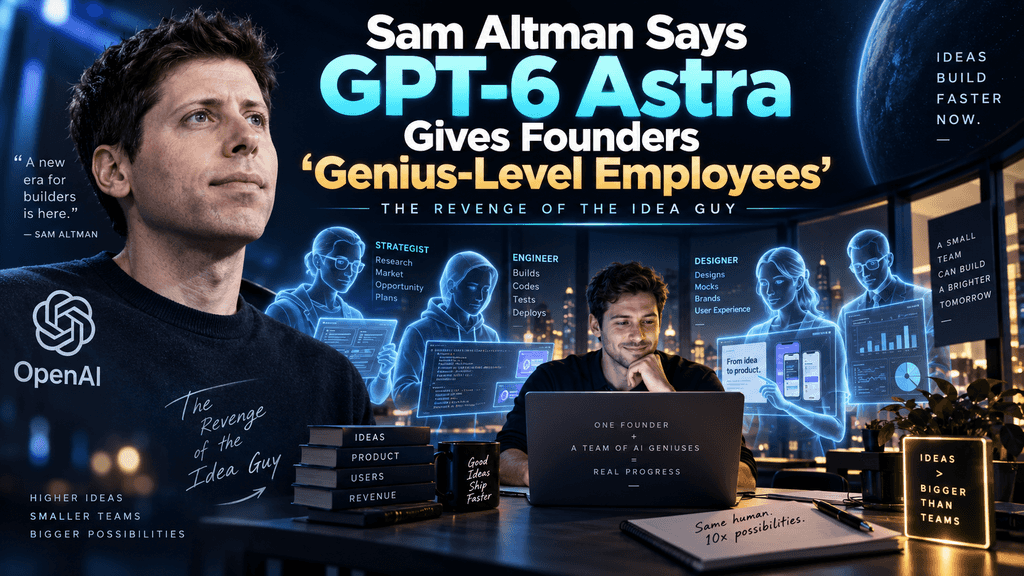
For years, Silicon Valley treated the “idea guy” as a joke. Having a clever startup concept meant little if you could not write the code, recruit engineers or raise enough money to build the product. Sam Altman now believes artificial intelligence is starting to change that equation.
Following the release of GPT-6 Astra, Altman argued that would-be founders increasingly have access to something like “genius-level employees in every area of expertise.” He also revived a phrase he used earlier in 2026: the “revenge of the idea guys.”
The point is bigger than one new AI model. AI is reducing the cost of research, coding, design and other forms of execution that once required entire teams. As that happens, the scarce resource in startups may shift from the ability to build software toward the ability to choose the right problem, understand users and reach customers. That could reshape not only who can become a founder, but also what kinds of businesses are worth building.
What Does “Genius-Level Employees” Really Mean?
Altman's description should not be interpreted literally. GPT-6 Astra is not the same as hiring a group of world-class engineers, designers, researchers and operators who can independently run a company. Instead, the phrase captures how dramatically the cost of accessing different types of expertise is falling.
A founder can now use the same AI system to research a market, analyze competitors, write and debug code, draft product documentation, create marketing material and help automate repetitive business tasks. The important change is not that every task becomes perfect or fully autonomous. It is that one person can attempt far more work without immediately hiring specialists for every function.
That matters because startups are usually constrained by resources long before they are constrained by ideas. A founder may know exactly what customers need but lack the money or technical ability to build it. More capable AI narrows that gap. The question increasingly becomes less “Can I assemble a team capable of testing this idea?” and more “Is this idea worth testing at all?”
GPT-6 Astra Changes the Economics of Building
The most important effect of advanced AI on startups may be economic rather than technological. Building a software company traditionally requires significant upfront investment before the first customer pays anything. Product research, engineering, design, testing and deployment all consume time and money, which means many potentially useful ideas are never tested.
AI lowers some of those fixed costs. A founder can move from concept to prototype much faster, test multiple versions of a product and discard weak ideas without spending months assembling a team. Altman recently highlighted an example of an entrepreneur who reportedly used an earlier GPT model to build a niche software product and reached roughly 50 customers paying about $500 per month. The business did not need millions of users to become meaningful because the cost of creating it was relatively low.
That illustrates a broader shift. AI does not simply help entrepreneurs build the same companies faster. It can make entirely new categories of business economically possible. A software idea that once needed $500,000 of development work might not make sense for a market worth only $200,000 a year. If the same idea can now be tested for a fraction of that cost, the market suddenly becomes interesting.
Why the “Idea Guy” Is Making a Comeback
The “idea guy” became a Silicon Valley stereotype because ideas were easy while execution was hard. Someone could claim to have the next great app, but unless that person could recruit technical talent or build the product personally, the idea rarely mattered. Investors therefore tended to favor founders who could turn concepts into working software themselves.
Altman's “revenge of the idea guys” argument suggests that this hierarchy may be changing. A founder with unusually deep knowledge of a customer problem can now use AI to compensate for some missing technical execution. That does not make engineering skill irrelevant. Complex systems still require expertise, and strong technical founders may become even more productive when they also use AI. The difference is that coding ability is becoming less of an absolute barrier to entry.
This could expand the definition of a strong technology founder. Someone who has spent 15 years inside logistics, healthcare, accounting or manufacturing may understand a valuable workflow better than an excellent programmer does. In the past, that person still needed a technical co-founder before testing the idea. In an AI-native startup environment, domain knowledge and user insight can become enough to reach a prototype, attract early customers and prove whether the opportunity is real.
AI Makes Smaller Markets Worth Building For
One of the least discussed consequences of cheaper software development is that smaller markets become more valuable. Traditional SaaS economics reward products that can serve large numbers of customers because engineering and operating costs are relatively high. A product aimed at only a few hundred businesses may never generate enough revenue to support a conventional startup team.
AI can change that calculation. Software designed specifically for independent dental clinics, regional freight operators, specialist accountants or a narrow compliance workflow may become profitable even if the total addressable market is small. A founder does not necessarily need a massive organization if AI can handle parts of research, development, onboarding, documentation and support.
This could create a much larger market for micro-SaaS and highly specialized digital businesses. Instead of every startup trying to become the next Salesforce, thousands of small companies could serve very specific customer groups. The same logic applies beyond business software. Niche games, creative tools, educational products and professional applications that would once have been too expensive to develop may become commercially viable.
The result could be an expansion of what Altman describes as the economically viable idea space. AI does not necessarily make every idea good. It simply reduces the minimum market size required for some ideas to become businesses.
One-Person Startups Could Become More Powerful
This shift also changes the size of the team needed to start a company. The internet already allowed one person to reach customers around the world. AI increasingly allows that same person to perform work that once required several different employees.
A founder might use AI to research a market in the morning, modify the product in the afternoon and prepare customer outreach in the evening. As AI agents become better at carrying out longer workflows, some tasks can move from simple assistance toward partial execution. This does not mean the founder disappears from the process. It means the founder can operate with much more leverage.
The most realistic near-term outcome is probably not a billion-dollar company permanently run by one person. It is the growth of one-person and very small startups that reach meaningful revenue before hiring traditional teams. Companies may also raise money later because they no longer need a large engineering organization just to discover whether customers want the product.
This could affect venture capital as well. If founders can reach a working product and early revenue with less capital, investors may increasingly fund proven distribution and growth rather than financing the initial act of building software. Bootstrapping could become viable for a larger number of technology businesses.
If Everyone Can Build, What Makes a Founder Valuable?
The easier it becomes to create software, the less defensible software creation alone becomes. If one founder can use AI to build a product in days, a competitor may be able to do the same. AI therefore lowers barriers to entry for entrepreneurs while simultaneously lowering barriers to entry for their competitors.
That makes judgment increasingly valuable. AI can generate dozens of product ideas, features and marketing strategies, but someone still has to decide which problems are worth solving. Deep knowledge of customers becomes more important because the founder who understands a market best is more likely to identify problems that customers will actually pay to fix. Taste also matters when technical possibilities become nearly unlimited. Being able to build everything makes choosing what not to build more important.
Distribution may become the biggest bottleneck of all. Building software can become cheaper without making customer attention cheaper. If hundreds of similar AI-generated products enter a market, trust, brand, community, partnerships and sales relationships become stronger competitive advantages. The future founder may therefore spend less time proving that a product can technically exist and more time proving why customers should choose it.
The “revenge of the idea guy” is not really the revenge of someone who merely has ideas. It is the rise of founders who combine strong ideas with user insight, judgment and distribution.
Why AI Still Cannot Run the Whole Company
There are important limits to Altman's “genius-level employees” thesis. AI models can still misunderstand instructions, produce incorrect conclusions and create software with bugs or security weaknesses. The more responsibility an AI agent receives, the more important monitoring and human verification become.
Startups also involve many problems that intelligence alone does not solve. A model can help create a sales strategy, but it cannot guarantee that customers trust a new company. It can draft contracts, but it cannot remove legal responsibility. It can analyze a market, but it cannot guarantee product-market fit. Leadership, negotiation, accountability and long-term customer relationships remain deeply human parts of running a business.
There is also a competitive paradox. When sophisticated AI becomes available to almost everyone, access to the technology itself becomes less of a moat. A founder cannot assume that using GPT-6 Astra creates a durable advantage if every rival has access to comparable tools. The competitive advantage increasingly comes from what the founder knows, what proprietary information the company develops, how quickly it learns and whether customers choose to stay.
Cheap intelligence can reduce the cost of starting a company. It cannot make a weak business good.
What AI Means for the Future of Startups
The long-term impact of models such as GPT-6 Astra may be less about replacing startup employees than changing when companies need employees and what those employees do. Founders can test ideas with smaller teams, specialists can become dramatically more productive and companies may reach revenue before building large organizations.
That could produce far more experimentation. Lower startup costs mean more founders can test ideas, more niche markets can support specialized products and more businesses can survive without chasing venture-scale outcomes. Entrepreneurship may become accessible to people whose biggest advantage is not technical skill but deep knowledge of a customer or industry.
At the same time, success could become harder to sustain. More founders means more products competing for the same attention. When execution becomes abundant, differentiation becomes scarce.
That is the deeper meaning behind the “revenge of the idea guy.” AI does not suddenly make ideas more valuable by themselves. It changes the economics around execution until insight, judgment and distribution become more important parts of the founder's advantage.
🔥 Beyond the Headlines: What KuCoin 5.0 Means for You
Market news moves fast — but where you act on it matters just as much. This October, KuCoin launches KuCoin 5.0, transforming KuCoin into a rebuilt platform. Here's what actually changes for you:
-
One account for everything. Older platforms split your money across separate "spot," "margin," and "futures" accounts and expected you to understand why. KuCoin 5.0's unified account removes that entirely — deposit once, and everything is simply there.
-
Stocks, indices, and commodities. KuCoin 5.0 expands beyond crypto into global markets. When crypto chops sideways and equities rally (or the reverse), you rotate in minutes instead of opening a brokerage account and waiting days for fiat rails.
-
Real-world assets (RWA). Tokenized exposure to traditional assets like commodities, right inside your crypto account. One of the fastest-growing segments in global finance is no longer reserved for institutions — you access it from the same balance you trade with.
-
Earn while you learn. Not ready to trade? KCUSD lets your stablecoins earn daily, auto-compounding interest. The lowest-stress way to put your idle deposit to work for 4% yield.
-
An AI assistant in plain language. Ask questions, get market context, understand what you're looking at — built into the platform, no jargon required.
-
An app that doesn't overwhelm. Faster, cleaner, and consistent — intuitive from the first tap, not after a tutorial.
-
Safety you can check, not just trust. A MiCAR-licensed EU entity, Proof of Reserves you can verify yourself, and internationally certified security (SOC 2 Type II, ISO 27001:2022).
Create your account in minutes — and start on the platform built for where crypto is going, not where it's been.
FAQs
Can a non-technical founder build a startup with GPT-6 Astra?
Yes, AI can significantly reduce the technical barrier to creating prototypes and early products. However, complex production systems may still require experienced engineers for architecture, security, reliability and ongoing maintenance.
Will AI make venture capital less important?
It may reduce the amount of capital some startups need before reaching product-market fit. Venture funding will still matter for companies that require rapid expansion, expensive infrastructure, regulated operations or large-scale customer acquisition.
What is an AI-native startup?
An AI-native startup is generally a company that uses AI as a fundamental part of its product, operations or organizational structure rather than simply adding AI features to an existing business model.
Can competitors easily copy AI-built products?
Potentially. As development becomes cheaper, technical implementation may become less defensible. Proprietary data, network effects, brand, distribution and customer relationships can therefore become more important competitive advantages.
Are one-person startups likely to replace traditional companies?
Probably not. AI may allow one person to build and operate more powerful businesses, especially in the early stages, but larger organizations still benefit from human specialization, leadership and relationships as they grow.
Conclusion
Sam Altman's “revenge of the idea guy” is ultimately a story about changing startup economics. AI is making coding, research, design and other forms of execution cheaper, which allows founders to test ideas that previously required larger teams and more capital.
That shift does not mean ideas alone suddenly become valuable. In fact, when everyone can build faster, choosing the right thing to build becomes more important. Understanding customers, identifying overlooked problems, earning trust and creating distribution may become the skills that separate successful founders from thousands of AI-powered competitors.
GPT-6 Astra makes that transition easier to see, but the trend is bigger than one model. The most important effect of AI on entrepreneurship may not be replacing founders or employees. It may be changing what founders are needed for. In an era of abundant execution, judgment may become the real competitive advantage.
Disclaimer: This content is for informational purposes only and does not constitute investment advice. Cryptocurrency investments carry risk. Please do your own research (DYOR).