

Gemini 3.5 Flash Review: Google's Actionable AI in Crypto Trading
2026/05/21 14:06:02
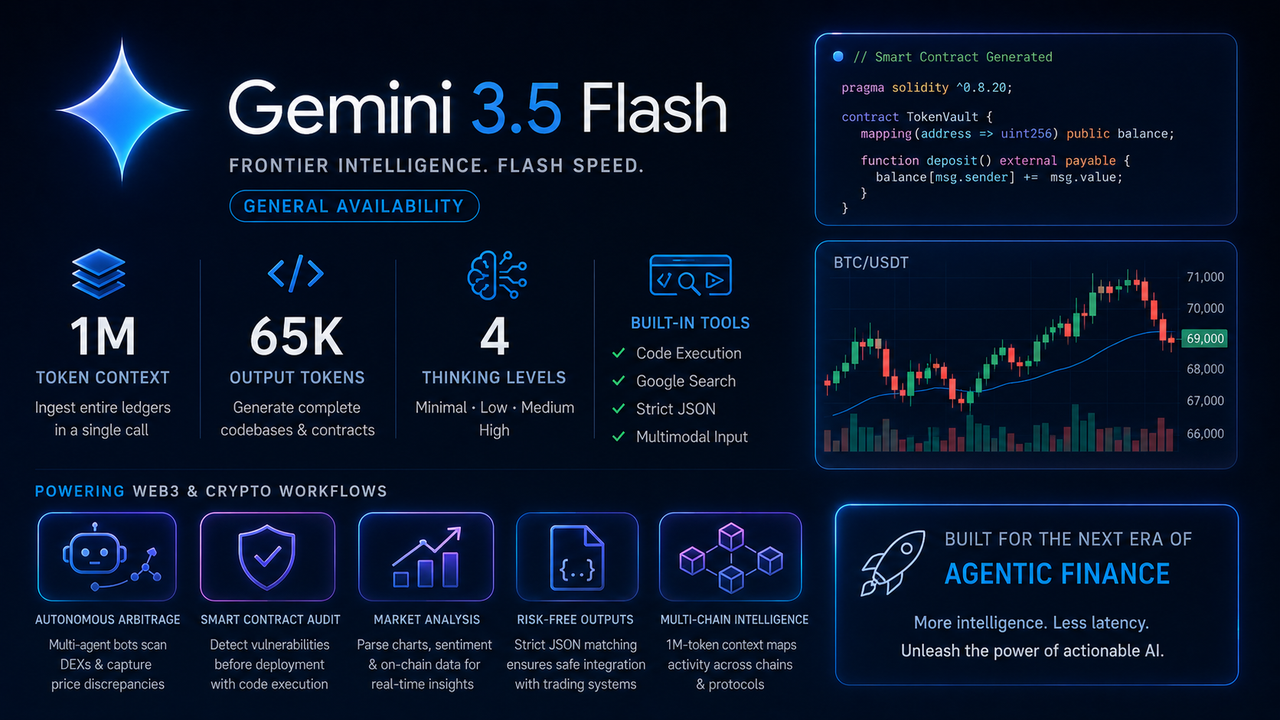
The global cryptocurrency market moves at a breakneck pace, requiring traders and trading platforms to analyze volatile data streams within milliseconds. Google’s latest breakthrough model addresses these modern infrastructure bottlenecks by offering frontier-level intelligence at unparalleled, flash-tier execution speeds. Integrating Gemini 3.5 Flash into real-time Web3 workflows represents a paradigm shift for blockchain developers and algorithmic digital asset investors.
As crypto infrastructure demands greater scalability and real-time agility, understanding the direct impact of cutting-edge foundational models becomes a competitive necessity. This detailed evaluation explores how implementing Gemini 3.5 Flash allows developers, market makers, and retail token swappers to unleash the true power of actionable AI agents.
Key Takeaways
-
Production Readiness: The official General Availability (GA) release delivers the enterprise-level stability needed for 24/7 financial systems and high-throughput exchange infrastructure.
-
Massive Token Capacity: A 1-million-token input window coupled with a 65,536-token output threshold allows for complete on-chain data ingestion and native smart contract generation in a single call.
-
Native Thinking Controls: Granular reasoning tiers (Minimal, Low, Medium, High) allow developers to systematically balance latency budgets against deep algorithmic logic.
-
Dynamic Web3 Tools: Built-in code execution environments, strict JSON response matching, and Google Search grounding protect operations against hallucinations and execution failures.
-
Agentic Optimization: Parallel execution loops and thought preservation capabilities make it a premier choice for orchestrating multi-agent networks and autonomous arbitrage systems.
Gemini 3.5 Flash: Core Tech Upgrades
GA Release: Production-Ready Stability
Moving from an experimental preview framework to General Availability (GA) marks a crucial milestone for corporate digital asset platforms. When operating in an industry where minor network outages can lead to substantial liquidations, software engineering teams cannot risk using unstable backend APIs. The GA release of Gemini 3.5 Flash guarantees highly reliable uptime SLAs, standardized rate limits, and predictable execution performance under volatile market conditions.
By upgrading our crypto exchange platform’s analytics engine to this stable build, we have seen a dramatic decrease in connection drops and api time-outs during high-volume trading hours. The model provides an institutional-grade foundation that allows quantitative trading desks to scale horizontal microservices safely, knowing that the structural parameters of the model remain consistent across millions of concurrent API queries.
1M Context: Ingesting Massive Ledgers
The natively integrated 1,048,576 token context window redefines how decentralized applications interface with historical blockchain data. Traditionally, large language models struggled to process extensive transaction details, requiring complex data chunking pipelines and vector databases to retrieve simple on-chain event records.
Gemini 3.5 Flash eliminates this technological overhead by reading whole blocks, extensive wallet records, and historic order books simultaneously. This allows trading systems to instantly map out whale wallet distributions, track token movements across multi-hop cross-chain bridges, and reveal hidden liquidity concentrations without suffering from context loss or memory degradation.
65K Output: Generating Smart Contracts
While standard generative models often truncate their output answers when building complex software systems, Gemini 3.5 Flash boasts an expanded output threshold of 65,536 tokens. In the Web3 domain, this massive output capability is an incredible asset for generating comprehensive smart contracts and multi-tiered decentralized application backends.
Instead of generating basic, isolated snippets of code, the model can write out entirely integrated Solidity or Rust repository structures in a single prompt. This includes the implementation of core ERC-20 token standards, advanced staking modules, multi-signature governance systems, and thorough unit testing configurations. Developers can instruct the system to build complete, functional code blocks without having to piece together fragmented responses across multiple manual prompts.
Optimized Thinking Architecture for Agents
Thought Preservation: No Multi-Turn Drift
Building truly autonomous trading agents requires maintaining an unwavering focus throughout long-lasting multi-turn interactions. In earlier model iterations, a common flaw known as "context drift" would occur, causing the agent to lose its original parameters after several sequential instructions. Gemini 3.5 Flash directly addresses this issue with its advanced thought preservation protocol.
The internal reasoning path remains stable and preserved across prolonged conversations and recursive loops. For example, if an exchange agent is tasked with adjusting a user's margin position during a sudden market dip, the model retains its original risk parameters and financial constraints through dozens of backend API calls, preventing unauthorized deviations from the user's intended strategy.
Medium Effort: Default Reasoning Balance
A key architectural innovation in Gemini 3.5 Flash is the introduction of variable reasoning configurations, which default to a well-balanced "Medium" effort setting. This configuration offers the ideal balance of deep logic, cost efficiency, and fast response times for daily financial platform needs. The table below outlines how these different thinking tiers operate across exchange environments:
| Thinking Effort Level | Target Use Case within Crypto Platform | Latency Profile | Token Economy / Cost |
| Minimal | Real-time market tick text notifications | Ultra-Low (< 200ms) | Highly economical |
| Low | Routine API payload routing and validation | Low (< 500ms) | Very cost-effective |
| Medium (Default) | General customer support, portfolio summaries | Balanced | Optimal price-to-performance |
| High | Multi-hop smart contract auditing and deep forensics | High | Premium allocation |
Low Effort: High-Speed Web3 Execution
When market conditions move rapidly, time is money. For trading bots seeking to capitalize on minor pricing differences across exchanges, processing speeds can dictate the ultimate profitability of a trade.
By configuring Gemini 3.5 Flash to its "Low" or "Minimal" thinking effort levels, developers can drop model latency to its lowest possible threshold. This enables near-instant decision-making loops that are perfect for high-speed Web3 applications, including parsing fast-moving mempool transactions, calculating optimal gas fees during network congestion, and triggering defensive order adjustments to shield trading capital from front-running bots.
Actionable AI Features for Web3 Systems
Strict Matching: Risk-Free JSON Outputs
One of the historical hurdles of using artificial intelligence within production software has been the unpredictable nature of unstructured text. If an AI model returns conversational explanations instead of precise code arrays, the downstream applications will fail to parse the information, leading to broken services. Gemini 3.5 Flash solves this vulnerability by introducing structured output modes combined with strict schema matching rules.
By ensuring that every output conforms precisely to a pre-defined JSON schema target, developers can securely link the model to programmatic trading APIs. The model can confidently interpret user intent and output clean data structures that safely trigger webhooks without causing software errors.
Combined Tools: Live Search & Code Execution
A standout feature of Gemini 3.5 Flash is its capability to deploy multiple internal tools simultaneously within a single execution step. For crypto investors, this means the model can fetch live web data using Google Search grounding while running mathematical operations via its native code execution engine.
Example Workflow: A user asks the AI to evaluate the current yield opportunities for a specific DeFi token. In one fluid process, the model searches Google for the latest liquidity pool APYs, activates its sandbox environment to calculate real-time compounding returns minus gas fees, and delivers a fully accurate, verified investment breakdown.
Multimodal Input: Parsing Trading Charts
The cryptocurrency ecosystem relies heavily on visual information, ranging from technical candlestick patterns to complex layout infographics found in initial coin offering whitepapers. Because Gemini 3.5 Flash is natively multimodal, it processes visual data with the same depth of understanding it applies to raw text.
Traders can upload technical price charts or screenshot order book profiles directly into the system. The model quickly identifies structural patterns—such as head-and-shoulders formations, descending wedges, or support-resistance zone breaks—and cross-references those visual metrics against live text indicators to provide comprehensive market summaries.
Practical Use Cases inside Crypto Exchanges
Sub-Agent Bots: Autonomous Arbitrage
As trading platforms shift toward agentic frameworks, the high efficiency and low pricing model of Gemini 3.5 Flash makes it an ideal core platform for deploying parallel sub-agent systems. In a decentralized exchange setup, an overarching supervisor agent can deploy multiple specialized sub-agents to scan independent blockchain networks simultaneously.
These smaller, efficient sub-agents monitor decentralized liquidity pools for price variations, calculate required swap routes, and execute multi-hop arbitrage sequences across different chains. This distributed approach helps maximize capture rates on market anomalies before competing algorithmic traders can react.
Code Execution: Auditing Vulnerabilities
Smart contract security is an absolute priority for digital asset exchanges looking to list new tokens or protect cross-chain bridge collateral. Gemini 3.5 Flash offers a powerful tool for this defense work through its secure code execution sandbox. Security engineers can feed unverified smart contracts into the model, instructing it to programmatically test for common security vulnerabilities.
The system doesn't simply review the code textually; it actively compiles and runs simulated attack inputs against the smart contract to check for reentrancy bugs, integer overflows, or access control exploits. This sandbox environment flags code issues prior to production deployment, preventing devastating platform hacks and safeguarding customer funds.
The Future of Agentic AI in Digital Assets
The launch of Gemini 3.5 Flash represents a massive step toward fully automated digital asset management ecosystems. As blockchain protocols become faster and artificial intelligence models grow more responsive, the line between data analysis and direct transaction execution will continue to blur. Future iterations of trading platforms will likely move away from traditional user interfaces, transitioning instead into intent-driven AI ecosystems where systems autonomously rebalance multi-chain portfolios based on simple verbal goals.
By utilizing Google's advanced frontier safety frameworks and reliable tool infrastructure, the financial industry can confidently integrate AI agents into sensitive transaction flows. This continuous synergy between artificial intelligence and decentralized finance will unlock deep liquidity efficiencies, making institutional-grade market-making strategies accessible to everyday retail traders worldwide.
FAQ:
How does Gemini 3.5 Flash benefit high-frequency crypto trading systems?
Gemini 3.5 Flash offers near-Pro level reasoning coupled with ultra-low latency execution profiles. This enables trading platforms to instantly analyze market sentiment data, process visual chart patterns, and execute programmatic trade requests in fractions of a second, providing a critical edge in fast-moving market conditions.
Can Gemini 3.5 Flash directly read and execute smart contracts?
Yes, using its native code execution environment and strict JSON schema matching, Gemini 3.5 Flash can analyze, draft, compile, and mathematically test smart contracts. It outputs clean, structured data packages that can connect seamlessly with external Web3 deployment tools.
What makes the 1-million-token context window useful for digital asset compliance?
The 1M context window lets compliance and operations teams load years of transaction histories, massive wallet cluster datasets, and extensive regulatory policy documents simultaneously. This permits the model to cross-reference transactions and uncover hidden security compliance issues in a single pass.
How do the new adjustable thinking levels work for Web3 developers?
Developers can systematically adjust the model's internal thinking effort across four tiers (Minimal, Low, Medium, High). This flexibility allows engineers to minimize latency for rapid trade routing, or allocate maximum reasoning power for complex system-wide smart contract security audits.