

Foreign Investors Favor U.S. Stocks Over Treasuries for First Time This Century: What It Means
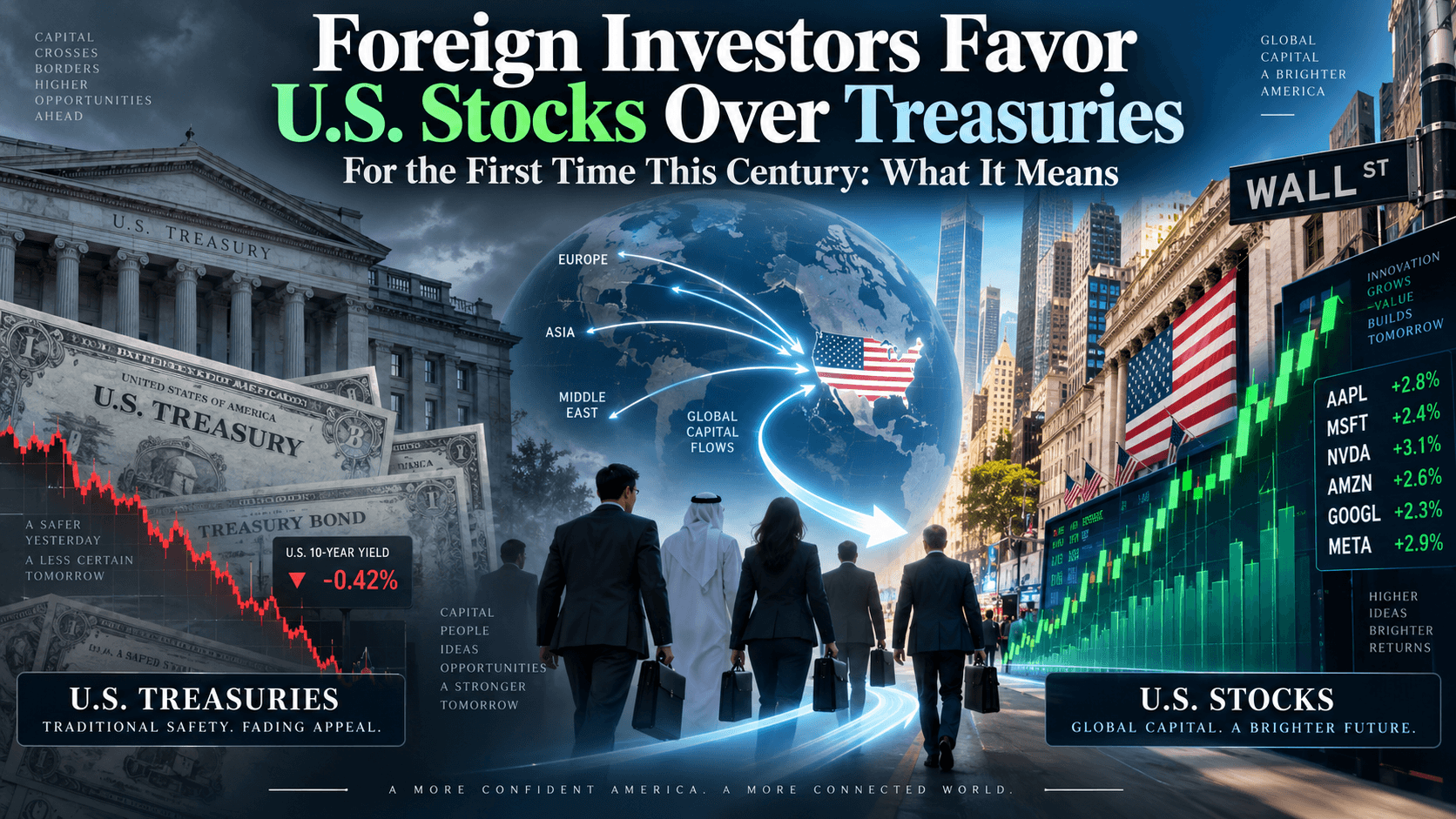
Foreign capital is still flowing into the United States, but investors are increasingly changing what they buy. In the 12 months through June 2026, international inflows into U.S. equities reached roughly 2.8% of U.S. GDP, compared with about 2% for Treasuries, according to Deutsche Bank calculations reported by the Financial Times. Outside limited crisis-related exceptions, that marked the first time this century that foreign equity inflows had overtaken flows into U.S. government debt on this basis.
The shift does not mean global investors have suddenly abandoned U.S. Treasuries or the dollar. Instead, it points to a more subtle divide: enthusiasm for American companies, especially businesses tied to AI and technology, remains strong even as investors demand more compensation for holding long-term government debt. With the 10-year Treasury yield now around 5%, federal debt above $40 trillion and U.S. equity markets still offering some of the world’s most sought-after growth exposure, global capital may be reassessing what counts as the most attractive American asset.
What Is Happening to Foreign Investment in the U.S.?
The underlying Treasury International Capital, or TIC, data show how dramatic the rotation has become. Foreign private investors purchased about $805 billion of U.S. equities over the 12 months through June 2026, up roughly 26% from the previous year. Over the same period, their purchases of Treasury notes and bonds totaled about $329 billion, a decline of around 40%. June alone produced a record $144.7 billion of private foreign equity inflows, while private purchases of longer-term Treasuries fell to only $16.6 billion.
Foreign official institutions also showed an unusual preference for equities. Treasury data indicate that official investors accumulated roughly $114 billion of U.S. equities over the period while collectively reducing longer-term Treasury exposure. That is notable because central banks and reserve managers have historically been among the most dependable holders of U.S. government debt.
| 12 Months Through June 2026 | Foreign Private Investors | Foreign Official Investors |
| U.S. equities | About +$805B | About +$114B |
| Treasury notes and bonds | About +$329B | About -$35B |
| Overall direction | Stronger equity demand | Equities favored over long Treasuries |
Yet the broader picture is not one of capital fleeing America. In June, the United States still recorded a $133.5 billion net TIC inflow, while foreign residents bought $207.1 billion of long-term U.S. securities. After adjustments, total net foreign purchases of long-term securities were estimated at $172.7 billion. The story is therefore better described as a rotation within U.S. markets rather than a wholesale retreat from them.
Why Are Foreign Investors Choosing U.S. Stocks?
AI and U.S. Corporate Earnings Remain Powerful Magnets
One explanation is straightforward: the United States still offers exposure to many of the companies at the center of the global AI investment boom. Investors seeking direct access to advanced semiconductors, cloud infrastructure, data centers, software and digital advertising inevitably encounter American companies. This makes U.S. equities attractive even to investors who have become less comfortable with the country’s fiscal trajectory.
The key distinction is between the U.S. sovereign balance sheet and U.S. corporate profitability. A portfolio manager can believe that persistent federal deficits will put upward pressure on Treasury yields while simultaneously expecting American technology companies to generate strong earnings from AI adoption. In other words, weaker confidence in government debt does not automatically translate into weaker confidence in corporate America.
This may represent a subtle change in the meaning of “American exceptionalism.” For years, the concept often supported the dollar, Treasuries and U.S. equities together. Increasingly, global investors may be separating those assets, remaining enthusiastic about U.S. businesses while becoming more selective about the price they are willing to pay for U.S. sovereign debt.
Stocks Can Adapt to Inflation Differently
Inflation creates another reason investors may prefer equities to long-duration nominal bonds. A Treasury bond promises fixed dollar payments. If inflation remains higher than expected, the real purchasing power of those future payments declines. Long-dated bonds are particularly vulnerable because investors must wait many years to receive much of their promised cash flow.
Companies have a different relationship with inflation. Businesses with strong pricing power may be able to raise prices, grow nominal revenue and partially protect profit margins. That does not make equities a guaranteed inflation hedge—high inflation can also damage margins and push discount rates higher—but corporate cash flows can adjust in ways that a fixed nominal Treasury coupon cannot.
Why Is Foreign Demand for Treasuries Weakening?
The demand problem needs to be viewed alongside rapidly increasing supply. The U.S. government is financing large annual deficits and must continuously issue and refinance enormous quantities of debt. Meanwhile, the federal deficit had already reached about $1.97 trillion in the first 11 months of fiscal 2026, exceeding the entire fiscal 2025 deficit, while federal debt had crossed the $40 trillion threshold.
At the same time, the composition of Treasury ownership has changed. Foreign central banks and governments have not been dumping Treasuries indiscriminately, but their holdings have failed to grow in line with the overall market. Private investors have increasingly filled the gap. Schwab estimates that foreign private Treasury holdings rose from roughly $1 trillion in 2010 to about $5.5 trillion by May 2026, while official-sector holdings have been comparatively stagnant.
That distinction matters because reserve managers can buy Treasuries for policy, liquidity and foreign-exchange-management reasons. Private investors are more price-sensitive. They compare Treasury yields with corporate bonds, equities, cash and other global opportunities. If the expected return is inadequate, they can demand a higher yield—or simply allocate elsewhere. As more Treasury financing depends on these return-sensitive buyers, the government may need to compete more aggressively for global savings.
Why Are Treasury Yields Above 5%?
The 10-year U.S. Treasury yield moved above 5% in September 2026, reaching roughly 5.03% on September 15, its highest level in nearly two decades. Markets have been responding to a combination of renewed inflation pressure, higher oil prices, expectations for additional Federal Reserve tightening, heavy government borrowing and large-scale corporate issuance associated partly with AI investment.
A high Treasury yield can look attractive to a new buyer, but it is important to understand how bond mathematics works: bond prices and yields move in opposite directions. A move from lower yields to 5% means existing bonds have fallen in price. Higher yields can therefore be both an opportunity for new investors and evidence that the market is demanding greater compensation for inflation, duration and fiscal uncertainty.
This is why a 5% Treasury yield should not automatically be interpreted as proof of strong Treasury demand. Part of the increase may instead reflect a higher term premium—the extra return investors require to lock money into a long-term bond rather than continuously rolling short-term instruments. Heavy debt issuance and uncertainty about future inflation can make that premium more important.
Are U.S. Treasuries Still Risk-Free?
Credit Risk Is Not the Same as Investment Risk
Treasuries remain the foundation of the global financial system and are still widely treated as the benchmark “risk-free” asset in financial models. That label largely refers to the extremely low assumed probability that the U.S. government will fail to make nominal dollar payments on Treasury securities. It does not mean an investor cannot lose money.
A 10- or 30-year Treasury carries substantial interest-rate and duration risk. If market yields rise after an investor buys the bond, its price falls. Foreign investors also face currency risk, while all holders of nominal bonds face inflation risk. Even without a default, an investor can suffer a large mark-to-market loss or discover that the bond’s future payments buy far less than expected.
The current debate is therefore not really about whether Treasury securities have become equivalent to speculative credit. It is about whether investors should continue accepting unusually low compensation simply because the borrower is the U.S. government. The “risk-free” label describes credit status better than it describes the experience of owning a long-duration bond in an inflationary, high-deficit environment.
Short-Term and Long-Term Treasuries Are Very Different
This distinction is especially important when comparing Treasury bills with long-term bonds. A three-month T-bill has very little duration risk because principal is returned quickly. A 30-year Treasury is extraordinarily sensitive to changes in interest rates and inflation expectations because its cash flows extend decades into the future.
Consequently, the current challenge to the Treasury safe-haven narrative is much more relevant to long-duration government bonds than to short-term bills held to maturity. Saying “Treasuries are risky” without distinguishing maturities can be just as misleading as claiming all government bonds are completely risk-free.
Does This Mean Foreign Investors Are Losing Faith in America?
Not necessarily. In fact, strong foreign purchases of U.S. stocks point to the opposite conclusion in one respect: international investors still appear willing to send large amounts of capital into American markets. They are simply directing more of it toward claims on corporate earnings rather than claims on government tax revenues.
June’s overall TIC data reinforce this interpretation. Foreign residents continued buying large amounts of long-term U.S. securities, and total net foreign capital inflows remained positive. Even total foreign Treasury holdings stood at about $9.3 trillion in June, up from a year earlier despite falling during the month.
The most useful way to describe the trend may therefore be: the world still wants American assets, but it is becoming more selective about which American assets it wants to own. That is different from a traditional capital-flight story in which foreign investors sell both American bonds and equities and move their money elsewhere.
Is This a Sign of De-Dollarization?
By itself, no. An overseas investor who sells a Treasury and buys an American stock is still maintaining exposure to a dollar-denominated U.S. asset. The portfolio composition changes, but the investor has not necessarily abandoned the dollar or the American financial system.
True de-dollarization is a broader process involving central-bank reserve composition, global trade invoicing, cross-border lending, commodity pricing, payment systems and overall foreign holdings of dollar assets. There is evidence of gradual diversification—the dollar’s share of disclosed global foreign-exchange reserves has declined over the long term, and some central banks have increased gold holdings—but equity inflows into the United States are not themselves evidence of capital abandoning the dollar.
What may be changing is how international investors express dollar exposure. Instead of relying as heavily on government securities, they may increasingly obtain that exposure through U.S. corporate assets. For the Treasury market, that shift still matters because the federal government must find alternative buyers for rapidly expanding debt supply.
Could Stocks Replace Treasuries as the Preferred U.S. Asset?
In the current environment, equities offer several features that Treasuries do not: exposure to economic growth, AI investment, corporate pricing power and earnings expansion. But that does not make stocks safer than government securities. Equity holders are residual owners of businesses, meaning their returns depend on future profits, valuation multiples and market sentiment. A large market correction can quickly erase years of gains.
| Asset | Main Attraction | Key Risk |
| U.S. equities | Growth, AI exposure and corporate earnings | Valuation and earnings risk |
| Long-term Treasuries | Fixed income, liquidity and government credit | Duration, inflation and fiscal risk |
| Short-term T-bills | Low duration and high liquidity | Reinvestment risk |
| Gold | Fiscal and currency hedge | No cash flow and high price volatility |
The more accurate interpretation is therefore that the relative attractiveness of stocks and long Treasuries has changed. Investors may currently believe that American corporate growth offers better compensation than long-term government debt, even after accounting for the additional equity risk. That judgment can reverse quickly if earnings weaken or Treasury yields rise enough to offer a more compelling alternative.
Could Rising Bond Yields Eventually Hurt Stocks?
This is the paradox at the center of the current market. Foreign investors are choosing U.S. equities while bond yields rise, but sufficiently high bond yields can eventually undermine the reason to own expensive stocks. The risk-free rate is a core input in equity valuation: when Treasury yields rise, the present value of future corporate cash flows generally falls because investors apply a higher discount rate.
There is also a portfolio-allocation effect. A Treasury yielding above 5% competes much more effectively for capital than one yielding 2% or 3%. Investors who once needed equities to target attractive returns can obtain substantial income from government bonds without accepting corporate earnings risk. Reuters has noted that the move above 5% could therefore shift some investor attention away from equities if elevated yields persist.
Higher government yields also raise borrowing costs across the economy. Mortgages, corporate loans, consumer credit and new bond issuance become more expensive. That can slow investment and household demand while increasing financing costs for AI infrastructure and other capital-intensive projects. In that sense, the bond selloff may eventually become a threat to the very equity boom that has attracted so much foreign money.
How Could This Change the U.S. Dollar?
Foreign demand for Treasuries has historically been closely linked to dollar demand. A reserve manager or international investor buying U.S. government securities typically needs dollar exposure as part of the process. If foreign inflows become more equity-driven, the dollar could become more sensitive to the performance of American stocks.
Consider a future downturn in which international investors sharply reduce exposure to U.S. technology companies. Equity sales could be followed by conversion of dollar proceeds into investors’ domestic currencies, adding downward pressure to the dollar at the same time stocks are falling. That would differ from the traditional safe-haven pattern in which risk aversion pushes investors simultaneously toward the dollar and Treasuries.
That relationship has not disappeared. The dollar has continued to strengthen during some recent periods of geopolitical stress, including the September rise in global bond yields. The more cautious conclusion is simply that the composition of foreign dollar demand may be becoming more equity-sensitive, not that the dollar has lost its safe-haven role.
What Does This Mean for Investors?
The most useful lesson is not to conclude that investors should sell bonds and buy stocks. Instead, the data show why broad labels such as “safe asset” and “risk asset” can obscure important differences. A short-term Treasury bill, a 30-year Treasury bond and a high-valuation AI stock all respond to different combinations of inflation, interest rates, earnings and liquidity.
For fixed-income investors, duration now deserves particular attention. A long-maturity Treasury can experience significant price volatility even though its credit quality remains extremely high. For equity investors, the opposite problem applies: strong foreign inflows and excitement around AI may support prices, but high valuations can become increasingly difficult to justify when the benchmark risk-free yield is above 5%.
Diversification therefore remains more useful than trying to declare a permanent winner between stocks and government bonds. The current foreign-flow data describe what international investors have preferred recently; they do not prove that the relationship will persist through the next recession, inflation shock or change in Federal Reserve policy.
What Should Markets Watch Next?
The clearest test will be whether the pattern survives future TIC reports. The U.S. Treasury is scheduled to release July 2026 TIC data on September 16, offering another opportunity to see whether foreign equity demand remains unusually strong and whether Treasury purchases continue to lag.
Investors should also pay attention to Treasury auctions, foreign official holdings, 10- and 30-year yields, the term premium and the behavior of the dollar. On the equity side, AI-related earnings and capital expenditures are particularly important because much of the international attraction to U.S. stocks depends on continued confidence that massive technology investment will translate into future profits.
The larger question is no longer whether stocks beat Treasuries during one 12-month period. It is whether the shift becomes persistent enough to change how the United States finances itself. If global investors increasingly require higher yields to buy government debt while eagerly financing American companies, the cost of capital for Washington and the valuation premium enjoyed by corporate America could move in very different directions.
🔥 Beyond the Headlines: What KuCoin 5.0 Means for You
Market news moves fast — but where you act on it matters just as much. This October, KuCoin launches KuCoin 5.0, transforming KuCoin into a rebuilt platform. Here's what actually changes for you:
-
One account for everything. Older platforms split your money across separate "spot," "margin," and "futures" accounts and expected you to understand why. KuCoin 5.0's unified account removes that entirely — deposit once, and everything is simply there.
-
Stocks, indices, and commodities. KuCoin 5.0 expands beyond crypto into global markets. When crypto chops sideways and equities rally (or the reverse), you rotate in minutes instead of opening a brokerage account and waiting days for fiat rails.
-
Real-world assets (RWA). Tokenized exposure to traditional assets like commodities, right inside your crypto account. One of the fastest-growing segments in global finance is no longer reserved for institutions — you access it from the same balance you trade with.
-
Earn while you learn. Not ready to trade? KCUSD lets your stablecoins earn daily, auto-compounding interest. The lowest-stress way to put your idle deposit to work for 4% yield.
-
An AI assistant in plain language. Ask questions, get market context, understand what you're looking at — built into the platform, no jargon required.
-
An app that doesn't overwhelm. Faster, cleaner, and consistent — intuitive from the first tap, not after a tutorial.
-
Safety you can check, not just trust. A MiCAR-licensed EU entity, Proof of Reserves you can verify yourself, and internationally certified security (SOC 2 Type II, ISO 27001:2022).
Create your account in minutes — and start on the platform built for where crypto is going, not where it's been.
Conclusion
Foreign investors favoring U.S. equities over Treasuries does not mean capital is abandoning America. If anything, the data show that the United States continues to attract enormous amounts of international money. What is changing is where that money goes.
American companies—especially those tied to AI, technology and global earnings growth—continue to offer an investment story that foreign buyers find compelling. U.S. government debt, meanwhile, must compete with rising supply, persistent inflation risk and increasingly price-sensitive investors. Treasuries remain central to the global financial system, but long-duration bonds are clearly not free of investment risk.
If this trend persists, the defining question for global investors may become less about whether to own American assets and more about whether corporate America or the U.S. government offers the better claim on the country’s economic future.
FAQs
What Is Treasury International Capital Data?
Treasury International Capital, or TIC, is a U.S. Treasury data system that tracks cross-border financial flows and holdings, including transactions in Treasuries, corporate bonds, equities, short-term securities and banking assets. It is one of the main sources used to assess how foreign investors are allocating capital to U.S. financial markets.
What Is the Difference Between Foreign Private and Official Investors?
Foreign private investors include institutions such as asset managers, banks, insurance companies, corporations and investment funds. Foreign official investors generally include central banks, governments and official reserve-management institutions. Private investors tend to be more return-sensitive, while official investors may hold assets for liquidity, currency-management or policy reasons.
Do Foreign Equity Flows Include Stock-Swap Activity?
Treasury data include adjustments for estimated foreign acquisitions of U.S. equities through stock swaps when calculating broader long-term securities flows. As a result, TIC numbers should not be interpreted as simply adding up transactions executed directly on U.S. stock exchanges.
Can Foreign Investment Flows Reverse Quickly?
Yes. Cross-border portfolio flows can change rapidly as interest rates, currencies, stock valuations, geopolitical risks and economic expectations shift. A strong 12-month trend is significant, but it is not enough on its own to establish a permanent structural change in global asset allocation.
Why Do Treasury Auctions Matter?
Treasury auctions provide a more immediate view of demand for newly issued U.S. government debt. Investors watch auction yields, bid-to-cover ratios, indirect bidders and the amount of price concession needed to attract buyers. Weak auctions can indicate that the market requires higher yields even before slower-moving TIC data reveal broader changes in foreign holdings.
Disclaimer: This article is for informational purposes only and does not constitute investment advice. Crypto assets can be highly volatile, and market conditions, token liquidity and project developments may change rapidly. Readers should conduct their own research and assess their risk tolerance before making financial decisions.