

Citrea Acquires Crest: The Self-Custodial Wallet Bringing Zcash-Style Privacy to Bitcoin
Citrea Brings Self-Custodial Privacy to Bitcoin With Crest Acquisition
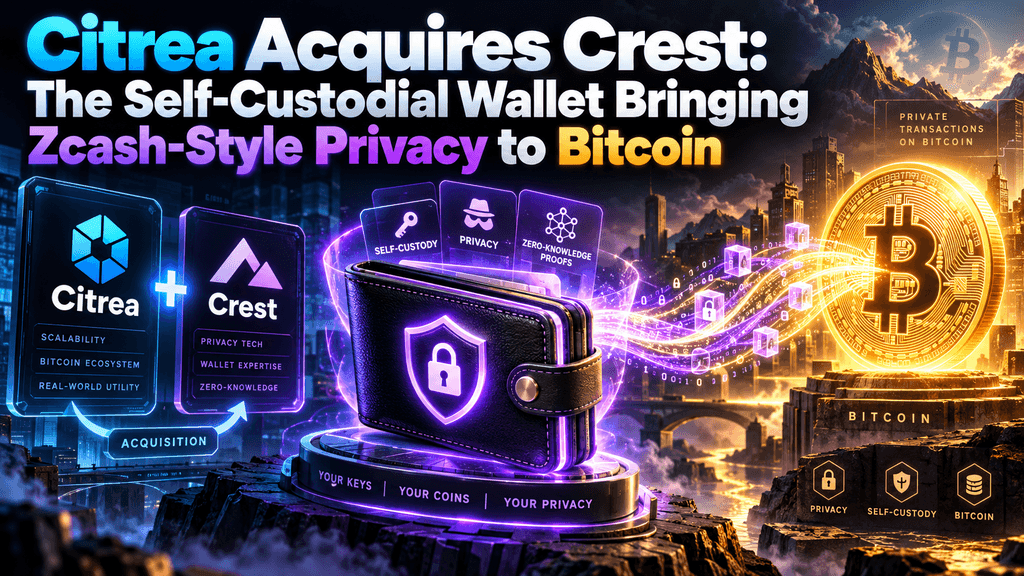
Citrea, the Bitcoin application layer secured by zero-knowledge proofs and BitVM technology, has acquired Crest, a self-custodial private Bitcoin wallet that began as an ecosystem project on its network. Announced on September 23-24, 2026, the deal positions Crest as Citrea’s flagship privacy product while bringing founder Meliksah Gurtemel aboard as Product Lead. Built directly on Citrea’s Bitcoin-secured execution environment, Crest attracted more than 1,000 privacy-focused users to its waitlist before the acquisition, signaling clear demand for practical confidentiality tools.
The wallet is scheduled to launch in the coming weeks with auto-shielding, private BTC transfers, seamless onboarding from Bitcoin and Ethereum, and private cross-chain swaps that let users spend shielded BTC to pay EVM addresses in assets such as USDC or ETH. By folding Crest into its core strategy, Citrea aims to make effortless, self-custodial privacy the default experience for holding and moving Bitcoin, addressing the transparency of the public ledger without forcing users to abandon custody or migrate to separate privacy assets.
How Citrea’s Bitcoin Layer Secures the New Privacy Product
Citrea operates as the first production zero-knowledge rollup that settles directly on Bitcoin, posting batch proofs and state differences to the base layer while offering an EVM-compatible execution environment. Launched on mainnet in January 2026, the network relies on Bitcoin for data availability and finality, with its Clementine bridge using BitVM2 under a 1-of-N honesty assumption so that a single honest verifier can protect pegged funds. This architecture allows applications to run with higher throughput and lower fees than Bitcoin Script while remaining anchored to Bitcoin’s security model. Crest was developed as an ecosystem project precisely on this foundation, meaning its privacy pools inherit Citrea’s settlement guarantees rather than introducing a separate trust model.
The acquisition therefore integrates the wallet into an already live Bitcoin application layer that supports programmable contracts without requiring changes to Bitcoin consensus rules. Official announcements emphasize that Crest will serve as the primary gateway for onboarding both users and liquidity from the Bitcoin and privacy communities into this environment. Over time, the plan is to extend private BTC utility across Citrea’s broader set of applications, including lending, trading, and settlement products already live on the network. The technical continuity between the layer and the wallet reduces the friction that has historically limited privacy adoption on Bitcoin, where users otherwise face complex workflows or the need to exit into alternative assets.
Crest’s Path From Ecosystem Project to Flagship Wallet
Crest began life inside the Citrea ecosystem with a focused goal: create a mobile-first, self-custodial wallet that makes private Bitcoin use as straightforward as ordinary cash transactions. The project’s early traction was immediate, drawing more than 1,000 privacy enthusiasts onto a waitlist and demonstrating that demand for frictionless tools already existed among dedicated users. Rather than remaining an independent experiment, the acquisition folds Crest fully into Citrea’s product strategy, giving the team access to core engineering resources, strategic growth support, and operational alignment.
Founder Meliksah Gurtemel moves into the Product Lead role at Citrea, ensuring continuity of vision while accelerating development. Official statements from both sides stress that the mission stays the same, delivering the simplest private Bitcoin wallet available, only now with greater speed and backing. In the days following the announcement, launch partners and full documentation are expected, followed shortly by the mobile wallet release. This transition from ecosystem project to the flagship product removes the isolation that often slows early-stage tools and places privacy at the center of Citrea’s roadmap for Bitcoin capital markets.
Auto-Shielding as the Core User Experience Upgrade
The forthcoming Crest mobile wallet centers on auto-shielding, a design choice that makes privacy the default rather than an optional extra step. Once Bitcoin enters the zero-knowledge privacy pool on Citrea, funds become shielded automatically, allowing subsequent transfers to occur without revealing the sender, receiver, or amount. This model differs from one-time mixing approaches by maintaining a persistent encrypted state inside the pool, so users can send and receive privately for as long as they remain within it.
Local generation of zero-knowledge proofs on the device handles the cryptographic complexity, abstracting the underlying mathematics so that the interface feels like any modern mobile wallet. The result is continuous privacy for balances and transfers without requiring users to understand or manage advanced tools. Official product descriptions highlight that this approach aims to eliminate the technical barriers that previously confined Bitcoin privacy to expert users. By making shielding automatic, Crest seeks to lower the barrier that has kept most Bitcoin activity on the transparent public ledger even when users prefer confidentiality.
Private BTC Transfers and Cross-Chain Onboarding Features
Crest’s planned feature set includes private peer-to-peer BTC transfers conducted entirely within the shielded environment, preserving confidentiality from start to finish. Users will also be able to onboard from both Bitcoin’s base layer and Ethereum, creating a single entry point that bridges the two major ecosystems. The wallet further supports private cross-chain swaps and exit routes, enabling holders of shielded BTC to pay EVM addresses directly in assets such as USDC or ETH without exposing the origin of the funds.
These capabilities extend private Bitcoin utility beyond pure transfers into practical spending and liquidity movement across chains. Official roadmaps indicate that these functions will appear with the initial mobile launch and expand over time across Citrea’s wider application suite. The design prioritizes self-custody throughout, ensuring users retain control of their keys while benefiting from the privacy pool. By combining private transfers with seamless multi-chain access, Crest positions itself as a practical gateway rather than a specialized niche tool limited to Bitcoin-native addresses.
Why Bitcoin’s Transparent Ledger Creates Persistent Privacy Demand
Bitcoin’s public ledger records every balance, counterparty, and transaction history in permanent, immutable form, turning routine activity into a potential surveillance target. Holders seeking confidentiality have historically faced three imperfect options: surrender self-custody to a third party, master complex technical workflows reserved for experts, or migrate value into separate privacy-focused assets. Citrea’s announcements explicitly frame this transparency as a core limitation of the $1.6 trillion asset, noting that networks such as Zcash have already proven strong demand for simpler, more intuitive privacy.
Recent data from Zcash show shielded transactions reaching 62,375 in a single week in late September 2026, the highest level since 2022, while the shielded pool holds roughly 29 percent of circulating supply, valued near $7 billion. That surge in private activity on a privacy-native network underscores the appetite that exists when usable tools are available. Citrea’s acquisition of Crest is presented as the direct response: commit full resources to delivering the same effortless standard on Bitcoin itself.
Lessons From Zcash’s Rising Shielded Adoption
Zcash’s recent metrics illustrate how privacy features gain traction once they become accessible. Shielded transaction counts climbed sharply through 2026, with weekly peaks exceeding 62,000 and the share of activity occurring in shielded form reaching nearly 60 percent in some periods. The portion of supply held in shielded pools rose from around 11 percent a year earlier to approximately 29 percent by September 2026, reflecting both new deposits and sustained private use.
Protocol upgrades scheduled for later in 2026 aim to further improve accessibility and block times, while institutional products such as a spot ETF have drawn additional capital even if custody remains transparent. These figures demonstrate that when privacy is made relatively straightforward, a meaningful segment of users chooses it. Citrea cites this evidence explicitly when positioning Crest as the vehicle to bring comparable usability to Bitcoin, arguing that the same demand exists for the larger store-of-value asset once friction is removed.
Leadership Continuity and Team Integration After the Deal
Meliksah Gurtemel, Crest’s founder, joins Citrea as Product Lead, ensuring that the original product vision carries forward under the new ownership structure. Simultaneously, statements from Chainway Labs, the core contributor behind Citrea, frame the acquisition as a natural continuation of earlier privacy work. Orkun Mahir Kılıç, co-founder and CEO of Chainway Labs, described solving Bitcoin privacy as “the single largest unlock for meeting real user demand on a Bitcoin layer” and positioned Crest as the primary gateway for users and liquidity.
Ekrem Bal, co-founder and chief scientist, noted that the move represents a full-circle moment, bringing privacy research that began years earlier directly onto Bitcoin. The integration unites the Crest team with Citrea’s engineering and growth resources, allowing concentrated focus on shipping the mobile wallet rather than independent fundraising or infrastructure building. This leadership continuity reduces execution risk while aligning the entire organization around privacy as a core value proposition.
Proof of Innocence and Citrea’s Longer Privacy Track Record
Chainway Labs, the primary contributor to Citrea, previously developed the open-source Proof of Innocence protocol in response to the 2022 Tornado Cash sanctions. The tool enables users of privacy pools to prove that their funds are not linked to illicit or blacklisted addresses without revealing identity. Concepts from that framework have since been adopted by leading privacy protocols, including Railgun and Privacy Pools.
Official Citrea communications present the Crest acquisition as the logical next step in that same journey, applying years of privacy research to the Bitcoin environment itself. By embedding zero-knowledge privacy pools into a mobile self-custodial wallet, the project aims to make the compliance-preserving techniques practical for everyday users rather than remaining confined to specialized tooling. This background provides technical continuity and demonstrates that privacy has been a sustained focus rather than a recent marketing addition.
What Changes for Users Holding and Spending Bitcoin
For ordinary holders, the Crest wallet is designed to remove the expertise barrier that has kept private Bitcoin use limited. Auto-shielding means privacy activates by default once funds enter the pool, while private transfers and cross-chain spending options expand the practical utility of those shielded balances. Users can move value from Bitcoin or Ethereum into the private environment and later exit to EVM addresses in stablecoins or ether without exposing the full transaction history. Because the product remains self-custodial, key control stays with the user throughout.
The mobile-first interface further lowers the threshold for non-technical participants who want confidentiality without managing complex scripts or separate privacy coins. Citrea’s broader ecosystem of applications, already live for lending, trading, and settlement, creates potential pathways for private BTC to interact with those services over time. The net effect is a reduction in the permanent financial trails that currently accompany most Bitcoin activity on the public ledger.
Understanding Bitcoin’s $1.6 Trillion Store-of-Value Position
Bitcoin’s market capitalization exceeding $1.6 trillion makes the transparency of its ledger especially consequential for large holders, institutions, and everyday users who prefer limited visibility into balances and counterparties. Official announcements repeatedly highlight this scale when explaining why privacy has become a strategic priority for a Bitcoin application layer. Existing options either compromise self-custody, demand specialized knowledge, or require leaving the Bitcoin ecosystem entirely.
Crest’s integration into Citrea seeks to keep value inside the Bitcoin security model while adding the confidentiality layer that has proven popular on networks purpose-built for privacy. The acquisition therefore sits at the intersection of Bitcoin’s dominance as a store of value and the growing preference for private transaction options observed elsewhere in the market.
Timeline for Wallet Launch and Ecosystem Expansion
Crest’s mobile wallet is scheduled to launch in the coming weeks following the September 2026 acquisition, beginning with auto-shielding, private BTC transfers, and cross-chain onboarding. Subsequent updates will introduce private cross-chain swaps and exit routes that allow shielded BTC to pay EVM addresses in USDC or ETH. Over a longer horizon the acquisition aims to extend private BTC functionality across Citrea’s full application suite, turning privacy into a foundational capability rather than a standalone feature.
Waitlist members are expected to receive early access, with launch partners and documentation released in the immediate days after the announcement. The accelerated timeline reflects the benefit of moving from an independent ecosystem project into a fully resourced core product team. Users interested in the private Bitcoin experience can currently join the waitlist at the project’s public site while development continues.
Industry Signals Around Financial Privacy Tools
Rising shielded activity on Zcash, combined with institutional interest in privacy-oriented products, indicates that demand for confidential value transfer is expanding beyond niche communities. Citrea’s decision to acquire and prioritize Crest places a major Bitcoin application layer squarely inside that trend, committing resources to deliver comparable usability on the largest cryptocurrency. The self-custodial design and mobile interface address two common objections to earlier privacy tools: loss of key control and excessive technical complexity.
By anchoring the solution to Bitcoin’s settlement layer through zero-knowledge proofs and BitVM verification, the project seeks to preserve the security properties that attract capital while adding the confidentiality layer many users now expect. The acquisition therefore represents both a product launch and a strategic signal that privacy is becoming a competitive requirement for Bitcoin application platforms.
Potential Pathways for Private Bitcoin Utility Across Applications
Once private BTC is established inside Crest’s privacy pools, Citrea intends to expand its usability across the wider network of applications already operating on the layer. This could include private interactions with lending markets, trading venues, and settlement tools that currently run on the EVM-compatible environment. The ability to spend shielded BTC into EVM assets privately creates a practical bridge between Bitcoin’s store-of-value role and the programmable activity occurring on Citrea.
Because the privacy pools themselves are built on the same Bitcoin-secured execution environment, the expanded utility remains within a single security and settlement model. Official statements describe this extension as a longer-term goal that builds on the initial wallet launch. The combination of self-custody, automatic shielding, and multi-chain exit options positions private BTC as a more versatile asset rather than a specialized holding.
🔥 Beyond the Headlines: What KuCoin 5.0 Means for You
Market news moves fast — but where you act on it matters just as much. This October, KuCoin launches KuCoin 5.0, transforming KuCoin into a rebuilt platform. Here's what actually changes for you:
-
One account for everything. Older platforms split your money across separate "spot," "margin," and "futures" accounts and expected you to understand why. KuCoin 5.0's unified account removes that entirely — deposit once, and everything is simply there (only available to VIPs for now).
-
Stocks, indices, and commodities. KuCoin 5.0 expands beyond crypto into global markets. When crypto chops sideways and equities rally (or the reverse), you rotate in minutes instead of opening a brokerage account and waiting days for fiat rails.
-
Real-world assets (RWA). Tokenized exposure to traditional assets like commodities, right inside your crypto account. One of the fastest-growing segments in global finance is no longer reserved for institutions — you access it from the same balance you trade with.
-
Earn while you learn. Not ready to trade? KCUSD lets your stablecoins earn daily, auto-compounding interest. The lowest-stress way to put your idle deposit to work for 4% yield.
-
An AI assistant in plain language. Ask questions, get market context, understand what you're looking at — built into the platform, no jargon required.
-
An app that doesn't overwhelm. Faster, cleaner, and consistent — intuitive from the first tap, not after a tutorial.
-
Safety you can check, not just trust. A MiCAR-licensed EU entity, Proof of Reserves you can verify yourself, and internationally certified security (SOC 2 Type II, ISO 27001:2022).
Create your account in minutes — and start on the platform built for where crypto is going, not where it's been.
FAQs
What exactly did Citrea acquire and when was the deal announced?
Citrea acquired Crest, a self-custodial private Bitcoin wallet that originated as an ecosystem project on its network, with the announcement published on September 23, 2026, and further coverage the following day. Crest becomes the flagship privacy product, and its founder, Meliksah Gurtemel, joins Citrea as Product Lead. The acquisition unites the teams to accelerate delivery of a mobile wallet focused on effortless privacy for Bitcoin holders.
How does Crest plan to make privacy usable for non-expert users?
The wallet centers on auto-shielding so that privacy activates by default once funds enter the zero-knowledge pool, removing the need for users to manually manage complex tools. Private transfers occur inside the shielded environment, and the mobile interface handles zero-knowledge proof generation locally, abstracting the cryptography. Cross-chain onboarding from Bitcoin and Ethereum further simplifies entry for users already active on those networks.
What specific features will the initial Crest mobile wallet include?
Launch features include auto-shielding, private BTC transfers, and seamless cross-chain onboarding from Bitcoin and Ethereum. Later updates will add private cross-chain swaps and exit routes that allow users to spend shielded BTC to pay EVM addresses in assets such as USDC or ETH without exposing the full transaction history.
Why does Citrea emphasize Zcash when discussing Bitcoin privacy?
Zcash has demonstrated measurable demand for simple, intuitive privacy through rising shielded transaction counts and a growing share of supply held in private pools. Citrea cites this evidence to argue that the same user preference exists for Bitcoin once comparable usability is available, without requiring holders to leave the Bitcoin security model.
Is Crest self-custodial, and how does that interact with Citrea’s architecture?
Crest is designed as a self-custodial wallet, meaning users retain control of their keys. It operates on Citrea’s Bitcoin-secured execution environment, which itself settles to Bitcoin via zero-knowledge proofs and a BitVM-based bridge under a 1-of-N honesty assumption, preserving the self-custody model while adding privacy pools.
Disclaimer: This content is for informational purposes only and does not constitute investment advice. Cryptocurrency investments carry risk. Please do your own research (DYOR).