

APEC Summit and IMF Address Highlight Regional Growth Pace and AI Productivity Shifts
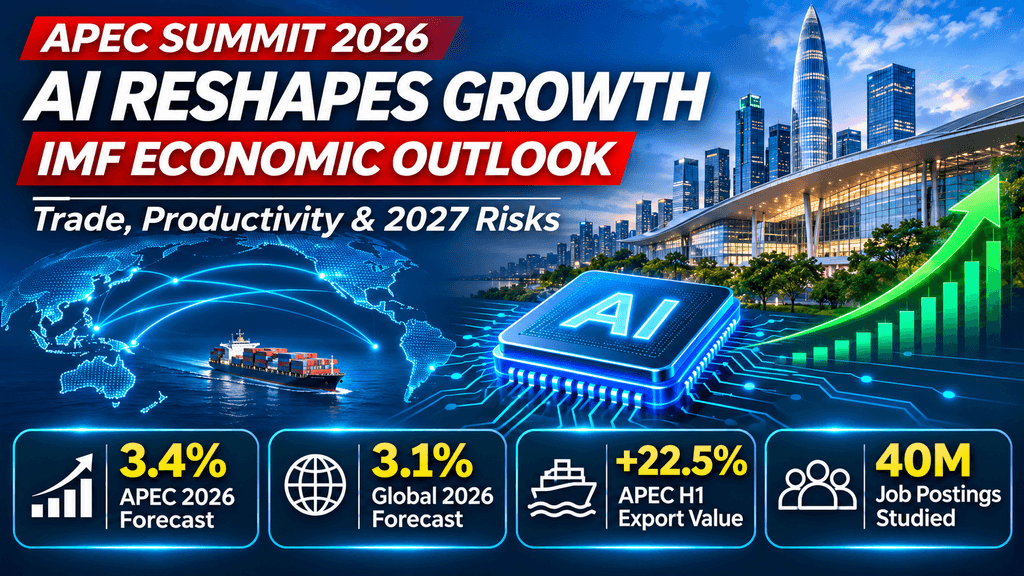
At the 2026 Asia-Pacific Economic Cooperation (APEC) leaders’ meeting in Shenzhen on November 19, International Monetary Fund (IMF) Managing Director Kristalina Georgieva highlighted how artificial intelligence is supporting economic activity despite energy supply shocks. The IMF projected 3.1% global growth in 2026, while APEC’s latest regional forecast pointed to 3.4% growth among its member economies. Stronger semiconductor demand and technology investment explain part of that resilience, but inflation, public debt and shifting employment patterns complicate the outlook. The central question is whether the AI investment boom can deliver lasting productivity gains as regional growth is expected to moderate in 2027.
Key Takeaways
-
The IMF projected 3.1% global economic growth in 2026, while the APEC region is forecast to expand by 3.4%.
-
APEC upgraded its 2026 outlook from 3.2% to 3.4%, supported by technology investment and regional trade.
-
APEC merchandise export values increased 22.5% year over year in the first half of 2026; export volumes rose 10.8%.
-
An IMF study of 40 million job postings found weaker relative demand in occupations more exposed to artificial intelligence.
-
APEC inflation is forecast at 2.8% in 2027, while regional gross public debt is estimated to reach 110% of GDP.
-
The region’s 2027 growth forecast is 3.1%, with energy costs, financial conditions and uneven technology adoption shaping the outlook.
What the IMF Revealed About Global Economic Growth at the APEC Summit 2026
Georgieva’s November 19 address placed the Asia-Pacific growth story within a wider global shift: investment in AI systems and associated hardware is generating economic activity even as energy costs strain businesses and households. Her message did not present technology as a guaranteed solution. Instead, it emphasized that stronger near-term demand must eventually translate into improved productivity, better jobs and sustainable economic performance. The distinction matters because spending on equipment can lift investment and trade before the long-term returns become clear. The durability of that momentum will depend on whether firms can apply the new capacity profitably once the initial wave of construction and equipment purchases slows.
IMF Global Growth Forecasts Show AI Supporting an Uneven Recovery
The IMF’s October 2026 World Economic Outlook projected global output growth of 3.1% in 2026 and 3.4% in 2027. At the summit, Georgieva associated the current year’s resilience with accelerated AI-related activity in a relatively small group of economies. She also cited 4.6% global trade growth and said AI hardware and related technology products accounted for more than one-tenth of world merchandise trade by value. These figures illustrate the breadth of demand for chips, computing equipment and supporting infrastructure, but they do not establish that AI investment alone caused the increase in global trade.
The geographical differences are equally important. Economies that manufacture advanced electronic components, assemble technology systems or supply essential inputs can benefit directly from rising capital expenditure. Those that import large amounts of energy or lack a substantial position in technology supply chains may face a less favorable balance of costs and opportunities. The IMF’s projections are estimates of annual real economic growth, not completed results for 2026. They also describe a different group of economies from APEC’s regional calculations, so the two headline growth rates should not be treated as interchangeable.
The IMF Links Future Growth to Monetary Stability and Structural Reform
The IMF forecast global headline inflation of 4.7% in 2026, easing to 4.1% in 2027. Georgieva said the combination of costly energy and strong AI-related demand was adding pressure to prices and borrowing rates. She also warned that worldwide public debt was approaching a level above 100% of global GDP. Higher debt-servicing costs can narrow the funds available for productive public investment, particularly where governments already face pressure to finance infrastructure, education and social services. The forecasts indicate financial vulnerabilities; they do not imply that every economy faces an imminent debt crisis.
The IMF’s proposed response goes beyond managing interest rates. Georgieva called attention to digital infrastructure, adaptable labor markets, capital-market development, financial stability and cybersecurity as conditions for sustained productivity growth. Financing is part of that equation: changes in interest rates and global liquidity can affect borrowing costs and risk assessments across traditional and digital financial markets. That is a broader monetary-policy relationship, not evidence that the summit itself caused any specific asset-price movement.
Why APEC Economic Growth Is Forecast at 3.4% in 2026 Amid Rising AI Investment and Trade
The APEC Policy Support Unit’s November 2026 Regional Trends Analysis raised its regional growth projection to 3.4% for 2026, compared with 3.2% in its August assessment and estimated growth of 3.3% in 2025. The revision reflects stronger-than-expected economic activity associated with emerging technology, resilient trade and policy responses to external pressures. As a forecast, it remains sensitive to changes in international demand, production costs and financial conditions. The figures also represent the APEC grouping rather than a uniform growth rate across its 21 member economies. The revision describes an improved growth expectation, not an additional 0.2% increase in economic output on top of the forecast.
Semiconductor Demand and AI Infrastructure Investment Support Regional Output
APEC merchandise export values rose 22.5% year over year in the first half of 2026, compared with 6.5% during the same period of 2025. Export volumes expanded 10.8%, versus 8.1% a year earlier. The distinction between value and volume matters: export receipts can rise because of higher prices, a larger quantity of goods or a shift toward more valuable products. The simultaneous expansion in both measures supports the conclusion that trade activity strengthened materially, while the especially sharp rise in value also points to changes in prices and product composition. Strong semiconductor demand was an important contributor, according to APEC’s analysis.
Investment in data centers, advanced chips and computing capacity creates demand across a wider industrial chain. Equipment makers require specialized components, networking products and electrical systems, while new facilities need construction services and reliable power infrastructure. Some activity therefore reaches beyond the businesses developing AI software. However, capital spending is not the same as realized productivity: the economic return depends on whether organizations ultimately use the additional computing capacity to produce goods and services more efficiently. High technology valuations may reflect expectations of such returns rather than measurable improvements already achieved.
Strong Goods Trade Contrasts With Slower Growth in Services
The regional trade picture is less uniform outside the technology sector. APEC reported that commercial services exports grew 6.7% in the first half of 2026, below the 8.5% pace recorded a year earlier, while services import growth held at 7.5%. Transport and travel activities were affected by interruptions to air connections and changes in shipping routes. Meanwhile, high-value technology cargo supported air freight even as parts of maritime transport faced weaker volumes and higher operational costs. These differences help explain why a strong overall export headline should not be mistaken for a broad acceleration across every business category.
The November APEC outlook forecast 6.9% growth in the volume of goods and services exports in 2026, following 7.4% in 2025; import volumes were forecast to increase 8.7%. Unlike the first-half merchandise figures, these are full-year estimates covering both goods and services. They cannot be directly compared with the 22.5% increase in merchandise export value. The practical implication for manufacturers and logistics providers is that the composition of trade matters as much as its total pace: demand linked to computing infrastructure may remain firm while other sectors face different conditions.
How AI Is Reshaping Productivity, Employment, and Technology Demand Across Asia-Pacific
Artificial intelligence is changing the Asia-Pacific economy through two connected but distinct channels: higher demand for technology infrastructure and changes in how firms organize work. The first is visible in industrial investment and exports; the second depends on whether workers and businesses can apply AI effectively. New IMF labor-market research and an APEC business survey released in 2026 provide useful evidence about adoption, while also showing why job displacement and future productivity gains cannot yet be reduced to a single regional estimate. Evidence from particular occupations and companies cannot automatically be extended to every sector of the economy.
IMF Job Posting Data Shows Uneven Effects on AI-Exposed Occupations
The IMF’s October 2026 Regional Economic Outlook examined approximately 40 million online job postings across 19 Asian economies, using observations through April 2026. It found that employer demand in occupations more exposed to AI had fallen by nearly 10% relative to demand in less-exposed occupations after the technology became widely available. The researchers compared jobs within similar economic and industry settings to reduce the influence of unrelated hiring trends. Crucially, this is a relative change in recruitment demand, not proof that 10% of workers lost their jobs. The IMF also found signs that the effect on postings had stabilized even as AI capabilities continued to improve, suggesting a shift in the tasks employers need rather than a simple disappearance of entire occupations.
Demand for AI Skills Is Growing, but Adoption Remains Limited
The same research found that about 6% of firms in its Asian job-posting analysis sought AI-related skills, highlighting the distance between widespread interest in the technology and practical workplace adoption. Employers increasingly value workers who can evaluate AI outputs, combine them with organizational data and use them within specialized processes. The labor-market consequences may vary with demographics: economies with younger populations need to create enough entry-level opportunities, while aging societies may see AI as one tool for dealing with workforce shortages. Training quality, access to digital infrastructure and workers’ ability to move between roles will influence who benefits. The statistic does not mean that only 6% of Asian companies use AI, since job advertisements are an incomplete measure of adoption.
APEC Business Cases Show Why Workflow Changes Determine Productivity
An APEC Business Advisory Council report released on November 17, 2026 reviewed 13 AI applications across nine APEC economies. One reported example involved an automotive inspection process that decreased from 20 seconds to two seconds while maintaining accuracy above 99.9%. Another case described warranty-processing time falling from four weeks to five days. These results are reported examples from individual deployments, not economy-wide productivity estimates or guaranteed outcomes for other companies. Their common lesson is operational: successful AI use often requires reliable data, redesigned workflows and employee involvement, rather than installing a model while leaving existing procedures unchanged. For smaller firms, access through familiar business software may lower the cost of experimentation and implementation.
Data Centers, Semiconductors and Energy Systems Shape the Next AI Investment Cycle
Demand for AI computing affects semiconductor fabrication, memory, networking, storage, cooling and electricity infrastructure. These connected requirements can create business opportunities at several stages of the supply chain, but they also expose projects to shortages of skilled workers, available grid capacity and financing. A data center contributes to investment when it is built; its longer-term economic value depends on utilization, operating costs and the measurable improvements it enables elsewhere. APEC’s AI Initiative for 2026–2030 places emphasis on responsible adoption, skills and cooperation, reflecting a policy shift from technology development alone toward broader access. The key uncertainty is whether expanding infrastructure can support productivity beyond a concentrated group of technology companies.
How Inflation, Public Debt, and Economic Risks Could Affect APEC Growth in 2027
The APEC Policy Support Unit expects regional growth to ease from 3.4% in 2026 to 3.1% in 2027. The projected slowdown reflects a more difficult balance between productive investment and rising costs: inflation remains a concern, borrowing is more expensive, and government finances provide less room for large responses to new shocks. Even if AI-related demand continues, its contribution may be offset in some economies by weaker purchasing power, uncertain trade conditions and constraints on public spending. The outlook is a baseline forecast, not a prediction that every member economy will slow at the same pace. A 0.3-percentage-point regional slowdown could therefore conceal much larger changes in individual economies.
Inflation and Interest Rates Could Limit Consumer Spending and Business Investment
APEC’s November analysis projected average regional inflation at 3.2% in 2026, up from 2.4% in 2025, before easing to 2.8% in 2027. Price trends are commonly tracked through measures such as the Consumer Price Index (CPI), which follows changes in the cost of a representative basket of goods and services. An inflation rate that declines but stays positive means prices are generally still increasing, only more slowly. The regional average also conceals substantial differences in household budgets, currency movements and domestic energy exposure, so the experience of individual consumers may not follow the headline figure.
The APEC report recorded increases since July 2026 of 35.9% for crude oil, 40.2% for liquefied natural gas and 14% for coal, using commodity data available through October. Higher fuel and electricity bills can raise transport and production expenses before reaching retail prices. By mid-November, more than one-third of APEC member economies had recently increased benchmark interest rates to address inflation pressure, according to the Policy Support Unit. That response can reduce price pressures over time but may also restrain credit demand. Whether inflation eases as forecast depends partly on energy markets, food supply conditions and the persistence of higher costs throughout production chains.
Higher Public Debt and Trade Uncertainty Narrow the 2027 Policy Outlook
APEC’s debt projections provide a clearer timeline than a single headline range: the regional gross public debt ratio is estimated at 108% of GDP in 2026, 110% in 2027 and 112% in 2028, compared with 106% in 2025. These are regional figures, not debt ratios for every member economy. Rising sovereign bond yields can increase refinancing costs and absorb more government revenue through interest payments. The effect is not an automatic fiscal emergency, but it may limit spending on transport links, education, research and other investments that support longer-term competitiveness. The outlook is particularly sensitive where public financing needs are high and tax revenues are less resilient.
The external environment adds another uncertainty. APEC projects goods-and-services export volume growth to slow to 3.8% in 2027, while its latest available 2025 inventory showed 1,591 trade remedies and restrictive measures in force against 562 trade-facilitating measures. Those counts describe policies already in force during the reporting period, not new measures announced at the Shenzhen summit. For 2027, the critical tests will be whether technology demand broadens beyond a narrow set of products, whether energy prices stabilize and whether governments can improve financial resilience without unnecessarily weakening domestic activity. APEC’s proposed priorities include more diversified trade and energy supplies, targeted support for vulnerable households and stronger regional cooperation.
Conclusion
The APEC Summit 2026 and the IMF’s November 19 address captured an economy in which AI investment and technology trade are providing significant support, while the path to durable productivity growth remains uncertain. The region’s improved 2026 forecast reflects real momentum in semiconductor demand and investment, but the benefits are distributed unevenly across industries and workers. The IMF’s labor-market findings and APEC’s business case studies suggest that skills, workflow changes and access to infrastructure will matter as much as spending on computing hardware. Looking into 2027, inflation, financing costs, public debt and trade conditions could restrict the scope for further expansion. The central measure of success will be whether technology-driven investment raises productivity widely enough to support stronger, more balanced economic activity over time.
FAQs
How many economies are members of APEC?
APEC brings together 21 member economies across the Asia-Pacific. It operates as a forum for economic cooperation, and its initiatives generally rely on consensus and voluntary commitments rather than binding regional legislation. Its members have different economic structures, making cooperation on shared trade and technology issues especially relevant.
Is the 3.4% APEC growth figure a confirmed 2026 result?
No. The 3.4% figure is the APEC Policy Support Unit’s November 2026 forecast for full-year regional growth. Final outcomes may differ as economic data for the remainder of the year become available. The estimate may also be revised when member economies publish updated national accounts.
Why does the IMF's Asia-Pacific growth forecast differ from APEC's forecast?
The IMF projected 4.8% growth for its Asia and Pacific grouping in 2026, while APEC forecast 3.4% for its member economies. The two forecasts cover different sets of economies and use their own regional aggregation methods, so they should not be compared as if they describe the same territory. APEC includes economies outside the IMF’s Asia and Pacific regional grouping, which affects the resulting average.
Does stronger AI-related trade mean every Asia-Pacific sector is expanding rapidly?
No. Semiconductor demand has supported merchandise exports, but the performance of tourism, transportation and other services has been more mixed. Growth in one high-value product category can lift aggregate figures without indicating similar conditions in every industry. Sector-level export volumes can help readers distinguish broader demand from shifts in the value of traded products.
Does the IMF's 10% AI employment finding mean one in ten jobs has disappeared?
No. The IMF measured an approximately 10% relative decline in employer demand for more AI-exposed occupations compared with less-exposed roles. Its research used job advertisements, which track hiring intentions rather than the total number of people employed. The study also found signs that this relative effect had stabilized, although future hiring patterns remain uncertain.
Disclaimer: This general market information, possibly from third-party, commercial, or sponsored sources, is provided for reference and educational purposes only and does not constitute financial or investment advice, an offer, solicitation, or guarantee. We disclaim liability for its accuracy, completeness, reliability, and any resulting losses. Investments/trading are risky; past performance doesn’t guarantee future results. Users should research, judge prudently, and take full responsibility. For further details, please consult KuCoin’s Terms of Use and Risk Disclosure.