

ADP Jobs Miss Gives Markets Brief Relief, but Friday NFP Still Looms Over Fed Hike Odds
Introduction
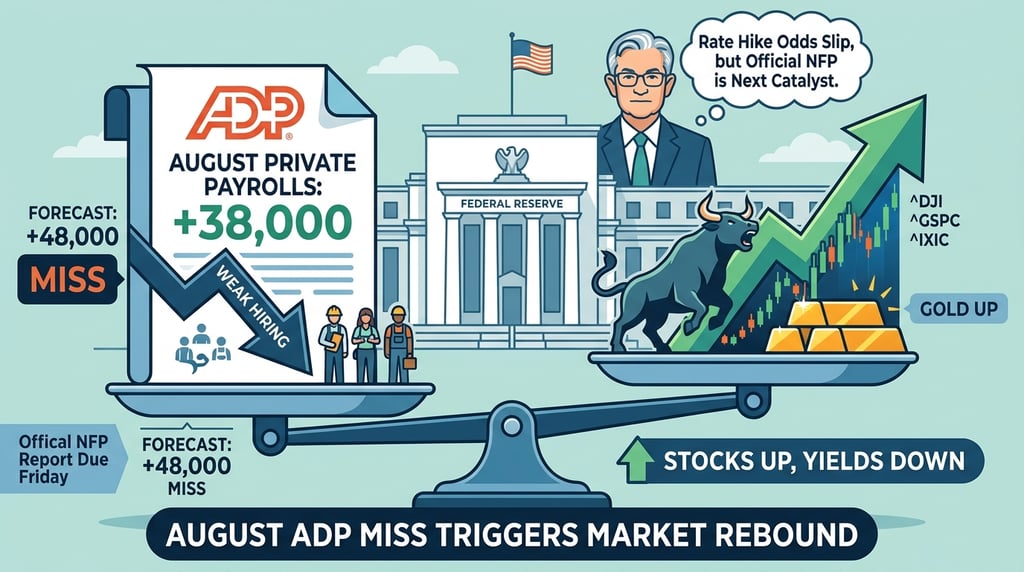
Did a single private-sector jobs print really flip three days of stock-market losses? U.S. equities rebounded after August ADP private payrolls rose only 38,000 versus a 48,000 consensus, the weakest reading since January, according to the ADP National Employment Report released September 2, 2026. Treasury yields fell, gold rose, and the Dow gained 0.56 percent while the S&P 500 and Nasdaq each added 0.46 percent, ending a three-session slide.
The official August nonfarm payrolls report due Friday remains the larger catalyst because it will either confirm cooling labor demand or keep September Fed hike odds elevated.
What Did the August ADP Report Actually Show?
August ADP private payrolls increased by 38,000 after a revised 46,000 in July and missed the 48,000 forecast, marking the slowest pace since January, according to ADP data published September 2, 2026. Education and health services added 45,000 jobs, leisure and hospitality gained 16,000, and construction rose 12,000. Manufacturing lost 17,000 positions and professional and business services shed 16,000.
Large firms with 500 or more employees accounted for most of the net gain at 34,000 jobs. Small firms added only 3,000 and mid-sized firms were flat. Annual pay growth for job-stayers held at 3.0 percent, according to the same ADP release.
ADP tracks private payrolls from more than 26 million workers and is treated as an early read on official Bureau of Labor Statistics figures. The two series do not move in lockstep every month, so Friday’s government report can still diverge.
Why Did Weak ADP Data Trigger a Stock Rebound and Yield Drop?
Weaker-than-expected hiring reduced near-term pressure on the Federal Reserve to tighten policy, which lifted risk assets and pulled Treasury yields lower on September 2. Markets had priced a high chance of a September rate increase after recent inflation data and Chair Kevin Warsh’s Jackson Hole remarks. The ADP miss briefly eased that concern.
Employment strength normally supports the case for higher rates because it signals an economy that can absorb tighter policy. Soft hiring points the other way: slower demand may eventually help inflation cool without additional tightening. That logic sent the 10-year yield lower and allowed equities to recover after three down days.
Gold also advanced as the dollar and real yields eased. The move was tactical rather than a full regime shift. Investors still await the official payrolls, unemployment rate, and wage figures that the Fed watches more closely.
How Reliable Is ADP as a Preview of Official Nonfarm Payrolls?
ADP is a useful but imperfect leading indicator. It often captures the direction of private-sector hiring yet frequently misses the official headline by tens of thousands of jobs. July official nonfarm payrolls fell 23,000, according to the Bureau of Labor Statistics August 7 release, while ADP had shown a modest private-sector gain that month.
Economists surveyed ahead of Friday’s report expect August nonfarm payrolls to rebound by roughly 53,000 to 65,000 after July’s surprise decline, according to Wall Street Journal and FactSet compilations published September 2, 2026. Unemployment is seen near 4.1 percent or edging up to 4.2 percent. Average hourly earnings are forecast to rise 0.3 percent month-over-month.
Immigration restrictions, lower birth rates, and an aging population have slowed labor-force growth, according to Bloomberg reporting cited in recent market notes. When supply barely expands, even modest job gains can keep the unemployment rate low. That structural backdrop is why Fed officials can view a 38,000 ADP print as consistent with a balanced market rather than outright weakness.
What Did Fed Chair Warsh Say About the Labor Market at Jackson Hole?
Chair Kevin Warsh described the labor market as consistent with full employment in his August 28, 2026 Jackson Hole speech. He acknowledged pockets of softness, including among recent graduates, but stated that people who want work are generally holding or finding jobs.
“When labor supply growth is nearly stagnant, monthly job gains will naturally run low,” Warsh said, according to the Federal Reserve’s published remarks. “Overall, those who want to work are, by and large, employed.” Unemployment remains near 4.1 percent, a level he called compatible with the Fed’s employment mandate.
Warsh placed greater emphasis on inflation still running above the 2 percent target. He said policymakers must be confident that underlying price pressures are moving toward the goal at sufficient speed; otherwise the Fed “has work to do.” That framing keeps a September hike on the table even after a soft ADP number.
How Did CME FedWatch Odds Change After the ADP Release?
September rate-hike probability slipped only modestly to 62.3 percent after the ADP print, according to CME FedWatch Tool readings cited in post-release market commentary on September 2, 2026. The figure remains well above a coin-flip and shows that one weak private-sector report did not eliminate tightening risk.
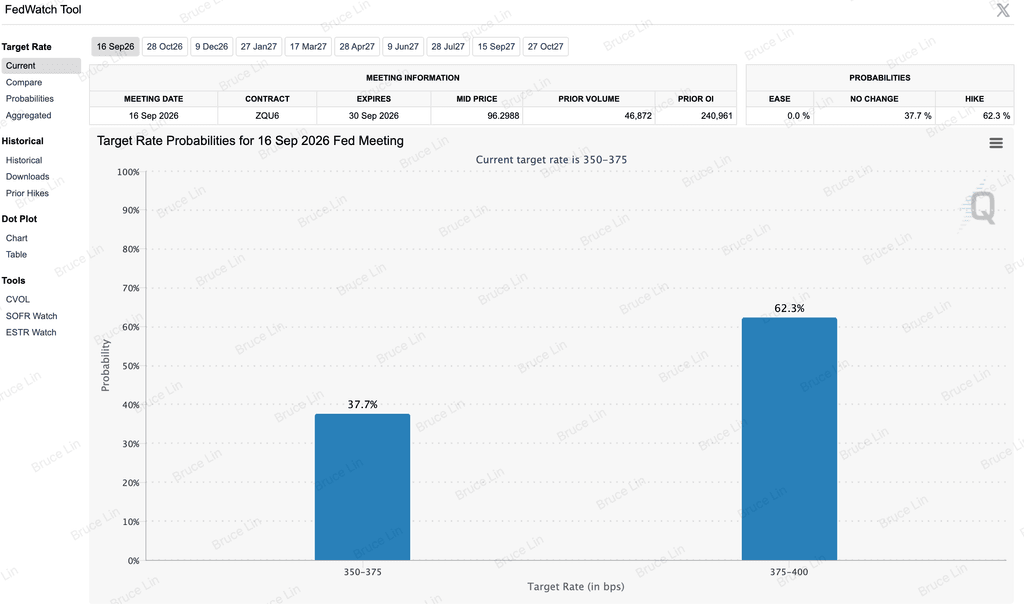
Odds had climbed earlier in the week after Warsh’s speech and firmer inflation signals. The limited decline after ADP underscores that officials still view the overall labor market as tight enough to prioritize inflation. Friday’s official payrolls, wages, and unemployment rate will therefore carry more weight than the ADP miss.
A stronger-than-expected NFP print, especially if wages accelerate, could push hike odds higher again. A clear miss that also lifts the unemployment rate could pull them lower. Either outcome is likely to move stocks, bonds, and the dollar in the first minutes after the 8:30 a.m. ET release.
What Structural Forces Are Holding Back U.S. Job Growth?
Tighter immigration rules, declining birth rates, and population aging have constrained labor-supply growth, according to Bloomberg analysis referenced in September 2026 market reports. Government data still show historically low unemployment, which supports the Fed view that the market is roughly balanced.
Low labor-force growth means the “breakeven” level of monthly job gains needed to keep unemployment stable is itself lower than in prior cycles. That is why officials can describe 38,000 private jobs as compatible with full employment even though the number looks weak by 2021–2023 standards.
Sector patterns also matter. Health care and education continue to hire while manufacturing and some professional services contract. The uneven picture gives the Fed room to look through a single soft ADP month and wait for the official report plus upcoming inflation data.
Trade the Setup on KuCoin and Enter the Prize Pool
When a market narrative is in motion, the next step is not only to decide the view, but to place it where liquidity, tools, and extra incentives line up. KuCoin’s KuLeague (Fall Season 2026) futures trading competition runs from August 31 to September 21, 2026 (UTC+8) and offers a 400,000 USDT prize pool, split across a Team Battle (100,000 USDT), a Solo PnL Contest (60,000 USDT), and a Grand Lucky Draw (240,000 USDT).
Trade $500 in a day to unlock a daily spin with a 100% prize rate. Use the same positions you would take for the story above — and compete for rewards at the same time:

Conclusion
August ADP private payrolls of 38,000 versus 48,000 expected delivered a short-lived equity bounce and a modest dip in September Fed hike odds to 62.3 percent. The official nonfarm payrolls report on Friday remains the higher-stakes event because it includes government jobs, the unemployment rate, and wage data the FOMC actually cites. Chair Warsh has already signaled that a stable labor market near full employment allows the Fed to keep inflation as its primary focus.
Structural limits on labor supply help explain why officials can treat low monthly job gains as consistent with balance rather than collapse. Investors therefore face a two-sided risk: a rebound toward 55,000-plus payrolls could revive tightening bets, while another miss could extend the relief.
FAQs
What time is the August nonfarm payrolls report released?
The Bureau of Labor Statistics publishes the Employment Situation report at 8:30 a.m. Eastern Time on Friday, September 4, 2026.
Does a weak ADP report always mean a weak official NFP?
No. ADP and BLS private-payroll estimates frequently diverge by 20,000–50,000 jobs in a given month, so Friday’s headline can still surprise in either direction.
Will the Fed hike in September if NFP comes in near 55,000?
A print near consensus would leave hike odds little changed because officials already view the labor market as consistent with full employment; inflation data later in September will matter more.
Disclaimer: This article is for informational purposes only and does not constitute financial, legal, or investment advice. Always conduct your own research before interacting with digital assets.