

Vitalik Buterin’s Snowmoon: The Open-Source Sci-Fi Novel on Zero-Knowledge Proofs, Quadratic Voting, and Digital Sovereignty
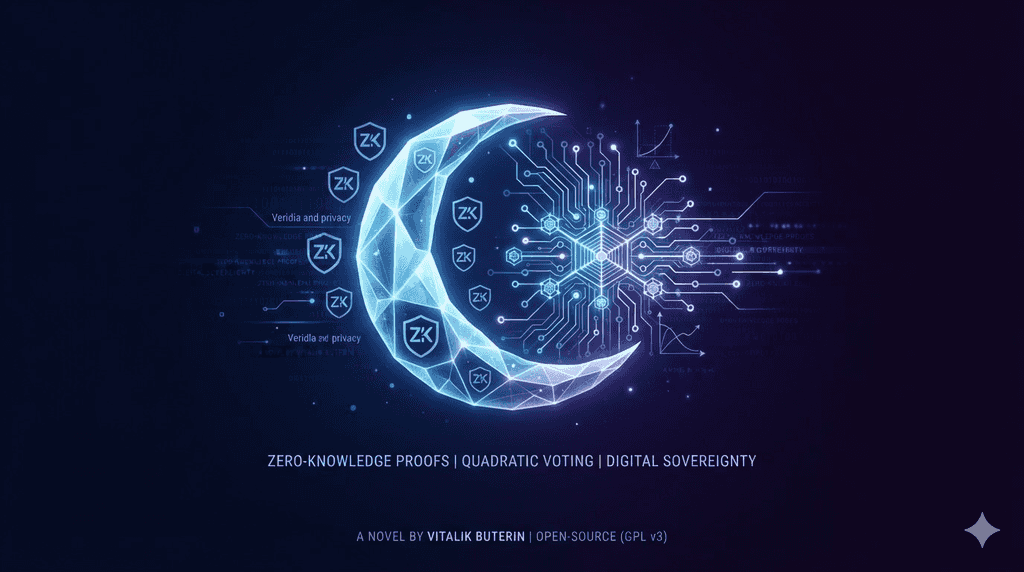
In late September 2026, Ethereum co-founder Vitalik Buterin published Snowmoon, a 32-chapter speculative science fiction novel. Moving beyond his standard output of protocol architecture whitepapers and technical blog posts, this project utilizes narrative fiction to explore decentralized governance, zero-knowledge proofs, and quadratic voting. The text serves as a conceptual model demonstrating the practical application of Web3 principles within a fictional society, moving cryptographic concepts from theoretical mathematics into structured world-building.
Rather than utilizing traditional publishing channels, Buterin opted for an open-source distribution model, applying the GPL v3 software license to the literary work. By doing so, he establishes specific intellectual property boundaries for future derivative projects, effectively demanding that adaptations adhere to open-source transparency standards.
Key Takeaways
-
Ethereum co-founder Vitalik Buterin released his first full-length speculative sci-fi novel, Snowmoon, completing the 32-chapter work in late September 2026.
-
The narrative systematically integrates Web3 governance structures—specifically zero-knowledge (ZK) proofs, quadratic voting, and cryptographic sortition—into a functional societal framework.
-
Snowmoon is licensed under the General Public License version 3 (GPL v3). Derivative works are permitted, provided the creator open-sources their entire creative pipeline, including scripts and AI prompts.
-
Buterin confirmed the text was authored entirely by him. Artificial intelligence tools were strictly restricted to auxiliary functions, including spell-checking, grammatical consistency verification, and formatting.
-
The plot centers on the ideological and structural conflict between Veridia, a cryptographic city-state focused on privacy, and the Arctic Empire, a highly centralized surveillance regime.
The Shift to Speculative Fiction
For over ten years, Buterin’s writing has primarily focused on the technical requirements of the Ethereum network, including Layer-2 scaling solutions, consensus mechanisms, and the mathematical proofs necessary to secure blockchain infrastructure. Snowmoon represents a shift from detailing the mathematical engineering of these systems to illustrating their hypothetical societal application.
Speculative fiction has historically served as a method for testing political and technological theories in simulated environments. By constructing a narrative, Buterin provides a practical framework for concepts that are often confined to academic discussions or governance forums. This approach allows developers, researchers, and general readers to observe how cryptographic mechanism design might influence civic behavior, resource allocation, and individual privacy. The objective is to translate abstract code into tangible social structures, providing a clearer view of the end-state goals of the decentralized technology sector. Instead of arguing for privacy mathematically, the novel demonstrates the utility of privacy tools in the daily routines of its characters.
Human Authorship in the Age of Generative LLMs
The publication of Snowmoon occurs during a period characterized by the widespread use of Large Language Models (LLMs) and generative artificial intelligence for content creation. In this context, Buterin established specific boundaries regarding the origin of the novel's text. Upon the release of the final chapter, he included a statement confirming the human authorship of the narrative, noting that "Snowmoon was written with love".
According to his explicit public disclaimers, the core elements of the novel—including narrative structure, character arcs, and philosophical dialogues—were written entirely by him. The use of artificial intelligence was restricted to the periphery of the creative process. Specifically, AI tools were utilized exclusively for spell-checking, grammar correction, verifying world-building consistency across the 32 chapters, and generating the final web layout. This distinction emphasizes the cypherpunk perspective that human intent should remain central to cultural production, even as synthetic generation tools become increasingly accessible and sophisticated.
Licensing and Derivative Works: The GPL v3 Requirement
A notable aspect of Snowmoon is its licensing structure. The novel is not controlled by a traditional publishing house; instead, it is open-sourced under the General Public License version 3 (GPL v3). This license is typically utilized for software development to ensure code remains open and accessible across iterations.
Applying GPL v3 to a literary work establishes strict parameters for how the community can interact with the text. Buterin has explicitly stated that he permits and encourages the adaptation of Snowmoon into derivative works, such as animations, films, or graphic novels. However, the "copyleft" provision of the license introduces a stringent requirement: creators of derivative works must open-source their entire creative pipeline.
If a creator utilizes AI image generators, video rendering software, or automated scripting tools to adapt a scene from the novel, releasing the final product alone is insufficient. They are legally obligated to publish their entire workflow under the same GPL v3 license. This includes releasing exact AI prompts, storyboards, editing scripts, and any non-generic materials used during production. The stated goal of this requirement is to maintain transparency in the creative process and prevent the enclosure of derivative works within proprietary, closed-source corporate systems.
The Ideological Conflict: Veridia vs. The Arctic Empire
The central narrative of Snowmoon is driven by the structural and ideological conflict between two contrasting societies. This dynamic functions as a direct allegory for contemporary debates regarding digital sovereignty, data privacy, and centralized state control.
Veridia: The Cryptographic City-State
Veridia serves as the fictional realization of cypherpunk and Web3 ideals. It is a decentralized city-state where civic trust relies on cryptography rather than centralized bureaucracies. Citizens within Veridia manage their interactions with public infrastructure and each other primarily through zero-knowledge (ZK) proofs.
In this society, individuals can cryptographically prove specific attributes—such as meeting the voting age requirement, fulfilling tax obligations, or holding professional qualifications—without disclosing their underlying personal data, birthdates, or financial histories. The system operates on the premise that privacy is a foundational human right and that large-scale social coordination does not necessitate the harvesting of personal information. By embedding ZK proofs into everyday governance, Veridia demonstrates a society where verifying truth does not require sacrificing anonymity.
The Arctic Empire: Centralized Surveillance
In direct opposition to Veridia is the Arctic Empire, an autocratic entity representing the logical extreme of centralized data harvesting and Web2 surveillance models. The Empire maintains control through a panoptic surveillance apparatus, recording and analyzing all citizen transactions, communications, and movements through an opaque central authority.
The narrative utilizes the conflict between these two factions to examine the operational vulnerabilities of both models. The plot tests whether a society structured around decentralized cryptographic consensus can effectively coordinate resources to defend against a hierarchical, highly organized military power. It poses the question of whether decentralized networks can scale to manage existential physical threats without defaulting to centralized authority.
Integrating Mechanism Theory into Fictional Society
A primary function of Snowmoon is to contextualize complex economic and governance mechanisms currently debated within the Ethereum ecosystem. The novel illustrates how these abstract concepts would function in the daily lives of its characters.
Zero-Knowledge Proofs in Daily Life
Beyond basic credential verification, the novel explores the routine application of ZK technology. Citizens of Veridia use zero-knowledge protocols to navigate public transit, access specific municipal zones, and conduct private financial transactions. By embedding these protocols into the narrative, the text demonstrates the practical utility of cryptographic privacy in physical environments, moving the discussion past Layer-2 scaling rollups into tangible user experiences.
Quadratic Voting and Funding in Civic Assemblies
In traditional democratic frameworks, resource allocation often relies on a one-person-one-vote system, which can occasionally result in the suppression of minority interests by a simple majority. Snowmoon depicts Veridia allocating its public resources using Quadratic Voting (QV) and Quadratic Funding (QF).
During civic assemblies, citizens are allocated a budget of "voice credits" to vote on municipal infrastructure and public goods. They possess the ability to allocate multiple credits to a single issue they prioritize, but the cost of each subsequent vote increases quadratically (e.g., one vote costs one credit, two votes cost four credits, three votes cost nine credits). This mechanism allows the society to measure both the direction and the intensity of public preference. It provides a structural defense against plutocracy while ensuring that deeply invested minority groups have a quantifiable impact on collective decisions regarding infrastructure and civic defense.
Cryptographic Sortition
The novel also outlines alternative civic structures, notably cryptographic sortition. Rather than electing career representatives who are subject to lobbying, Veridia fulfills its governance and civic jury duties by randomly selecting citizens through verifiable on-chain randomness. This modern adaptation of ancient Athenian sortition is presented as a method to distribute governance responsibilities evenly among the population. The text suggests that relying on cryptographic randomness mitigates the influence of campaign finance and political tribalism, rotating power fairly across the populace.
Content-Based Taxation Models
Additionally, Snowmoon incorporates experimental economic models into its world-building. The text references content-based taxation mechanisms, drawing conceptual inspiration from Harberger taxes. In this model, taxation is calculated not purely on individual income, but on the consumption and monopolization of rivalrous public resources. This ensures that assets are continually priced by the market, preventing resource hoarding and expanding the economic theories tested within the narrative framework.
Conclusion
While categorized as speculative fiction, Snowmoon functions as an accessible reference document for the theoretical end goals of the decentralized technology sector. When software engineers develop ZK-rollups or decentralized identity (DID) protocols, the objective extends beyond increasing transaction throughput or establishing new financial derivatives. The overarching goal, as depicted in the societal structure of Veridia, is to facilitate and secure digital sovereignty.
This involves providing individuals with cryptographic tools capable of protecting their wealth, privacy, and organizational capacity from centralized overreach. By translating mathematical models into a narrative format, Buterin outlines the cultural and philosophical motivations driving Web3 development. Establishing a decentralized network infrastructure requires not only robust, secure code but also a cohesive understanding of the societal structures that code is intended to support.
By publishing the 32-chapter novel under the GPL v3 license, Vitalik Buterin has established a functional framework for open-source storytelling. The strict requirement that derivative works maintain fully transparent creative pipelines ensures that the mechanics of adaptation remain accessible to the public. Through the structured conflict between Veridia and the Arctic Empire, the text successfully translates complex mechanisms like zero-knowledge proofs and quadratic voting from technical theory into observable civic practice, offering a definitive model for digital sovereignty based on cryptographic principles.
🔥 Beyond the Headlines: What KuCoin 5.0 Means for You
Market news moves fast — but where you act on it matters just as much. This October, KuCoin launches KuCoin 5.0, transforming KuCoin into a rebuilt platform. Here's what actually changes for you:
-
One account for everything. Older platforms split your money across separate "spot," "margin," and "futures" accounts and expected you to understand why. KuCoin 5.0's unified account removes that entirely — deposit once, and everything is simply there (only available to VIPs for now).
-
Stocks, indices, and commodities. KuCoin 5.0 expands beyond crypto into global markets. When crypto chops sideways and equities rally (or the reverse), you rotate in minutes instead of opening a brokerage account and waiting days for fiat rails.
-
Real-world assets (RWA). Tokenized exposure to traditional assets like commodities, right inside your crypto account. One of the fastest-growing segments in global finance is no longer reserved for institutions — you access it from the same balance you trade with.
-
Earn while you learn. Not ready to trade? KCUSD lets your stablecoins earn daily, auto-compounding interest. The lowest-stress way to put your idle deposit to work for 4% yield.
-
An AI assistant in plain language. Ask questions, get market context, understand what you're looking at — built into the platform, no jargon required.
-
An app that doesn't overwhelm. Faster, cleaner, and consistent — intuitive from the first tap, not after a tutorial.
-
Safety you can check, not just trust. A MiCAR-licensed EU entity, Proof of Reserves you can verify yourself, and internationally certified security (SOC 2 Type II, ISO 27001:2022).
Create your account in minutes — and start on the platform built for where crypto is going, not where it's been.
FAQs
What is the core subject of Vitalik Buterin's novel Snowmoon?
Snowmoon is a 32-chapter speculative sci-fi novel exploring a future society built on cryptographic principles, focusing on the conflict between the decentralized city-state of Veridia and the centralized Arctic Empire.
How does the novel depict quadratic voting?
Citizens use "voice credits" to vote on public infrastructure. The cost of multiple votes increases quadratically, measuring the intensity of preference while preventing wealthy individuals from monopolizing public decisions.
How are zero-knowledge proofs utilized in the story?
ZK proofs allow citizens of Veridia to verify their credentials, such as voting age or qualifications, without revealing their underlying personal data, ensuring privacy in public life.
Is the novel Snowmoon available as open-source material?
Yes, the novel is released under the General Public License version 3 (GPL v3), allowing the public to read, distribute, and adapt the text according to open-source standards.
What is cryptographic sortition in the context of the novel?
Instead of electing career politicians, Veridia selects citizens for civic juries and governance duties through verifiable on-chain randomness, rotating responsibilities evenly among the population.
Disclaimer
The information provided on this page may originate from third-party sources and does not necessarily represent the views or opinions of KuCoin. This content is intended solely for general informational purposes and should not be considered financial, investment, or professional advice. KuCoin does not guarantee the accuracy, completeness, or reliability of the information, and is not responsible for any errors, omissions, or outcomes resulting from its use. Investing in digital assets carries inherent risks. Please carefully evaluate your risk tolerance and financial situation before making any investment decisions. For further details, please consult KuCoin’s Terms of Use and Risk Disclosure.