

Vitalik Warns AI Could Threaten ECDSA Sooner Than Expected: Should Crypto Holders Move Funds?
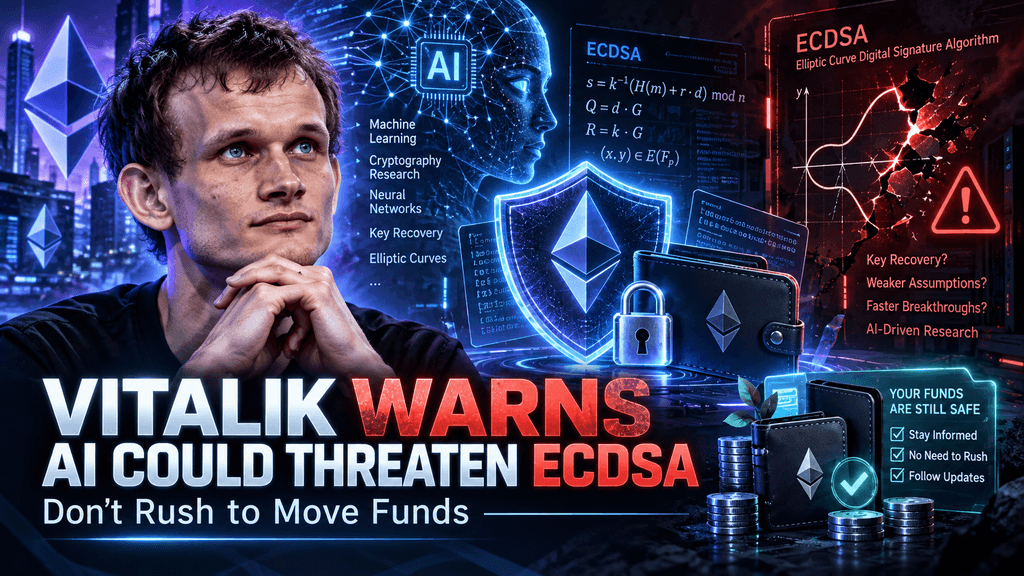
Ethereum co-founder Vitalik Buterin has raised concerns that rapid advances in artificial intelligence could accelerate breakthroughs in cryptographic mathematics, potentially challenging the security assumptions behind major blockchain technologies sooner than expected. The warning has renewed discussions about the Elliptic Curve Digital Signature Algorithm (ECDSA), lattice-based cryptography, and the long-term safety of Bitcoin and Ethereum wallets. However, Buterin has also cautioned against rushing to move cryptocurrency holdings, emphasizing that unnecessary wallet migrations can introduce immediate security risks.
The debate highlights a growing challenge for the cryptocurrency industry: preparing for future cryptographic threats without creating unnecessary panic today. Although AI has not been publicly demonstrated to break ECDSA, increasingly capable mathematical reasoning systems could change how researchers evaluate the security of existing algorithms. With Ethereum already developing post-quantum infrastructure, the central question is whether blockchain security can evolve quickly enough while protecting users from both future attacks and present-day operational mistakes.
What Did Vitalik Buterin Actually Warn About?
AI Mathematical Advances Raise New Cryptographic Concerns
The latest discussion emerged in early October 2026 as improvements in AI-assisted mathematical research prompted renewed debate about the security assumptions underlying modern cryptography. Ethereum researcher Justin Drake raised concerns that increasingly capable AI systems could accelerate the discovery of mathematical techniques capable of weakening established cryptographic methods.
Buterin subsequently emphasized that these developments deserve serious attention, particularly for cryptographic systems whose security depends on the assumed difficulty of specific mathematical problems. His concerns extended beyond ECDSA to lattice-based schemes, which are widely considered important building blocks for post-quantum security.
Importantly, the warning should not be interpreted as a prediction that AI will definitely break ECDSA within two years. The shorter timeframe discussed in the debate concerns uncertainty surrounding AI-driven mathematical progress, especially the possibility that some lattice-based constructions could experience meaningful reductions in their estimated security margins. A practical attack against ECDSA has not been publicly demonstrated.
Why Did Vitalik Advise Against Rushing Wallet Migrations?
Despite the potential long-term implications, Buterin discouraged users from immediately moving cryptocurrency holdings in response to the discussion. His reasoning reflects a distinction between hypothetical future cryptographic weaknesses and the well-established operational risks associated with transferring digital assets.
Moving funds requires users to manage private keys, transaction destinations, network compatibility, and potentially unfamiliar wallet software. A single mistake, including sending assets to an unsupported address or exposing a recovery phrase, can cause irreversible losses. Moving assets into a newly created wallet that still uses ECDSA also does not eliminate the underlying cryptographic dependency.
The practical message is therefore one of preparation rather than emergency action. Users should follow official security developments, maintain strong wallet practices, and avoid unverified migration tools. Developers and institutions, meanwhile, should begin evaluating how future cryptographic upgrades could be deployed safely across existing blockchain infrastructure.
How Could AI Threaten ECDSA Security?
How ECDSA Protects Ethereum and Bitcoin Wallets
ECDSA, short for Elliptic Curve Digital Signature Algorithm, is a public-key cryptographic system used to authenticate blockchain transactions. It allows users to prove that they control a private key without revealing that key to the network.
In standard Ethereum externally owned accounts, private keys generate digital signatures that can be verified using corresponding public keys. Ethereum relies on ECDSA over the secp256k1 elliptic curve for these account signatures. Bitcoin also uses ECDSA in traditional transaction types, while Taproot transactions use Schnorr signatures based on related elliptic curve mathematics.
The security of these systems depends on the difficulty of recovering a private key from its public key. For properly implemented ECDSA, this problem is computationally infeasible using currently known practical classical methods. That mathematical difficulty has helped protect blockchain accounts containing substantial amounts of digital assets.
Could AI Discover a Shortcut to Private Keys?
AI does not automatically defeat modern cryptography simply by processing information faster. A successful attack against properly implemented ECDSA would require a fundamentally effective algorithmic breakthrough, a weakness in the implementation, compromised key generation, or another exploitable security failure.
The concern surrounding advanced AI is more subtle. Mathematical reasoning systems may help researchers explore large spaces of potential algorithms, identify unexpected relationships, or improve existing cryptanalytic techniques. If such systems discover new methods that substantially reduce the computational difficulty of elliptic curve discrete logarithms, existing estimates of ECDSA security could change.
Historical progress in mathematics illustrates why algorithmic discoveries matter. Improvements in integer factorization algorithms have made previously difficult computations more practical without requiring equivalent increases in hardware performance. However, integer factorization and elliptic curve discrete logarithms are different problems. Progress in one does not prove that the other can be solved efficiently.
At present, there is no publicly verified AI-generated algorithm capable of recovering arbitrary ECDSA private keys from their public keys at a practical scale. The warning concerns a possible future change in mathematical knowledge, not a currently demonstrated compromise of cryptocurrency wallets.
AI vs Quantum Computing: What's the Difference?
Quantum Computers Present a More Established Theoretical Threat
The risks associated with AI-assisted cryptanalysis differ fundamentally from those posed by quantum computing. Large-scale fault-tolerant quantum computers could use Shor's algorithm to solve the discrete logarithm problems underlying elliptic curve cryptography efficiently.
This creates a well-established theoretical vulnerability for ECDSA and Schnorr signatures. Given sufficient quantum computing resources and access to a relevant public key, an attacker could potentially derive the corresponding private key and produce unauthorized signatures.
However, the necessary quantum hardware is not currently available at a practical scale. In March 2026, Google Quantum AI published research suggesting that attacking 256-bit elliptic curve cryptography could require approximately 1,200 logical qubits, a substantially lower estimate than some earlier projections. The engineering challenges associated with fault correction and reliable quantum computation remain significant.
AI Could Change the Timeline Through Mathematical Discovery
AI-related threats do not necessarily require a quantum computer. Their potential impact would depend on whether advanced systems can discover more efficient classical algorithms or expose weaknesses in particular cryptographic constructions.
Unlike the known theoretical vulnerability created by Shor's algorithm, an AI-enabled breakthrough against ECDSA remains speculative. There is no established timetable or demonstrated attack showing that it will happen.
| Security Dimension | AI-Assisted Cryptanalysis | Quantum Computing |
| Primary mechanism | Discovering algorithms or mathematical weaknesses | Quantum algorithms applied to hard problems |
| ECDSA threat | Hypothetical algorithmic breakthrough | Established theoretical vulnerability |
| Practical attack available today | No verified general ECDSA break | No practical large-scale quantum attack |
| Main uncertainty | Future mathematical discoveries | Hardware scale and error correction |
| Long-term response | Stronger analysis and cryptographic agility | Post-quantum cryptographic migration |
Both risks explain why blockchain developers are increasingly interested in cryptographic agility: the ability to replace vulnerable algorithms without destabilizing existing networks or user accounts.
Why Are Lattice-Based Cryptography and ML-DSA Under Scrutiny?
Lattice Cryptography Is Central to Post-Quantum Security
Lattice-based cryptography is one of the leading approaches to protecting digital systems against future quantum attacks. Its security relies on mathematical problems involving high-dimensional lattices that are believed to remain computationally difficult even for quantum computers.
In August 2024, the US National Institute of Standards and Technology finalized three major post-quantum cryptography standards. FIPS 203 specifies ML-KEM, a lattice-based key encapsulation mechanism. FIPS 204 defines ML-DSA, a lattice-based digital signature algorithm. FIPS 205 specifies SLH-DSA, a hash-based signature system.
These standards address different cryptographic requirements. ML-KEM supports secure key establishment, while ML-DSA and SLH-DSA support authentication through digital signatures. Their development represents an important step toward reducing dependence on mathematical assumptions vulnerable to known quantum algorithms.
Why Could AI Affect Post-Quantum Security Estimates?
Buterin's concern about the next two years is particularly relevant to lattice-based cryptography because improved mathematical techniques could change the estimated difficulty of attacking certain lattice problems.
Cryptographers evaluate algorithms using the best attacks currently known. If researchers discover substantially more efficient methods, the security margins associated with particular parameter choices may decrease. AI systems capable of assisting with advanced mathematics could potentially accelerate this process.
However, a reduction in estimated security strength is not equivalent to a complete break. A new algorithm might make an attack somewhat cheaper without making it practical. Its consequences would depend on the affected mathematical problem, specific cryptographic construction, implementation, and parameter set.
For developers, this uncertainty supports conservative security parameters, independent audits, and contingency planning. It also highlights the value of cryptographic diversity, since relying entirely on one mathematical family can create concentrated exposure to a future breakthrough.
Hash-Based Signatures Offer an Alternative Security Foundation
Hash-based signature systems provide an alternative to lattice-based digital signatures. Their security primarily depends on cryptographic hash functions rather than elliptic curve discrete logarithms or particular lattice problems.
NIST's SLH-DSA standard reflects this approach, offering a post-quantum signature mechanism based on established hash-based constructions. Ethereum researchers are also exploring hash-based approaches for validator authentication.
Nevertheless, hash-based schemes introduce practical tradeoffs. Signatures and public keys may be larger, verification costs can differ from existing schemes, and some constructions require careful management of signing state. Consequently, transitioning to post-quantum signatures involves more than replacing one mathematical formula with another.
Should Ethereum and Bitcoin Holders Move Their Funds?
Public Key Exposure Matters for Future Security
An important consideration is whether an account's public key has already been revealed.
On Ethereum, a standard externally owned account that has only received ETH and has never sent a transaction generally exposes its address without revealing the full public key on-chain. Once the account signs and broadcasts a transaction, observers can recover the public key from its signature.
If a future attacker gains the ability to derive private keys efficiently from public keys, accounts with exposed public keys could face more direct risks. Accounts whose public keys remain concealed behind address hashing may have an additional layer of protection, although this does not make them permanently immune.
Bitcoin also has transaction structures in which public keys become visible, although exposure patterns depend on address and script type. Users should not assume that all Bitcoin addresses have identical cryptographic characteristics or that simply creating a new address eliminates every future threat.
Why Immediate Transfers May Create More Risk Than Protection
A rushed transfer can introduce immediate vulnerabilities that have nothing to do with quantum computing or advanced AI.
For example, users may inadvertently disclose recovery phrases to malicious websites claiming to provide quantum-resistant wallets. Others might move assets to untested smart contracts, unsupported networks, or addresses they no longer control.
A newly generated ordinary Ethereum wallet still uses the same ECDSA-based security model. Although moving assets to an address with an unrevealed public key can change a particular exposure condition, it does not constitute a full transition to post-quantum cryptography.
The more practical response is to maintain secure backups, use trustworthy wallet software, verify transaction destinations, and wait for audited migration mechanisms supported by the relevant blockchain ecosystem.
What Should Long-Term Crypto Holders Consider?
Long-term cryptocurrency holders should focus on secure key management and the ability to adapt when official protocol upgrades become available. Hardware wallet users should maintain verified firmware and follow manufacturer security announcements rather than assuming that current hardware devices already provide complete post-quantum protection.
Institutions face additional responsibilities because they may manage multiple signing systems, custody arrangements, smart contract permissions, and organizational approval procedures. Preparing a cryptographic migration plan can reduce operational risk if future security standards change.
The central principle is that preparing for a possible threat is different from acting as though the threat has already materialized. There is currently no verified general-purpose AI attack capable of breaking properly implemented ECDSA, and users should not interpret speculative timelines as deadlines for transferring funds.
Lean Ethereum Introduces Hash-Based Security Research
Ethereum has already begun developing a long-term strategy to replace cryptographic components vulnerable to future quantum attacks. The Lean Ethereum roadmap targets several areas, including validator signatures, account authentication, data commitments, and zero-knowledge proof systems.
One important initiative is leanXMSS, a hash-based signature scheme being researched as a potential replacement for the BLS signatures currently used by Ethereum validators. Because BLS signatures rely on elliptic curve mathematics, they face theoretical risks from sufficiently powerful quantum computers.
Ethereum researchers are also developing leanVM, a minimal zero-knowledge virtual machine intended to help aggregate and verify larger post-quantum signatures efficiently. These systems remain under development, with interoperability testing and performance evaluation necessary before broad deployment.
Account Abstraction Could Enable Safer Wallet Upgrades
Ethereum's account abstraction roadmap may provide another important mechanism for protecting users. EIP-8141, under consideration for the Hegotá upgrade, aims to give accounts greater flexibility in how transactions are authorized.
Rather than requiring every account to continue relying exclusively on ECDSA, cryptographic agility could allow compatible wallets to adopt alternative signature verification methods. This would create opportunities for users and institutions to transition toward post-quantum signatures as suitable infrastructure becomes available.
However, account abstraction does not automatically make existing wallets quantum-resistant. Wallet developers must implement secure validation logic, users must have access to compatible software, and protocols must support efficient verification of the new signatures.
Ethereum's roadmap targets major post-quantum infrastructure milestones around 2029, although full ecosystem migration may extend beyond that period. These dates are development objectives rather than guarantees.
Ethereum Must Upgrade More Than Wallet Signatures
Post-quantum preparation extends beyond individual wallet security. Ethereum's validator consensus mechanism uses BLS signatures, while its scaling infrastructure relies on cryptographic commitments and various zero-knowledge proof systems.
Some commitment and proof constructions depend on mathematical assumptions that quantum computers could eventually undermine. Alternative approaches, including hash-based STARK systems and new commitment schemes, may help reduce these dependencies.
A successful transition must balance security with scalability. Larger signatures and additional verification costs could affect transaction throughput, data availability, and network fees. Ethereum's challenge is therefore to introduce stronger cryptographic protection without sacrificing the performance needed for decentralized finance, payments, and rollup-based applications.
What Does Vitalik's AI Warning Mean for Crypto Markets?
The immediate market implications of Buterin's warning should be distinguished from its long-term technological significance. There is no publicly confirmed AI-enabled ECDSA break, and the warning alone does not establish a direct explanation for movements in Ethereum or Bitcoin prices. Cryptocurrency valuations continue to reflect broader factors, including liquidity, institutional investment, macroeconomic conditions, and investor risk appetite.
Over a longer period, cryptographic security may become an increasingly important consideration for institutional adoption. Exchanges, custodians, and financial institutions managing substantial digital asset holdings need confidence that their signing infrastructure can evolve as security standards change. Developing credible post-quantum migration paths could strengthen the resilience of blockchain-based financial systems, although implementation costs and technical uncertainties remain significant.
🔥 Beyond the Headlines: What KuCoin 5.0 Means for You
-
One account for everything. Older platforms split your money across separate "spot," "margin," and "futures" accounts and expected you to understand why. KuCoin 5.0's unified account removes that entirely — deposit once, and everything is simply there (only available to VIPs for now).
-
Stocks, indices, and commodities. KuCoin 5.0 expands beyond crypto into global markets. When crypto chops sideways and equities rally (or the reverse), you rotate in minutes instead of opening a brokerage account and waiting days for fiat rails.
-
Real-world assets (RWA). Tokenized exposure to traditional assets like commodities, right inside your crypto account. One of the fastest-growing segments in global finance is no longer reserved for institutions — you access it from the same balance you trade with.
-
Earn while you learn. Not ready to trade? KCUSD lets your stablecoins earn daily, auto-compounding interest. The lowest-stress way to put your idle deposit to work for 4% yield.
-
An AI assistant in plain language. Ask questions, get market context, understand what you're looking at — built into the platform, no jargon required.
-
An app that doesn't overwhelm. Faster, cleaner, and consistent — intuitive from the first tap, not after a tutorial.
-
Safety you can check, not just trust. A MiCAR-licensed EU entity, Proof of Reserves you can verify yourself, and internationally certified security (SOC 2 Type II, ISO 27001:2022).
Create your account in minutes — and start on the platform built for where crypto is going, not where it's been.
Conclusion
Vitalik Buterin's latest warning reflects growing uncertainty about how rapidly AI could advance mathematical research and potentially challenge established cryptographic assumptions. While future breakthroughs could affect ECDSA or lattice-based security systems, no practical AI-enabled ECDSA break has been publicly verified. The discussion therefore represents a reason for preparation, not evidence of an ongoing compromise.
For cryptocurrency holders, avoiding unnecessary wallet migrations remains an important precaution against immediate operational risks. Meanwhile, Ethereum's post-quantum roadmap, hash-based signatures, and account abstraction research illustrate how blockchain infrastructure could gradually adapt to emerging threats. The industry's long-term security will depend on careful research, independently tested implementations, and migration processes that protect users without creating new vulnerabilities.
FAQs
Has Artificial Intelligence Already Cracked ECDSA?
No publicly verified AI system has demonstrated a practical general-purpose attack that derives arbitrary ECDSA private keys from public keys. Current concerns focus on possible future mathematical discoveries rather than an established exploit.
Can a Hardware Wallet Protect Against Future Quantum Attacks?
Hardware wallets help protect private keys from many current threats, including certain forms of malware and unauthorized signing. However, devices using ECDSA are not automatically resistant to future attacks against the underlying algorithm.
Does Ethereum Use the Same Cryptography as Bitcoin?
Both networks use elliptic curve cryptography, but their transaction and signature systems differ. Standard Ethereum accounts use ECDSA over secp256k1, while Bitcoin supports ECDSA and Schnorr signatures across different transaction types.
What Is the Difference Between ML-DSA and SLH-DSA?
ML-DSA is a lattice-based digital signature algorithm standardized by NIST. SLH-DSA uses hash-based cryptographic constructions. Both are designed to resist known quantum attacks, but they rely on different mathematical foundations and involve different performance tradeoffs.
Could a Future Cryptographic Break Affect Old Blockchain Transactions?
A future cryptographic weakness could create risks involving exposed public keys, historical encrypted information, or certain cryptographic proofs. The practical consequences would depend on the affected algorithm and protocol. Public blockchain transaction records are not automatically erased or rewritten by such a discovery.
Disclaimer: This content is for informational purposes only and does not constitute investment advice. Investments carry risk. Please do your own research (DYOR).