

USDe Briefly Depegs to $0.92 on Binance: Why Analysts Say the 1011 Risk Contagion Won’t Repeat
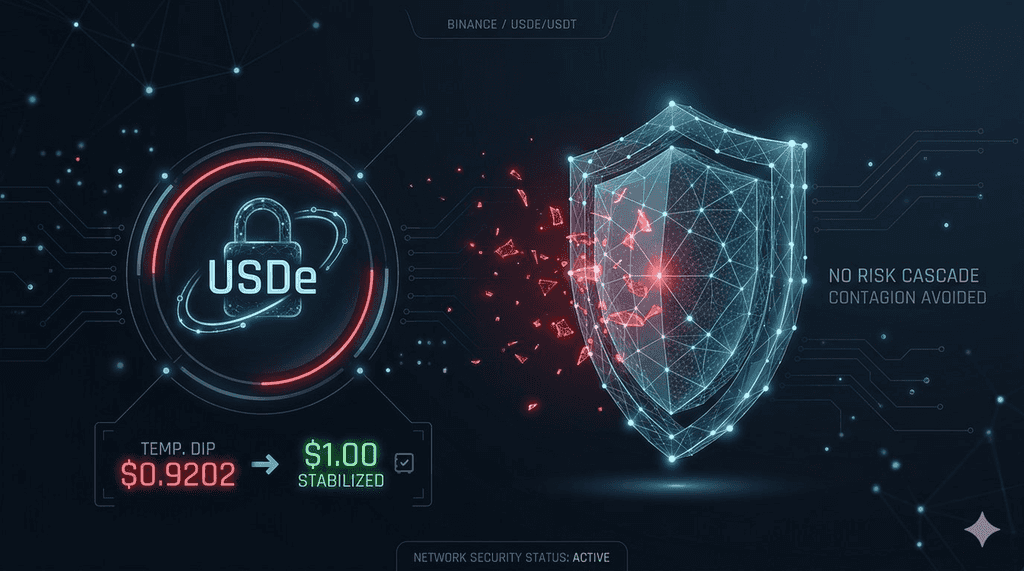
At 13:04 Beijing Time on September 22, 2026, Ethena Labs' synthetic dollar, USDe, registered a sharp anomaly on the world's largest cryptocurrency exchange. In a matter of seconds, the USDE/USDT spot trading pair on Binance wicked down to $0.9202, representing an 8% deviation from its intended dollar peg. Within minutes, algorithmic arbitrageurs and organic buyers absorbed the sell pressure, returning the asset to a stable $0.9996.
For veteran traders, any sharp deviation in a major stablecoin immediately resurrects the memory of the "1011 risk contagion", a historic liquidation cascade triggered by a similar USDe spot depeg in late 2025. However, market analysts and risk management firms quickly confirmed that the architectural vulnerabilities responsible for the 1011 crash have been patched.
Key Takeaways
-
On September 22, 2026, Ethena's synthetic dollar (USDe) experienced a brief flash crash on the Binance USDE/USDT spot market, wicking down to $0.9202 before recovering to $0.9996 within minutes.
-
The flash depeg was an isolated centralized exchange order book anomaly caused by pre-maintenance liquidity withdrawal, not a structural insolvency of Ethena's delta-neutral collateral.
-
Unlike the systemic October 11 (1011) crypto crash where a spot depeg triggered mass derivative liquidations, this event caused zero cascading margin calls.
-
Binance's reformed index price calculation now relies on multi-source on-chain oracle feeds rather than isolated spot order books, severing the link between thin spot wicks and collateral valuation.
What Happened on Binance?
The 8% price drop on September 22 was a localized liquidity event, strictly contained within a single spot trading pair on a single exchange. To understand why it occurred, it is necessary to examine the market conditions on the Binance platform at that specific time.
Order Book Thinning and the Flash Crash
While the flash crash occurred less than an hour before a scheduled Binance wallet system upgrade, blockchain data and market analysis show no definitive causal link between the upcoming maintenance and the depeg. The event was not driven by a coordinated, precautionary liquidity withdrawal by market makers ahead of the deposit suspension.
Instead, the flash crash was a classic instance of localized order book depletion. Due to a temporary organic drop in liquidity depth on the USDE/USDT spot book, the trading pair became exceptionally thin. When a relatively large market-price sell order was executed during this brief window, it instantly chewed through the available bid side, pushing the execution price down to a wick of $0.9202 before algorithmic arbitrageurs immediately stabilized the peg.
The 0.92 Spike and Swift Recovery to $0.999
Because the underlying asset remained fundamentally sound, the mispricing presented a direct arbitrage opportunity. Once the price hit $0.92, active trading bots and remaining market participants aggressively bought the discounted USDe.
Furthermore, on-chain data confirms that during the exact minute of the Binance flash crash, USDe's global average price and its exchange rate within primary decentralized finance (DeFi) liquidity pools, such as Curve Finance, remained steady at approximately $0.999. The depeg was a localized order book vacuum, not a systemic failure of Ethena's delta-neutral hedging mechanism.
What Caused the Historic $0.65 Contagion?
The immediate community panic following the $0.92 wick was rooted in recent history. On October 10 and 11, 2025, the cryptocurrency market experienced the "1011 crypto crash," a systemic liquidation event that erased tens of billions of dollars in open interest and affected over 1.6 million traders. The epicenter of that crash was a USDe depeg on Binance.
The 2025 Liquidation Cascade Explained
During the 1011 event, a sudden withdrawal of market maker liquidity, combined with temporary oracle latency, caused the USDe spot price on Binance to plummet to $0.65—a catastrophic 35% deviation.
However, the spot price drop was only the catalyst. The true destruction occurred within the derivatives market. USDe had become a highly popular asset used as collateral (margin) by traders opening leveraged futures positions.
Spot Depeg Triggering Derivative Liquidations
At the time of the 1011 event, Binance’s risk engine calculated the value of a user's collateral heavily based on the asset's internal spot market price. When the spot price of USDe wicked down to $0.65, the risk engine immediately registered a 35% drop in the collateral value for thousands of unified accounts.
This sudden, artificial drop in margin balance triggered automatic liquidations. The liquidation engine force-closed users' long positions by market-selling their assets, which drove broader market prices down. This caused more accounts to fall below their margin requirements, triggering further liquidations. The result was a devastating risk contagion loop where a localized spot market anomaly liquidated perfectly healthy derivative positions.
Why the 1011 Contagion Won’t Repeat: The Architectural Shift
The reason the September 2026 flash crash did not result in a single unwarranted margin call is that the architectural flaws exposed by the 1011 event have been systematically eliminated.
Reformed Index Pricing: Decoupling Spot Wicks from Collateral Value
The most critical upgrade implemented by Binance and other major exchanges following the 1011 crash was the reform of the index price calculation for collateral assets.
Exchanges no longer rely on their own thin spot order books to determine the real-time value of collateral. Instead, the Binance index price calculation for USDe now utilizes a robust, multi-source oracle feed that aggregates prices from deep on-chain liquidity pools (like Curve) and actual redemption values.
When the USDe spot price wicked to $0.92 on the isolated USDE/USDT pair, the global index price used by the liquidation engine remained anchored at $1.00. Because the risk engine recognized the spot wick as an anomaly rather than a true reflection of asset value, traders' collateral balances were not marked down, and the liquidation cascade was entirely prevented.
1011 Event vs. 2026 Flash Crash Comparison
| Metric | 1011 Crypto Crash (Oct 2025) | Flash Crash (Sep 2026) |
| Spot Depeg Depth | Dropped to $0.65 (35% deviation) | Dropped to $0.92 (8% deviation) |
| Duration of Anomaly | Sustained for hours | Recovered in minutes |
| Collateral Valuation Source | Internal CEX spot order book | Multi-source on-chain oracle feeds |
| Market Consequence | Systemic multi-billion liquidation cascade | Zero associated margin calls |
Robust On-Chain Liquidity and Delta-Neutral Resilience
Beyond exchange mechanics, Ethena Labs has continued to prove the resilience of its underlying synthetic dollar risk model. USDe maintains its peg through delta-neutral hedging—holding staked Ethereum and Bitcoin while simultaneously shorting equivalent amounts in the perpetual futures market. Despite the spot order book volatility, the actual on-chain minting and redemption mechanisms functioned flawlessly during the incident, keeping the true market value of the asset completely stable.
Institutional Maturation: Aladdin, FalconX, and $4.9B Supply
Since the 2025 crisis, USDe has matured into a $4.9 billion asset deeply embedded in both DeFi and traditional institutional finance. In 2026, BlackRock's Aladdin platform integrated USDe data, and crypto prime broker FalconX launched a $1 billion support facility for the asset. Furthermore, the rollout of the Ethena Pay neobank has diversified its retail holder base across 48 countries. This institutional scale ensures that isolated exchange anomalies are quickly arbitraged away by well-capitalized market participants before they can metastasize.
Trading Implications: Managing Stablecoin Collateral on Exchanges
The recent 0.92 wick serves as a practical case study for managing stablecoin collateral risks. While structural exchange upgrades have neutralized the threat of systemic liquidation contagion, traders must still navigate the realities of spot market volatility.
For users engaging in crypto arbitrage opportunities or yield farming, relying on a single centralized exchange order book for exiting large stablecoin positions during maintenance windows is highly discouraged. Traders should utilize on-chain liquidity pools or over-the-counter (OTC) desks for executing block trades to avoid incurring massive slippage.
Conclusion
The brief depeg of USDe to $0.92 on Binance demonstrates the lingering fragility of centralized spot order books during liquidity withdrawal. However, the market's reaction—and the complete absence of derivative liquidations—proves that the catastrophic 1011 risk contagion is a relic of the past.
By restructuring how collateral value is calculated and relying on decentralized oracle pricing, exchanges have successfully insulated their risk engines from localized spot wicks. Ethena's USDe continues to prove its delta-neutral resilience, confirming that while spot prices may occasionally decouple under thin liquidity, the structural integrity of the asset remains intact.
🔥 Beyond the Headlines: What KuCoin 5.0 Means for You
Market news moves fast — but where you act on it matters just as much. This October, KuCoin launches KuCoin 5.0, transforming KuCoin into a rebuilt platform. Here's what actually changes for you:
-
One account for everything. Older platforms split your money across separate "spot," "margin," and "futures" accounts and expected you to understand why. KuCoin 5.0's unified account removes that entirely — deposit once, and everything is simply there (only available to VIPs for now).
-
Stocks, indices, and commodities. KuCoin 5.0 expands beyond crypto into global markets. When crypto chops sideways and equities rally (or the reverse), you rotate in minutes instead of opening a brokerage account and waiting days for fiat rails.
-
Real-world assets (RWA). Tokenized exposure to traditional assets like commodities, right inside your crypto account. One of the fastest-growing segments in global finance is no longer reserved for institutions — you access it from the same balance you trade with.
-
Earn while you learn. Not ready to trade? KCUSD lets your stablecoins earn daily, auto-compounding interest. The lowest-stress way to put your idle deposit to work for 4% yield.
-
An AI assistant in plain language. Ask questions, get market context, understand what you're looking at — built into the platform, no jargon required.
-
An app that doesn't overwhelm. Faster, cleaner, and consistent — intuitive from the first tap, not after a tutorial.
-
Safety you can check, not just trust. A MiCAR-licensed EU entity, Proof of Reserves you can verify yourself, and internationally certified security (SOC 2 Type II, ISO 27001:2022).
Create your account in minutes — and start on the platform built for where crypto is going, not where it's been.
FAQs
Why did USDe flash crash to $0.92 on Binance?
The flash depeg was a localized order book anomaly driven by a temporary deficit in market depth on the USDE/USDT spot trading pair. During this brief window of thin liquidity, a relatively large market-price sell order was executed, instantly absorbing all available bids and pushing the execution price down to $0.9202 before algorithmic arbitrageurs immediately stabilized the peg.
What was the 1011 liquidation cascade in crypto?
The 1011 crypto crash was a historic event in October 2025 where USDe's spot price on Binance dropped to $0.65. Because the exchange's risk engine used that flawed spot price to value user collateral, it triggered massive, unwarranted margin calls and force-liquidated healthy derivative positions, causing a multi-billion dollar market contagion.
Will USDe trigger another liquidation contagion?
Market analysts indicate that a repeat of the 1011 contagion is highly unlikely. Exchanges have upgraded their index price calculation mechanics to rely on multi-source on-chain oracles rather than isolated spot order books. This means a flash crash on a single spot pair no longer artificially devalues a trader's margin collateral.
Is Ethena USDe safe after the Binance depeg?
Yes. The $0.92 wick was exclusively a centralized exchange order book anomaly. Throughout the event, USDe's global average price and its valuation within on-chain liquidity pools (such as Curve) remained completely stable at $0.999, proving that Ethena's underlying delta-neutral backing was unaffected.
Disclaimer
The information provided on this page may originate from third-party sources and does not necessarily represent the views or opinions of KuCoin. This content is intended solely for general informational purposes and should not be considered financial, investment, or professional advice. KuCoin does not guarantee the accuracy, completeness, or reliability of the information, and is not responsible for any errors, omissions, or outcomes resulting from its use. Investing in digital assets carries inherent risks. Please carefully evaluate your risk tolerance and financial situation before making any investment decisions. For further details, please consult KuCoin’s Terms of Use and Risk Disclosure.