

Why US Equities Maintain Resilience as Treasury Yields Remain Elevated: The AI Infrastructure Dynamic in 2026
In macroeconomic frameworks, long-term US Treasury yields serve as the fundamental benchmark for global capital allocation. The established financial orthodoxy dictates a strict inverse relationship between the risk-free rate and equity valuations: as yields rise, the cost of capital increases, leading to downward pressure on stock market multiples. This dynamic is traditionally most pronounced in the technology sector, where valuations are heavily dependent on distant future growth projections.
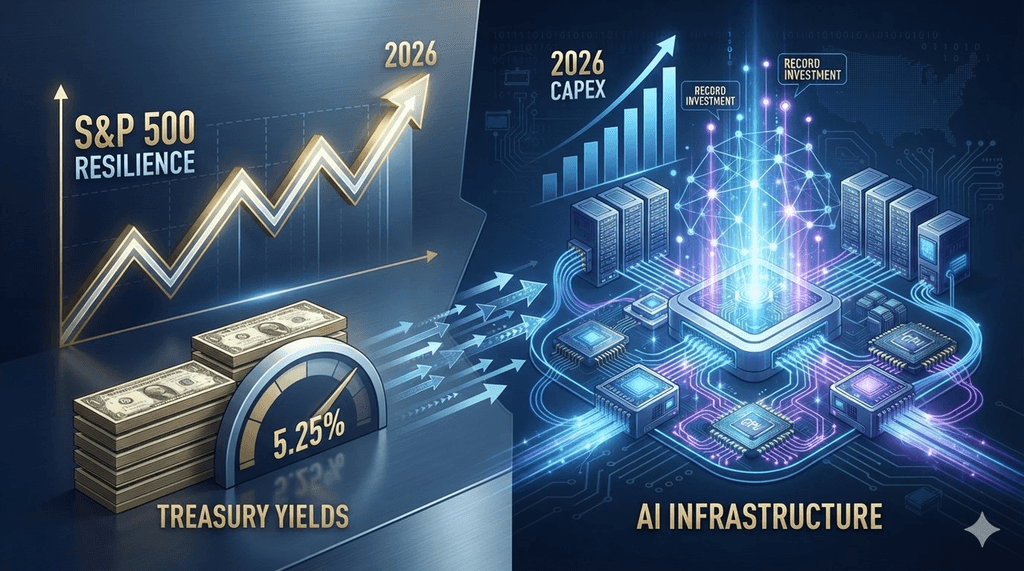
However, the market dynamics of late 2026 present a notable divergence from historical precedents. The major US equity indices have maintained structural strength despite long-term sovereign borrowing costs remaining exceptionally high. The 10-year US Treasury yield has consistently probed the 5.25% threshold throughout the third quarter of 2026. Rather than triggering a systemic equity market contraction, indices like the S&P 500 have continued to trade near all-time highs above the 7,700 level. The primary catalyst for this macroeconomic resilience is the sheer velocity of value creation stemming from the global artificial intelligence infrastructure supercycle.
The Evolution of DCF Models and the Equity Duration Paradox
To comprehend the structural resilience of the 2026 equity market, it is necessary to critically examine the Discounted Cash Flow (DCF) model and the concept of equity duration.
The DCF model calculates the intrinsic value of a corporation based on its projected future cash flows. Because capital possesses a time value, future earnings must be discounted to their present value. The baseline metric for this discount rate is the risk-free rate, represented by the 10-year US Treasury yield. Historically, when the 10-year Treasury yield exceeds 5%, the denominator in the DCF equation expands significantly. This compresses the present value of distant cash flows, typically triggering immediate multiple compression across the technology sector.
During the early stages of the 2026 market cycle, traditional models suggested that mega-cap technology firms would experience multiple compression due to their long-duration asset status. In practice, a fundamental paradox emerged: the equity duration of tech giants lengthened significantly, yet their valuations expanded. By committing hundreds of billions to physical data centers and nuclear power infrastructure, these firms transitioned into heavy-asset, utility-like conglomerates. In traditional finance, extending duration in a high-rate environment is typically highly punitive.
The major indices resisted corrections because the market collectively determined that the rapid expansion of the numerator, driven by compounding AI hardware revenues and infrastructure monopolization, overwhelmed the expansion of the denominator. Investors became singularly focused on the scaling laws of advanced AI models. The prospect of capturing the foundational layer of the next economic paradigm allowed institutional capital to selectively revise terminal growth rates, ignoring traditional discount rate penalties.
From Cash Hoarders to Heavy-Asset Titans
A persistent, yet structurally flawed, narrative carried over from previous years was the concept of complete "balance sheet insulation." In 2023 and 2024, during the Federal Reserve's peak tightening cycle, tech giants operated as massive cash hoarders. They parked hundreds of billions of dollars in short-term Treasury bills, harvesting 5% risk-free interest.
However, the market reality of 2026 represents a stark departure from that defensive posture. The notion that these mega-caps are fully insulated from high capital costs because they are comfortably earning interest income misrepresents the current AI infrastructure race. To maintain their competitive advantages, hyperscalers are heavily deploying their free cash flow (FCF) reserves. The capital expenditure required for gigawatt-scale data centers, continuous procurement of advanced GPU clusters, and specialized immersion cooling infrastructure is historically unprecedented.
Crucially, while these firms may not be issuing traditional unsecured corporate bonds at elevated interest rates, they have accumulated significant off-balance-sheet liabilities. To guarantee the immense electrical power required for AI training, hyperscalers have entered into 10-to-20-year Power Purchase Agreements (PPAs) with nuclear and renewable energy providers, such as the agreements to restart dormant nuclear facilities in late 2026. When aggregating these non-cancelable power agreements, colossal data center lease liabilities, and advanced silicon manufacturing commitments, the adjusted infrastructure debt exposure across the top cloud providers exceeds a trillion dollars.
These corporations are actively absorbing immense capital costs and long-term operational liabilities, operating on the premise that the eventual monetization of enterprise AI will justify this historic rate of capital deployment.
Infrastructure Dominance vs. The SaaS Monetization Gap
If the foundational infrastructure buildout defines the capital expenditure cycle, the actual monetization of artificial intelligence reveals a stark profitability chasm. It is a critical analytical error to view the technology sector as a monolithic entity in 2026.
At the base layer, infrastructure and hardware providers are experiencing financial success. Semiconductor designers, specialized foundries, and hyperscale cloud infrastructure hosts have captured the majority of economic value. Because the physical supply of advanced computing power remains fiercely constrained relative to global enterprise demand, these base-layer entities command absolute pricing power. Core infrastructure companies have consistently recorded Earnings Per Share (EPS) growth rates ranging from 70% to 90% year-over-year. When a company compounds real earnings at this velocity, equity markets enthusiastically absorb a higher risk-free rate.
Moving up the technology stack to the application layer reveals a more challenged landscape. Enterprise Software-as-a-Service (SaaS) providers and consumer-facing application developers are navigating the "AI Monetization Gap." While these companies successfully integrated generative models into their core product suites, they face two significant structural headwinds. First, inference costs—the continuous computational expense incurred every time a user prompts an AI model—are placing sustained downward pressure on gross margins. Second, enterprise clients have demonstrated subscription fatigue, resisting the aggressive pricing adjustments SaaS companies require to offset their soaring compute expenditures.
Consequently, rather than enjoying unprecedented pricing power, many downstream software companies are experiencing margin compression. This internal divergence highlights that the index's resilience is supported predominantly by the foundational infrastructure layer.
The Trillion-Dollar Private Sector Stimulus
Beyond the immediate technology ecosystem, the hyperscalers' commitment to artificial intelligence has catalyzed one of the largest industrial capital expenditure supercycles in modern economic history. With major financial institutions projecting global AI-related data center investments to scale from roughly $800 billion in 2026 to over $1.5 trillion annually by the end of the decade, the economic impact has transitioned into traditional value sectors.
This massive capital outlay is effectively functioning as a targeted private-sector stimulus package. The construction of next-generation data centers requires vast physical resources. It demands advanced liquid cooling systems, complex structural engineering, staggering quantities of copper and high-bandwidth fiber optics, and uninterrupted baseload electrical power.
Utility providers, nuclear energy operators, power management component manufacturers, and industrial engineering firms have experienced a structural renaissance. Companies specializing in electrical transformers, grid modernization, and thermal management have secured non-cancelable, decade-long contracts that ensure unprecedented revenue visibility. This downstream capital flow has supported the earnings profiles of traditional industrial and energy sectors, insulating specific industrial constituents of the S&P 500 from the recessionary pressures normally associated with high sovereign borrowing costs.
The Reality of a K-Shaped Market Bifurcation
Indices such as the Russell 2000, tracking the performance of small-cap and mid-cap domestic equities, accurately reflect the restrictive reality of elevated capital costs. Traditional manufacturing, commercial real estate, and regional retail enterprises lack the balance sheet capacity to fund capital-intensive operations entirely through internal cash flow. These entities rely heavily on securing commercial bank loans and rolling over short-term debt facilities to maintain operations.
For the lower segment of this K-shaped economy, borrowing costs have stabilized at restrictive levels. Many of these companies rely on floating-rate credit facilities. As these businesses approach the maturity dates of debt originally secured during the zero-interest-rate environment of the early 2020s, they face a challenging refinancing environment. Rolling over debt into a 5% to 7% commercial lending market significantly reduces operational free cash flows. This dynamic has resulted in margin compression, delayed expansion plans, and increased pressure on highly leveraged domestic corporations.
Macro Liquidity and Implications for the Digital Asset Ecosystem
For investors operating within the digital asset ecosystem, understanding the structural resilience of US equities in 2026 is critical. The correlation between traditional financial markets and the cryptocurrency sector is governed by macro liquidity and global risk appetite.
Historically, sustained spikes in Treasury yields elevate the risk of a systemic equity market correction, which often triggers broad institutional deleveraging. During such events, fund managers systematically liquidate their most volatile assets to cover margin requirements. In previous macro cycles, this dynamic consistently resulted in correlated drawdowns for Bitcoin and the broader digital asset market.
However, because the rapid growth of the AI infrastructure sector prevented a broad collapse in the major equity indices, global financial liquidity avoided a systemic contraction. The ability of the infrastructure mega-caps to maintain the structural integrity of the S&P 500 ensured that institutional risk appetite remained stable. By avoiding a full-scale equity downturn, high-beta assets were afforded a stable macroeconomic operating environment, insulated from panic-driven liquidity drains.
Furthermore, the physical limitations of the AI supercycle have directly validated core utility narratives within the cryptocurrency sector. The centralized AI infrastructure buildout is currently colliding with physical bottlenecks. Hyperscalers are navigating regional power grid limitations, hardware procurement delays, and geographic data center constraints. In response, Decentralized Physical Infrastructure Networks (DePIN) and decentralized compute protocols have transitioned into revenue-generating platforms.
Conclusion
The resilience of US equities in 2026, despite 10-year Treasury yields exceeding 5%, is driven by the AI infrastructure supercycle. Mega-cap technology firms are deploying significant capital and assuming long-term operational liabilities to construct advanced AI facilities. This unprecedented spending extends their equity duration, yet markets accept higher discount rates due to exceptional hardware-layer earnings growth. This massive capital expenditure functions as a targeted stimulus for industrial and energy sectors. The resulting market stability prevents systemic liquidity contractions, maintaining a favorable macroeconomic environment for digital assets and allowing decentralized infrastructure networks to thrive.
🔥 Beyond the Headlines: What KuCoin 5.0 Means for You
Market news moves fast — but where you act on it matters just as much. This October, KuCoin launches KuCoin 5.0, transforming KuCoin into a rebuilt platform. Here's what actually changes for you:
-
One account for everything. Older platforms split your money across separate "spot," "margin," and "futures" accounts and expected you to understand why. KuCoin 5.0's unified account removes that entirely — deposit once, and everything is simply there (only available to VIPs for now).
-
Stocks, indices, and commodities. KuCoin 5.0 expands beyond crypto into global markets. When crypto chops sideways and equities rally (or the reverse), you rotate in minutes instead of opening a brokerage account and waiting days for fiat rails.
-
Real-world assets (RWA). Tokenized exposure to traditional assets like commodities, right inside your crypto account. One of the fastest-growing segments in global finance is no longer reserved for institutions — you access it from the same balance you trade with.
-
Earn while you learn. Not ready to trade? KCUSD lets your stablecoins earn daily, auto-compounding interest. The lowest-stress way to put your idle deposit to work for 4% yield.
-
An AI assistant in plain language. Ask questions, get market context, understand what you're looking at — built into the platform, no jargon required.
-
An app that doesn't overwhelm. Faster, cleaner, and consistent — intuitive from the first tap, not after a tutorial.
-
Safety you can check, not just trust. A MiCAR-licensed EU entity, Proof of Reserves you can verify yourself, and internationally certified security (SOC 2 Type II, ISO 27001:2022).
Create your account in minutes — and start on the platform built for where crypto is going, not where it's been.
FAQs
Why are US stocks resilient despite Treasury yields staying near 5.25%?
Resilience is concentrated. The substantial earnings growth and massive capital expenditures of AI infrastructure providers—including semiconductors, hyperscalers, and energy firms—are expanding valuations enough to offset the mathematical drag of a higher discount rate.
Are tech giants maintaining valuations by earning interest on cash reserves?
No, that narrative is outdated. While holding cash, tech giants are actively deploying free cash flow and taking on long-term liabilities, such as 20-year nuclear power purchase agreements and data center leases, to fund AI expansion.
Is the entire technology sector highly profitable due to artificial intelligence?
No, there is a profitability chasm. Base-layer infrastructure and semiconductor companies report significant EPS growth, but downstream SaaS application developers are experiencing margin compression due to high AI inference costs and customer resistance to subscription price increases.
What is the K-shaped market divergence observed in 2026?
It describes a bifurcated economic landscape. While AI infrastructure and industrial giants see expanding valuations, traditional, highly leveraged small-cap companies are struggling with elevated floating-rate borrowing costs, margin compression, and a challenging debt refinancing environment.
Disclaimer
The information provided on this page may originate from third-party sources and does not necessarily represent the views or opinions of KuCoin. This content is intended solely for general informational purposes and should not be considered financial, investment, or professional advice. KuCoin does not guarantee the accuracy, completeness, or reliability of the information, and is not responsible for any errors, omissions, or outcomes resulting from its use. Investing in digital assets carries inherent risks. Please carefully evaluate your risk tolerance and financial situation before making any investment decisions. For further details, please consult KuCoin’s Terms of Use and Risk Disclosure.