

US Payrolls Fall by 23K in July: What the Labor Slowdown Means for Bitcoin
2026/08/12 16:47:00
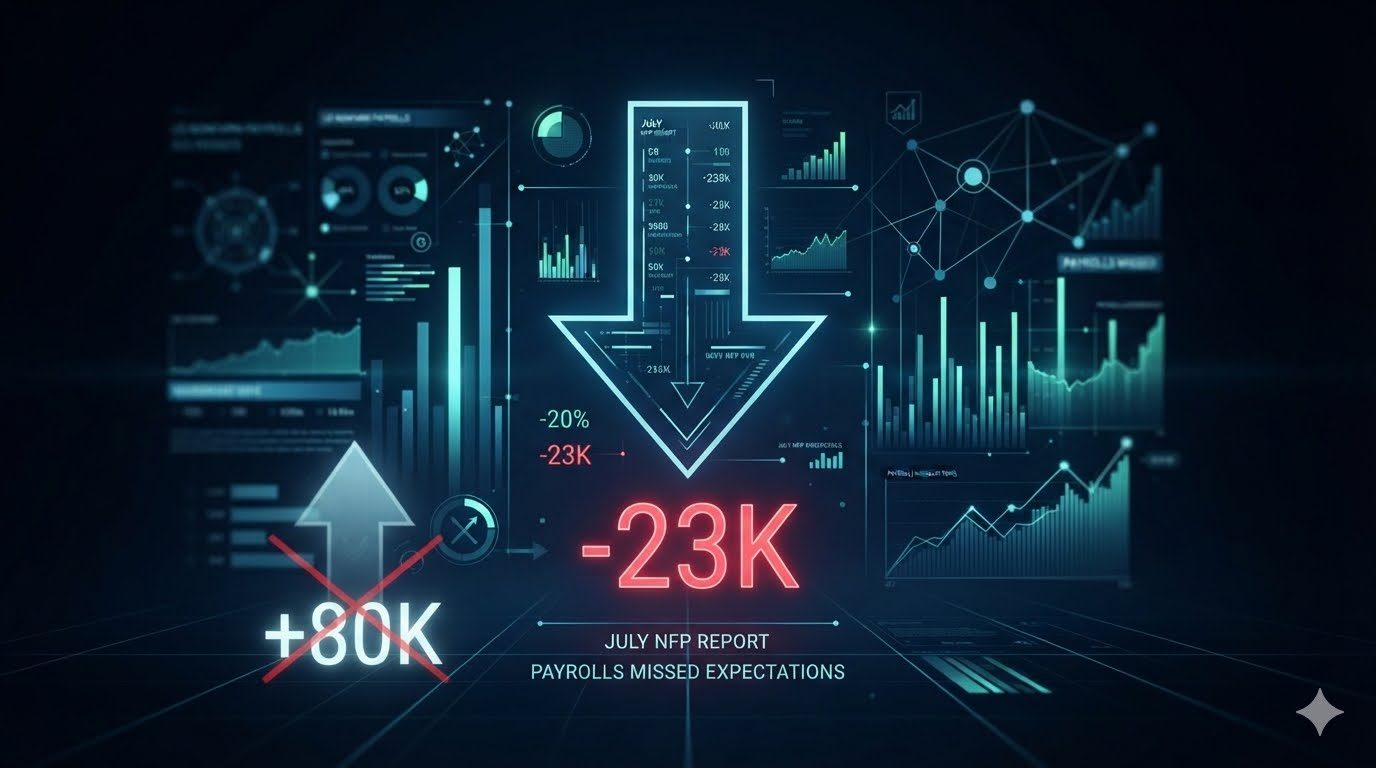
On August 7, 2026, the global financial landscape experienced a notable shift when the U.S. Bureau of Labor Statistics (BLS) released its much-anticipated employment data. The report revealed that U.S. Nonfarm Payrolls (NFP) fell by 23,000 jobs in July. This contraction stood in sharp contrast to the consensus expectation of Wall Street analysts, who had projected a modest expansion of 80,000 new positions.
The immediate reaction across trading desks was swift. Within minutes of the 8:30 AM EST release, traditional equity futures reversed earlier losses and staged a sharp rally, driven by speculations that the Federal Reserve would completely abandon its plans for a September rate hike. Concurrently, U.S. Treasury yields dropped significantly as fixed-income assets re-priced the shifting rate outlook, and the spot price of gold surged on safe-haven demand and a weaker dollar. In tandem with the broader risk-on sentiment, the cryptocurrency market registered a surge in volatility, with Bitcoin (BTC) bouncing off local support levels and gaining traction as algorithmic trading suites reconfigured their risk models for a cooler American economy and a more supportive monetary environment.
Why Crypto Investors Must Care About TradFi Labor Data
For digital asset market participants, treating cryptocurrency as an isolated ecosystem is no longer practical. In the current macroeconomic landscape, crypto assets—particularly Bitcoin and Ethereum—function as highly responsive indicators of global fiat liquidity. Central bank monetary policy is the primary driver of this liquidity, and few indicators shape the Federal Reserve's decision-making matrix quite like the health of the U.S. labor market.
When Traditional Finance (TradFi) data shows economic slowdowns, it triggers a predictable sequence of monetary responses. Historically, weak employment data pressures central banks to pivot from restrictive high-interest-rate environments toward monetary easing. For fixed-supply digital assets, a softer macroeconomic background in the legacy financial system frequently serves as a fundamental catalyst for long-term capital inflows, making reports like the July NFP essential reading for any crypto trader.
Inside the Weaker-Than-Expected July Labor Report
The Impact of Downward Revisions: A Reduction of 103,000 Jobs
The headline decline of 23,000 jobs in July was only one component of a broader statistical picture. To understand the full scale of the labor market deceleration, analysts look closely at the revisions to prior months' data. The July release presented a notable challenge to the narrative of economic resilience by retroactively reducing a total of 103,000 previously reported jobs from May and June.
Specifically, the employment gains for May 2026 were downshifted by 66,000, dropping the final tally from a solid expansion to a modest 63,000. June's numbers were similarly adjusted, losing 37,000 jobs to finish at just 20,000 positions added. These multi-month retroactive reductions indicate that the underlying structural momentum of the U.S. workforce had been moderating well before the negative July headline figure was published.
Why Did It Drop to 4.1%?
A point of discussion within the July report was the headline unemployment rate, which ticked downward from 4.2% in June to 4.1% in July. In a healthy economy, a falling unemployment rate is a positive sign. However, the underlying dynamics of this specific decline reveal a more nuanced reality.
The drop in the unemployment rate was primarily driven by a contraction in the labor force itself. During July, an estimated 264,000 individuals exited the active workforce, ceasing their job searches. Because the BLS calculations exclude individuals who are not actively seeking employment from the official unemployment rate, this departure mathematically lowered the percentage. Consequently, the labor force participation rate fell to a five-and-a-half-year low of 61.4%, suggesting that the lower unemployment rate was a symptom of worker discouragement rather than job growth.
July NFP Core Metrics vs Expectations
| Macroeconomic Indicator | July Actual Value | Wall Street Consensus | Prior Month Value (June) | Net Two-Month Revision |
| Nonfarm Payrolls (NFP) | -23,000 | 80,000 | +20,000 (Revised Down) | -103,000 Jobs |
| Unemployment Rate | 4.10% | 4.20% | 4.20% | N/A |
| Labor Participation Rate | 61.40% | 61.70% | 61.60% | N/A |
| Average Hourly Wages (MoM) | 0.10% | 0.20% | 0.30% | N/A |
| Average Hourly Wages (YoY) | 3.20% | 3.40% | 3.50% | N/A |
Sector-by-Sector Breakdown: Where Jobs Were Reduced
The job losses in July were distributed across several key sectors, reflecting broader macroeconomic headwinds:
-
Government and Education: This sector led the declines, shedding 53,000 positions. A major factor was a reduction of 50,000 local government education roles, heavily impacted by negative seasonal adjustment trends and tightening municipal budgets.
-
Leisure and Hospitality: A sector highly dependent on discretionary consumer spending, it cut 40,000 jobs, signaling a pullback from the American consumer.
-
Retail Trade: Employment dropped by 19,400 positions, with warehouse clubs and traditional department stores accounting for the majority of the job cuts.
-
Financial Activities: This sector lost 14,000 jobs in July, continuing a long-term decline that has seen 121,000 positions disappear since the industry's employment peak in May 2025.
-
Healthcare: Healthcare added 22,000 jobs, but this fell short of its 12-month trailing average of 36,000 monthly additions.
-
Manufacturing and Construction: Growth moderated significantly, with construction adding a modest 22,000 positions and manufacturing remaining flat with 5,000 jobs added.
The Purchasing Power Squeeze: Wages vs. Inflation
5-Year Low in Wage Growth
In addition to the contraction in payroll numbers, the July report highlighted a slowdown in wage growth. Average hourly earnings edged up by just 0.1% on a month-over-month basis, missing expectations of a 0.2% increase. This pulled the year-over-year wage growth metric down to 3.2%, marking its lowest level since May 2021. While moderating wages can reduce concerns about a wage-price inflation spiral, this slowdown indicates diminishing consumer purchasing power within the domestic economy.
The Inflation Challenge: 3.2% Wages vs 3.5% CPI
The primary challenge for the consumer economy is the gap between wage growth and persistent inflation. With year-over-year wage growth at 3.2% and the latest Consumer Price Index (CPI) reading at 3.5%, real wages have entered negative territory. The average American worker's earnings are growing more slowly than the cost of living. This deficit represents a net loss of 0.3% in real purchasing power for households, indicating that consumer inflation continues to outpace worker pay.
This dynamic changes how retail capital behaves. When traditional banking systems offer low nominal yields on savings that fail to keep pace with inflation, capital often seeks alternative options. For individuals looking to protect their wealth from purchasing power degradation, digital assets with predefined issuance schedules—such as Bitcoin—can become an attractive alternative to holding inflating fiat currency.
The Fed’s Dilemma: From Tightening Bias to a Wait-and-See Pause
The Sharp Decline in Rate Hike Expectations
Prior to the release of the July NFP report, the Federal Reserve maintained a restrictive stance. The central bank had kept its benchmark interest rate at a high range of 3.50% to 3.75%, and three hawkish dissenting members of the Federal Open Market Committee (FOMC) had openly advocated for an additional 25-basis-point rate hike to bring inflation down to their 2.0% target.
The negative NFP data significantly altered these market expectations. Prior to the report, federal funds futures implied a 57% probability of another rate hike by September. Following the release, that probability dropped to the low-40% range, while expectations for the Fed to hold rates steady rose notably. The narrative shifted from how many more rate hikes would be needed to how long the central bank must pause its tightening cycle to support the slowing labor market.
July CPI: A Critical Data Point
The Federal Reserve now faces a challenging economic scenario: employment numbers are weakening, yet inflation remains sticky at 3.5%. Easing monetary policy or stopping hikes too quickly could reignite inflationary pressures, while holding rates high for too long risks accelerating the downturn in the labor market.
As a result, the upcoming mid-August July CPI inflation report will be highly critical. If the CPI print shows inflation moderating (with consensus expecting headline CPI to nudge down to 3.4%) alongside the weak jobs data, it will give the Fed the data needed to justify a pause at their September meeting. Conversely, if inflation remains stubbornly high, the Fed will face a grueling balancing act, creating an environment of heightened volatility across both traditional and crypto markets.
The Crypto Transmission Mechanism: How a Weak NFP Drives Bitcoin
The Liquidity Thesis: Lower Rates, Higher Risk Appetite
The relationship between weak traditional economic data and positive performance in cryptocurrency markets is tied to global liquidity cycles. This transmission sequence begins with negative employment data, which pressures the Federal Reserve to reduce benchmark interest rates to support the economy.
As the central bank lowers rates, the yields offered by government bonds and traditional cash savings accounts decline. Facing diminished returns in defensive sectors, large institutional funds, asset managers, and retail investors often shift their capital up the risk curve. This search for yield historically routes capital inflows into alternative growth spaces and fixed-supply digital assets like Bitcoin.
The Dollar Depreciation Factor
Another key factor is the inverse relationship between the U.S. Dollar Index (DXY) and Bitcoin. A weak jobs report and the prospect of lower interest rates tend to put downward pressure on the dollar, as capital seeks higher yields abroad.
When the purchasing power and relative strength of the fiat system decline, fixed-supply digital assets tend to reprice higher in dollar terms. Furthermore, broader internal political friction and swelling sovereign debt burdens continue to degrade long-term confidence in the fiat monetary architecture, subtly reinforcing the structural appeal of decentralized, mathematically transparent ledgers like Bitcoin.
Altcoins and Capital Rotation: Tracking Liquidity Spillover
A sustained macro-driven rally typically begins with Bitcoin, which absorbs the initial wave of institutional and risk-averse capital entering the digital asset space. Once Bitcoin establishes a firm upward trend and approaches key resistance levels, market dynamics often shift.
Capital from Bitcoin positions regularly cycles down the risk spectrum into major altcoins like Ethereum (ETH) and Solana (SOL), and eventually into higher-beta layer-1 and layer-2 protocols. If the macro environment turns structurally favorable due to shifting central bank policies, the broader digital asset ecosystem can benefit from the resulting capital inflows.
Mitigating Short-Term Choppiness with KuCoin Trading Bots
While a softening labor market can be a positive indicator for long-term crypto liquidity, the immediate aftermath of such high-impact data releases is often characterized by notable short-term price fluctuations. Liquidations can occur in both directions as leveraged traders react to changing headlines.
To navigate this volatility without constantly monitoring order books, investors can utilize automated tools like the KuCoin Spot and Futures Grid Trading Bots. These systems are designed to automate buying low and selling high within a defined price range. By capitalizing on short-term price swings methodically, traders can manage positions during choppy macro-driven market conditions.
Dollar-Cost Averaging (DCA) into the Next Liquidity Cycle
For long-term investors less concerned with daily price action, macro turning points can be an opportune time to build positions. If the data indicates that the global monetary cycle is moving from a period of tightening to one of easing, a systematic accumulation strategy can be effective.
Using the KuCoin DCA (Dollar-Cost Averaging) Bot, investors can set up automated, recurring purchases of assets like BTC or ETH at fixed intervals, regardless of short-term price fluctuations. This approach reduces the risks associated with trying to time the absolute market bottom and builds a position systematically as the broader macroeconomic landscape shifts toward increased liquidity.
Conclusion
The July reduction of 23,000 jobs, combined with the 103,000 downward revision to prior months' data, marks a clear turning point for the U.S. economy. The Federal Reserve's path toward further rate hikes has narrowed, prompting policymakers to balance supporting economic growth with managing sticky inflation.
For the cryptocurrency market, this shift in the macroeconomic backdrop strengthens the long-term investment case for digital assets. As traditional fiat options face pressure from persistent inflation and flattening yields, decentralized assets with fixed issuance schedules offer a compelling alternative. While short-term market fluctuations are expected as the market processes upcoming July CPI data and central bank commentary, the structural shift toward a prolonged central bank pause provides a favorable environment for the next digital asset cycle.
FAQs
Why did the July NFP drop cause immediate volatility in the crypto market?
The unexpected drop signaled a sharp economic slowdown. Crypto markets reacted instantly because traders immediately priced out the likelihood of a September Federal Reserve rate hike, shifting the market narrative from ongoing tightening to a prolonged pause and sparking a wave of relief-driven risk appetite.
How do negative U.S. payroll numbers historically impact Bitcoin’s price?
Negative payrolls put downward pressure on the U.S. Dollar Index (DXY) as macroeconomic growth expectations cool. Because Bitcoin is historically inversely correlated with dollar strength, a declining fiat currency outlook, combined with a less aggressive Fed, typically bolsters the long-term structural appeal of fixed-supply digital assets.
What is the direct connection between a Fed policy pause and crypto liquidity?
When the Federal Reserve pauses its tightening cycle, it caps the upward march of traditional bond yields and cash returns. This stagnation in defensive yields prompts institutional and retail capital to look back up the risk curve, positioning ahead of the next global liquidity expansion cycle.
Why did the unemployment rate fall to 4.1% if payrolls contracted?
The decline was mathematically artificial. The unemployment rate dropped from 4.2% to 4.1% because roughly 264,000 individuals exited the active workforce and stopped their job searches. Since the BLS excludes these discouraged workers from the labor pool, this departure pushed the labor force participation rate to a 5.5-year low of 61.4%.
Disclaimer
The information provided on this page may originate from third-party sources and does not necessarily represent the views or opinions of KuCoin. This content is intended solely for general informational purposes and should not be considered financial, investment, or professional advice. KuCoin does not guarantee the accuracy, completeness, or reliability of the information, and is not responsible for any errors, omissions, or outcomes resulting from its use. Investing in digital assets carries inherent risks. Please carefully evaluate your risk tolerance and financial situation before making any investment decisions. For further details, please consult KuCoin’s Terms of Use and Risk Disclosure.