

US GDP and PCE Go Onchain With Chainlink: What It Means for DeFi, RWA, and Prediction Markets
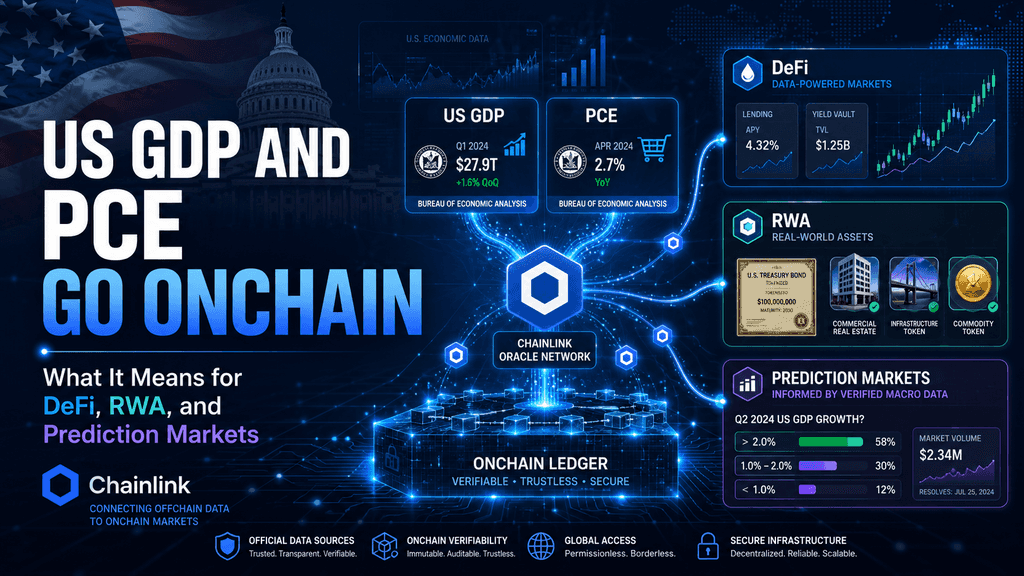
Chainlink Brings Government Macroeconomic Data Directly On-Chain
The U.S. Department of Commerce, working with the Bureau of Economic Analysis, has made official macroeconomic statistics available on public blockchains through Chainlink Data Feeds. Six feeds covering real GDP, the Personal Consumption Expenditures Price Index, and Real Final Sales to Private Domestic Purchasers launched in late August 2025 and received renewed attention in early September 2026 as coverage expanded and usage discussions intensified. The data appear both as absolute levels and as quarter-over-quarter percent changes at a seasonally adjusted annual rate, updating on the same monthly or quarterly schedule the government already follows.
These feeds now operate across Ethereum, Arbitrum, Avalanche, Base, Botanix, Linea, Mantle, Optimism, Sonic, and ZKsync, with the possibility of further networks based on demand. This development supplies smart contracts with authoritative, government-sourced inputs that previously required off-chain retrieval or trusted intermediaries. The result is a direct bridge between traditional macroeconomic reporting and on-chain applications in decentralized finance, real-world asset tokenization, and prediction markets. Protocols can now condition risk parameters, product terms, or settlement outcomes on verified BEA releases without introducing additional trust assumptions about data provenance.
Secure Oracle Delivery of BEA Macroeconomic Releases Across Ten Public Networks
Chainlink Data Feeds deliver the six BEA series with the same security properties that already underwrite tens of trillions of dollars in historical transaction value. Each feed is produced by a decentralized oracle network that fetches, validates, and aggregates the official release before posting a cryptographically signed result on-chain. The infrastructure carries ISO 27001 certification and a SOC 2 Type 1 attestation, giving institutions clearer assurance that the data path meets enterprise controls. Updates follow the BEA calendar exactly, so a quarterly GDP advance estimate or monthly PCE print becomes readable by contracts within the normal publication window rather than after manual entry or delayed API polling. Developers access the feeds through documented contract addresses on each of the ten supported networks, reducing integration friction for teams already building on those chains.
The dual-format design, level plus annualized percent change, matters for practical use. A lending protocol can read the absolute real-GDP figure for long-term trend context while using the growth-rate feed to trigger immediate parameter adjustments after a soft or strong print. Because the same data set is simultaneously available on multiple chains, applications can maintain consistent logic across ecosystems without maintaining separate off-chain data pipelines. This uniformity supports cross-chain strategies that reference the identical official number, lowering the risk of divergent interpretations that historically arose when different parties scraped government websites independently.
Real GDP Level and Growth Feeds Enable Responsive Onchain Economic Tracking
Real GDP appears as a level measured in billions of chained 2017 dollars and as a quarter-over-quarter percent change at an annual rate. The level feed gives contracts a continuous measure of the inflation-adjusted size of the U.S. economy; the growth feed supplies a standardized signal of expansion or contraction. Smart contracts can therefore compare current output against historical thresholds or against other onchain variables without relying on external oracles that may lag or introduce interpretation risk. In practice, a protocol can set collateral factors or borrowing limits that tighten automatically when the annualized growth rate falls below a predefined floor or loosen when growth exceeds an upper ceiling.
The availability of both series also supports more sophisticated modeling. An automated market maker or structured-product vault can weigh its exposure to risk assets according to the latest growth reading while still anchoring long-term capital allocation to the absolute level of real GDP. Because the feeds update on the official schedule, reaction time shrinks from hours or days of manual monitoring to the latency of a single oracle report. This compresses the window during which front-running or information asymmetry can occur around major economic releases, improving fairness for participants who interact solely through smart contracts. Traders monitoring Bitcoin price movements alongside macro releases now have a verifiable on-chain reference that aligns with the same numbers driving traditional market reactions.
PCE Price Index Feeds Align Blockchain Products with the Federal Reserve’s Preferred Inflation Gauge
The Personal Consumption Expenditures Price Index is the Federal Reserve’s preferred measure of inflation. Chainlink supplies both the index level (2017 = 100) and the annualized quarter-over-quarter percent change. These two feeds allow contracts to reference the exact series that policymakers watch when setting interest-rate policy. An inflation-linked token or a rate-sensitive lending pool can therefore adjust coupons, collateral requirements, or liquidation thresholds in lockstep with the same data that moves Treasury yields and equity valuations.
Because the feeds are government-sourced and oracle-attested, settlement disputes that sometimes arise in purely community-resolved markets become less likely. A product promising to pay a variable coupon equal to the latest PCE inflation rate can settle automatically against the official feed rather than against a manual vote or a third-party data provider. This reduces operational risk and legal uncertainty for both issuers and holders. Developers building on the supported networks can therefore design instruments whose cash-flow mechanics track the Fed’s preferred gauge with high fidelity, narrowing the gap between traditional inflation products and their onchain counterparts.
Private Domestic Demand Indicators Support Consumption-Sensitive Smart-Contract Logic
Real Final Sales to Private Domestic Purchasers measures inflation-adjusted spending by U.S. households and businesses on final goods. The level and annualized growth feeds give contracts a direct view of domestic demand strength. Protocols that underwrite consumer-credit-style products, inventory-financing facilities, or retail-oriented tokenized assets can condition terms on this series. When private demand growth accelerates, risk parameters may ease; when it slows, buffers can increase. The dual feeds again provide both a stock measure of demand and a flow measure of its momentum.
This data set complements GDP and PCE by isolating the private-sector component of activity. Contracts that previously relied on synthetic proxies or delayed surveys can now reference the official BEA series. The result is tighter coupling between onchain financial logic and the real economy’s demand side. Over time, such coupling can improve the information content of onchain markets and reduce the basis risk that arises when decentralized instruments drift away from underlying economic fundamentals.
DeFi Risk Frameworks Incorporate Authoritative Macro Inputs for Dynamic Parameter Management
Decentralized lending and perpetual and structured-product protocols have historically adjusted risk parameters through governance votes or fixed schedules. With on-chain GDP, PCE, and private-demand feeds, those adjustments can become data-driven and near-real-time. A lending market can raise loan-to-value ratios after a strong GDP print or lower them after an upside inflation surprise, all without requiring a separate proposal cycle. The same feeds can feed into insurance or options protocols that price coverage against macroeconomic scenarios.
The practical advantage is speed and consistency. Because every integrated protocol reads the identical attested feed, parameter changes occur simultaneously across the ecosystem rather than through staggered manual updates. This reduces the period during which some venues operate on stale assumptions while others have already reacted. Risk managers can also back-test strategies against the historical series now available through the same infrastructure, improving model calibration. Users tracking broader market conditions, including Ethereum network activity, gain a clearer link between macro releases and protocol behavior.
Tokenized Real-World Assets Acquire Macro-Sensitive Pricing and Risk Layers
Real-world asset platforms that issue tokenized bonds, equities, or credit instruments can embed the new feeds into valuation and risk engines. An inflation-linked tokenized Treasury product can reprice coupons against the PCE percent-change feed. A private-credit vault can adjust expected-loss assumptions when real GDP growth decelerates. Because the data arrives through the same oracle infrastructure already used for price feeds and proof-of-reserve checks, integration cost remain low.
Composability improves as well. A tokenized RWA can serve as collateral in a DeFi lending market whose risk parameters themselves respond to the same GDP or PCE series. The resulting stack remains fully on-chain and auditable. Institutional issuers that already rely on Chainlink for other data services can extend those relationships to macro feeds without introducing new counterparties. This alignment lowers the operational barrier to launching macro-aware RWA products at scale.
Prediction Market Settlement Gains Precision from Direct Government Data References
Prediction markets that previously resolved GDP or inflation questions through human oracles or multi-source aggregation can now settle against the official Chainlink feeds. A market asking whether quarterly real GDP growth will exceed 2 percent can read the annualized percent-change feed at the scheduled release time and pay winners automatically. This removes a common source of dispute and reduces the time between data publication and payout.
The credibility gain is material. Participants know the resolution source is the same series published by the BEA and consumed by traditional markets. Volume and open interest can therefore concentrate on genuine economic views rather than on secondary debates about data accuracy. Platforms already integrating Chainlink Data Streams for other resolution needs can extend those integrations to the macroeconomic series with minimal additional work, accelerating product expansion into macro categories.
Inflation-Linked Onchain Instruments Become Practical with Verifiable PCE Benchmarks
Issuers can now design tokens, notes, or structured products whose payments explicitly reference the PCE Price Index level or its annualized change. Because the reference is available on-chain and attested, the product’s smart-contract logic can compute and distribute payments without external calculation agents. This architecture reduces counterparty and operational risk while preserving the economic intent of traditional inflation-linked instruments.
Secondary markets benefit as well. Holders can hedge or trade the inflation exposure in DeFi venues that themselves read the same feed, creating a closed loop of consistent pricing. The dual feeds allow both zero-coupon-style products that track the index level and floating-rate products that track the percent-change series. Over successive release cycles, a track record of reliable settlement can attract capital that previously remained in traditional inflation markets.
Cross-Chain Deployment Lowers Barriers for Developers on Leading Layer-2 Networks
The simultaneous launch on ten networks, including major Layer-2 environments, means most active DeFi and RWA teams can access the feeds on the chain they already use. No single network becomes a bottleneck, and liquidity or user bases need not migrate solely to obtain macro data. Teams can therefore experiment with GDP- or PCE-conditioned logic without multi-chain bridging overhead for the data layer itself.
Support for additional networks remains demand-driven, giving the ecosystem a clear path to broader coverage. Developers evaluating new deployments can treat the presence of these feeds as a positive factor when choosing among chains. The resulting network effects reinforce the value of the original ten deployments while preserving optionality for future expansion.
Automated Strategies Execute Against Scheduled Macro Releases with Reduced Latency
Trading systems and vaults can subscribe to the feeds and execute predefined responses the moment a new report posts. A strategy that increases exposure to risk assets after a soft inflation print or reduces leverage after a strong GDP surprise can operate without human intervention. Because the data path is oracle-secured, the strategy avoids the need for trusted off-chain bots that parse government websites.
This capability compresses reaction times to the length of an oracle report rather than the length of a news cycle. Information advantages that once accrued to participants with faster data terminals diminish when the same official number is readable by every contract at roughly the same moment. The result is a more level playing field for automated and discretionary participants alike. Market participants watching major cryptocurrency pairs can now incorporate the same verified macro signals into both on-chain and off-chain decision processes.
Institutional Adoption Accelerates as Federal Data Infrastructure Meets Oracle Standards
The Commerce Department’s decision to publish BEA statistics through a widely used oracle network signals growing comfort with public-blockchain infrastructure for official data distribution. Institutions that already consume Chainlink services for price feeds, proof of reserve, or cross-chain messaging can treat the macroeconomic series as a natural extension. Compliance and risk teams gain an auditable trail from the government release through the oracle network to the consuming contract.
This continuity lowers the marginal cost of incorporating macro data into tokenized products and DeFi strategies. Over time, the presence of official U.S. economic series on-chain can serve as a reference point for other public-sector data sets, further deepening the connection between traditional statistics and decentralized applications.
Composability Between Macro Data and Decentralized Protocols Expands Design Space
When GDP, PCE, and private-demand feeds sit alongside price, reserve, and identity data on the same oracle infrastructure, developers can compose multi-factor logic that was previously impractical. A single vault can condition its strategy on inflation, growth, asset prices, and collateral quality without stitching together disparate data sources. The shared security and update model reduces the surface area for data-related failures.
The design space therefore expands from static, governance-controlled parameters toward continuous, data-responsive systems. Protocols that adopt these feeds early can differentiate on responsiveness and transparency, while later adopters benefit from established integration patterns and accumulated usage history. The net effect is a gradual tightening of the feedback loop between the real economy and on-chain financial activity.
FAQs
How frequently do the onchain GDP and PCE feeds update?
The feeds follow the Bureau of Economic Analysis publication calendar. Real GDP and related series update quarterly with advance, second, and third estimates; the PCE Price Index updates monthly. Contracts receive the new values once the oracle network processes and posts the official release, typically within the same window traditional market participants access the numbers.
Which blockchains currently host the six macroeconomic feeds?
At launch, the feeds are available on Ethereum, Arbitrum, Avalanche, Base, Botanix, Linea, Mantle, Optimism, Sonic, and ZKsync. Chainlink has stated that additional networks can be added in response to demonstrated demand from developers and applications.
Can smart contracts settle prediction markets directly against the official GDP growth rate?
Yes. A market can read the Real GDP percent-change feed at the scheduled release time and determine the outcome without human intervention or multi-source aggregation. This approach reduces settlement disputes and shortens the interval between data publication and payout.
How do the level and percent-change feeds differ in practical use?
The level feeds report the absolute value, real GDP in billions of chained 2017 dollars or the PCE index with a 2017 base of 100. The percent-change feeds report the quarter-over-quarter movement expressed at a seasonally adjusted annual rate. Level feeds support trend and size comparisons; percent-change feeds support momentum and threshold triggers.
What security assurances accompany the government data feeds?
The feeds are delivered through Chainlink Data Feeds infrastructure that holds ISO 27001 certification and a SOC 2 Type 1 attestation. Multiple independent nodes fetch and aggregate the official BEA release before posting a signed result, providing the same decentralization and cryptographic guarantees used for major price feeds.
Do these feeds enable inflation-linked tokens that automatically adjust payments?
Yes. A token or structured product can reference the PCE Price Index level or its annualized percent change inside its smart-contract logic. Payments or principal adjustments can then occur automatically against the attested feed, eliminating the need for an external calculation agent.
🔥 KuCoin Offers A More Stable Option in A Volatile Market
If you worry about the frequent ups and downs in the market, and pursue a more stable option to earn money passively, KuCoin is the right place to come:

Simple Earn: Deposit and withdraw tokens anytime, earning stable returns.
Kucoin Earn: Earn stable profits with professional asset management.
Hold to Earn: Earn rewards by holding assets in Funding, Trading, Margin, Futures, Mining, and Unified Accounts.
Staking: Unlock the earning potential of on-chain assets.
Advanced Investments: Advanced Investments offer a variety of structured products to help your money grow in any market.
Shark Fin: Principal Protection and Guaranteed Gains
Dual Investment: Buy low and sell high with transparent return calculations.
Snowball: High yields, with price protection.
Discount Buy: Buy crypto at discount prices.
KCS Loyalty: Level up to enjoy exclusive perks by staking ≥ 1 KCS.
KuCoin Wealth: Discover future value and begin your smart investing journey.
KCS Benefits: Hold and stake KCS to access benefits across the platform.
KCS Staking 2.0: Participate in KCS on-chain governance to earn yield.
Disclaimer: This content is for informational purposes only and does not constitute investment advice. Cryptocurrency investments carry risk. Please do your own research (DYOR).