

US DOJ Launches AI Task Force to Counter Foreign Threats and Protect Critical Infrastructure
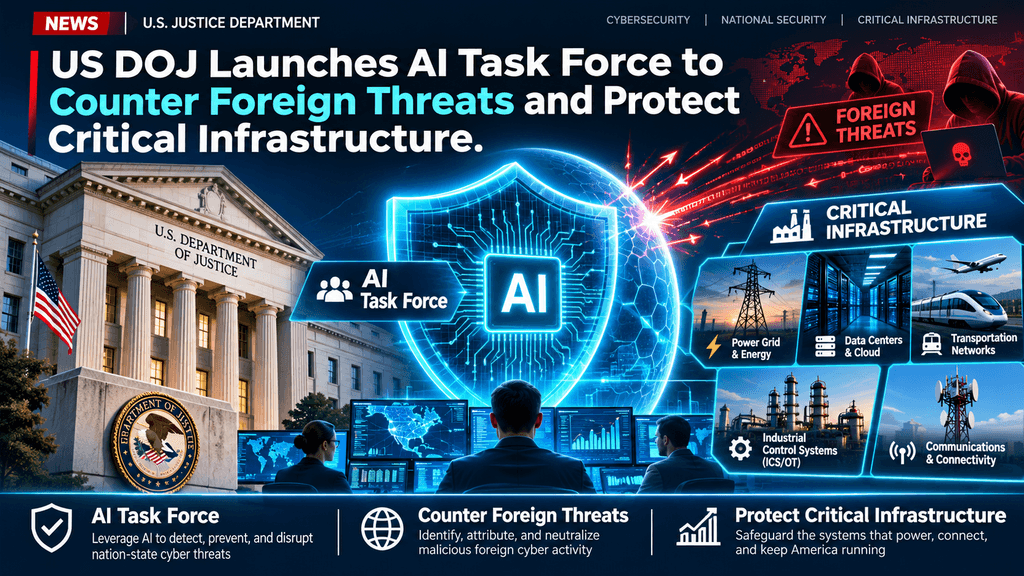
DOJ Establishes Task Force to Counter AI Misuse and Strengthen National Security
The U.S. Department of Justice announced the formation of its Super Intelligence Task Force on November 5, 2026, establishing a dedicated body to address the misuse of advanced artificial intelligence systems by foreign state actors, transnational criminal organizations, and entities engaged in fraud. Attorney General Todd Blanche stated that the effort will ensure critical technologies serve the American people and are not manipulated by bad actors at home or abroad, while the department continues to identify and prosecute violations that target taxpayers, critical U.S. infrastructure, or national security. The task force, formally known as DOJ-SITF, was established through an October 13 memorandum and operates under the leadership of Associate Attorney General Stanley Woodward and Associate Deputy Attorney General Stephen Weiss. It complements the broader White House Super Intelligence Force chaired by Director of National Intelligence Jay Clayton, reflecting the administration’s preference for the term “super intelligence” or SI in official references to these technologies.
This development occurs amid documented increases in AI-assisted cyber operations and fraud schemes that exploit automated capabilities for scale and sophistication. The task force organizes criminal and civil enforcement across departmental components, deconflicts overlapping investigations, and sets priorities aimed at public safety. It also incorporates prior work from an earlier AI-related unit announced in January 2026. Companies utilizing these systems are expected to maintain vigorous internal controls so that the technology behaves as intended, according to statements from department officials. The establishment of the Department of Justice Super Intelligence Task Force creates a structured mechanism to align law enforcement priorities with national goals of technological leadership, focusing enforcement resources on foreign and criminal misuse while requiring stronger corporate safeguards around AI systems.
Key Takeaways
-
DOJ launched the Super Intelligence Task Force on November 5, 2026, to address AI misuse by foreign actors and criminals.
-
Stanley Woodward and Stephen Weiss lead the task force, which partners with the White House Super Intelligence Force under Jay Clayton.
-
The effort prioritizes protection of critical infrastructure, taxpayers, and national security from AI-enabled threats.
-
It absorbs the prior January 2026 Artificial Intelligence Task Force and coordinates criminal plus civil matters.
-
Officials emphasize corporate internal controls to ensure AI systems operate as intended and support U.S. innovation.
How the Super Intelligence Task Force Coordinates Enforcement Across Department Components
The Super Intelligence Task Force coordinates the Department of Justice’s criminal and civil enforcement efforts involving advanced artificial intelligence systems, ensuring that investigations are properly organized across departmental divisions and United States Attorneys’ Offices. Its structure addresses overlapping jurisdictional challenges in cases involving fraud, national security, antitrust violations, and civil litigation. Representatives from the FBI, Antitrust Division, Civil Division, Criminal Division, National Fraud Enforcement Division, and National Security Division participate, alongside the Attorney General’s Advisory Committee and the Office of the Solicitor General. Prosecutors are required to notify the task force when investigations begin and before charges are filed or cases are resolved, when requested. However, exceptions apply when urgent public safety threats emerge or evidence faces immediate loss, ensuring coordination does not delay critical enforcement actions.
Associate Attorney General Stanley Woodward and Associate Deputy Attorney General Stephen Weiss co-chair the initiative, overseeing enforcement priorities and efforts to prevent AI misuse. The task force also absorbs the responsibilities, pending cases, and personnel of the Artificial Intelligence Task Force announced by former Attorney General Pam Bondi on January 9, 2026. This consolidation preserves ongoing civil litigation concerning state-level AI regulations while extending the department’s reach into criminal prosecutions. By centralizing oversight, the DOJ aims to reduce inconsistent enforcement approaches and improve information sharing across jurisdictions. Its responsibilities include recommending prosecution priorities, developing guidance on unlawful AI-related activities, and coordinating with the White House Super Intelligence Force. These measures are intended to strengthen responses to AI-enabled fraud, automated phishing, cyber intrusions, and other emerging threats while directing investigative resources toward cases with broader national security and public safety implications.
Leadership Roles of Stanley Woodward and Stephen Weiss in Shaping Enforcement Priorities
Associate Attorney General Stanley Woodward and Associate Deputy Attorney General Stephen Weiss lead the Super Intelligence Task Force, providing senior-level oversight of enforcement priorities, investigations, and prosecution guidance for AI-related violations. Woodward has described the initiative as supporting the department’s mission to protect Americans while promoting innovation and preventing the misuse of advanced AI technologies. Weiss has emphasized the importance of law enforcement in deterring improper use, strengthening risk reporting, and ensuring companies maintain effective internal controls so their AI systems operate as intended. Their joint leadership covers both criminal prosecutions and civil enforcement, as outlined in Attorney General Todd Blanche’s October 13, 2026 memorandum. Under their direction, the task force recommends enforcement priorities focused on public safety, including AI-assisted attacks against critical infrastructure and large-scale fraud targeting taxpayers.
The co-chairs also oversee the integration of the former Artificial Intelligence Task Force, ensuring that ongoing civil litigation and new criminal investigations receive coordinated attention. Their responsibilities include maintaining communication with the White House Super Intelligence Force, chaired by Jay Clayton, to facilitate information sharing on emerging threats requiring intelligence and law enforcement responses. The memorandum also directs relevant departmental offices to assess legislative and regulatory proposals in ways that support domestic technological advancement. Through this leadership structure, the DOJ aims to resolve overlapping investigations, coordinate enforcement across departments, and develop practical guidance for prosecutors evaluating corporate AI compliance measures. Their decisions will help determine which forms of AI misuse receive investigative priority, particularly activities involving foreign state actors and transnational criminal organizations.
Linking DOJ Efforts to the White House Super Intelligence Force Under Jay Clayton
The Super Intelligence Task Force serves as the Department of Justice’s principal point of contact with the White House Super Intelligence Force, chaired by Director of National Intelligence Jay Clayton. The federal body coordinates engagement with AI companies, critical infrastructure operators, and other stakeholders while addressing emerging risks and opportunities. President Trump announced its formation in early October 2026 following a White House meeting with major technology executives, directing it to strengthen America’s leadership in advanced AI technologies. Clayton, who also serves as AI czar, has described superintelligence as a national security issue. The force includes representatives from the Federal Trade Commission, Department of Defense, and Office of Personnel Management. Connecting the DOJ task force to this broader initiative allows law enforcement priorities to align with federal efforts to address threats involving foreign state actors and critical infrastructure.
Attorney General Todd Blanche said the partnership would help ensure advanced technologies serve the American people rather than being exploited by malicious actors. Information gathered through criminal investigations, including AI-assisted cyberattacks, can inform the force’s risk assessments and engagement with industry stakeholders. Similarly, insights from its work with technology companies and infrastructure operators can help the DOJ refine enforcement priorities and compliance guidance. The force received an initial 120-day mandate to prepare a report outlining risks and opportunities, with a possible extension. By establishing DOJ-SITF as its primary departmental contact, the administration aims to reduce fragmented oversight and strengthen coordination between criminal enforcement, national security, and its broader AI development strategy.
Protecting Critical Infrastructure from State-Sponsored AI-Enabled Operations
The Super Intelligence Task Force identifies the protection of critical U.S. infrastructure as a central priority, particularly where foreign state or state-sponsored actors use advanced artificial intelligence to target essential networks, including energy, telecommunications, and water systems. Attorney General Todd Blanche has stated that the department will continue identifying and prosecuting individuals who unlawfully use these technologies to threaten critical infrastructure. Federal agencies have documented cases involving state-backed groups, particularly those linked to China, incorporating AI tools into cyber operations designed to establish persistent access to infrastructure systems. These activities can involve AI-assisted code development, automated vulnerability scanning, and sophisticated social-engineering techniques used to exploit network weaknesses. The task force's coordination role allows the National Security Division and FBI to align investigative resources, reduce overlapping efforts, and address related cyber threats more effectively.
As AI systems accelerate malware development and the analysis of network vulnerabilities, infrastructure operators face growing pressure to strengthen security controls and establish reliable operational safeguards. The initiative also complements guidance from CISA, the FBI, and the NSA, which encourages infrastructure organizations to assess AI-related risks, govern model usage, and implement protective measures. By centralizing enforcement priorities, the DOJ can strengthen investigations involving criminal activity and foreign interference while supporting efforts to disrupt adversary infrastructure. Its approach distinguishes legitimate defensive applications of AI from offensive activities targeting essential systems. Depending on the circumstances, enforcement may involve unauthorized access, fraud, or national security violations. Prosecutorial notification requirements also provide headquarters-level oversight of significant infrastructure cases while preserving the ability to respond promptly to urgent threats.
Addressing Transnational Criminal Organizations Using AI for Fraud and Scale
Transnational criminal organizations are a major focus of the Super Intelligence Task Force because they can exploit advanced artificial intelligence systems to expand the scale and sophistication of fraud targeting U.S. taxpayers, financial institutions, and other economic systems. AI tools allow criminal networks to generate personalized phishing messages, create synthetic identities for fraudulent account openings, and automate cross-border movement of illicit proceeds. The task force's inclusion of National Fraud Enforcement Division and Criminal Division representatives supports coordinated investigations into these activities, addressing both the technologies facilitating the crimes and the networks operating them. Its requirement for notification of investigations and charging decisions also helps identify overlapping cases across federal districts, particularly those involving shared AI-enabled tactics, fraudulent documents, deepfake audio, and social engineering. These measures are important as generative AI makes it easier for criminal groups to produce convincing materials and conduct fraud at greater scale.
The department's emphasis on strong corporate internal controls also extends to financial institutions and businesses that could become unwitting channels for AI-assisted financial crimes. Through prosecution guidance, the task force can clarify how existing laws covering wire fraud, identity theft, and money laundering apply when advanced AI systems facilitate unlawful activities. Its coordination role is equally important because transnational criminal groups operate across jurisdictions, requiring federal agencies to align investigations and cooperate with international partners where appropriate. The integration of previous civil enforcement efforts further expands the department's ability to address corporate practices that may contribute to these schemes. Over time, enforcement priorities could direct resources toward high-impact threats, including tax-related identity theft and AI-assisted investment scams, while applying existing criminal statutes to emerging forms of technology-enabled misconduct.
Corporate Internal Controls Expectations for AI Systems Under the Framework
Associate Deputy Attorney General Stephen Weiss emphasized that companies must maintain strong internal controls to ensure super intelligence technology operates as intended, an expectation the Super Intelligence Task Force will support through guidance and enforcement. The requirement covers organizations that develop, deploy, or use advanced AI systems, particularly those handling sensitive data or supporting critical operations. The task force will develop guidance for evaluating corporate compliance measures, including how companies monitor AI-generated outputs, restrict access to high-risk capabilities, and document decisions involving these technologies. Businesses with inadequate safeguards could face civil or criminal scrutiny if their systems facilitate fraud, unauthorized access, or other unlawful activities. The approach builds on existing Department of Justice practices for assessing corporate compliance programs, adapting them to the risks posed by AI systems capable of generating content and executing actions at machine speed.
The task force will also encourage structured reporting of AI-related incidents, helping companies share relevant information with law enforcement. Its guidance will address different industry requirements, including financial institutions using AI for customer interactions and infrastructure operators relying on automated monitoring systems. Enforcement priorities may include cases where weak corporate safeguards allow foreign actors or criminal organizations to exploit AI infrastructure. However, the memorandum also directs officials to provide legislative and regulatory advice that supports innovation, suggesting a risk-based approach rather than uniform compliance requirements. Companies with clear AI accountability structures, regular testing, and effective incident response procedures will be better positioned to demonstrate responsible oversight. This framework connects corporate responsibility for AI governance with the department's broader efforts to prevent technological misuse while protecting legitimate business activities.
Integrating the Prior Artificial Intelligence Task Force into the Broader Structure
The Super Intelligence Task Force incorporates the work of the Artificial Intelligence Task Force, announced on January 9, 2026, by then-Attorney General Pam Bondi, transferring its ongoing matters, personnel, and affirmative civil litigation responsibilities into the new structure. The earlier unit focused on challenging state-level AI laws that the department considered inconsistent with federal policy, a civil enforcement responsibility that remains part of the expanded mandate. Under the October 13 memorandum, the previous task force ceases to operate independently, with its functions formally merged into DOJ-SITF. This consolidation eliminates overlapping responsibilities while expanding coordination to criminal investigations and national security matters. Representatives from the Civil Division and Office of the Solicitor General maintain continuity in litigation involving state AI regulations, while participation from the Criminal Division, National Security Division, and FBI broadens the task force's enforcement capabilities.
The integration also allows the department to draw on existing legal experience involving federal preemption and innovation concerns when developing guidance for prosecuting unlawful AI-related conduct. Open investigations and pending cases transfer into the new structure, preserving institutional knowledge and ongoing enforcement work. The task force can therefore coordinate civil litigation, prioritize criminal investigations involving foreign or criminal misuse, and advise on legislative and regulatory proposals through the Offices of Legal Policy and Legislative Affairs. Ultimately, the merger establishes a centralized framework for addressing AI-related legal challenges, ranging from disputes over state regulations to prosecutions involving AI-enabled fraud and threats to critical infrastructure, while supporting the administration's broader technological development objectives.
Developing Guidance for Prosecuting Unlawful AI-Related Conduct
The Super Intelligence Task Force is responsible for developing prosecution guidance for unlawful super intelligence-related activities and evaluating corporate compliance measures, giving prosecutors clearer standards for handling AI-enabled cases. This function supports the consistent application of existing laws, including wire fraud, computer fraud and abuse, and national security statutes, to offenses involving advanced AI systems. For instance, the guidance may clarify how liability applies when generative AI tools are used to produce fraudulent communications or when autonomous agents facilitate unauthorized network access. It can also establish factors for assessing whether companies maintained adequate safeguards against the misuse of their systems. With representatives from the Criminal Division and National Security Division, the task force combines general criminal enforcement experience with specialized knowledge of cybersecurity and foreign threats.
Requirements to notify the task force of relevant investigations and charging decisions will help identify recurring legal challenges and inform updates to prosecution guidance. The Offices of Legal Policy and Legislative Affairs will also contribute by advising on potential legislative and regulatory proposals. As AI capabilities continue to evolve, the department expects its guidance to adapt through lessons drawn from coordinated investigations and actual case outcomes. This approach allows prosecutors to refine enforcement strategies using existing legal authorities without necessarily waiting for new legislation. It also helps distinguish companies that have implemented reasonable AI safeguards from those whose compliance failures may warrant corporate enforcement actions. Overall, the guidance aims to promote consistent prosecution standards, strengthen corporate accountability, and support effective enforcement against unlawful AI-related activities.
Promoting American Technological Leadership While Mitigating Misuse Risks
The Super Intelligence Task Force is mandated to take appropriate measures to promote American dominance in super intelligence while protecting technological leadership from misuse by foreign and criminal actors. Attorney General Todd Blanche has emphasized that SI development should remain driven by American innovators, with the task force coordinating with the White House Super Intelligence Force under Jay Clayton to advance this objective. The approach prioritizes enforcement against malicious actors rather than imposing broad restrictions on domestic developers, reflecting the memorandum’s direction that legislative and regulatory recommendations should support innovation. By targeting foreign state-sponsored operations, transnational criminal organizations, and fraud schemes, the task force aims to limit adversaries’ ability to exploit AI tools for cyberattacks, espionage, and intellectual property theft. Corporate safeguards are expected to prevent systems from facilitating unlawful activities without unnecessarily restricting legitimate research or commercial deployment.
Coordination with the White House force also provides a channel for sharing intelligence on emerging threats and informing industry engagement without introducing uniform technical requirements. Officials have presented the initiative as a means of protecting American innovation, businesses, and critical infrastructure through targeted enforcement. Its integration of previous civil work involving state AI laws also reflects an effort to prevent fragmented regulations from slowing domestic development. By directing enforcement priorities toward threats that undermine U.S. technological advantages, the task force seeks to strengthen national competitiveness while establishing clearer expectations for responsible AI deployment.
Deconflicting Investigations and Setting Enforcement Priorities for Public Safety
The Super Intelligence Task Force deconflicts investigations, cases, and other matters among Department of Justice components and United States Attorneys’ Offices while recommending enforcement priorities designed to preserve public safety and prevent the misuse of superintelligence technologies. Deconfliction becomes necessary when multiple offices pursue related AI-enabled schemes that share infrastructure, financial flows, or technical methods. The notification process for the start of investigations and for charging or resolution decisions allows the task force to identify overlaps early and facilitate coordination or consolidation where appropriate. Exceptions for urgent public safety threats ensure that time-sensitive actions are not delayed. Priority recommendations can elevate cases involving large-scale fraud, infrastructure targeting, or foreign actor involvement above routine matters.
The co-chairs’ oversight provides a mechanism for resolving conflicts between components, such as when a criminal investigation intersects with ongoing civil litigation. This function draws on the participation of the Attorney General’s Advisory Committee, which represents U.S. Attorneys and can surface field-level perspectives on emerging AI threats. By centralizing priority setting, the task force can allocate limited investigative resources toward the highest-impact public safety risks rather than allowing dispersal across uncoordinated cases. The approach also supports consistent application of guidance on prosecution and compliance evaluation. In practice, deconfliction may involve sharing technical indicators of AI tool usage or coordinating with the FBI on multi-district fraud operations. The result is a more efficient use of departmental capacity to address AI-related threats that affect public safety.
Coordination with Other Federal Agencies on AI Threat Response
The Super Intelligence Task Force serves as the Department of Justice’s principal point of contact with the Super Intelligence Force and, as appropriate, with other departments and agencies, enabling aligned responses to AI-related threats that cross jurisdictional lines. This coordination function supports information sharing with entities such as the Department of Homeland Security, CISA, and the intelligence community on patterns of foreign actor activity or infrastructure targeting. The task force can also engage with the Federal Trade Commission on matters involving consumer protection or corporate practices related to AI systems. Because the Super Intelligence Force includes representatives from multiple agencies and focuses on stakeholder engagement, the DOJ linkage provides a channel for law enforcement input into broader risk assessments.
Notification and deconfliction processes within DOJ can generate indicators that are relevant to other agencies’ protective missions. The arrangement helps avoid duplicative efforts when, for example, an FBI investigation into AI-assisted cyber activity overlaps with CISA’s work with infrastructure operators. Guidance developed by the task force on compliance measures can inform interagency discussions on expectations for private-sector operators. At the same time, the task force retains its focus on prosecutorial authorities rather than assuming operational roles held by other departments. This coordination supports the overall objective of protecting critical infrastructure and national security while promoting domestic technological leadership. Over time, established channels can facilitate joint responses to emerging AI-enabled threats without requiring new formal structures for every case.
Future Directions for Law Enforcement Adaptation to Growing AI Capabilities
The Super Intelligence Task Force provides a standing mechanism for the Department of Justice to adapt its enforcement approach as artificial intelligence capabilities continue to grow, including through updated guidance, refined priorities, and ongoing coordination with the Super Intelligence Force. Because new model releases and agentic systems can introduce novel misuse patterns, the task force’s role in recommending priorities and developing prosecution guidance allows for iterative adjustments based on observed case outcomes. The integration of criminal, civil, and national security perspectives within a single body supports comprehensive analysis of emerging threats, such as the use of autonomous agents in intrusion campaigns or the generation of highly convincing fraudulent content. Corporate internal controls expectations can be refined as industry practices mature and as the department gathers more data on effective safeguards.
The partnership with Jay Clayton’s Super Intelligence Force ensures that law enforcement adaptation remains connected to administration-wide assessments of risks and opportunities. Notification requirements generate a continuous flow of information on active investigations, enabling the co-chairs to identify shifts in adversary tactics. The memorandum’s direction to promote American technological leadership while preventing misuse provides a consistent framework for these adaptations. In practice, the task force can issue updated guidance on charging theories or compliance evaluation as courts address novel AI-related fact patterns. This institutional structure positions the department to respond to future developments without requiring repeated reorganization. The result is a durable capacity for addressing AI-enabled threats to infrastructure, taxpayers, and national security as the underlying technologies advance.
FAQs
What is the primary mission of the DOJ Super Intelligence Task Force?
The Super Intelligence Task Force ensures that American leadership in advanced artificial intelligence systems is not compromised by misuse from foreign states and state-sponsored actors, transnational criminal organizations, or individuals and companies engaged in fraud or other unlawful conduct. It organizes criminal and civil enforcement efforts, deconflicts investigations, recommends priorities for public safety, and serves as the department’s main contact with the White House Super Intelligence Force.
Who leads the Super Intelligence Task Force and which components participate?
Associate Attorney General Stanley Woodward and Associate Deputy Attorney General Stephen Weiss co-chair the task force. Participating components include the FBI, the Antitrust Division, the Civil Division, the Criminal Division, the National Fraud Enforcement Division, the National Security Division, the Attorney General’s Advisory Committee, and the Office of the Solicitor General. This composition supports coordination across criminal, civil, national security, and fraud-related matters.
How does the task force relate to the White House Super Intelligence Force?
The DOJ task force acts as the department’s principal point of contact with the Super Intelligence Force, chaired by Director of National Intelligence Jay Clayton. This linkage allows law enforcement priorities and case insights to inform the broader interagency effort on AI risks and opportunities, while the force’s stakeholder engagement can help refine DOJ guidance on corporate controls and threat patterns.
What happened to the earlier Artificial Intelligence Task Force announced in January 2026?
The Artificial Intelligence Task Force established under then-Attorney General Pam Bondi on January 9, 2026, was merged into the Super Intelligence Task Force. Its open matters, staff, and affirmative civil litigation responsibilities regarding state AI laws continue under the new structure, which expands the mandate to include criminal enforcement and national security coordination.
What expectations exist for companies regarding AI internal controls?
Department officials have stated that companies must exercise vigorous internal controls so that artificial intelligence systems behave as intended. The task force will develop guidance on evaluating these compliance measures, which can influence charging decisions and corporate resolutions in cases where weak controls enabled fraud, unauthorized access, or other unlawful activity. The expectation is risk-based and tied to existing enforcement authorities.
Does the task force create new criminal laws for AI misuse?
The task force focuses on organizing enforcement under existing statutes, such as those covering fraud, computer crimes, and national security violations, when artificial intelligence tools are used to facilitate unlawful conduct. It develops guidance for prosecutors on applying these laws to AI-enabled scenarios and recommends priorities, rather than establishing entirely new statutory offenses.
Disclaimer: This general market information, possibly from third-party, commercial, or sponsored sources, is provided for reference and educational purposes only and does not constitute financial or investment advice, an offer, solicitation, or guarantee. We disclaim liability for its accuracy, completeness, reliability, and any resulting losses. Investments/trading are risky; past performance doesn’t guarantee future results. Users should research, judge prudently, and take full responsibility. For further details, please consult KuCoin’s Terms of Use and Risk Disclosure.