

XRP Wallets Surge 8,000 After $6B Binance Hack as Self-Custody Demand Rises
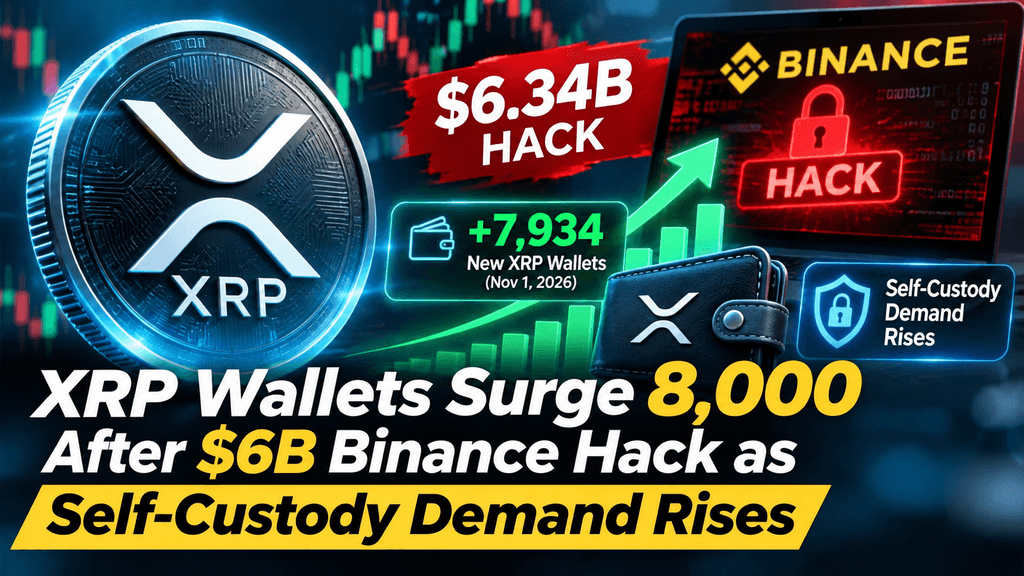
The XRP Ledger recorded 7,934 new wallets on November 1, 2026, marking one of its strongest daily growth figures of the year following Binance's $6.34 billion cryptocurrency security breach. Blockchain analytics firm Santiment highlighted the increase as investors reassessed exchange security and digital asset custody. Although the timing suggests that some XRP holders may have moved toward self-custody, available blockchain data does not establish the extent of that shift. Meanwhile, XRP traded near $1.25 on November 2, highlighting a gap between rising network activity and market performance. The developments raise important questions about XRP adoption, wallet security, and future price momentum.
Key Takeaways
-
XRP Ledger recorded 7,934 new wallets on November 1, 2026, marking its sixth-highest daily wallet growth of the year, Santiment reported.
-
Binance's October 29 security breach affected approximately $6.34 billion in digital assets, including 233.46 million XRP transferred from five exchange hot wallets.
-
Binance began restoring XRP withdrawals on November 1 and reported replenishing 98% of affected token assets as of October 31.
-
Rising XRP wallet creation may indicate growing self-custody interest, but the data does not establish whether new addresses represent additional investors or existing holders.
-
XRP self-custody offers greater control over private keys, although users must manage wallet security, recovery credentials, and irreversible transaction risks.
-
Santiment identified $1.20 and $1.30 as historical XRP price reference levels, while sustained network activity and investor demand remain important for market direction.
XRP Ledger Adds 7,934 New Wallets as Network Growth Reaches Its Sixth-Highest Daily Level of 2026
The XRP Ledger recorded 7,934 new wallets on November 1, 2026, marking its sixth-highest daily total of the year. Blockchain analytics firm Santiment reported the increase on November 2, highlighting unusually strong network activity during a Sunday, when cryptocurrency participation is typically quieter. The surge followed the October 29 Binance security breach, raising questions about whether XRP holders were creating new wallets to gain direct control of their assets. However, the increase occurred while XRP traded near $1.25, indicating that stronger network activity had not translated into a corresponding price recovery.
Santiment Reports the Sixth-Highest Daily XRP Wallet Growth of 2026
Santiment's November 2 analysis identified the November 1 increase as one of the XRP Ledger's strongest account-creation days in 2026. The network growth metric tracks newly created wallet addresses, providing insight into changes in blockchain participation. The result is particularly notable because it occurred outside the usual weekday trading cycle. However, the figure represents a single day's activity rather than evidence of a sustained expansion in the network's user base. Evaluating its significance requires comparing subsequent account creation with longer-term trends.
The distinction between new XRP wallets and new investors is important. A single holder can operate multiple addresses, while existing investors may create additional accounts for security, asset management, or transfers. Under the XRP Ledger's standard reserve rules, activating an account generally requires a minimum reserve of 1 XRP, although specific sponsorship arrangements are supported. This requirement means newly activated accounts must meet network funding conditions, but it does not establish whether their owners purchased additional XRP. Consequently, the 7,934-wallet increase cannot independently confirm an equivalent rise in investor numbers or cryptocurrency demand.
XRP Network Activity Signals Growing Participation but Leaves Adoption Questions Open
The timing of the wallet surge has attracted attention because Binance began restoring cryptocurrency withdrawals in phases on November 1, including XRP transfers through its native network. Santiment suggested that the October 29 security incident may have encouraged some holders to establish self-custody wallets. Binance subsequently expanded withdrawal services on November 3, creating another opportunity to assess how investors responded as access to funds improved. Nevertheless, the available wallet-growth figures do not identify which addresses received exchange withdrawals or how many belonged to existing XRP holders. A shift toward self-custody remains a plausible explanation rather than a confirmed driver of the increase.
For the XRP market outlook, the more meaningful development will be whether elevated wallet creation continues after exchange withdrawals stabilize. Santiment's November 2 assessment identified daily growth above approximately 4,000 wallets as a potentially constructive condition when combined with improving XRP prices, while a decline below 3,000 would weaken that signal. These are analytical reference levels, not guaranteed indicators of future performance. Investors can gain a clearer understanding of underlying adoption by monitoring sustained account creation, active addresses, transaction activity, and exchange flows together. Continued growth supported by broader network usage would provide stronger evidence of lasting participation than a short-lived increase linked to security concerns.
Binance $6.34 Billion Hack Exposes XRP Wallet Security Risks and Triggers Exchange Withdrawal Concerns
The October 29, 2026, Binance security breach affected approximately $6.34 billion in digital assets, raising concerns about centralized exchange security, wallet infrastructure, and access to cryptocurrency withdrawals. Binance's November 3 investigation confirmed that attackers gained unauthorized access to an internal wallet-signing service, allowing them to transfer funds outside the exchange's normal withdrawal process. The incident directly affected XRP holdings alongside several other cryptocurrencies, highlighting the risks associated with compromised exchange infrastructure rather than a vulnerability in the XRP Ledger itself.
How the Binance Security Breach Compromised XRP Hot Wallets
Binance's November 3 technical report confirmed that attackers transferred 233.46 million XRP from five exchange hot wallets to an attacker-controlled address between 20:05 and 20:09 UTC on October 29. Hot wallets are internet-connected cryptocurrency storage systems used by exchanges to process transactions and customer withdrawals. The investigation traced the intrusion to a sophisticated campaign involving malicious software, fraudulent recruitment interviews, compromised employee devices, and misuse of internal AI tools. By October 20, attackers had exploited access to employee systems, eventually obtaining credentials that enabled unauthorized wallet-signing operations. The findings demonstrate how compromised internal access controls can expose substantial cryptocurrency holdings without requiring a direct attack on the underlying blockchain.
The breach also involved Ethereum's EIP-7702 transaction authorization mechanism, which allows accounts to delegate execution permissions to smart contracts. Binance reported that attackers established malicious authorizations that permitted further asset transfers even after ordinary withdrawals were suspended. Because the affected Ethereum hot wallet used multiparty computation, revoking those permissions required additional technical procedures rather than simply replacing a single private key. The final unauthorized transfer was confirmed at 23:56 UTC on October 29. This mechanism was separate from the XRP transfers, but it illustrates an important security concern: suspending exchange withdrawals does not necessarily invalidate permissions already recorded on a blockchain. Binance subsequently rebuilt affected systems, strengthened transaction controls, and announced an independent cybersecurity review, although its investigation remained ongoing as of November 3.
Binance Restores XRP Withdrawals and Reports 98% Asset Replenishment
Following the attack, Binance temporarily suspended cryptocurrency withdrawals while conducting security checks and working with blockchain intelligence firms to trace stolen assets. On November 1, 2026, the exchange announced a phased withdrawal reopening scheduled between 06:00 and 09:00 UTC, with XRP on the XRP Ledger included in the initial rollout. Binance's November 3 report subsequently stated that 98% of affected token assets had been replenished as of October 31, using company resources to restore asset backing. The exchange also reported approximately $2.85 billion in stolen assets frozen or intercepted, although this figure should not be confused with funds returned to Binance or the percentage of customer assets replenished.
Binance said it was continuing to acquire less-liquid replacement assets and strengthen wallet security, with independent review findings still pending. For XRP holders, the withdrawal interruption highlights the operational risks of custodial platforms, where users depend on exchange infrastructure to access their cryptocurrency. However, the reopening of XRP withdrawals does not independently establish that investors transferred significant holdings into self-custody. Confirming such a shift would require verified exchange outflow data and evidence linking withdrawals to newly activated XRP addresses.
XRP Self-Custody Demand Draws Attention as Investors Assess Exchange Security and Wallet Growth
The October 29, 2026, Binance security breach has renewed attention on XRP self-custody, particularly as investors assess the risks of keeping digital assets on centralized exchanges. Blockchain analytics firm Santiment suggested that security concerns may have contributed to the XRP Ledger's unusual wallet growth on November 1. Although the timing supports this possibility, available data does not confirm how many holders transferred XRP into personal wallets. The development highlights an important distinction between growing blockchain participation and changing investor custody preferences.
How XRP Self-Custody Differs From Centralized Exchange Wallets
Self-custody allows XRP holders to control the private keys used to authorize transactions, rather than relying on an exchange to manage their assets. With custodial wallets, platforms such as Binance typically maintain the underlying signing infrastructure and process withdrawals on behalf of customers. This arrangement can simplify account access and recovery, but it also exposes users to exchange-level operational disruptions, withdrawal restrictions, and security incidents. Non-custodial wallets reduce dependence on an exchange for transaction authorization, although users become responsible for protecting their credentials. The XRP Ledger supports additional security mechanisms, including regular keys and multi-signature authorization, which can help users manage transaction permissions. However, self-custody does not eliminate phishing, malware, or irreversible transaction risks.
What XRP Wallet Growth Reveals About Investor Custody Preferences
The increase in XRP wallet creation may reflect existing holders establishing new addresses to move assets from exchanges into personal storage. On the XRP Ledger, a new account is activated when it receives sufficient XRP to meet the network's reserve requirement, which stood at 1 XRP as of November 4, 2026. However, account activation alone cannot distinguish new investors from existing holders reorganizing their assets. Establishing a meaningful shift toward self-custody would require comparing newly funded addresses with identifiable exchange outflows, transfer patterns, and subsequent wallet activity. A sustained increase in independently controlled accounts could indicate changing custody preferences, but the available figures do not establish the scale of such a transition or demonstrate additional XRP purchasing demand.
Security Benefits and Risks of Moving XRP Into Personal Wallets
For investors considering XRP self-custody after the Binance hack, the main benefit is greater independence from centralized exchange infrastructure. Personal wallets allow holders to authorize transfers directly, while hardware-based signing devices can help keep sensitive credentials away from internet-connected environments. However, losing access to private keys or recovery information can result in permanent loss of funds, and transactions confirmed on the XRP Ledger generally cannot be reversed by a central administrator. Investors must also consider wallet compatibility, secure backups, transaction fees, and reserve requirements when transferring assets. Looking ahead, Binance's planned independent security review and subsequent exchange-withdrawal data may provide additional insight into investor confidence and custody behavior. Until stronger evidence emerges, the reported wallet increase should be viewed as a notable network development rather than confirmation of a permanent migration away from centralized exchanges.
XRP Price Outlook After Wallet Surge as Santiment Highlights Market Signals and Adoption Trends
XRP's price outlook remains uncertain despite stronger blockchain activity in early November 2026. The cryptocurrency traded near $1.25 on November 2, as Santiment highlighted a divergence between rising network participation and subdued market performance. While increased wallet creation may indicate growing interest in the XRP Ledger, sustained price recovery depends on broader investor demand, market liquidity, and improvements in cryptocurrency sentiment.
Santiment Identifies $1.20 Support and $1.30 Recovery Levels
Santiment's November 2 analysis identified $1.25 as an immediate price reference, with a move above $1.30 potentially indicating improving XRP price momentum. The firm considered a recovery more constructive if daily wallet growth remained above approximately 4,000 addresses. Conversely, a decline below $1.20 alongside fewer than 3,000 new wallets per day would weaken the network-growth signal. These levels represent conditional market scenarios rather than guaranteed support, resistance, or price targets. Actual XRP performance will depend on trading volume, buyer participation, and wider cryptocurrency market conditions.
XRP Market Sentiment and Institutional Demand Remain Key Factors
Beyond blockchain activity, XRP's short-term performance faces pressure from cautious investor sentiment and weaker institutional demand indicators. Reports published on November 3 highlighted slowing inflows into U.S. spot XRP exchange-traded funds and a negative Coinbase Premium Index, suggesting softer buying interest on that platform relative to other markets. These developments help explain why stronger wallet creation has not necessarily produced sustained upward price momentum. However, ETF flows and exchange premiums capture specific segments of market activity and cannot establish overall investor demand independently. A broader recovery would require more consistent buying interest, improving liquidity, and stabilization across major cryptocurrency markets.
XRP Price Catalysts and Network Adoption Outlook
Looking ahead, sustained XRP Ledger activity, institutional investment flows, and exchange security developments could influence market sentiment. Investors may monitor whether newly created wallets remain active, transaction volumes increase, and exchange balances show consistent changes rather than temporary transfers. Further developments in Ripple's institutional payment infrastructure could also affect expectations for the XRP ecosystem, although the commercial adoption of Ripple products does not automatically translate into demand for XRP. The strongest evidence of improving market conditions would combine sustained network usage with rising trading participation and healthier capital flows. Until those indicators align, the November wallet surge remains an encouraging activity signal rather than confirmation of a lasting XRP price recovery.
Conclusion
The addition of 7,934 new XRP wallets on November 1, 2026, highlights a notable increase in XRP Ledger activity following Binance's $6.34 billion security breach. Santiment's findings suggest that exchange security concerns may have encouraged some holders to consider self-custody, but wallet creation alone cannot establish a widespread change in investor behavior or additional buying demand.
Binance's withdrawal restoration and asset replenishment efforts provide important context for assessing the incident's consequences. For XRP's longer-term outlook, sustained network participation, exchange flows, institutional demand, and market liquidity will be more informative than a single day of wallet growth. Until stronger supporting evidence emerges, the increase remains a significant network activity signal rather than confirmation of sustained adoption or an XRP price recovery.
FAQs
Was the XRP Ledger itself hacked during the Binance security breach?
No. The October 29, 2026, incident involved compromised Binance wallet infrastructure rather than a confirmed vulnerability in the XRP Ledger. Attackers gained unauthorized access to the exchange's internal signing systems. The distinction matters because exchange security failures do not necessarily indicate weaknesses in the underlying blockchain network.
Why do XRP transfers sometimes require a destination tag?
A destination tag is a numerical identifier that helps exchanges assign incoming XRP deposits to individual customers using shared wallet addresses. Sending XRP without a required tag may delay account crediting or require support assistance. Users should verify both the receiving address and destination tag before transferring funds.
Is the 1 XRP wallet reserve a transaction fee?
No. The 1 XRP base reserve is a minimum balance requirement for standard XRP Ledger accounts, not an ordinary transaction fee. This amount generally remains unavailable for regular transfers while the account is active. Eligible accounts can recover part of their remaining balance through account deletion, subject to network requirements and a special transaction cost.
How can XRP holders verify whether a wallet transfer was successful?
XRP holders can use a public XRP Ledger explorer to search for a transaction hash or receiving address. A successful transaction should appear in a validated ledger with a successful result code and the expected balance changes. Exchange account crediting may still take additional processing time after blockchain confirmation.
Can blockchain data identify whether Binance customers created the new XRP wallets?
Not reliably from wallet counts alone. Public blockchain records reveal transactions and addresses but do not automatically identify their owners. Analysts can examine known exchange wallets, funding patterns, and subsequent transfers to estimate possible connections. However, address ownership and investor identity cannot be established solely through account creation data.
Does Binance Proof of Reserves guarantee complete protection against future hacks?
No. Proof of Reserves can provide evidence about assets held by an exchange at a particular reporting point, but it does not guarantee that its security systems are immune to future attacks. Investors should also consider independent audits, liability disclosures, wallet controls, and withdrawal policies when evaluating exchange custody risks.
Disclaimer: This general market information, possibly from third-party, commercial, or sponsored sources, is provided for reference and educational purposes only and does not constitute financial or investment advice, an offer, solicitation, or guarantee. We disclaim liability for its accuracy, completeness, reliability, and any resulting losses. Investments/trading are risky; past performance doesn’t guarantee future results. Users should research, judge prudently, and take full responsibility. For further details, please consult KuCoin’s Terms of Use and Risk Disclosure.