

Why AI Token Costs Are Falling: The LLM Price War, AI Agents, and the Future of Inference
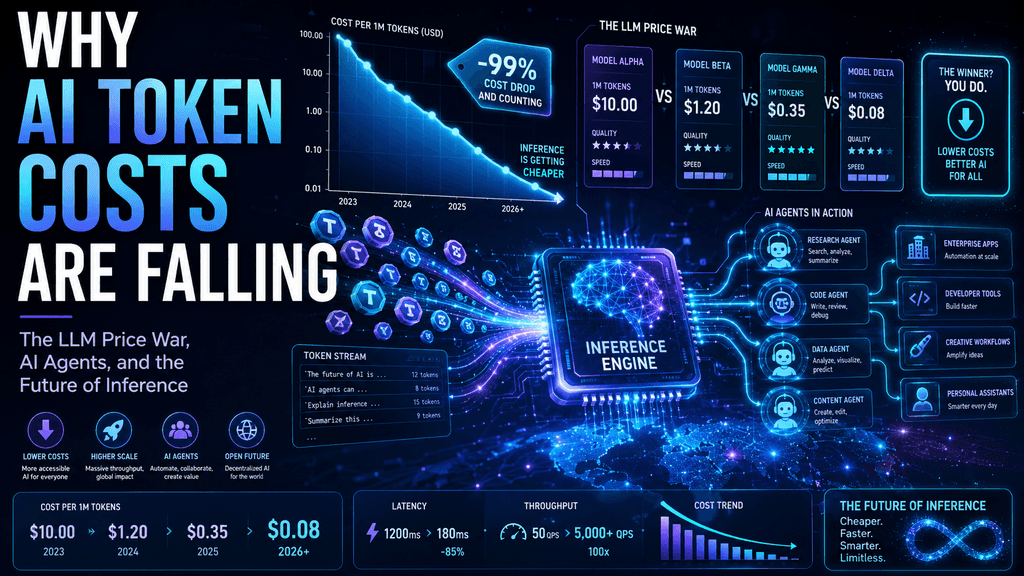
The cost of generating and processing large language model tokens has collapsed at a pace few industries have matched. By early September 2026, the Silicon Data LLM Token Expenditure Index, a usage-weighted benchmark of effective market prices, reached a record low of 97 cents per million tokens, more than half its summer peak and a fraction of levels seen only a few years earlier. This decline shows intense competition among frontier labs, the quick rise of capable open-weight models from Chinese developers, software and hardware efficiency improvements, and shifting demand patterns driven by AI agents.
The result is a market in which high-volume inference has become dramatically more affordable even as sophisticated multi-step agent workflows consume far more tokens than simple chat interactions. Falling token prices stem primarily from competitive pressure and technical efficiency rather than pure demand destruction, enabling broader agentic applications while creating margin pressure for model providers and forcing enterprises to optimize routing and model selection carefully.
Record Low Token Prices Signal Intensifying Market Competition
The Silicon Data LLM Token Expenditure Index, published under the Bloomberg ticker SDLLMTK, dropped to 0.97 dollars per million tokens on September 1, 2026, according to data from the firm and contemporaneous reporting. This marked the lowest reading since the index’s launch and represented a decline of more than 50 percent from peaks earlier in the summer. Broader analysis showed average inference costs falling from roughly 2.04 dollars at the end of May 2026 to the 1.16–1.18 range by early August before continuing lower. These figures capture usage-weighted effective prices across a mix of frontier and open models observed through multi-provider routing platforms, providing a clearer picture of what the market actually pays than list prices alone.
Long-term context underscores the scale of the shift: GPT-3.5-class performance that cost around 20 dollars per million tokens in late 2022 had already fallen to approximately 0.07 dollars by October 2024 in Stanford HAI tracking, with further compression since. Capability-adjusted costs have declined even faster in many cases, with estimates of 5–10 times annual improvement on the price-performance frontier for certain benchmarks. The recent acceleration coincides with specific competitive moves rather than a sudden drop in overall AI usage. Enterprises and developers continue to expand token consumption, yet the blended price paid continues to fall as cheaper options capture share, and providers adjust list rates. This dynamic has made previously expensive high-volume tasks more viable while highlighting the difference between unit economics and total spend.
OpenAI’s Aggressive GPT-5.6 Price Cuts Accelerate the Decline
In late July 2026, OpenAI reduced prices on its GPT-5.6 family only weeks after general availability. The Luna tier saw an 80 percent cut, bringing input tokens to 0.20 dollars and output tokens to 1.20 dollars per million. The mid-tier Terra model received a 20 percent reduction to 2 dollars input and 12 dollars output. The flagship Sol model initially held its 5/30 pricing before a later promotional cut of more than 20 percent for a three-month window. Company statements attributed the changes in part to internal efficiency gains from the models themselves, including improved code optimization and serving efficiency. These moves came as businesses increased scrutiny of AI bills and as lower-cost alternatives gained traction.
The timing, repricing so soon after launch, signaled a willingness to prioritize volume and market position over near-term margin on mid- and lower-tier traffic. High-volume workloads such as classification, extraction, routing, and the early stages of agent loops stand to benefit most, since they can now run at scale on capable models without the previous cost barrier. Subsequent adjustments and the introduction of faster modes at premium pricing illustrate a tiered strategy that keeps frontier capability differentiated while making everyday intelligence more accessible. The cuts contributed directly to the observed compression in blended market indices.
Chinese Open-Weight Models Reset the Competitive Floor
Chinese developers have introduced highly capable open-weight and low-cost models that undercut Western frontier pricing by substantial margins. DeepSeek offerings have frequently appeared among the most economical options on routing platforms, with certain configurations historically priced in the low tens of cents per million tokens and later iterations maintaining aggressive rates even after adjustments for peak and off-peak periods. Moonshot AI’s Kimi models, including the K3 series, provide another competitive vector with list prices that, while higher than the absolute cheapest open options, still undercut many proprietary mid-tier offerings on a performance-adjusted basis in specific workloads.
Reporting from mid-2026 indicated Chinese models capturing significant share on aggregator platforms, with some analyses noting that the four most popular models on one major router were Chinese at points during the year. Capability gaps have narrowed on many practical tasks such as coding, summarization, and general knowledge work, allowing cost-sensitive users and startups to shift volume. This pressure forces proprietary providers to respond with their own cuts or risk losing high-volume segments. Open weights also enable self-hosting and third-party hosting at further reduced effective costs for organizations with the operational capacity. The cumulative effect appears in the blended indices as usage migrates toward lower-priced alternatives for suitable tasks.
Efficiency Gains in Software and Serving Compound Price Pressure
Beyond list-price competition, technical progress has lowered the underlying cost of generating each token. Quantization, speculative decoding, improved KV-cache management, better batching, and model-specific optimizations have all reduced the compute required per token. OpenAI engineers publicly discussed software-only optimizations in mid-2026 that more than halved certain inference costs, allowing guest traffic on ChatGPT to run on a dramatically smaller GPU footprint than earlier estimates suggested. Custom accelerators and closer co-design between models and hardware continue to push utilization higher.
These gains allow providers to lower prices while protecting or even improving margins on remaining high-value traffic. Hardware price-performance improvements of roughly 30 percent annually and energy-efficiency gains near 40 percent, as noted in related industry analyses, provide a structural tailwind. The combination means that even without competitive pressure, the cost floor would continue to decline, albeit more slowly. When layered on top of open-model competition and aggressive pricing responses, the result is the quick observed compression. Providers that fail to capture these efficiencies risk being undercut more severely.
AI Agents Drive Higher Token Volumes Despite Lower Unit Costs
While the price per token has fallen sharply, total expenditure on inference has not necessarily declined in parallel. Agentic systems, multi-step workflows that plan, call tools, verify results, and iterate, consume substantially more tokens than traditional chat or single-turn applications. Analyses indicate agents can require 5 to 30 times more tokens for equivalent tasks because of repeated context transmission, intermediate reasoning, tool outputs, and self-correction loops. A coding agent running for an hour might process millions of tokens where a simple chatbot uses tens of thousands.
Gartner and other research projections suggest inference costs for agentic workflows could rise several-fold even as unit prices fall, reflecting both higher volume and the frequent need for stronger reasoning models. This pattern resembles Jevons' paradox: cheaper intelligence expands the set of economically viable uses, increasing overall consumption. Enterprises that deploy agents at scale therefore face rising absolute bills unless they implement careful routing, caching, model cascading, and prompt optimization. The falling unit cost is precisely what makes large-scale agent deployment feasible; without it, many of these systems would remain too expensive for production use.
Capability-Adjusted Costs Fall Faster Than Nominal Token Prices
Nominal price-per-token figures understate the true improvement because models continue to gain capability. A dollar spent in 2026 purchases both cheaper tokens and more capable systems than the same dollar bought years earlier. Stanford HAI and Epoch AI tracking show cost declines at fixed capability levels on the order of 10 times per year in many cases, with task-specific improvements ranging higher. Frontier models themselves have become cheaper over successive generations even as absolute performance rises.
GPT-4-class intelligence that once commanded tens of dollars per million tokens is now available at a small fraction of that cost from multiple providers. Quality-adjusted metrics therefore show even steeper declines than the headline index. This dual movement, lower unit prices plus rising capability, explains why agentic and test-time compute workloads that were uneconomic in 2023–2024 have become routine. Organizations evaluating total cost of ownership must account for both dimensions rather than focusing solely on list rates.
Open-Weight Models and Hosting Competition Expand Supply
The availability of strong open-weight models has expanded the effective supply of inference capacity far beyond the proprietary labs. Cloud providers and specialized inference hosts can offer competitive rates on Llama-class, DeepSeek, Qwen, and similar models without bearing the full cost of frontier training. This creates a permanent competitive constraint on proprietary pricing. Routing platforms have seen open-source or open-weight traffic share rise substantially in periods of aggressive Chinese model releases.
Enterprises with security or data-residency requirements that once avoided such models are increasingly evaluating them for non-sensitive workloads. Self-hosting further reduces marginal costs for organizations that can amortize hardware and engineering effort. The net result is a bifurcated market in which the highest-capability proprietary models command a premium while a large and growing share of volume migrates to lower-cost alternatives. Providers must therefore compete on both absolute capability and price-performance across the full spectrum of demand.
Enterprise Spending Patterns Shift Toward Optimization and Routing
As unit prices fall and agent volumes rise, sophisticated buyers have responded by implementing model routing, cascading, caching, and usage controls. Legal-tech and other specialized firms have reported multi-fold cost reductions by combining premium models for critical steps with cheaper alternatives for routine processing, without measurable quality loss on their workloads. Aggregators and internal gateways now make it practical to send each request to the lowest-cost model that meets the required quality threshold.
Prompt caching, batch processing, and slower non-urgent modes further compress effective costs. Some organizations that exhausted annual AI budgets early in the year have imposed internal caps or shifted toward lower-tier models. These behaviors amplify the downward pressure on blended market prices while allowing overall AI adoption to continue expanding. The winners in this environment are teams that treat model selection and infrastructure as ongoing optimization problems rather than static vendor choices.
Margin Pressure Builds on Frontier Model Providers
Quick price declines create clear challenges for companies that have invested heavily in training frontier models. Lower token revenue per unit of capability can squeeze the path to profitability even as total usage grows. Both OpenAI and Anthropic have faced heightened scrutiny around pricing power and future margins, particularly in the context of potential public-market filings. Chinese labs that train at lower reported costs and prices aggressively capture volume that might otherwise support higher Western prices.
At the same time, the shift toward agentic workloads that favor stronger reasoning models provides some offset, since those models still command meaningful premiums. Providers are responding with tiered pricing, efficiency-driven cost reductions, and product differentiation. Whether these strategies can restore attractive unit economics while defending share remains an open question that will shape the industry’s capital intensity and competitive structure in coming years.
Hardware and Infrastructure Economics Continue to Evolve
Underlying compute costs form the foundation of inference pricing. Improvements in GPU utilization, specialized accelerators, memory bandwidth, and networking all contribute to lower cost per token. Custom chips designed specifically for transformer workloads promise further gains once they reach volume production. Energy efficiency improvements reduce operating expenses at scale. These structural trends support continued price declines independent of competitive intensity.
At the same time, the enormous capital required to build and operate large clusters creates barriers and shapes which firms can compete at the frontier. The interaction between hardware progress and software optimization will determine how quickly the cost floor continues to drop and whether open-weight models can close remaining capability gaps at comparable economics.
Future of Inference Points Toward Specialized and Cascaded Systems
Looking ahead, the combination of falling token costs and rising agent complexity points toward more sophisticated inference architectures. Cascaded systems that use cheap models for initial filtering and expensive models only when needed, mixture-of-experts routing, specialized small models for common subtasks, and advanced caching will become standard. Test-time compute techniques that trade additional tokens for higher reliability become more attractive as the price of those tokens falls.
The economic viability of continuous background agents and large-scale automation expands. Organizations that build robust evaluation, routing, and cost-monitoring infrastructure will extract the most value. The price war itself is unlikely to end abruptly; instead, it is likely to evolve into ongoing competition across quality tiers, latency tiers, and specialization.
Practical Effects for Developers and Enterprises
Developers and enterprises now operate in an environment where the marginal cost of intelligence is low enough to experiment aggressively, yet total spend can still escalate quickly with agent deployments. Best practices include continuous benchmarking of price-performance across providers, aggressive use of caching and batch modes, careful prompt engineering to reduce unnecessary tokens, and clear internal budgeting for agent workloads.
Choosing the right model for each step of a workflow often yields larger savings than negotiating list-price discounts. Monitoring usage-weighted costs rather than list prices provides a more accurate picture of true economics. The companies that treat inference cost management as a core engineering discipline rather than an afterthought will scale AI applications most effectively as the market continues to evolve.
FAQs
How much have AI token prices actually fallen in recent years?
Long-term data from Stanford HAI and related trackers show GPT-3.5-class inference costs declining by more than 280 times between late 2022 and late 2024, with further compression into 2026. Capability-adjusted measures often show even steeper annual improvements of roughly 5–10 times or higher on specific benchmarks. Recent blended indices, such as Silicon Data's, reached record lows near 97 cents per million tokens in early September 2026 after larger declines earlier in the year.
What specifically caused the sharp drop in mid-to-late 2026?
The primary near-term drivers were OpenAI’s substantial price reductions on the GPT-5.6 Luna and Terra models in late July 2026, combined with continued aggressive pricing and capability gains from Chinese open-weight models such as those from DeepSeek and Moonshot. These moves shifted usage toward lower-cost options and forced broader market adjustments visible in usage-weighted indices.
Do falling token prices mean total AI bills are decreasing?
Not necessarily. Agentic systems consume far more tokens per completed task, often 5 to 30 times more than simple interactions, because of iterative reasoning, tool use, and context re-transmission. Many organizations therefore see rising absolute spend even as the price per token falls, a classic illustration of expanded usage following cost declines.
How do Chinese models compare on price and capability?
Chinese open-weight and API models frequently undercut Western frontier pricing by large margins on comparable workloads, with some configurations historically available for well under one dollar per million tokens and later offerings remaining highly competitive. Capability has improved rapidly on practical tasks, leading to measurable share gains on routing platforms, although differences remain on the absolute highest-end reasoning and specialized benchmarks.
What role do efficiency improvements play versus pure price competition?
Both matter. Software optimizations such as better quantization, speculative decoding, and serving techniques have lowered the real cost of producing tokens, enabling providers to cut prices while protecting margins. Hardware gains reinforce this trend. Competitive pressure from open models and rival labs accelerates the translation of those efficiencies into lower lists and effective market prices.
Should enterprises switch entirely to the cheapest available models?
Rarely. The optimal approach is usually selective routing: use lower-cost models for high-volume, lower-stakes steps and reserve stronger models for critical reasoning or high-error-cost tasks. Many organizations achieve substantial savings through cascading and evaluation-driven selection without sacrificing overall output quality.
🔥 KuCoin Offers A More Stable Option in A Volatile Market
If you worry about the frequent ups and downs in the market, and pursue a more stable option to earn money passively, KuCoin is the right place to come:

Simple Earn: Deposit and withdraw tokens anytime, earning stable returns.
Kucoin Earn: Earn stable profits with professional asset management.
Hold to Earn: Earn rewards by holding assets in Funding, Trading, Margin, Futures, Mining, and Unified Accounts.
Staking: Unlock the earning potential of on-chain assets.
Advanced Investments: Advanced Investments offer a variety of structured products to help your money grow in any market.
Shark Fin: Principal Protection and Guaranteed Gains
Dual Investment: Buy low and sell high with transparent return calculations.
Snowball: High yields, with price protection.
Discount Buy: Buy crypto at discount prices.
KCS Loyalty: Level up to enjoy exclusive perks by staking ≥ 1 KCS.
KuCoin Wealth: Discover future value and begin your smart investing journey.
KCS Benefits: Hold and stake KCS to access benefits across the platform.
KCS Staking 2.0: Participate in KCS on-chain governance to earn yield.
Disclaimer: This content is for informational purposes only and does not constitute investment advice. Cryptocurrency investments carry risk. Please do your own research (DYOR).