

What Is Gemini 4 Neon? Google's New AI Model for Faster Agentic Workflows
Introduction
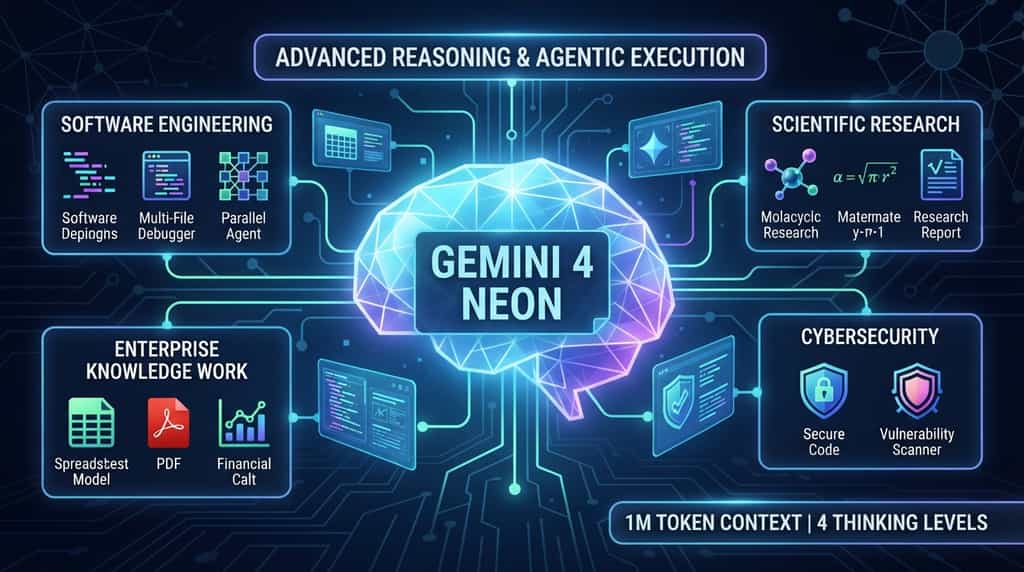
Google introduced Gemini 4 Neon on November 18, 2026, as a reasoning model designed to complete complex tasks across software engineering, enterprise knowledge work, and scientific research. Its central proposition is to combine advanced reasoning with faster end-to-end execution and lower task costs than larger models.
Gemini 4 Neon is positioned between Gemini 4 Carbon, designed for demanding long-horizon projects, and Gemini 4 Hydrogen, intended for fast everyday tasks. It features a 1 million-token context window, four configurable thinking levels, and support for extended workflows involving multiple tools and agents. These capabilities make it relevant to developers and businesses exploring AI automation, although practical performance still depends on task complexity, data quality, security controls, and the reliability of the surrounding tools.
Quick Answer: What Are the Main Features of Gemini 4 Neon?
Gemini 4 Neon is Google's AI reasoning model for complex, tool-intensive workflows that require a balance of intelligence, speed, and cost efficiency. Its main features include:
-
Agentic execution: Supports long-running tasks involving planning, coding, research, tool interactions, and iterative execution.
-
Large context window: Supports up to 1 million tokens and can process information from spreadsheets, PDFs, charts, audio, and video.
-
Four thinking levels: Allows developers and users to adjust reasoning effort and token consumption according to task requirements.
-
Software engineering capabilities: Supports multi-file debugging, repository-wide refactoring, and coordination with parallel AI agents.
-
Enterprise and scientific applications: Targets analytical work such as legal research, tax analysis, spreadsheet modeling, automation, and scientific reasoning.
-
Flexible access: Rolling out through the Gemini API, Google AI Studio, Gemini for business, Google Antigravity, and eligible Gemini app subscriptions.
Google's official Gemini 4 Neon announcement provides the model's technical positioning, benchmark results, pricing, safety information, and rollout details. The reported performance figures should be understood in the context of the specific evaluations and configurations used.
What Is Gemini 4 Neon and How Does It Work?
Gemini 4 Neon is a large language model developed by Google DeepMind for complex reasoning and agentic workflows. Rather than generating only a response to an individual prompt, it is designed to maintain task context, interact with tools, respond to changing instructions, and complete multiple connected steps.
An agentic workflow generally involves five stages:
-
Task interpretation: The model identifies the objective, requirements, constraints, and available information.
-
Planning: It divides the objective into smaller tasks and establishes an execution sequence.
-
Tool interaction: It accesses relevant tools, files, or other resources to perform the required operations.
-
Progress evaluation: It reviews intermediate results, incorporates new instructions, and adjusts its approach when necessary.
-
Output generation: It consolidates the work into a deliverable, such as code, a research report, or structured analysis.
For example, debugging a large software repository may require an AI system to inspect multiple files, trace dependencies, identify the source of an error, modify related code, and test the implementation. A conventional question-and-answer interaction can assist with individual steps, but an agentic model is intended to coordinate the broader process.
Google says Neon is engineered for long-running, tool-heavy tasks. It can reduce redundant file reads, share progress during execution, and handle context compaction in extended sessions. Context compaction refers to summarizing or reorganizing accumulated information so that an AI system can continue working when a task generates more context than it can retain in its original form.
These capabilities address a practical challenge in AI automation: maintaining continuity and following instructions as workflows become longer and more complicated. However, successful execution still depends on the quality of the tools, permissions, input data, and surrounding application.
Gemini 4 Neon Delivers Strong Performance Across Enterprise, Analytical, and Scientific Work
Gemini 4 Neon is designed to handle complex professional tasks that require more than text generation. Its 1-million-token context window allows it to process spreadsheets, PDFs, charts, audio, and video within a single workflow, helping users turn information from multiple formats into structured outputs. This makes it relevant to enterprise research, financial analysis, legal work, accounting, and other tasks that involve large volumes of information.
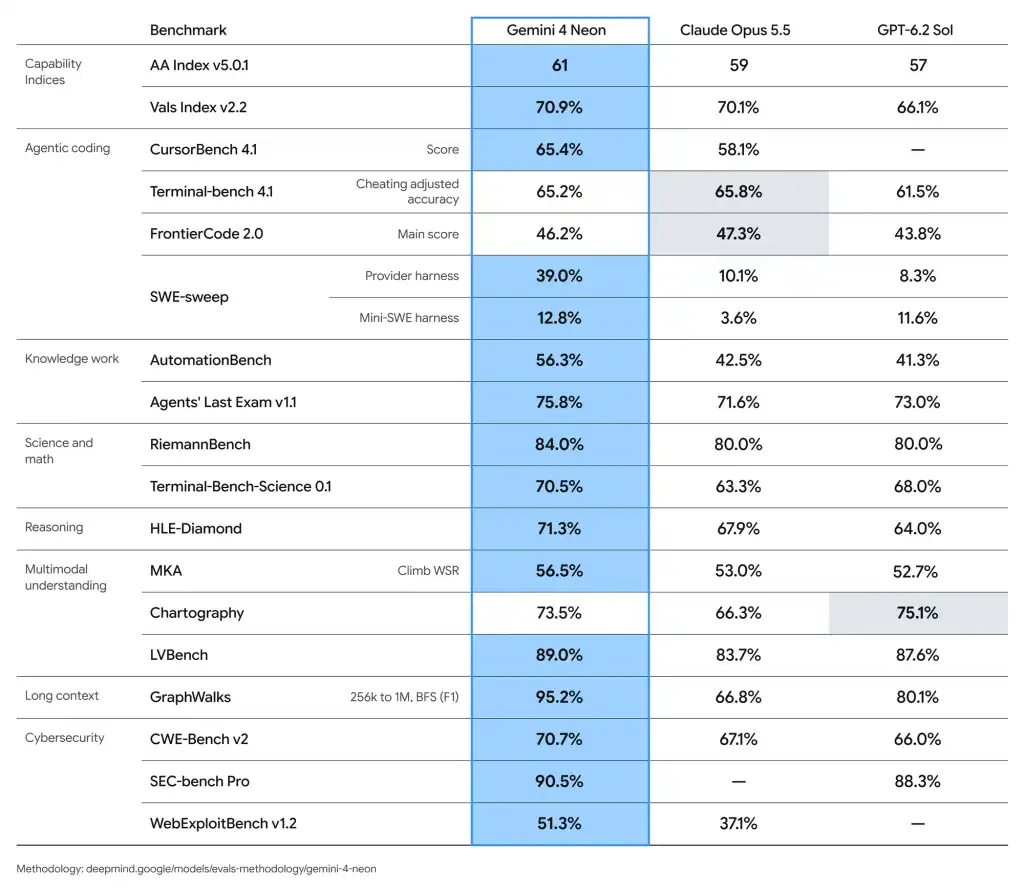
Neon also performs strongly in evaluations of professional and agentic workflows. According to Google's announcement, it ranks second on the Vals Index with a score of 70.9%, and first on both the Legal Research Bench and Tax Agent Bench. Google also reports that Neon ranks first on most Surge AI benchmarks covering finance, accounting, spreadsheet modeling, and complex constraint following. In chart interpretation, it scores 73.5% on Chartography, while achieving 75.8% on Agents' Last Exam v1.1.
Its automation results further demonstrate its ability to complete multi-step tasks. Neon ranks first on Zapier's AutomationBench with a score of 56.3% and on Andon Labs' Vending-Bench 2, where it achieves a simulated business performance score of $16,843. It also debuts at second place on the Agent Arena Index with a score of 1,336, based on more than 4,200 real-world agent sessions.
In scientific and mathematical reasoning, Neon achieves 70.5% on Terminal-Bench Science, 84.0% on RiemannBench, and 71.3% on HLE-Diamond. These results indicate its ability to work through quantitative analysis, mathematical problems, and technical research tasks, rather than relying solely on general-purpose language capabilities.
Overall, the benchmark results position Gemini 4 Neon as a model built for professional workflows that combine reasoning, information synthesis, and task execution. However, these scores reflect performance under specific evaluation conditions and should not be treated as guarantees of equivalent results in every production environment.
How Does Gemini 4 Neon Support Cybersecurity Work?
Gemini 4 Neon is designed to support defensive cybersecurity tasks, including secure code generation, vulnerability discovery, risk validation, and patching. Google presents these capabilities as part of a broader workflow for identifying and addressing software weaknesses.
The company's November 18 announcement highlights several evaluation results:
-
AutoBaxBench: Neon achieved 76% on the hard tier. Google reports stronger secure-code performance than Carbon across easy, medium, and hard challenges.
-
WebExploitBench v1.2: The model achieved 51.26%, which Google describes as a leading result at the time of publication.
-
SEC-bench Pro: Neon scored 90.5% on vulnerability identification.
-
CWE-bench v2: It achieved 70.7% on vulnerability patching, a reported 3.4 percentage-point improvement over Carbon.
These evaluations cover different stages of defensive security. Finding a vulnerability does not necessarily establish that it can be exploited, while identifying an exploitable issue does not guarantee that a generated patch resolves the underlying cause.
Google also says that Gemini 4 Neon for cyber will initially be made available to eligible defenders through its Fairwind Program. This is a more restricted access route than the general model rollout.
For enterprise security teams, the practical implication is that AI agents may help accelerate vulnerability discovery and remediation. However, security findings still require validation, and generated patches should be tested before being applied to production systems.
What Safety Measures and Limitations Does Gemini 4 Neon Have?
Gemini 4 Neon incorporates safeguards intended to reduce harmful outputs, prompt injection risks, and actions that exceed a user's instructions. These controls are particularly relevant because agentic models can interact with external information and software rather than simply generating text.
Google says Neon maintains protections against severe misuse and prompt injection comparable to those in Gemini 4 Carbon, while making further improvements to model alignment and agent behavior. Its internal evaluations report a 0.09% misaligned action rate on Google's agentic safety suite and a 99.2% pass rate on its agent honesty evaluation. Google also reports a 0.0% attack success rate on the Gray Swan indirect prompt injection benchmark when the highest thinking level and real-time safeguards were used.
Indirect prompt injection occurs when malicious instructions are embedded in content an AI agent accesses, such as a webpage, email, document, or code file. An agent may encounter these instructions while performing an otherwise legitimate task. Google's reported result indicates performance under a particular benchmark configuration, not immunity to all prompt injection attacks.
The model's safety measures should therefore be considered one layer of a broader security framework. Organizations deploying agents still need permission boundaries, monitoring, human approval for sensitive actions, and controls over access to confidential data.
Google provides additional technical information in its Gemini 4 Neon Model Card. The document is relevant for developers and organizations that need more detail about the model's capabilities, evaluations, and safety considerations.
Conclusion
Gemini 4 Neon represents Google's effort to make advanced AI reasoning more practical for long-running, tool-intensive workflows. Its position within the Gemini 4 family reflects a balance between the deeper reasoning associated with Carbon and the faster execution associated with Hydrogen. The model targets complex software engineering, enterprise analysis, scientific research, and other tasks that require multiple connected steps.
Google's published evaluations indicate competitive performance across coding, cybersecurity, agent execution, and analytical work. Its 1 million-token context window, four thinking levels, and API pricing structure also give developers several ways to configure workloads according to their requirements.
However, benchmark results and internal safety evaluations should be treated as evidence of measured performance under specific conditions, not guarantees of production reliability. Actual results will depend on task design, surrounding tools, data quality, security controls, and human oversight.
For businesses considering agentic AI, the central question is not simply which model ranks highest. It is whether a model can complete real tasks accurately, consistently, securely, and at an acceptable total cost. Gemini 4 Neon is designed to address that combination of requirements, but deployment decisions still require independent testing.
FAQs
-
Is Gemini 4 Neon a reasoning model or an AI agent?
Gemini 4 Neon is a reasoning model designed to support agentic workflows. It can plan and execute multi-step tasks, interact with tools, and maintain context across extended sessions, but the complete agent system also depends on the surrounding software and permissions.
-
What is the context window of Gemini 4 Neon?
Gemini 4 Neon supports a context window of up to 1 million tokens. This allows it to process large collections of supported information within a single context, although actual usage depends on the application and available limits.
-
Is Gemini 4 Neon better than Gemini 4 Carbon?
Neither model is universally better. Google positions Carbon for the most demanding, long-horizon projects, while Neon aims to balance advanced reasoning with faster and more cost-efficient execution for frequent complex workflows.
-
Can Gemini 4 Neon write and debug production code?
Gemini 4 Neon is designed for coding tasks such as multi-file debugging, repository refactoring, and extended software engineering workflows. However, generated code still requires review, testing, and appropriate security checks before production deployment.
Disclaimer
This general market information, possibly from third-party, commercial, or sponsored sources, is provided for reference and educational purposes only and does not constitute financial or investment advice, an offer, solicitation, or guarantee. We disclaim liability for its accuracy, completeness, reliability, and any resulting losses. Investments/trading are risky; past performance doesn’t guarantee future results. Users should research, judge prudently, and take full responsibility. For further details, please consult KuCoin’s Terms of Use and Risk Disclosure."