

What Does Berkshire Hathaway’s Q3 2026 Investment in Bending Spoons Reveal?
Introduction
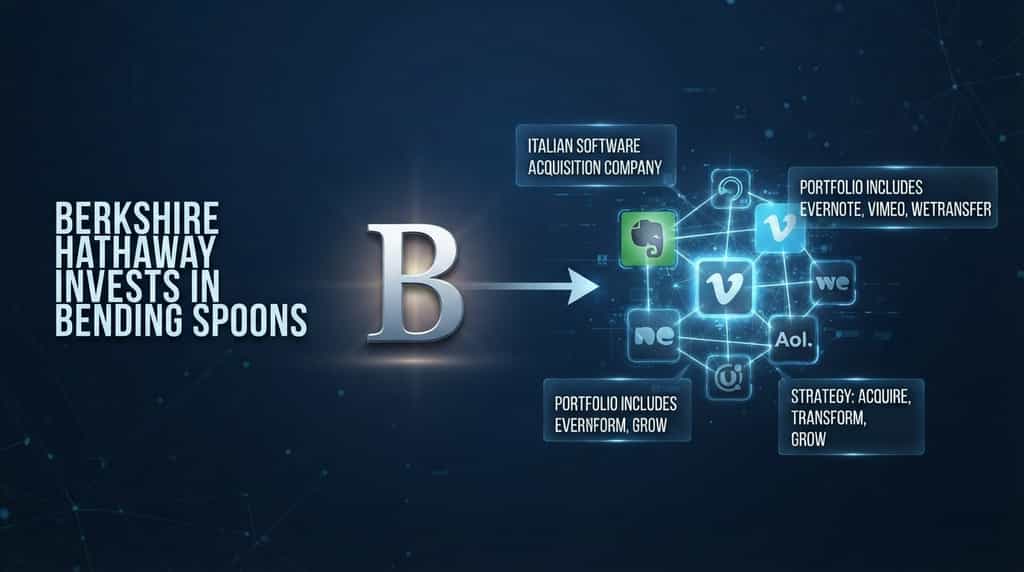
Berkshire Hathaway’s third-quarter 2026 portfolio disclosure revealed a new position in Bending Spoons, an Italian software company known for acquiring and managing established digital businesses. The investment was valued at approximately $689.4 million at the end of September, according to Berkshire’s latest Form 13F filing. The position is notable because Bending Spoons is a relatively unfamiliar name compared with Berkshire’s large, established holdings.
The investment also needs to be understood in the context of a subsequent transaction: Berkshire invested another $330 million in October, bringing its reported ownership to approximately 4%. The two transactions point to a substantial commitment, but they do not establish Berkshire’s investment rationale or guarantee that the company will deliver strong returns. Understanding the deal requires examining Bending Spoons’ acquisition-led business model, Berkshire’s other portfolio changes, and the limitations of quarterly holdings disclosures.
Quick Answer: What Did Berkshire Hathaway Buy in Q3 2026?
Berkshire Hathaway disclosed a new position of 20,689,655 Bending Spoons shares, valued at approximately $689.4 million as of September 30, 2026.
-
New holding: Bending Spoons was the only newly reported position in Berkshire’s Q3 2026 Form 13F.
-
Additional investment: Berkshire completed a separate $330 million investment on October 29, taking its ownership to approximately 4%.
-
Business model: Bending Spoons acquires established software and digital businesses and seeks to improve their operations and commercial performance.
-
Other portfolio changes: Berkshire increased its holdings in Lennar and Delta Air Lines while reducing positions in Bank of America, VeriSign, Capital One, and other companies.
-
Important limitation: A Form 13F reports holdings at a specific quarter-end date. It does not disclose the exact purchase dates, transaction prices, or the investment decision-maker.
What Is Bending Spoons and How Does Its Business Model Work?
Bending Spoons is an Italian technology company headquartered in Milan that focuses on acquiring established digital businesses and improving their operations. Rather than relying primarily on launching new applications, the company follows an acquisition-led strategy: it purchases existing products, restructures their operations, invests in technology, and seeks to increase their long-term earnings.
The company describes this approach as a recurring cycle of acquisitions, operational transformation, and reinvestment. Its October 2026 disclosure states that it has pursued the strategy for more than a decade and has not sold a material business during that period. The company also says that its transformation process can involve reorganizing teams, upgrading technology, redesigning user interfaces, improving product development, and changing marketing and monetization strategies. These details are outlined in its October 2026 SEC filing.
Which Companies and Products Does Bending Spoons Own?
Bending Spoons' portfolio includes a range of consumer and business software products. Its October 2026 corporate disclosure lists businesses such as:
-
AOL: An established internet services and digital media brand.
-
Evernote: A note-taking and productivity application.
-
WeTransfer: A file-sharing and transfer service.
-
Vimeo: A video hosting and creation platform.
-
Eventbrite: An event management and ticketing platform.
-
Brightcove: A video technology company.
-
Airtable: A collaborative work management and database platform.
-
Miro: A digital whiteboard and visual collaboration platform.
-
Tractive: A company focused on GPS tracking products for pets.
The portfolio spans different customer groups, subscription models, and software categories. This gives Bending Spoons exposure to multiple established user bases rather than depending on a single application or product market.
However, owning a recognizable product does not automatically mean that the product is growing or generating attractive returns. The performance of each acquisition depends on customer retention, pricing, product quality, operating costs, and the company's ability to manage changes without damaging the existing user experience.
Why Is Bending Spoons Sometimes Described as an App Acquisition Company?
Bending Spoons is often characterized as an app acquisition company because its business model centers on buying existing digital products and attempting to improve their economics. This differs from the conventional software startup model, in which a company develops a product from the beginning and gradually builds a customer base.
The acquisition model can offer several potential advantages. An established application may already have brand recognition, recurring customers, distribution channels, and a functioning product. A new owner can then focus on improving monetization, reducing operating inefficiencies, or introducing technical changes.
The approach also has meaningful execution risks. Cost reductions can weaken customer support or product development, while aggressive pricing changes may lead users to cancel subscriptions or switch to competitors. Acquisitions can also create integration challenges, particularly when a portfolio includes products with different technologies, teams, and customer expectations.
Bending Spoons' ability to create value therefore depends not simply on how many companies it acquires, but on whether operational changes produce sustainable improvements in revenue, profitability, and customer retention.
Why Did Berkshire Hathaway's Bending Spoons Investment Attract Attention?
The investment attracted attention because it represents a sizable commitment to a software company whose acquisition-led strategy differs from the business models associated with many of Berkshire Hathaway's best-known holdings. It also became more significant after Berkshire made a second investment following the initial public offering.
According to Berkshire's Form 13F, the company held 20,689,655 Bending Spoons shares at the end of September 2026. The reported value was approximately $689.4 million, representing around 0.23% of the disclosed portfolio. The filing was submitted to the U.S. Securities and Exchange Commission on November 16, 2026, and covers holdings as of September 30.
The subsequent transaction was separate from the third-quarter holdings snapshot. Bending Spoons announced on October 29 that Berkshire had completed a further $330 million investment through a private placement of 10 million ordinary shares at $33 per share. The company stated that Berkshire's ownership had consequently increased to approximately 4%, following its earlier $600 million investment at the July 2026 initial public offering. The transaction details are available in Bending Spoons' Form 6-K.
These figures should be kept separate when interpreting the investment. The approximately $689.4 million figure is the value reported for the September 30 position, while the additional $330 million transaction closed on October 29. Combining them into a single quarter-end holding value would misrepresent the reporting dates and valuation basis.
Does the Investment Reveal Warren Buffett's Investment Strategy?
The filing does not establish that Warren Buffett personally selected or directed the investment. Berkshire's Form 13F is filed at the institutional level and includes holdings reported by Berkshire and other included managers. It does not identify the individual responsible for each investment decision.
This distinction matters because Berkshire's investment management structure has changed. A portfolio disclosure can show what the institution held at a reporting date, but it cannot independently establish who initiated a transaction or what analysis supported it.
The Bending Spoons investment can therefore be discussed as a Berkshire Hathaway position, rather than attributed to Buffett personally without further evidence. The same caution applies to the company's wider portfolio changes: a filing records reported share counts, not the reasoning behind each purchase or sale.
What Are the Main Risks in Bending Spoons' Acquisition-Led Model?
The acquisition-led software model can create value, but it also concentrates several operational and financial risks. Investors assessing Bending Spoons need to consider whether the company can maintain the quality and competitiveness of its acquired products while improving their financial performance.
Customer retention is a central risk. Established applications often have loyal users, but significant changes to subscription prices, free features, interfaces, or customer support can affect retention. If users leave faster than the company can attract new customers, improvements in short-term monetization may not translate into sustainable growth.
Acquisition integration is another challenge. Managing a portfolio of software businesses requires technical infrastructure, experienced management, and an understanding of different customer markets. Integrating too many acquisitions or changing products too quickly could create operational complexity.
Capital allocation also matters. The company needs to determine how much capital to allocate to acquisitions, product development, infrastructure, and existing operations. Paying too much for an acquisition can make it difficult to generate an attractive return, even if the acquired business continues to operate successfully.
Finally, the strategy depends on the availability of suitable acquisition targets. Competition for established digital businesses can increase purchase prices, while a shortage of attractive targets may limit the company's ability to reinvest capital efficiently. The long-term outcome will depend on execution and financial results, not simply on the number or visibility of its acquisitions.
Conclusion
Berkshire Hathaway's Q3 2026 filing disclosed a new position in Bending Spoons worth approximately $689.4 million at September 30. The investment became more notable after Berkshire completed a further $330 million private placement in October, taking its ownership to approximately 4%. Together, the disclosures confirm a substantial investment in an Italian software company built around acquiring and transforming established digital businesses.
Bending Spoons' portfolio includes recognizable products such as Evernote, Vimeo, WeTransfer, and AOL. Its strategy offers a different approach to software growth, focusing on operational improvements and acquisitions rather than relying exclusively on developing new products. However, this model also brings risks involving customer retention, integration, acquisition costs, and capital allocation.
The Berkshire disclosure is useful evidence of institutional ownership, but it should not be treated as a recommendation or proof of future performance. Form 13F reports are delayed snapshots and do not reveal the full investment rationale or current positions. A balanced assessment of Bending Spoons requires examining its financial disclosures, acquisition execution, and operating performance independently of the identity of its shareholders.
FAQs
-
How much did Berkshire Hathaway invest in Bending Spoons?
Berkshire's September 30, 2026 holding was reported at approximately $689.4 million. It subsequently completed another $330 million investment on October 29, bringing its ownership to approximately 4%.
-
Is Bending Spoons a publicly traded company?
Yes. Bending Spoons completed its initial public offering in July 2026 and is listed on Nasdaq. Its October 2026 Form 6-K documents the subsequent private placement involving Berkshire Hathaway.
-
Does Berkshire Hathaway own 4% of Bending Spoons?
Bending Spoons stated on October 29, 2026, that Berkshire's ownership had reached approximately 4% after the additional $330 million investment. This figure reflects the company's disclosure following the private placement, not the September 30 Form 13F snapshot alone.
Disclaimer
This general market information, possibly from third-party, commercial, or sponsored sources, is provided for reference and educational purposes only and does not constitute financial or investment advice, an offer, solicitation, or guarantee. We disclaim liability for its accuracy, completeness, reliability, and any resulting losses. Investments/trading are risky; past performance doesn’t guarantee future results. Users should research, judge prudently, and take full responsibility. For further details, please consult KuCoin’s Terms of Use and Risk Disclosure.