

What Did the Justin Sun and Jing Tian Dispute Actually Reveal About Money Psychology?
2026/08/28 11:01:00
Introduction
The dispute is a public case study in transactional thinking versus compounding thinking.
Justin Sun, founder of TRON, publicly alleged that he paid Jing Tian tens of millions of yuan in connection with a relationship and egg-donation arrangement, then sued after she allegedly demanded more money and did not complete the process. Jing Tian’s studio denied the claims and said the matter belongs in court. Independent reporting put the original payment around 30 million yuan, with additional sums disputed in social posts.
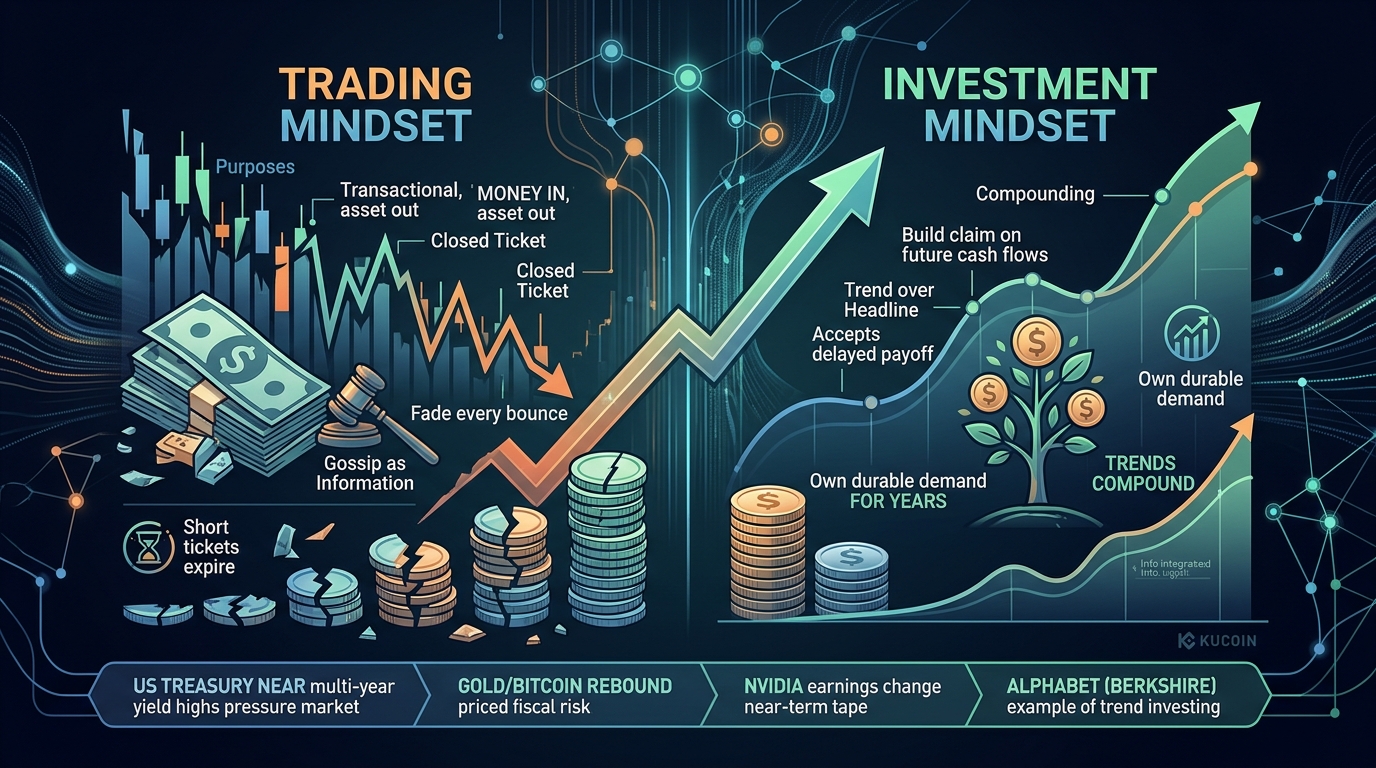
Jack Yi’s point was blunt: a trading mindset treats every interaction as a closed ticket — money in, asset out, then renegotiate. An investment mindset accepts delayed payoff, builds a larger claim on future cash flows, and refuses to “sit on the price” after the deal is struck.
Markets punish the first style. They reward the second when the underlying trend is real.
Why Does a Trading Mindset Fail in Today’s U.S. Stock Market?
A trading mindset fails because macro pressure and narrative uncertainty make next-week direction harder than next-year ownership.
U.S. Treasuries have been the first constraint. As of late August 2026, the 10-year yield traded near 4.65%–4.75%, while the 30-year yield touched levels last seen around 2007, near 5.3%. Total U.S. public debt has surpassed $40 trillion. Treasury buybacks briefly cooled the long end, then yields bounced again.
That rate shock has not flattened every stock. It has split the tape. A handful of AI leaders can still rip on earnings. The rest of the market absorbs a higher discount rate.
De-dollarization trades have followed the same bond stress. Gold’s one-month gain is about 13%–14% based on late-August spot and Comex settlement series. Bitcoin’s rebound from the August 19 low near $64,000 to around $80,000 is more than 20% in roughly a week. Those moves are not day-trade trivia. They are the market pricing fiscal risk and currency dilution.
A trader tries to fade every bounce. An investor asks which assets still work if yields stay high and the dollar stays noisy.
Is the AI Narrative a Bubble or a Multi-Year Shortage?
The honest answer is that both camps have recent evidence — which is exactly why short-term calls are fragile.
Bearish voices include Ray Dalio. In recent 2026 comments he has said great technology waves produce bubbles, compared current valuation extremes with 1929 and 2000, and separately warned that U.S. fiscal conditions are at an “inflection point.” He has also told investors to underweight bonds, hold about 10%–15% in gold, and own “a bit” of Bitcoin.
Bullish supply-chain evidence also arrived. SK Hynix CEO Kwak Noh-Jung said the global memory shortage is expected to last through the end of 2030, oversupply risk looks low, and memory is no longer “just a commodity” in the AI era. He said he sees no clear signal of a classic industry slump while AI customer demand stays strong.
Memory names such as SK Hynix, SanDisk, and Micron have already shown the trader’s problem. After earlier drawdowns from highs — including sharp mid-cycle cuts — they have bounced into a “neither cheap nor confirmed breakout” zone. That is where short-term conviction dies.
When bulls and bears both sound rigorous, the tape becomes event-driven. One earnings print can move a multi-trillion-dollar stock like a meme coin.
What Did NVIDIA’s Latest Earnings Actually Change?
NVIDIA’s report changed the near-term tape. It did not remove the need for a long-term filter.
According to company filings and contemporaneous coverage on August 26–27, 2026, NVIDIA posted fiscal second-quarter revenue of $96.22 billion, more than double year over year, beating Wall Street estimates near $92 billion. Adjusted EPS came in at $2.22 versus estimates around $2.08–$2.10. Data-center revenue was about $89 billion. Guidance for the current quarter is about $108 billion, plus or minus 2%, with no assumed China data-center compute sales. Management also sketched roughly 70% revenue growth for fiscal 2028.
Jensen Huang said AI has reached an “inflection point”: tokens are productive and profitable, and “compute is revenue.” Shares then jumped nearly 9% in the following session, according to August 28 market wrap notes that also cited a roughly $3 trillion one-day market-cap swing and a Nasdaq gain of about 1.6%.
That is the trading-mindset trap. A single speech and a beat can reprice a mega-cap overnight. The investment-mindset question is different: which businesses still compound if the next print is only “good,” not spectacular?
How Should Investors Apply an Investment Mindset to AI Stocks?
They should own businesses tied to AI demand for years, not hours.
Alphabet is the cleanest public example in the source material. Berkshire Hathaway’s Q2 2026 13F, released in mid-August, showed an 83% increase in its Alphabet stake to about 106 million shares, valued near $37–$38 billion. That made Alphabet Berkshire’s third-largest equity holding behind Apple and American Express. About $10 billion of the increase came from a June private placement tied to Alphabet’s AI infrastructure raise. Warren Buffett has said he initiated the position.
That is trend investing, not a scalp. Google Search still prints cash. Google Cloud and Gemini attach the company to the same compute cycle that lifts NVIDIA, without forcing the holder to time every GPU product cycle.
Memory and accelerator suppliers can still belong in a portfolio. They should not be the only expression of the theme if the holder cannot tolerate 50% drawdowns between earnings.
Why Do Gold and Bitcoin Fit a Long-Term Dollar Hedge?
Gold and Bitcoin fit because dollar debasement is a multi-year fiscal story, not a one-week headline.
Dalio’s August 2026 note framed U.S. finances as an inflection: large deficits, rising debt service, and the risk that weak demand for Treasuries forces higher yields or more money creation. He paired that warning with gold and a smaller Bitcoin sleeve. Market prices have already started to agree. Gold’s August rebound is double-digit. Bitcoin’s week-long surge above $80,000 tracks the same debasement tape.
Investment mindset does not require all-in Bitcoin maximalism. It requires a planned allocation that can sit through 20% weekly swings because the hedge thesis is measured in years.
Trading mindset treats every $5,000 Bitcoin candle as a verdict. That is how people sell the hedge at the exact moment the fiscal story is working.
How to Buy Bitcoin, Gold Exposure, and AI-Linked Assets on KuCoin
You do not need to chase counterparties across continents to assemble a long-horizon mix.
KuCoin lets users buy and hold Bitcoin directly, rotate into major tokens tied to the same liquidity cycle, and use listed perpetual or options-style tools where available to hedge drawdowns instead of panic-selling the core position. Spot BTC is the simplest expression of the debasement hedge described above.
For investors who still want equity-like AI exposure alongside crypto, the same account discipline applies: size the volatile sleeve, keep a core that can compound, and treat options or derivatives as insurance — not as a second gambling table.
Registration, identity verification, and a first Bitcoin purchase can be completed in one flow. That is the practical version of “investment mindset”: fewer frantic trips, more repeatable allocation.
Conclusion
The Sun–Jing Tian story crowded out market talk for a day. The useful residue is Jack Yi’s distinction. Trading mindset settles every ledger tonight and then tries to raise the price. Investment mindset accepts time, builds a larger claim, and rides a trend that is bigger than one headline.
U.S. Treasuries near multi-year yield highs have pressured the average stock. Gold’s roughly 13%–14% one-month rise and Bitcoin’s more than 20% rebound in a week show how fast the hedge trade can move when fiscal anxiety returns. NVIDIA’s $96.22 billion quarter and Huang’s inflection-point language prove that one report can still whip a mega-cap. SK Hynix’s 2030 shortage call and Dalio’s bubble-and-debt warnings prove the narrative is still two-sided.
The investment response is not to ignore volatility. It is to own what remains tied to AI demand for years — including cash-rich platforms such as Alphabet that Berkshire has been adding — and to keep a measured gold and Bitcoin sleeve against a weaker dollar. KuCoin can warehouse the crypto side of that mix without turning every session into a renegotiation.
Short tickets expire. Trends compound. That is the only part of the gossip that belongs in a portfolio.
FAQs
Is the Justin Sun and Jing Tian case confirmed in court?
The lawsuit has been filed and accepted according to Sun’s counsel and August 27, 2026 reporting. Jing Tian’s studio denies the allegations. Courts, not social media, will decide facts and damages.
Does an investment mindset mean never selling?
No. It means the default holding period matches the thesis — years for AI infrastructure and monetary hedges — not the next influencer post.
Why mention Alphabet if this is a crypto article?
Berkshire’s mid-August 2026 filing made Alphabet a third-largest holding after a large Q2 add. It is a public example of buying durable AI cash flow instead of trading every semiconductor print.
Is Bitcoin only a short-term de-dollarization trade?
Recent weeks show a short-term spike. The investment case is longer: fiscal deficits, high long-bond yields, and demand for assets outside the Treasury complex.
Can options replace position sizing?
No. Options can hedge a core holding. They cannot fix a position that is too large for the holder’s time horizon.
Disclaimer: This article is for informational purposes only and does not constitute financial, legal, or investment advice. Always conduct your own research before interacting with digital assets.