

Wealth Illusion vs. Inflation Pain: Decoding the $82k Bitcoin Peak and the Historic Collapse in Consumer Sentiment
2026/05/17 11:17:44
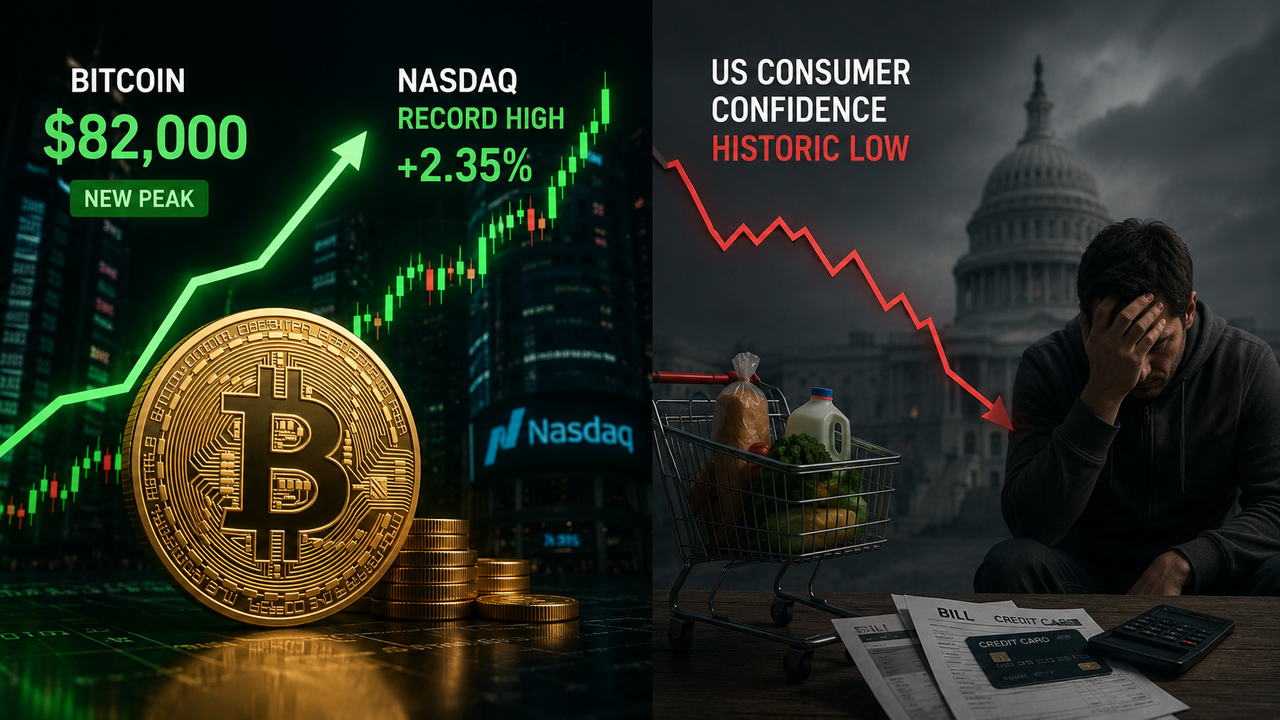
In the volatile financial landscape of 2026, a staggering divergence has emerged between elite market performance and everyday economic reality. While bitcoin has recently shattered expectations by surging to an $82,000 peak alongside record-breaking Nasdaq indices, US consumer confidence has simultaneously cratered to historic lows, signaling a profound disconnect.
This deep dive explores the mechanics behind the current bitcoin rally and why the "wealth effect" of soaring asset prices has failed to resonate with the struggling American household.
Market Snapshot: Bitcoin and Nasdaq Reach Uncharted Territory
The second quarter of 2026 has been characterized by a "everything rally" in the digital and tech sectors. For the first time in history, we are witnessing a coordinated surge where traditional tech giants and decentralized assets are moving in lockstep toward the stratosphere, fueled by massive liquidity injections from institutional players who see these assets as the only viable hedge against a stagnating global economy.
Bitcoin Surges Past $82,000: How the CLARITY Act Fueled the Institutional Rally
The primary catalyst for the recent bitcoin breakout is the landmark passage of the CLARITY Act (Clarifying Lawful Oversight and Regulatory Infrastructure for Technological Yields). For years, institutional capital sat on the sidelines due to "regulatory fog." With this new framework, the gates have opened:
-
Legal Certainty: The act clearly defines the jurisdictional boundaries between the SEC and CFTC, removing the threat of "regulation by enforcement."
-
Banking Integration: Top-tier US banks are now permitted to provide custody services for bitcoin without punitive capital requirements.
-
Pension Fund Allocation: We have observed a 150% increase in state pension funds allocating a small percentage (1-3%) of their portfolios to crypto assets since the bill moved through the Senate.
Nasdaq’s Record Highs: AI Premiums and the Inflow of Risk-On Capital
Simultaneously, the Nasdaq has decoupled from the broader S&P 500, driven by a hyper-concentration in Artificial Intelligence infrastructure. Investors are no longer valuing companies based on current P/E ratios but on "compute-sovereignty." This influx of risk-on capital has created a feedback loop: as tech stocks rise, the wealth generated is often diversified into bitcoin, which is increasingly viewed as the "high-beta" version of the Nasdaq.
The Core Contradiction: Why is US Consumer Confidence at a Historic Low?
Despite the green candles on trading screens at our crypto exchange and Wall Street desks, the University of Michigan Consumer Sentiment Index has plunged to levels not seen since the 2008 financial crisis. This creates a "Great Divergence" where the "Economy of Assets" is booming while the "Economy of Survival" is failing.
The Price Persistence Trap: Why Deflationary Trends Haven't Reached the Grocery Aisle
While the Federal Reserve points to cooling "core inflation" metrics, the average consumer lives in a world of "price persistence." Even if the rate of inflation drops to 2%, the prices of eggs, milk, and electricity are still 30-40% higher than they were three years ago.
-
Supply Chain Lag: Wholesale costs have dropped, but retailers are maintaining high margins to recoup losses from 2024-2025.
-
Energy Costs: Sustained geopolitical tension in oil-producing regions keeps the "floor" for transportation costs high, trickling down to every physical product.
Purchasing Power Erosion: Assessing Household Debt in a High-Interest Environment
The "wealth illusion" is shattered when one looks at the balance sheets of middle-class Americans. With interest rates remaining "higher for longer," the cost of servicing credit card debt and mortgages has reached an inflection point.
-
Credit Card Delinquencies: These have hit a 15-year high in May 2026.
-
Housing Lock-in: Current homeowners cannot afford to move because a new mortgage would double their monthly payment, leading to a stagnant labor market.
The K-Shaped Reality: Why the "Average American" Feels Left Behind by the Bull Market
The 2026 economy is the ultimate K-shaped recovery. On the upper arm of the K, investors holding bitcoin and AI stocks are seeing their net worth skyrocket. On the lower arm, those reliant on fixed wages find their "real wages" (inflation-adjusted) are actually lower than they were in the pre-pandemic era. This leads to deep-seated resentment and a collapse in confidence, as the stock market is no longer a barometer for national prosperity.
Institutional Playbook: Who is Driving the Crypto "Irrational Exuberance"?
Many retail investors ask: if the public is broke, how is bitcoin hitting $82k? The answer lies in the shift from "retail-driven" hype to "sovereign and institutional" accumulation. The current market is being moved by entities that operate on a 10-year time horizon, indifferent to the price of milk in the Midwest.
Spot ETF Data Analysis: Why BlackRock and Fidelity Continue to Buy the Top
Recent data from our exchange and public filings show that the "Big Three" asset managers are not just holding; they are aggressively accumulating during every minor dip.
-
Consistent Inflows: BlackRock’s IBIT has seen a 12-day streak of net inflows exceeding $200 million daily.
-
Corporate Treasury Adoption: Following the lead of pioneers, mid-cap tech firms are now replacing 5% of their cash reserves with bitcoin to offset the melting value of the USD.
Safe Haven Transition: Is Bitcoin Finally Decoupling from Traditional Market Sentiments?
We are witnessing the birth of "Digital Gold 2.0." In previous cycles, a crash in consumer confidence usually predicted a sell-off in crypto. However, in 2026, the narrative has shifted. As people lose faith in the government's ability to manage the economy, they turn to decentralized assets. Bitcoin is beginning to trade more like a "fear hedge" than a "speculative tech play."
Macro Black Swans: Future Risks and Market Outlook for Late 2026
While the $82k milestone is cause for celebration among enthusiasts, SEO experts and analysts warn of "Black Swan" events that could destabilize this fragile equilibrium by the fourth quarter.
Resurgent Inflation Threats: The Potential Impact on Risk Assets in Q4
There is a growing concern that the "Second Wave" of inflation is building. If energy prices spike due to late-year geopolitical shifts, the Fed may be forced to hike rates again, even as the economy slows—a classic stagflation scenario. For bitcoin, this would be a true test: would it fall with the markets, or thrive as the ultimate alternative currency?
The Fed’s Dilemma: Balancing Market Euphoria Against a Grinding Main Street Recession
The Federal Reserve is trapped. If they cut rates to help the struggling consumer, they risk blowing a massive bubble in the Nasdaq and bitcoin that could lead to a catastrophic pop later. If they keep rates high, they might break the back of the American consumer entirely.
Conclusion
The current economic era is defined by a paradoxical "Great Divergence" where bitcoin reaches an $82,000 peak amidst record-breaking equity markets, while the average citizen faces a historic collapse in confidence. This wealth illusion highlights a structural rift between the booming digital asset economy and the inflationary pressures of Main Street. For investors, the rise of bitcoin represents a successful hedge against monetary debasement, but for the broader economy, the historic low in consumer sentiment serves as a warning. Ultimately, the sustainability of this rally depends on whether institutional adoption can withstand the brewing macro-economic storm of late 2026.
FAQ
Why is the stock market rising if the general public feels poor?
The stock market currently reflects institutional liquidity and AI-driven growth rather than general economic health. Large-scale investors are moving capital into assets like bitcoin and tech stocks to outpace inflation, creating a "wealth gap" where asset owners thrive while wage earners struggle with the high cost of living.
What are the key support levels for Bitcoin after the $82k milestone?
Following the surge to $82,000, the primary psychological support sits at $75,000, which was the previous consolidation zone. If bitcoin faces a macro-driven correction, the $68,000 level—bolstered by institutional ETF entry prices—will serve as the ultimate floor for the remainder of 2026.
Is the current Bitcoin price surge a bubble?
Unlike previous "retail bubbles," the 2026 rally is driven by the CLARITY Act and institutional treasury allocations. While local volatility is expected, the underlying shift toward digital sovereignty suggests this is a structural re-evaluation of bitcoin rather than a purely speculative mania.
How does the CLARITY Act affect the average crypto trader?
The CLARITY Act provides a safer environment for users of crypto exchange platforms by mandating transparency and consumer protections. It reduces the risk of sudden exchange de-listings and ensures that bitcoin is treated as a legitimate asset class by traditional financial institutions.
Can consumer confidence recover in 2026?
A recovery in consumer confidence requires a significant drop in "shelter" and "energy" costs, which remain stubbornly high. Until real wages catch up with the accumulated inflation of the last few years, the public sentiment will likely remain detached from the success of bitcoin and the Nasdaq.